

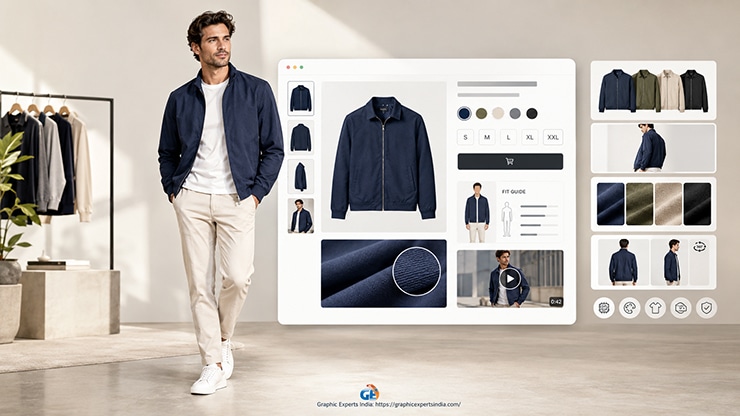
Top fashion brands sell online by making the product page do the fitting room’s job: they show the garment on a body and in scale, resolve fabric under zoom, keep every colorway color-true, add movement or video, guide fit from data rather than a static chart, state price or provenance plainly, put the return policy in view and structure size and attribute data the way Google and marketplaces require.
This guide documents eight of those practices with the brand’s own statements or Baymard Institute’s benchmark data, read on 29 September 2026, and translates each into a step a small clothing brand can copy on a Shopify or marketplace product page.
It is the product-page companion to the guide on how to start an online clothing store.
What Do Top Fashion Brands Do Differently Online at a Glance?
Top fashion brands differ from average stores on the product page, where Baymard Institute finds that up to 62% of sites still have “mediocre” or worse product-page usability and where the largest retailers have built fit, imagery and returns tooling that smaller brands can approximate.
| Question | Short answer | Source |
|---|---|---|
| How much apparel is bought online? | 35.2% of the top 1,000 US apparel retailers’ combined sales in 2023, at $108.19 billion | Digital Commerce 360 |
| How good are most product pages? | Up to 62% of benchmarked sites rate “mediocre” or worse; 37% lack in-scale images; 23% lack human-model images | Baymard Institute, updated March 2026 |
| What did ASOS change? | A £3.95 fee deducted from refunds for customers with a 70%-plus return rate over three or more orders | ASOS Fair Use Policy |
| What is Zalando doing with imagery? | “Approximately 70% of editorial campaign assets” were AI-generated in Q4 2024 using digital twins of real models | Zalando corporate, May 2025 |
| What does Google require for apparel images? | Apparel “worn by people”; about 1500 × 1500 pixels; no overlays | Google Merchant Center Help |
| Why do shoppers return clothes? | 39% sizing; 28% “didn’t look the way I thought it would” | PowerReviews, June 2023 survey |
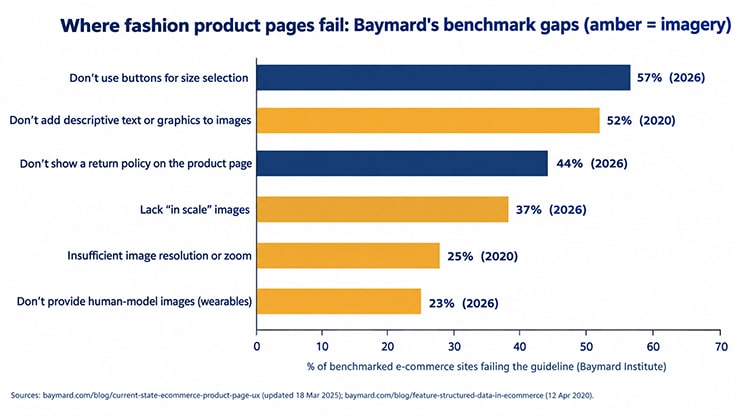
Figure 1. Where product pages fail, from Baymard Institute’s benchmarks (2020 and 2026 rounds). Amber bars are imagery gaps.
Why Study How Top Fashion Brands Sell Online?
Studying the largest fashion retailers’ product pages is useful because their practices are documented, their problems (fit, color, returns) are the same as a small brand’s, and most competing stores have not copied them.
Online sales were 35.2% of the top 1,000 US apparel and accessories retailers’ combined sales in 2023, at $108.19 billion (Digital Commerce 360, updated 17 September 2024).
Baymard Institute’s product-page benchmark, based on more than 30,000 manually rated performance scores across 155-plus sites, finds “up to 62% of sites have a ‘mediocre’ or worse Product Page UX” (updated 18 March 2026). The lessons below are therefore not table stakes; they are gaps.
The lessons also share a root cause. Apparel returns are driven by fit (39%) and by the item not looking as expected (28%), in PowerReviews’ survey of 25,452 US consumers (June 2023), and an estimated 19.3% of US online sales were returned in 2025 (National Retail Federation and Happy Returns, 15 October 2025).
Every practice below either shows the garment more truthfully or manages the return that follows when it is not.
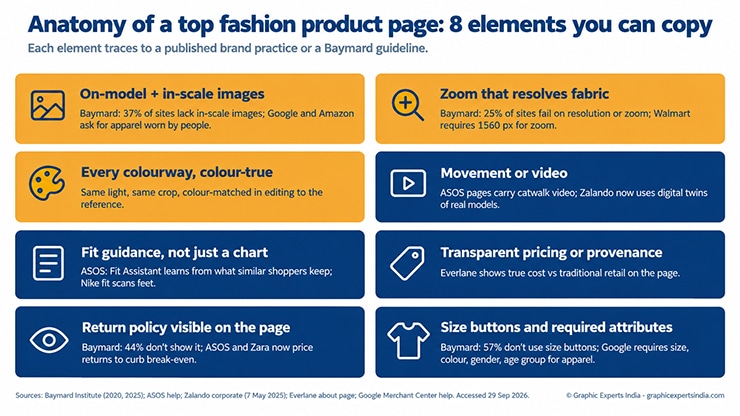
Figure 2. Anatomy of a top fashion product page. Each element traces to a brand statement or a Baymard guideline.
Lesson 1: How Do Top Fashion Brands Show Garments on a Body and in Scale?
Top brands show every garment on a person and in scale, because that is what shoppers look for first and what the platforms now require.
Baymard found that 56% of users’ first action on a product page is exploring the images, that 42% of users try to gauge size from the images, and, in its 2026 benchmark, that 37% of sites lack in-scale images and 23% do not provide human-model images for wearable products (Baymard, 2017, 2020 and 2026).
Google Merchant Center instructs stores to “provide images of products worn by people for clothing (apparel) products,” and Amazon’s Clothing & Accessories guidelines require “all adult apparel should be imaged on-model.”
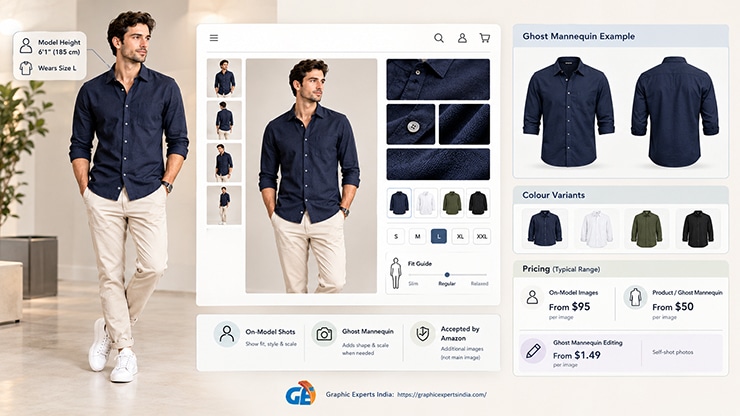
Copy it: shoot every adult style on a model and state the model’s height and size worn beside the image. Where an on-model shoot is out of budget, a ghost mannequin image gives shape and scale without a model fee: Squareshot lists on-model images from $95 per image against product images from $50, and Graphic Experts India lists ghost mannequin editing of self-shot photos from $1.49 per image.
Amazon accepts ghost mannequin images as additional images but not as the main image for adult apparel.
Lesson 2: How Do Top Fashion Brands Handle Zoom and Fabric Detail?
Top brands supply images large enough that zoom resolves the weave, because 25% of e-commerce sites provide images with insufficient resolution or zoom, split between 14% low-resolution and 11% inadequate zoom (Baymard, 2 April 2020).
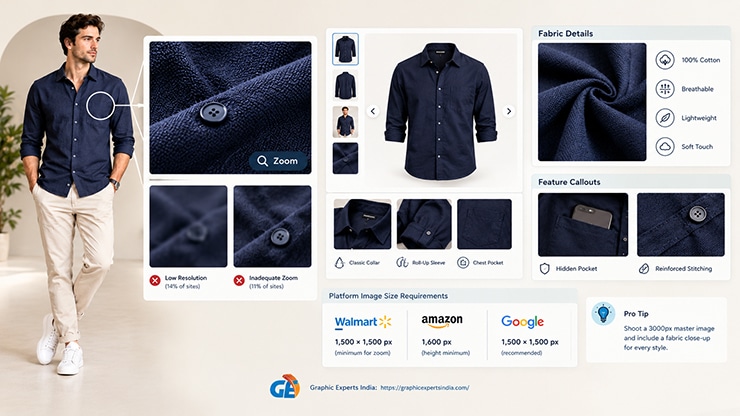
Baymard also found 52% of sites omit descriptive text or graphics on product images, the feature-callout shots that name a fabric weight or a hidden pocket. The platform floors make the point concrete: Walmart requires a 1500 × 1500 pixel minimum specifically for zoom, Amazon 1,600 pixels in height, and Google recommends about 1500 × 1500.
Copy it: shoot a 3000-pixel master and include a fabric close-up per style; the platform-by-platform export sizes are in the guide to fashion eCommerce platforms and their product image requirements.
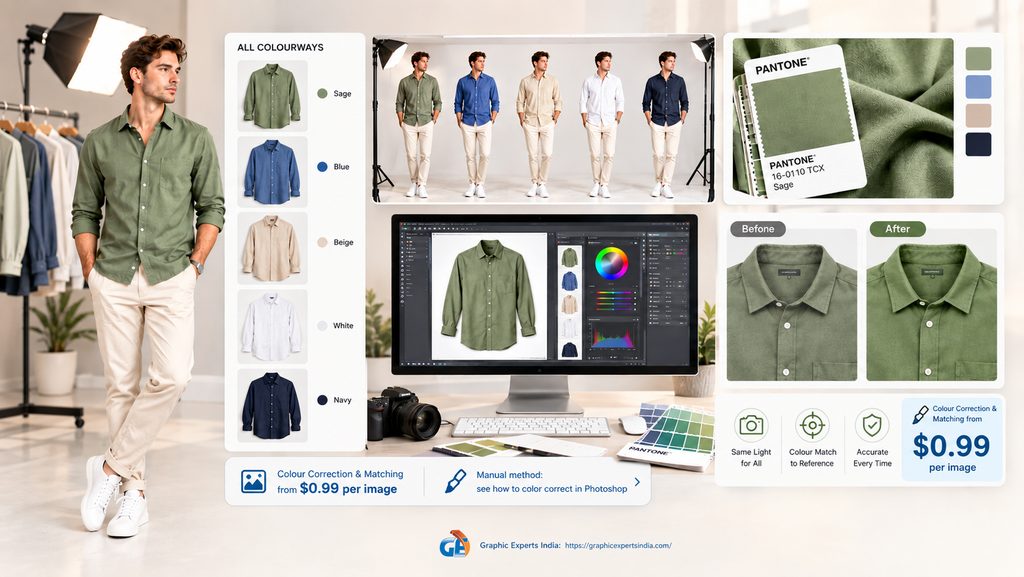
Lesson 3: How Do Top Fashion Brands Keep Every Colorway Color-True?
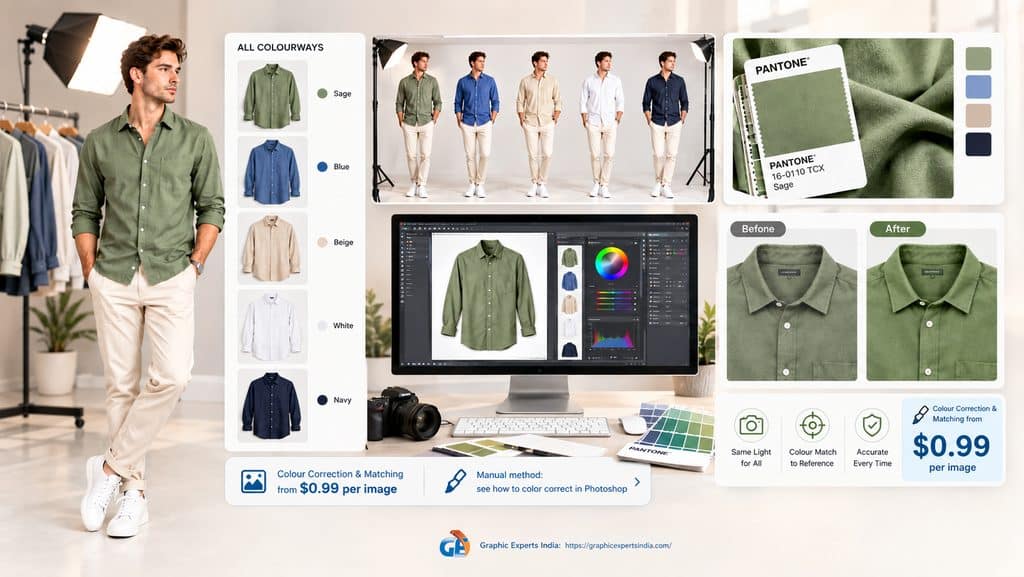
Top brands shoot every colorway under the same light and correct the files to a reference, because color is one of the ways a garment fails to “look the way I thought it would.”
Google Merchant Center requires a color attribute for every apparel product in free listings and in Shopping ads in the United States and five other countries, alongside size, gender and age_group (Google Merchant Center attribute specifications), so the image labelled “sage” is checked against the word “sage” by the feed as well as by the customer.
Salsify’s 2025 consumer research reported that 71% of shoppers had returned items over inaccurate descriptions and 54% had dropped purchases over conflicting information (survey of 1,910 US and UK consumers, October 2024).
Copy it: photograph colorways in one session and color-match them in editing to a Pantone or physical reference. Graphic Experts India lists color correction and matching from $0.99 per image; the manual method is in the guide to how to color correct in Photoshop.
Lesson 4: How Do Top Fashion Brands Show Movement?
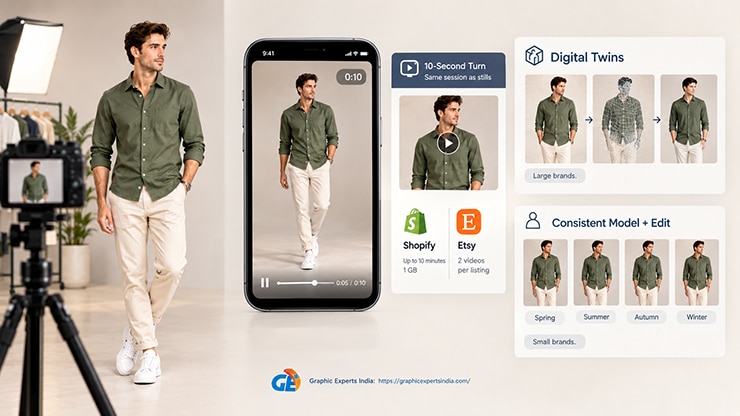
Top brands add movement to the product page through video or, increasingly, digital twins of real models. ASOS product pages have long carried short catwalk videos, a practice noted in usability coverage since 2016 and observable on the site today.
Zalando has gone further: it describes “high-fidelity 3D replicas of real models,” with “approximately 70% of editorial campaign assets being AI-generated in Q4 2024,” and states that “a real model might appear in an inspirational campaign, and the same recognizable presence can continue on detailed product pages,” while “human involvement remains a key part of the process, from model scans to creative direction” (Zalando corporate, 7 May 2025).
H&M began releasing imagery built from digital twins of its models in July 2025, with its chief creative officer describing it as “exploring emerging technologies like generative AI to amplify creativity and reimagine how we showcase fashion” (H&M Group, 2 July 2025).
Levi Strauss & Co. piloted AI-generated models with Lalaland.ai in 2023 and stated that “AI will likely never fully replace human models for us” (LS&Co., 22 March 2023).
Copy it: a 10-second turn on a phone, shot in the same session as the stills, meets Shopify’s video support (up to 10 minutes, 1 GB) and Etsy’s two videos per listing. Digital twins remain a large-brand tool; a small brand’s equivalent is a consistent model and a consistent edit across seasons.
Lesson 5: How Do Top Fashion Brands Guide Fit?
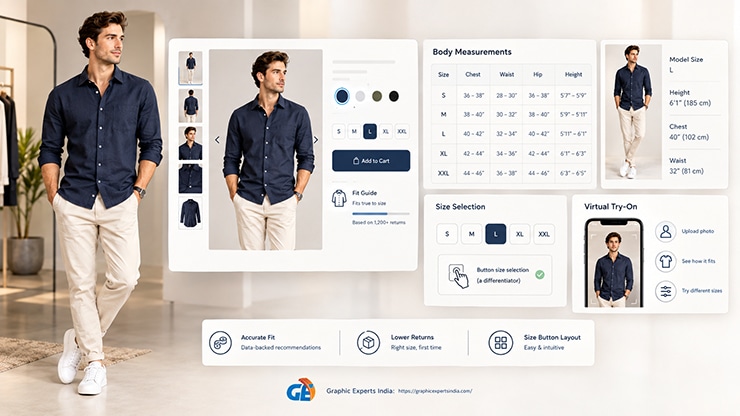
Top brands replace the static size chart with fit guidance built from data. ASOS’s Fit Assistant “takes the information you provide and tailors it to what similar shoppers have bought, to provide recommendations that aim to be as accurate as possible” (ASOS help), and ASOS scaled its See My Fit tool in 2020 to show “a simulated view of up to 500 products each week on six real-life models” by “digitally mapping each product onto the model in a realistic way, taking account of the size, cut and fit of each garment” (ASOS plc, 5 May 2020).
Nike Fit, launched in 2019, scans a shopper’s feet to recommend a size; Nike’s head of digital products called fit “such a big friction point for our customers” (CNBC, 8 May 2019).
Google’s virtual try-on, launched for tops in June 2023, now lets US shoppers “virtually try billions of apparel listings on yourself, just by uploading a photo,” covering shirts, pants, skirts and dresses (Google, 20 May 2025).
Copy it: publish body measurements per size, not just garment labels; state the model’s size on every on-model image; and add a “fits true to size / runs small” line drawn from returns data once you have it. Baymard’s 2026 benchmark found 57% of sites do not even use buttons for size selection, so the basic layout is itself a differentiator.
Lesson 6: How Do Top Fashion Brands Use Price and Provenance Transparency?
Some top brands put cost or provenance on the product page as a trust device. Everlane’s “Radical Transparency” states: “We believe our customers have a right to know how much their clothes cost to make,” and “we reveal the true costs behind all of our products—from materials to labor to transportation—then offer them to you, minus the traditional retail markup,” with a worked example of a $30 Everlane t-shirt against $55 at traditional retail (everlane.com/about).
Everlane publishes no performance data for the breakdown, so the lesson is the practice, not a measured uplift.
Copy it: a small brand can state fabric origin, factory country and care on the page, and, for print on demand, the blank’s brand and weight. Google Merchant Center’s prohibition on promotional overlays means the transparency belongs in text beside the image, never on it.
Lesson 7: How Do Top Fashion Brands Manage Returns on the Product Page?
Top brands now price returns and say so before purchase, and Baymard finds 44% of sites still show no return policy on the product page (2026 benchmark).
ASOS’s Fair Use Policy states that where a customer’s “Return Rate is 70% or higher and you’ve placed 3 or more orders,” ASOS “may deduct and retain £3.95 from your refund for each returned parcel (unless you keep more than £40 of your order),” with an additional £3.95 handling fee at an 80% return rate over five orders, and that “our Fair Use Policy exists to ensure we can continue offering free returns to the vast majority of our customers” (asos.com, accessed 29 September 2026).
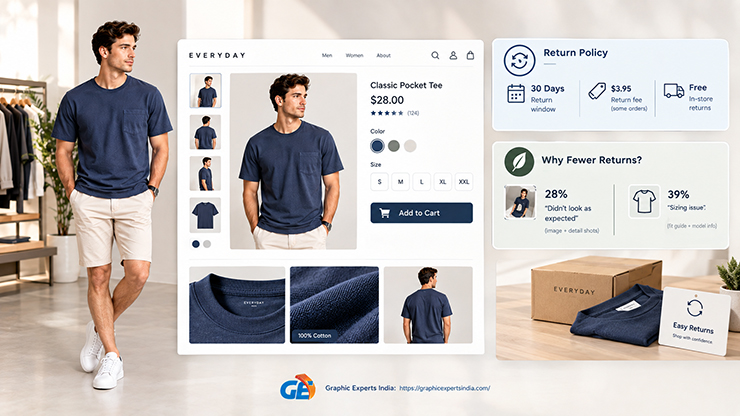
Zara introduced a £1.95 charge for UK online returns via third-party drop-off points in May 2022, while keeping in-store returns free (Zara statement reported by Which?, 26 May 2022). Bracketing, buying multiple sizes to return the rest, is cited by 13% of apparel returners (PowerReviews, 2023) and by 51% of Gen Z shoppers in Happy Returns’ 2025 report.
Copy it: state the return window and any fee in the product page’s buy box, and reduce the cause: the two imagery lessons above address the 28% “didn’t look as expected” reason directly, and the fit lesson addresses the 39% sizing reason.
Lesson 8: How Do Top Fashion Brands Structure Size and Attribute Data?
Top brands treat size, color, gender and age group as required data, because Google does. Google Merchant Center requires size for all clothing and shoes in free listings and requires color, gender and age_group for all apparel and accessories, with the same four required for Shopping ads in the United States, United Kingdom, Germany, France, Japan and Brazil (Google Merchant Center attribute specifications).
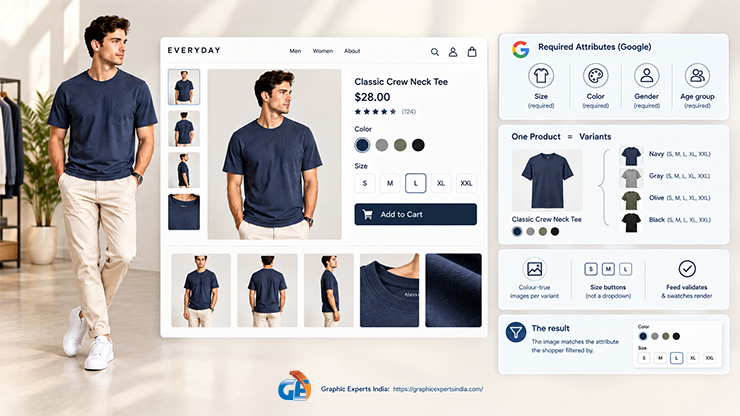
Google’s apparel image guidance adds: “Show clothing on models,” and “multiple angles and close-ups help customers decide.”
Copy it: set up each style as one product with variants per size and color, each variant carrying its own color-true image, and use size buttons rather than a dropdown. The feed then validates, the swatches render, and the image the shopper clicks matches the attribute the shopper filtered by.
What Can a Small Clothing Brand Copy First?
A small clothing brand should copy the imagery lessons first, because they are the cheapest and they address the largest return reason.
The four imagery practices (on-model and in-scale, zoom-grade resolution, color-true colorways, and a short movement clip) come from one shoot per style and one editing pass: background removal from $0.39 per image, ghost mannequin editing from $1.49 per image, e-commerce retouching from $0.99 per image and color correction from $0.99 per image at Graphic Experts India, or studio production from $50 to $95 per image at Squareshot. Fit guidance and returns wording are text changes.
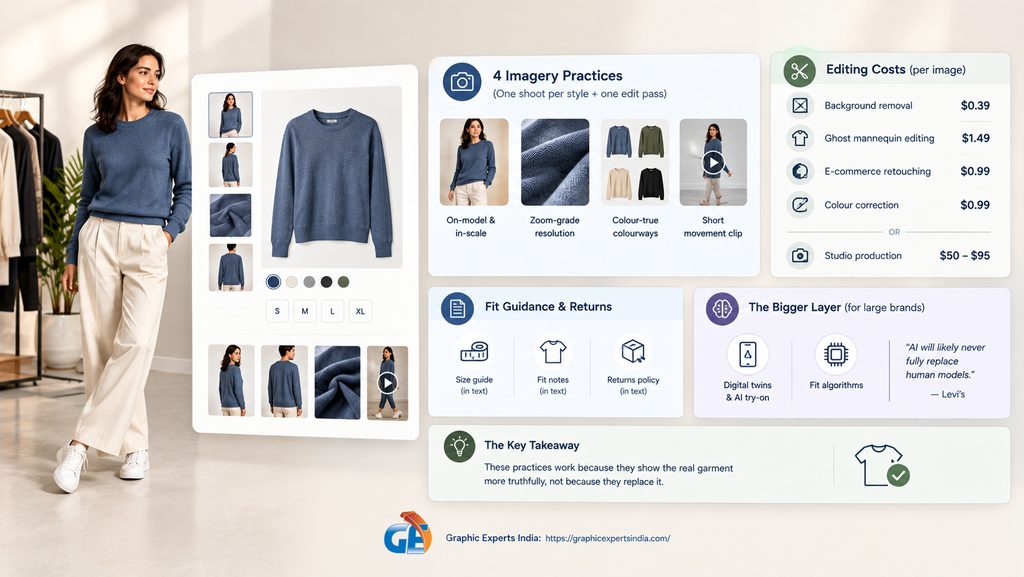
Digital twins, AI try-on and fit algorithms are the large-brand layer, and Levi’s own statement that AI “will likely never fully replace human models” is the useful caution: the practices above work because they show the real garment more truthfully, not because they replace it.
What Do Founders Ask Most Often About How Top Fashion Brands Sell Online?
They make the product page do the fitting room’s work: on-model and in-scale images, zoom that resolves fabric, color-true colorways, video or digital-twin movement, data-driven fit tools such as ASOS’s Fit Assistant, transparent pricing in Everlane’s case, a visible and sometimes priced return policy, and structured size and color data that Google requires.
Baymard’s benchmarks show the gaps most sites still have: 37% lack in-scale images, 23% lack human-model images, 25% have insufficient resolution or zoom, 44% show no return policy and 57% lack size buttons (2020 and 2026 rounds). The best pages close all five, and the first three are photography and editing decisions.
Some do. Zalando reported that about 70% of its editorial campaign assets were AI-generated in Q4 2024 using digital twins of real models; H&M began releasing digital-twin imagery in July 2025; Levi’s piloted AI models in 2023 and stated AI “will likely never fully replace human models.” Amazon still requires adult apparel imaged on-model.
To curb serial returning and bracketing. ASOS deducts £3.95 per returned parcel from customers with a 70%-plus return rate over three or more orders unless they keep over £40 of the order; Zara introduced a £1.95 fee for UK drop-off returns in 2022. Thirteen percent of apparel returners bracket sizes (PowerReviews).
Large enough to zoom: Walmart requires 1500 × 1500 pixels for zoom, Amazon at least 1,600 pixels high, Google recommends about 1500 × 1500 and Shopify displays 2048 × 2048 best. A 3000-pixel master exports to all of them, which is how one shoot serves every channel.
Where Can a Clothing Brand Get Product Images Edited to the Standard Top Brands Use?
A clothing brand can send its product shoot to Graphic Experts India, which lists background removal from $0.39 per image, ghost mannequin editing from $1.49 per image, e-commerce retouching from $0.99 per image, color correction and matching from $0.99 per image and shadow creation from $0.40 per image, each with a 24-hour average turnaround and a three-step quality check.
A free trial on sample images is available through the photo retouching services page, returned within 24 hours with no credit card required.

Salim Ahmed is the CEO of Graphic Experts India, with over 25 years of expertise in photo editing, clipping path, image retouching, and eCommerce image editing services.