

To make merch, you design artwork you own the rights to, choose between print on demand, a limited drop with a minimum order, or a bulk run, sample and price each item for margin, photograph the samples, open the sale through a store or a creator platform, and reorder only what sells.
Merch, short for merchandise, is branded product (most often t-shirts and hoodies) sold by a creator, band, podcast, team or company to its own audience.
This guide covers the six-stage workflow, the published platform terms for creators, the unit economics of a tee and a hoodie, the rights and tax rules, and the fastest way to get a drop photographed, using sources read on 29 September 2026. It sits alongside the guides on how to sell t-shirts online and how to start an online clothing store.
What Does Making Merch Involve at a Glance?
Making merch involves a design you can legally sell, a production model chosen by how much stock you are willing to hold, and a photo-and-listing workflow fast enough to run a drop while the audience’s attention lasts.
| Question | Short answer | Source |
|---|---|---|
| How large is the creator market? | About 50 million global creators; the creator economy “could roughly double” to $480 billion by 2027 | Goldman Sachs Research, April 2023 (projection) |
| What does a print-on-demand tee or hoodie cost? | Bella+Canvas 3001 from $11.69; Gildan 18500 hoodie from $22.19, one print included | Printful blogs, May and July 2026 |
| What margin is normal? | “20% to 40% for most sellers”; most t-shirt businesses see 30% to 50% | Printful, September and May 2026 |
| What do creator platforms charge? | Fourthwall: no monthly fee, catalogue base cost plus 2.9% + $0.30 processing; Spring: free, fee inside base cost | fourthwall.com/pricing; spri.ng |
| Who can sell merch through YouTube? | Channels in the YouTube Partner Program (1,000 subscribers plus 4,000 watch hours or 10 million Shorts views) | YouTube Help |
| How is the design protected? | Copyright registration $45 per single work; trademark $350 per class | US Copyright Office; USPTO |
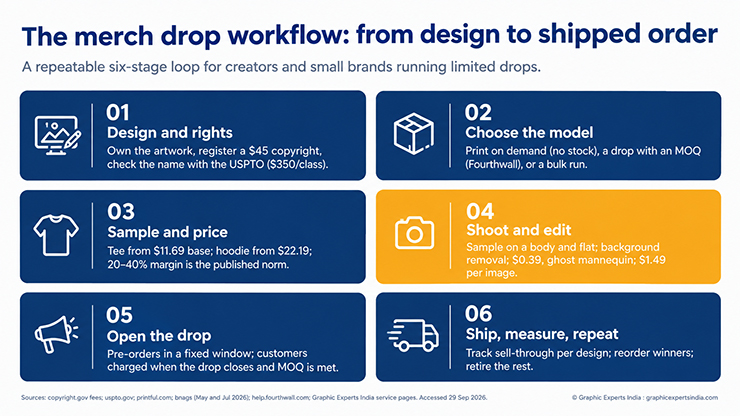
Figure 1. The merch drop workflow. Stage 4, shoot and edit, is where a drop most often stalls.
Why Make Merch?
Merch turns an existing audience into product revenue without building a clothing brand from scratch, because the audience already exists and the garments are stock blanks.
Goldman Sachs Research estimated in April 2023 that “the total addressable market of the creator economy could roughly double in size over the next five years to $480 billion by 2027 from $250 billion today,” with about 50 million global creators growing at 10% to 20% a year; the figure is a projection, not a measurement.
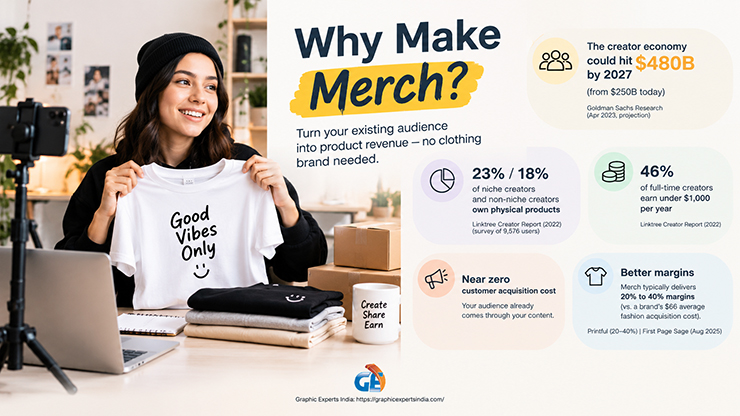
In Linktree’s 2022 Creator Report, a survey of 9,576 users, 23% of niche creators and 18% of non-niche creators listed “own physical products” as a revenue channel, and 46% of full-time creators earned under $1,000 a year, which is the gap merch is usually meant to fill.
The economics differ from a clothing brand in one way: a creator’s customer acquisition cost is close to zero, because the audience arrives through content the creator already makes.
The $66 average fashion acquisition cost (First Page Sage, updated 15 August 2025) that a new label must recover is, for merch, replaced by the cost of a post. Consequently, merch margins at the “20% to 40%” Printful describes are workable where a brand’s would not be.
How Do You Make Merch Step by Step?
To make merch, run the six stages below as a loop, with each drop feeding the design and quantity decisions of the next.
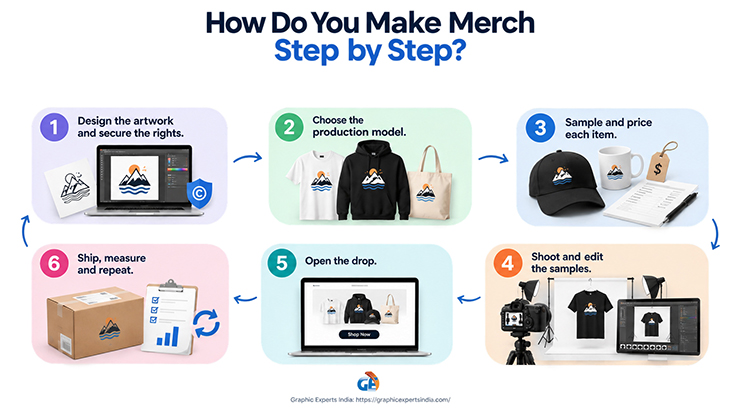
- Design the artwork and secure the rights.
- Choose the production model.
- Sample and price each item.
- Shoot and edit the samples.
- Open the drop.
- Ship, measure and repeat.
Stage 1: How Do You Design Merch You Are Allowed to Sell?
To design merch you are allowed to sell, use artwork you created or licensed, and register the design and the brand name before the first drop. A design’s copyright can be registered for $45 as “single author, same claimant, one work, not for hire” (US Copyright Office fee schedule).
The brand or channel name can be registered as a trademark for a base fee of $350 per class under the USPTO schedule effective January 2025; a trademark “can be any word, phrase, symbol, design, or a combination of these things that identifies your goods or services” (USPTO).
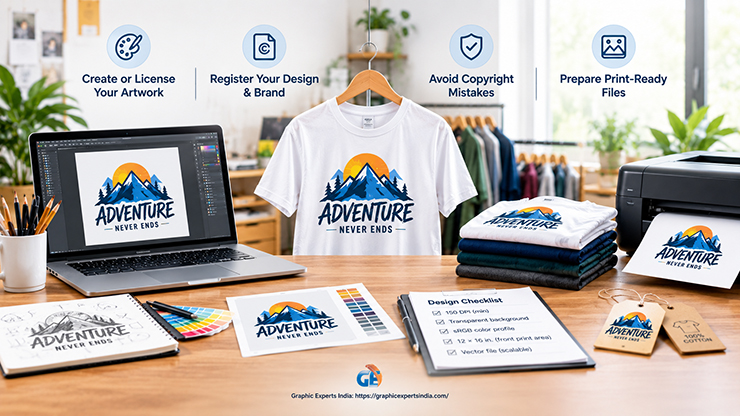
Fan art, logos of other brands and characters are the common merch mistake: “if you use a copyrighted work without authorization, the owner may be entitled to bring an infringement action against you,” and “in cases of doubt, the Copyright Office recommends that permission be obtained” (US Copyright Office).
The artwork also has to print. Printful requires print files of at least 150 DPI as PNGs with transparent backgrounds in the sRGB profile, with a standard front print area of 12 × 16 inches; a logo should exist as a vector file so it scales from a left-chest print to a full back without blurring. Graphic Experts India converts raster logos to editable vectors at $4.48 per image on its raster to vector conversion service.
Stage 2: Which Merch Production Model Should You Choose?
A creator should choose print on demand for a first drop, a minimum-order drop once demand is proven, and a bulk run only for designs that have sold repeatedly. Three models have published terms.
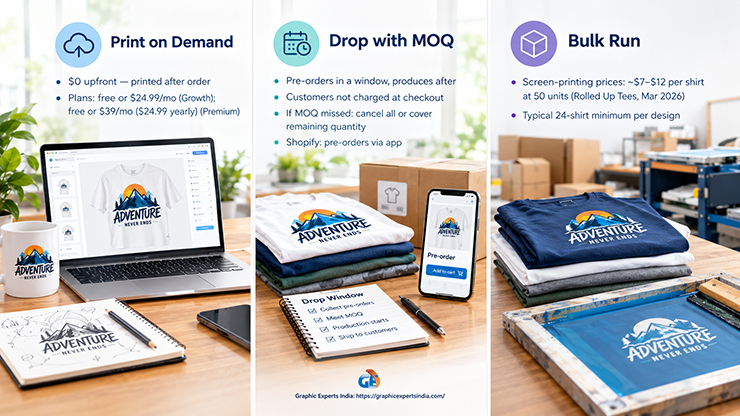
- Print on demand carries “$0 upfront—products are printed only after a customer orders” (Printful, May 2025). Printful’s plans are free or $24.99 per month for Growth; Printify’s are free or $39 per month ($24.99 billed yearly) for Premium, which discounts products by up to 20%.
- Drop with a minimum order quantity (MOQ) collects pre-orders in a window and produces afterwards. On Fourthwall, “orders are collected during a drop window, and production starts after the drop ends and the MOQ is met”; “customers are not charged at checkout” but when the window closes, and if the MOQ is missed the creator “must either cancel all orders or cover the remaining quantity yourself” (Fourthwall Help). Shopify supports pre-orders through a pre-order app from its App Store (Shopify Help).
- Bulk run buys stock at screen-printing prices, which fall from about $7 to $12 per shirt at 50 units (Rolled Up Tees, March 2026) with a typical 24-shirt minimum per design, as covered in the guide on how to start a t-shirt business.
Stage 3: How Do You Sample and Price Merch?
To sample and price merch, order one of each item, record the base cost and set a retail price that leaves a 20% to 40% margin after payment fees. Published base costs at Printful are $11.69 for a Bella+Canvas 3001 tee (14 May 2026) and $22.19 for a Gildan 18500 hoodie with one print placement (24 July 2026).
Printful states that “print-on-demand profit margins usually range from 20% to 40% for most sellers,” that “most t-shirt businesses see average profit margins between 30% and 50%,” and that net profit runs “$3 to $8 per shirt” in its examples (September and May 2026).
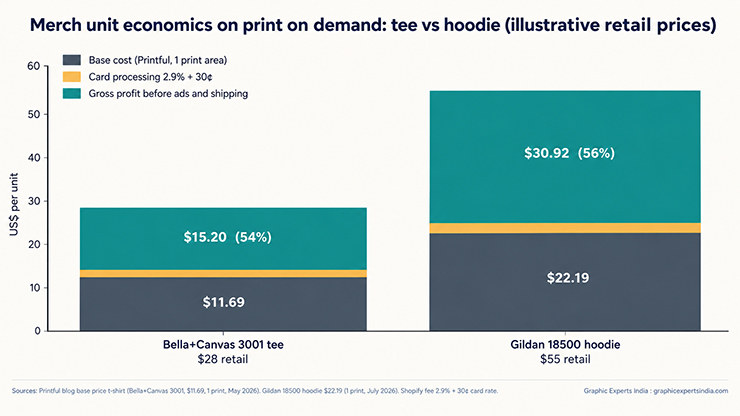
Figure 2. Illustrative unit economics on print on demand. Base costs from Printful’s blogs; card rate from Shopify Basic; retail prices are assumptions.
| Item | Retail (assumed) | Base cost | Card fee (2.9% + 30¢) | Gross profit | Margin |
|---|---|---|---|---|---|
| Bella+Canvas 3001 tee | $28.00 | $11.69 | $1.11 | $15.20 | 54% |
| Gildan 18500 hoodie | $55.00 | $22.19 | $1.90 | $30.91 | 56% |
Two costs sit outside the table. Platform fees apply where the merch is sold through a marketplace (Etsy 6.5% plus processing; Amazon 17% on clothing over $20; TikTok Shop 6% under its October 2024 schedule). Shipping is charged to the customer or absorbed; Printful’s fulfilment takes two to five business days before shipping begins.
Stage 4: How Do You Photograph Merch Fast?
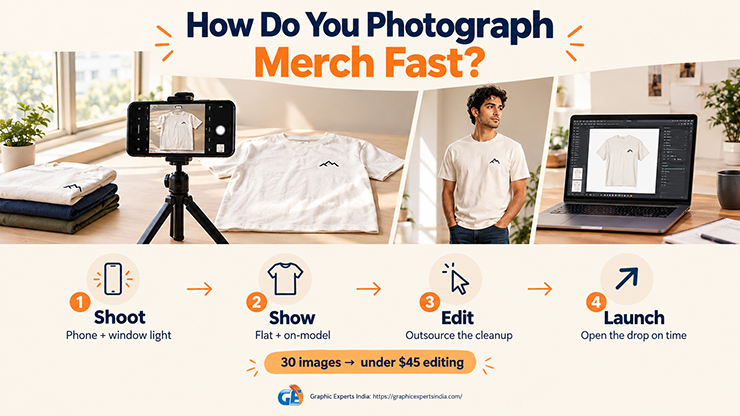
To photograph merch fast, shoot every sample in one session, flat and on a person, against one plain background, and outsource the editing so the drop opens on time. A drop’s window is set by audience attention, and the photo step is the one most often skipped in favour of the supplier’s mockup.
Mockups have two problems: they are the same image every other seller of that blank uses, and they fail marketplace rules. Amazon’s Clothing & Accessories guidelines require “all adult apparel should be imaged on-model” on “a pure white background (RGB Value 255, HEX Value #FFFFFF)” with the product filling at least 85% of the image.
In Etsy’s buyer surveys, “90% of shoppers said the quality of the photos were ‘extremely important’ or ‘very important’ to a purchase decision.”
The fast workflow is a phone, a window and an outsourced edit. Shopify displays 2048 × 2048 pixel product images best, so shoot at the phone’s full resolution.
Background removal to pure white costs from $0.39 per image, ghost mannequin editing from $1.49 per image and e-commerce retouching from $0.99 per image at Graphic Experts India, each with a 24-hour average turnaround, against studio product images from $50 and on-model from $95 per image at Squareshot.
A ten-item drop with three images each is 30 images, or under $45 in editing, back the next day. Compositing the merch into a lifestyle scene or a branded background is an image-manipulation job, listed from $1.00 per image on the image manipulation service page; the shooting setups themselves are in the guide to t-shirt photography ideas for apparel photoshoots.
Stage 5: How Do You Open a Merch Drop?
To open a merch drop, announce a fixed window, sell through the platform your audience already uses, and connect the store to the channel’s shopping features. Creator platforms publish their terms.
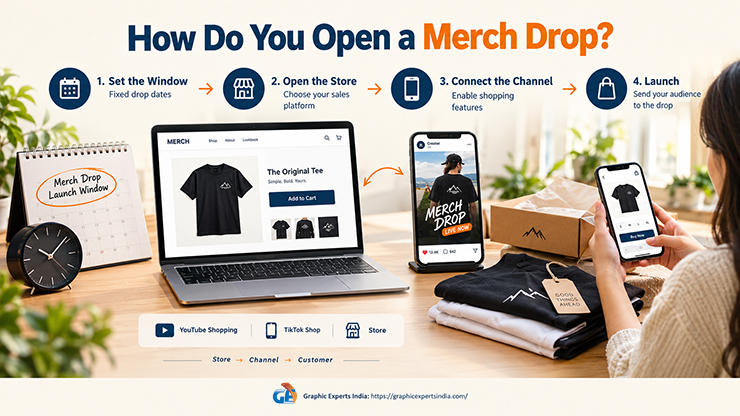
Fourthwall charges “no monthly fees, no upfront costs,” deducts the catalogue item’s listed flat cost from the selling price, adds 2.9% + $0.30 on US card transactions and charges 0% on self-sourced products (fourthwall.com/pricing).
Spring “is free to use”; its fee “is included in the base cost of the product,” so a $10 base sold at $24 leaves $14 (Spring FAQ). A Shopify store costs $29 per month billed annually and takes 2.9% + 30¢ per card order.
YouTube connects merch to the channel through YouTube Shopping. Eligibility requires membership of the YouTube Partner Program, which needs 1,000 subscribers plus either 4,000 qualified watch hours in the past 12 months or 10 million qualified Shorts views in the past 90 days, a channel not set as made for kids and no hate-speech strikes (YouTube Help).
YouTube’s supported merch platforms include Fourthwall, Shopify, Spring, Spreadshop, TeePublic and Wix (YouTube Help). On TikTok Shop, clothing sales carried a 6% referral fee under the schedule effective 31 October 2024.
Stage 6: How Do You Measure a Drop and Decide What to Reorder?
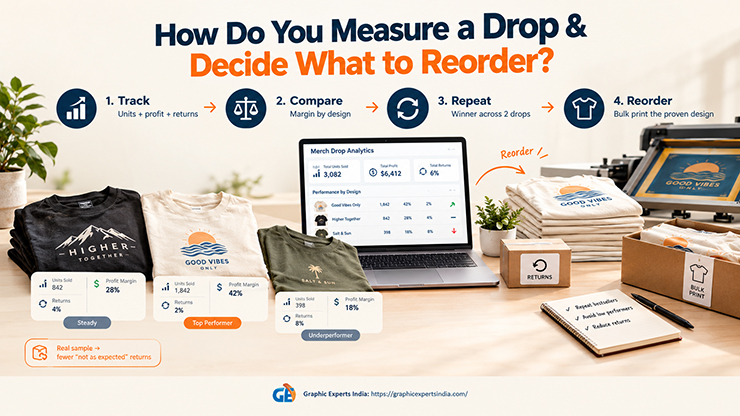
To measure a drop, record units sold, gross profit after fees and return rate per design, and reorder only designs that clear the margin target.
Apparel returns run at an estimated 19.3% of online sales (National Retail Federation and Happy Returns, 15 October 2025), and 28% of apparel returners say the “item didn’t look the way they thought it would” (PowerReviews, 2023); a merch drop photographed on a real sample rather than a mockup reduces that reason directly.
Designs that repeat across two drops are candidates for a bulk screen-printed run, where the per-shirt cost falls and the margin widens.
What Tax Rules Apply to Selling Merch?
Selling merch is a retail sale, so sales tax applies where the seller has nexus, and marketplaces often collect it on the seller’s behalf.
In California, for example, “retailers engaged in business in California must register with the California Department of Tax and Fee Administration (CDTFA) and pay the state’s sales tax,” and under the state’s Marketplace Facilitator Act, “beginning October 1, 2019, a marketplace facilitator is considered the seller and retailer for each sale facilitated through its marketplace,” so platforms such as Etsy and Amazon collect and remit on those sales (CDTFA).
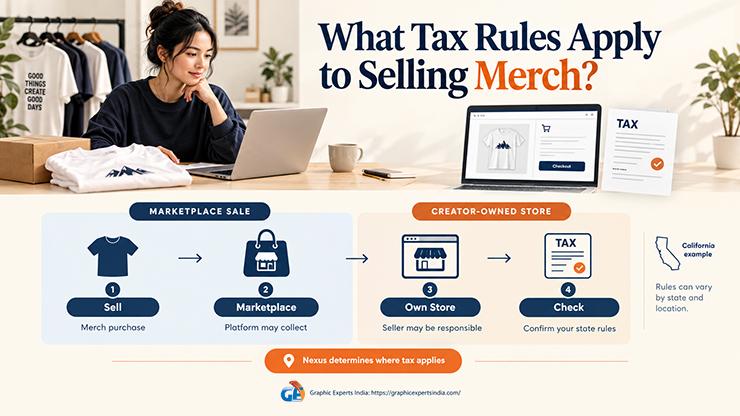
Sales through a creator’s own Shopify or Fourthwall store remain the creator’s responsibility in states where the creator has nexus after the 2018 Wayfair decision. Confirm the rules for your state before the first drop.
What Do Creators Ask Most Often About Making Merch?
Use print on demand, which carries “$0 upfront” at Printful, on a free Fourthwall or Spring store; both deduct product cost from the sale price and charge no monthly fee. Shoot samples on a phone and outsource editing from $0.39 per image. The only fixed costs are optional: a $45 copyright registration and a $350 trademark.
A print-on-demand Bella+Canvas 3001 tee costs $11.69 and a Gildan 18500 hoodie $22.19 at Printful (2026 blog prices), with no minimum. A screen-printed bulk run costs about $7 to $12 per shirt at 50 units with a 24-shirt minimum per design. Sample, photo editing and rights fees add under $100 for a small drop.
Join the YouTube Partner Program (1,000 subscribers plus 4,000 watch hours or 10 million Shorts views), then connect a supported merch platform such as Fourthwall, Shopify, Spring, Spreadshop, TeePublic or Wix through YouTube Shopping. The channel must not be set as made for kids and must have no hate-speech strikes.
Printful states that print-on-demand margins “usually range from 20% to 40% for most sellers” and that most t-shirt businesses see 30% to 50%. A $28 tee on an $11.69 base leaves about $15 after card fees; a $55 hoodie on a $22.19 base leaves about $31, before shipping and any marketplace fee.
Real photos are required on Amazon, where adult apparel must be imaged on-model, and they separate a drop from the identical supplier mockups other sellers use. Ninety percent of Etsy shoppers rate photo quality as very or extremely important. One phone session plus outsourced editing from $0.39 per image covers a drop in a day.
Where Can a Creator Get a Merch Drop Photographed and Edited Overnight?
A creator can shoot a merch drop on a phone and send the files to Graphic Experts India, which lists background removal from $0.39 per image, ghost mannequin editing from $1.49 per image, e-commerce retouching from $0.99 per image and image manipulation for lifestyle composites from $1.00 per image, each with a 24-hour average turnaround and a three-step quality check.
A free trial on sample images is available through the image manipulation service page, returned within 24 hours with no credit card required.

Salim Ahmed is the CEO of Graphic Experts India, with over 25 years of expertise in photo editing, clipping path, image retouching, and eCommerce image editing services.