

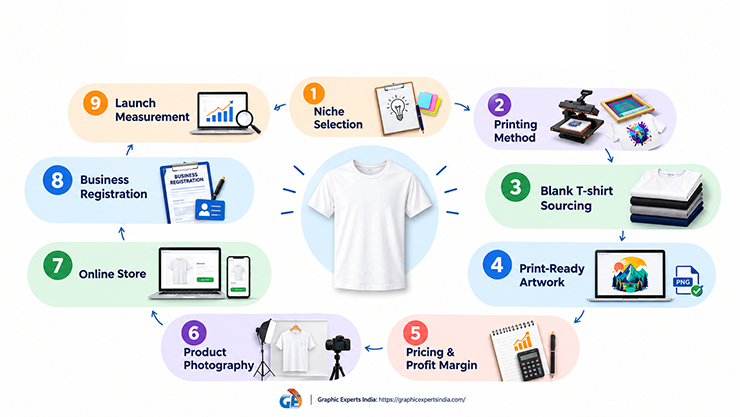
To start a t-shirt business, you choose a niche, pick a printing method, source blanks or a print-on-demand supplier, prepare print-ready artwork, price each shirt for margin, photograph the product, open a store and register the business.
A t-shirt business, also called a tee brand or custom shirt company, is a clothing business that sells its own designs printed on standard blank garments.
This guide covers the nine steps in order, with the published prices of printing methods, blanks and marketplaces as of 18 September 2026, and the print-file and product-image specifications that decide whether a design prints and sells as intended. It is the t-shirt-specific route through the wider guide on how to start a clothing brand.
What Does Starting a T-Shirt Business Involve at a Glance?
Starting a t-shirt business involves choosing between print on demand and bulk printing, a start-up budget of roughly $1,280 for a print-on-demand launch, and three specification sheets: the printer’s file requirements, the marketplace’s image requirements and the print-size standards for each placement.
| Question | Short answer | Source |
|---|---|---|
| How big is the market? | The global custom t-shirt printing market was valued at US$5.2 billion in 2024, projected to reach US$9.8 billion by 2030 at an 11.5% compound annual growth rate | Grand View Research, November 2024 |
| What does a print-on-demand tee cost to make? | A DTG-printed tee costs about $9–$14 per shirt; Printful lists a Bella+Canvas 3001 at a $11.75 base price | Printify, October 2025; Printful, December 2025 |
| What does screen printing cost? | About $7–$12 per shirt at 50 shirts, with a typical 24-shirt minimum per design | Rolled Up Tees, March 2026; French Press Custom |
| What does a blank cost wholesale? | Gildan 5000 from $2.61; Bella+Canvas 3001 from roughly $4.70–$5.86 (XS–XL) | ShirtSpace, accessed 18 September 2026 |
| What margin should a tee earn? | Printful: 20% to 40% is a good print-on-demand margin; Printify: at least 40% | Printful, December 2024; Printify, April 2026 |
| What do shoppers judge first? | 90% of Etsy shoppers rated photo quality “extremely important” or “very important” to a purchase decision | Etsy Seller Handbook |
Why Start a T-Shirt Business in 2026?
A t-shirt business is the lowest-capital entry into apparel because the garment already exists and only the design, the print and the presentation are the founder’s work. The global custom t-shirt printing market was valued at US$5.2 billion in 2024 and is projected to reach US$9.8 billion by 2030, an 11.5% compound annual growth rate from 2025, according to Grand View Research (November 2024).
Print on demand removes inventory entirely: Printful’s cost guide states “$0” inventory for a print-on-demand launch against “$20,000–$50,000” of stock for a traditional one (27 May 2025).
The trade-off is margin and differentiation. A print-on-demand tee costs “around $9-$14 per shirt” to produce, according to Printify (30 October 2025), and every competitor has access to the same blanks and the same printers.
Consequently, a t-shirt business competes on design, on the audience it reaches and on how well the product is presented, which is why print files and product photos each get a step below.
How Do You Start a T-Shirt Business Step by Step?
To start a t-shirt business, follow the nine steps below in order. Each step names the decision, the specification to meet and the published cost.
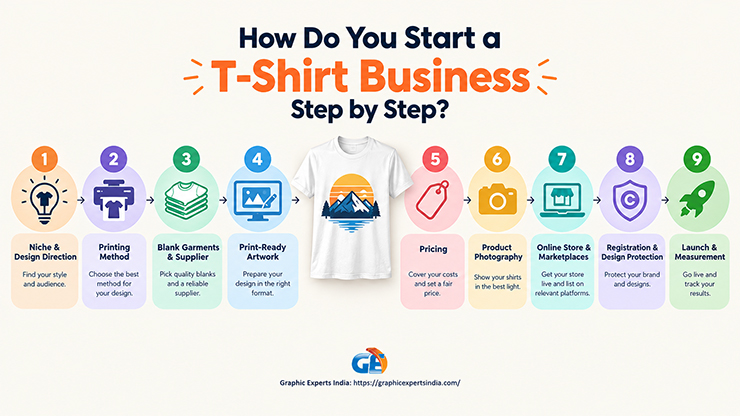
- Choose a niche and a design direction.
- Choose a printing method: print on demand, DTG, screen printing or DTF.
- Choose blanks and a supplier.
- Prepare print-ready artwork to the printer’s specification.
- Price each shirt for margin.
- Photograph the shirts (real photos, not only mockups).
- Open the store and list on marketplaces.
- Register the business and protect the designs.
- Launch and measure.
Step 1: How Do You Choose a Niche for a T-Shirt Business?
To choose a t-shirt niche, pick a community you can reach directly and a design style you can repeat across a collection. A t-shirt niche is defined by the wearer, not the garment: the blank is the same for a running club, a bakery’s merchandise and a streetwear label.
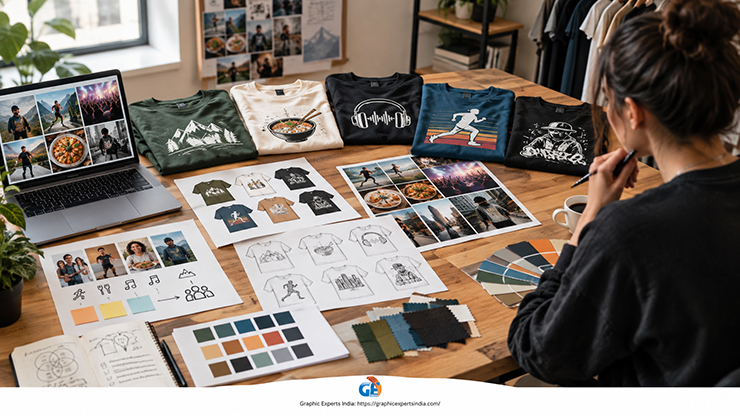
Because the product is undifferentiated, the audience is the asset. The validation methods in the clothing-brand guide apply unchanged: a pre-order page, a print-on-demand test listing or a single market stall, each read for which designs sell before any bulk order is placed.
Step 2: Which Printing Method Should a T-Shirt Business Use?
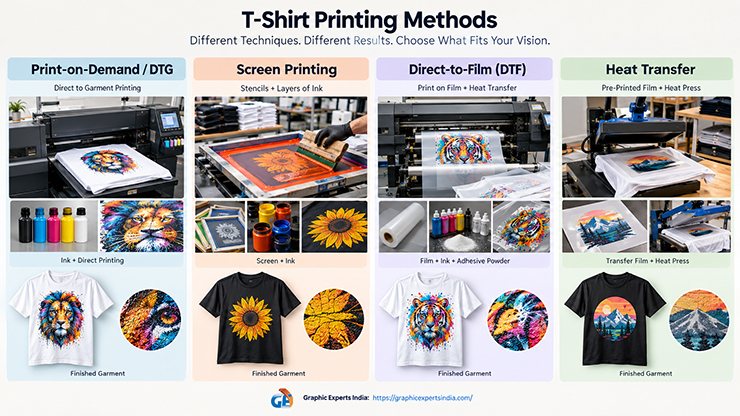
A t-shirt business should use print on demand or direct-to-garment (DTG) printing for small quantities and many designs, and screen printing once one design sells 24 or more units at a time. Four methods cover almost every case, and one printer’s published ranges show the cost difference at 50 shirts.
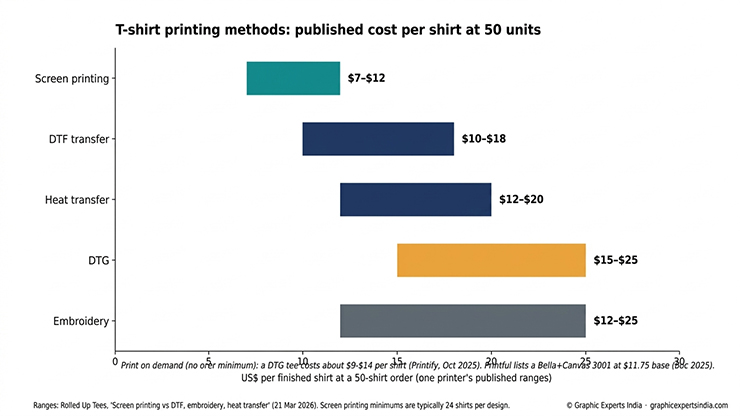
Figure 1. Published cost per finished shirt at a 50-shirt order. Ranges from Rolled Up Tees (21 March 2026); print-on-demand figures from Printify and Printful.
| Method | How it works | Published cost signal | Minimum |
|---|---|---|---|
| Print on demand (POD) | A supplier prints and ships each order; you upload designs | DTG tee “around $9-$14 per shirt” (Printify, October 2025); Bella+Canvas 3001 base “$11.75” (Printful, December 2025) | None |
| Direct-to-garment (DTG) | Inkjet printing directly onto the fabric | “$15–$25 per shirt” at 50 units (Rolled Up Tees, March 2026); “no minimum and no setup fee” (French Press Custom) | None |
| Screen printing | Ink pushed through a stencil screen, one screen per color | “$7–$12 per shirt” at 50 units; setup “$25.00 per color per screen” plus film and press setup (French Press Custom) | “24 pieces per design” (French Press Custom); “Minimum order for all screenprinting is 24” (QRSTs, May 2025) |
| Direct-to-film (DTF) transfer | Design printed on film, heat-pressed onto the shirt | “$10–$18 per shirt” at 50 units (Rolled Up Tees, March 2026) | Varies |
Screen printing’s per-shirt cost falls with volume: one printer lists decoration-only prices of $7.04 per shirt at 24–47 pieces, $4.93 at 48–99, $3.52 at 100–199 and $1.41 at 1,000 or more for a one-color print, garment not included (French Press Custom, accessed 18 September 2026).
A common sequence is therefore to launch on print on demand, identify the two or three designs that repeat, and move those to screen-printed stock.
Step 3: Which Blanks Should a T-Shirt Business Use, and What Do They Cost?
A t-shirt business should choose one or two blank styles and hold them constant, because a consistent blank means consistent fit, color and photography across the catalogue. Two blanks dominate the market and both have public wholesale prices.
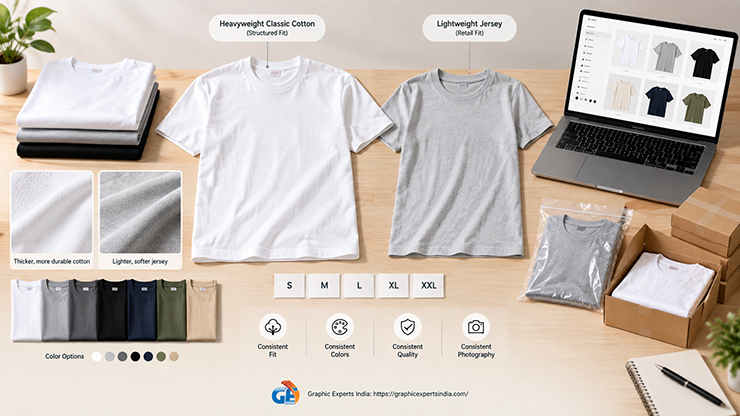
The Gildan 5000 heavy cotton tee starts at $2.61 per shirt in sizes S–XL at ShirtSpace, and from $1.82 for white at Jiffy (both accessed 18 September 2026). The Bella+Canvas 3001 jersey tee, a lighter retail-fit blank, lists at roughly $4.70–$5.86 per shirt in XS–XL at ShirtSpace, with 2XL at $7.98.
For a print-on-demand business, the blank is bundled into the supplier’s base price: Printify lists the Gildan 5000 from $8.80 and the Bella+Canvas 3001 from $10.98 (21 April 2026), and Printful lists the 3001 at $11.75 (2 December 2025).
The difference between the wholesale blank and the print-on-demand base price is the printing, handling and margin the supplier charges for carrying no minimum.
Step 4: How Do You Prepare Print-Ready Artwork for T-Shirts?
To prepare print-ready artwork, export each design as a PNG with a transparent background, in the sRGB color profile, at the printer’s stated resolution and print-area size.
Printful’s DTG file guidelines state that a print file “has to be at least 150 DPI” and should be saved “as a PNG file” because “JPG files don’t support transparent backgrounds,” in the “sRGB IEC61966-2.1” profile.
Printful’s and Printify’s support pages both recommend 300 DPI for JPEG and PNG files, with a 100 MB size limit. The standard front print area is “up to 12″ × 16″ for t-shirts, expanding to 15″ × 18″ on select DTG products” (Printful, 28 July 2025). At 300 DPI, a 12 × 16 inch print area is 3,600 × 4,800 pixels; at Printful’s 150 DPI minimum it is 1,800 × 2,400 pixels.
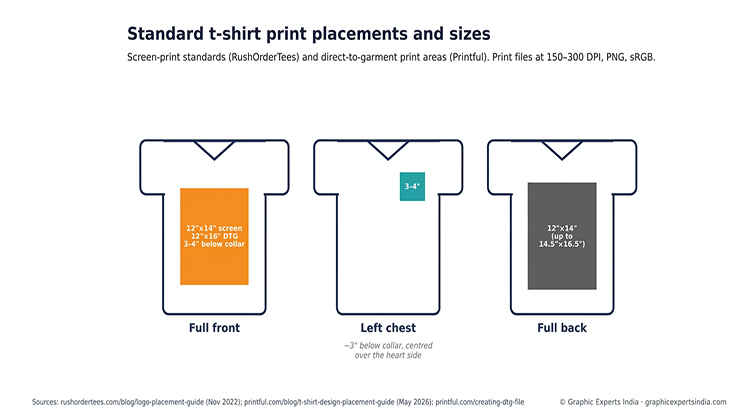
Figure 2. Standard placements and sizes. Screen-print standards from RushOrderTees (November 2022); DTG print areas from Printful (May 2026).
Placement standards are published by printers. A full-front print is “12”w x 14”h, and placement is around 3″ down from the collar”; a left-chest print is “typically 3” to 4” wide”; a full-back print is 12 by 14 inches, “up to 14.5” wide by 16.5” high” (RushOrderTees logo placement guide, 14 November 2022).
Printful places the front print “3–4 inches below the collar” and sizes a left-chest design “between 2.5″ × 2.5″ and 5″ × 5″” (14 May 2026).
A logo or type-based design should exist as a vector file before printing, because raster artwork blurs when a printer scales it between a left-chest and a full-back placement; Graphic Experts India lists logo vector conversion at $4.48 per image on its raster to vector conversion service page.
Step 5: How Do You Price a T-Shirt for Profit?
To price a t-shirt, add the blank, the print, the delivery and the platform fee, then divide by one minus the target margin. Printify states the formula as “Retail price = Total cost ÷ (1 – desired profit margin %)” and recommends “at least a 40% margin” (21 April 2026).
Printful’s guidance is that “a good profit margin for print-on-demand businesses typically ranges from 20% to 40%” (14 December 2024), and that “many successful merch sellers aim for a 30-40% markup” (2 December 2025).
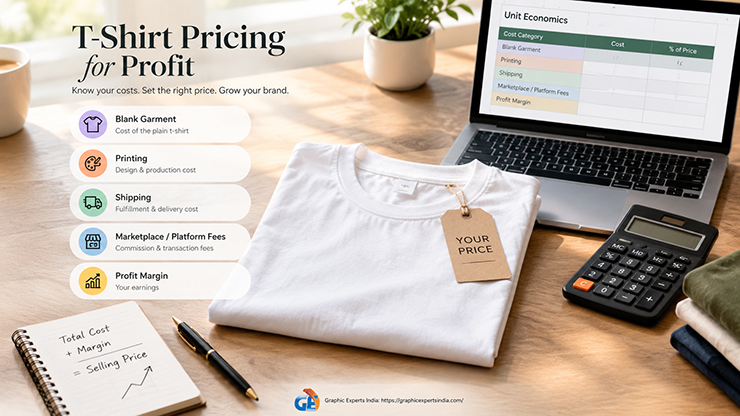
Printful’s own worked example prices a Bella+Canvas 3001 at $11.75 base plus $4.75 delivery, sold at $24.75 for a 50% margin (2 December 2025).
Marketplace fees sit on top: Etsy charges $0.20 per listing and 6.5% of the price plus shipping per transaction (Etsy fees policy, updated 13 February 2026), and Amazon charges a 17% referral fee on clothing priced above $20 (sell.amazon.com/pricing).
On a $25 tee, Etsy’s transaction fee is $1.63 before payment processing; Amazon’s referral fee is $4.25. The full unit-economics arithmetic, including customer acquisition cost, is worked through in the clothing brand business plan guide.
Step 6: How Do You Photograph T-Shirts So They Sell?
To photograph t-shirts so they sell, shoot at least one real product photo per design in addition to the supplier’s mockup, then edit every image to one background and color standard. Print-on-demand suppliers generate a flat mockup for every design automatically, and every other seller on the platform uses the same mockup template.
In Etsy’s buyer surveys, “90% of shoppers said the quality of the photos were ‘extremely important’ or ‘very important’ to a purchase decision” (Etsy Seller Handbook). No supplier publishes A/B data comparing mockups with real photos, so the case rests on that survey and on the marketplace rules below.
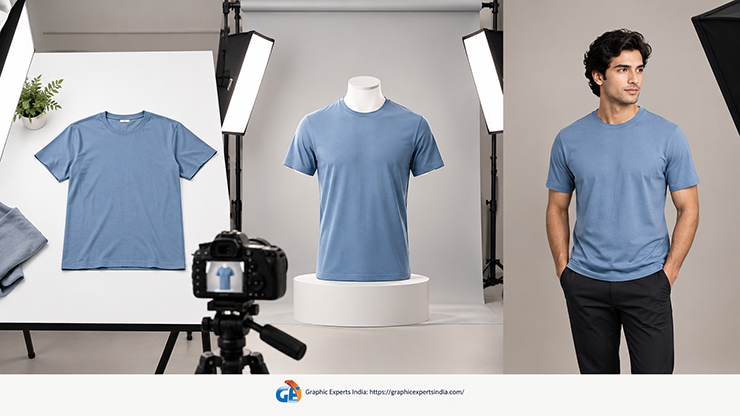
A t-shirt business has three real-photo formats, each with a published cost.
- Flat lay: the shirt laid or pinned on a plain surface, then background-removed to pure white. Self-shot with outsourced background removal from $0.39 per image at Graphic Experts India; studio product images from $50 per image at Squareshot.
- Ghost mannequin: the shirt on a mannequin, with the mannequin removed and the inside collar reconstructed in editing, from $1.49 per image at Graphic Experts India. The shooting setup is in the ghost mannequin photography and editing guide.
- On-model: the shirt worn by a person; studio on-model images from $95 per image at Squareshot, or a self-run shoot with e-commerce retouching from $0.99 per image.
Amazon’s Clothing & Accessories imaging guidelines (Spring 2021 edition) require that “all adult apparel should be imaged on-model,” that “all kids, baby, accessories, multipacks & sets should be off-model,” and that main images have “a pure white background (RGB Value 255, HEX Value #FFFFFF)” at “at least 1,600 pixels in height.”
A print-on-demand mockup therefore does not qualify as an Amazon main image for an adult tee. Order one sample of each design, shoot it once on a model and once flat, and the same raw files serve Etsy, Shopify and Amazon after editing. Lifestyle setups for the same shoot are listed in the guide to t-shirt photography ideas for apparel photoshoots.
Step 7: Where Should a T-Shirt Business Sell?
A t-shirt business should sell through one owned store and one or two marketplaces, chosen by fee structure and image rules. Published terms as of 18 September 2026 are below.
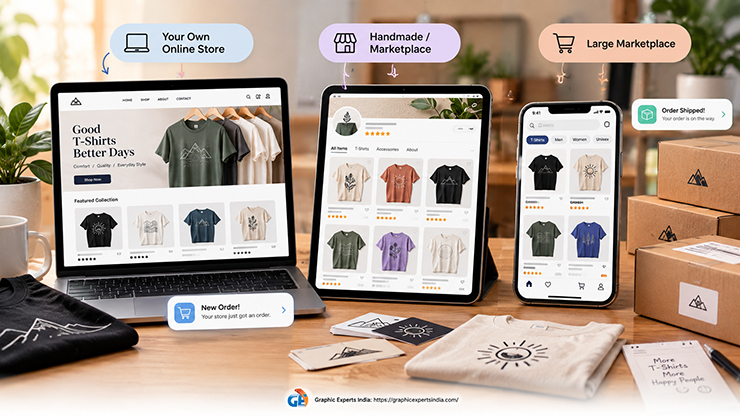
| Channel | Fee to sell | Image specification |
|---|---|---|
| Shopify | Basic $39 per month billed monthly or $29 annually; 2.9% + 30¢ card rate | 2048 × 2048 px “usually displays best”; up to 5000 × 5000 px; under 20 MB; PNG preferred, then JPEG (Shopify Help Center) |
| Etsy | $0.20 per listing; 6.5% transaction fee on price plus shipping; Offsite Ads 15% (under $10,000 annual sales) or 12% | “At least 2000 pixels” in width and height recommended; first photo at least 635 px; files over 1 MB may fail to upload; transparent PNGs not supported (Etsy Help) |
| Amazon | Professional plan $39.99 per month; clothing referral fee 5% up to $15, 10% from $15 to $20, 17% above $20 | Pure white background RGB 255; adult apparel on-model; kids flat; at least 1,600 px high; JPEG preferred (Amazon Clothing & Accessories guidelines, 2021) |
| Amazon Merch on Demand | Royalty-based programme; Amazon prints and ships; new accounts start with a limited number of live designs and unlock more as designs sell | Amazon supplies the product image from your artwork |
Amazon Merch on Demand’s royalty rates and tier thresholds are published only inside the programme’s own resource pages, which require a seller login; a founder should read the current rates at merch.amazon.com before pricing for that channel.
The Amazon photo-editing conventions that apply to a tee listing, including the 85% frame fill, are covered in the guide to Amazon photo editing.
Step 8: How Do You Register a T-Shirt Business and Protect Your Designs?
To register a t-shirt business in the United States, register the business name where required, obtain the permits your state and city require, and file copyright or trademark protection for the designs and brand.
The US Small Business Administration states that “for most small businesses, registering your business is as simple as registering your business name with state and local governments,” and that “most states require you to register your DBA if you use one” (SBA, updated 28 August 2026).
Forming an LLC costs from $40 in Kentucky to $500 in Massachusetts on the two states’ fee schedules.
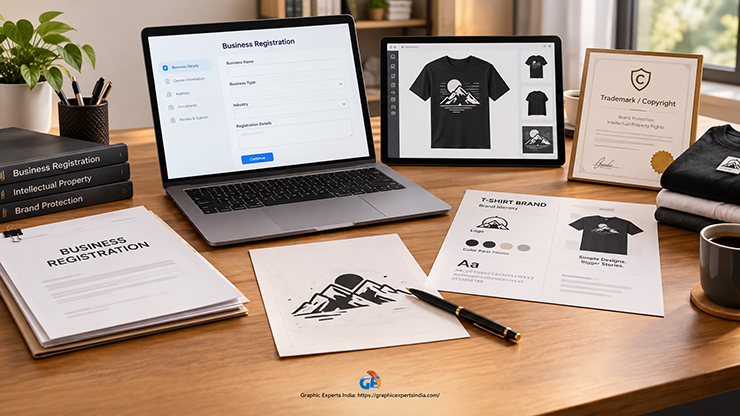
Design protection has two published fees. Registering a single design’s copyright costs $45 for “single author, same claimant, one work, not for hire” on the US Copyright Office fee schedule. Registering the brand name as a trademark costs a $350 base fee per class under the USPTO schedule effective 18 January 2025; clothing is Class 25.
A home-based t-shirt business can also deduct home-office space at “$5 per square foot” up to a “maximum 300 square feet” under the IRS simplified method (page reviewed 2 March 2026).
Step 9: How Do You Launch and Measure a T-Shirt Business?
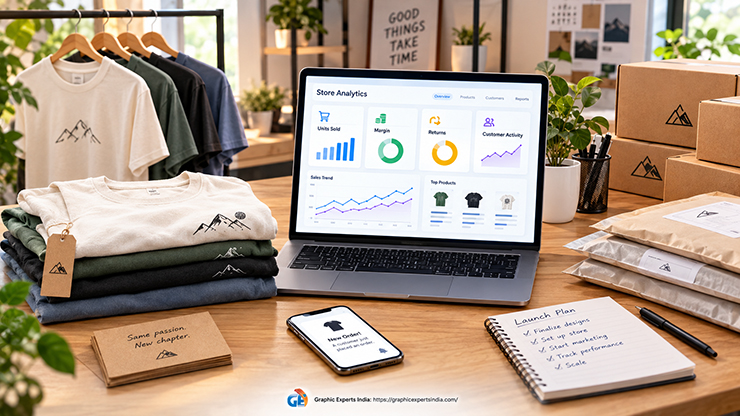
To launch a t-shirt business, release a small first collection to the audience from Step 1, then measure three numbers per design: units sold, margin after fees and returns.
Fashion clothing and accessories stores converted 1.81% of visits in July 2026 (IRP Commerce market data), and fashion and apparel e-commerce companies averaged a $66 customer acquisition cost between 2020 and 2025 (First Page Sage, updated 15 August 2025).
At a $24.75 retail price and a 50% margin, one sale returns about $12.38 gross, so the first order rarely covers its acquisition cost; repeat buyers and organic reach carry a t-shirt business, which is why the niche in Step 1 matters more than the printing method in Step 2.
How Much Does It Cost to Start a T-Shirt Business?
Starting a t-shirt business costs about $1,280 in a print-on-demand launch budget built from published price lists: $0 inventory, about $60 in samples, $390 for an LLC and trademark, $358 for a Shopify Basic annual plan and domain, about $21 in photo editing and $450 in advertising at $5 per day for 90 days.
A screen-printed inventory launch adds the blanks and print run: 50 Gildan 5000 shirts at $2.61 plus one-color screen printing at $4.93 per shirt and setup fees comes to roughly $400 per design before samples. The full line-by-line budget, with the cut-and-sew comparison, is in the guide to how much it costs to start a clothing brand.
What Mistakes Do New T-Shirt Businesses Make?
New t-shirt businesses most often fail on artwork resolution, mockup-only listings, under-priced shirts and unprotected designs. Each has a published fix.
- Low-resolution artwork. Printful requires at least 150 DPI and recommends 300 DPI; a 1,200-pixel-wide logo cannot print cleanly across a 12-inch chest. Rebuild type and logos as vectors.
- Mockup-only listings. Amazon requires adult apparel on-model, and 90% of Etsy shoppers rate photo quality as very or extremely important. Shoot at least one real photo per design.
- Pricing below a 40% margin. Printify’s benchmark is at least 40%; below that, Etsy’s 6.5% or Amazon’s 17% fee plus a $66 acquisition cost leaves nothing.
- Skipping design and brand protection. A $45 copyright registration and a $350 trademark filing are cheaper than a takedown dispute.
- Screen printing before demand is proven. With a 24-shirt minimum per design and setup fees per color, unsold designs become dead stock. Test on print on demand first.
What Do Founders Ask Most Often About Starting a T-Shirt Business?
Start from home with print on demand: upload designs to a supplier such as Printful or Printify, list them on Etsy at $0.20 per listing or a Shopify Basic store at $29 per month billed annually, and shoot product photos on a phone against a plain wall. The IRS simplified home-office deduction allows $5 per square foot up to 300 square feet.
A print-on-demand t-shirt business costs about $1,280 in year one, built from published prices: $0 inventory, about $60 in samples, $390 legal and trademark, $358 store and domain, about $21 photo editing and $450 in ads. Screen-printed stock adds roughly $400 per design for 50 shirts including setup.
A t-shirt business is profitable at the margins the suppliers themselves recommend: Printful cites 20% to 40% as a good print-on-demand margin and Printify recommends at least 40%. On a $24.75 tee at 50% margin, gross profit is about $12.38 per shirt before marketplace fees and customer acquisition.
Printers require a PNG with a transparent background in the sRGB color profile, at 150 to 300 DPI, sized to the print area, typically 12 × 16 inches for a front print (3,600 × 4,800 pixels at 300 DPI). Logos and type should be supplied as vector files so they scale cleanly.
Real photos are needed for Amazon, which requires adult apparel imaged on-model on a pure white background, and they are strongly indicated everywhere else: 90% of Etsy shoppers rate photo quality as very or extremely important. Shoot one sample per design flat and on-model; editing starts at $0.39 per image.
Where Can a T-Shirt Business Get Product Photos Edited?
A t-shirt business can outsource product photo editing to Graphic Experts India, which lists background removal from $0.39 per image, ghost mannequin editing from $1.49 per image and e-commerce retouching from $0.99 per image, each with a 24-hour average turnaround and a three-step quality check.
Graphic Experts India also converts raster logos to print-ready vector files at $4.48 per image. A free trial on sample images is available through the e-commerce product photo editing service page, returned within 24 hours with no credit card required.

Salim Ahmed is the CEO of Graphic Experts India, with over 25 years of expertise in photo editing, clipping path, image retouching, and eCommerce image editing services.