

To start a clothing business, you choose between making garments and reselling them, write the plan and budget, register the business and permits, source stock from wholesale platforms, set up a store and point of sale, build the online storefront with product photos, and open.
A clothing business, in the retail sense this guide covers, is a clothing store or boutique that buys finished garments at wholesale and sells them to consumers at retail, in a shop, online or both. This is the retail counterpart to the guide on how to start a clothing brand, which covers designing and producing your own line.
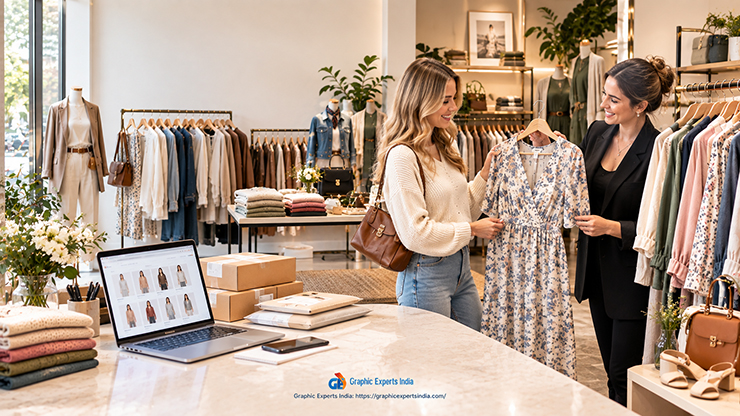
The two paths share the legal and marketing steps and diverge on sourcing, inventory and the role of the physical store.
What Does Starting a Clothing Business Involve at a Glance?
Starting a clothing store or boutique involves an average opening cost near $40,000, rent of about $25.65 per square foot per year, a wholesale-to-retail markup of two times, and an online storefront that most shoppers now consult before or instead of visiting.
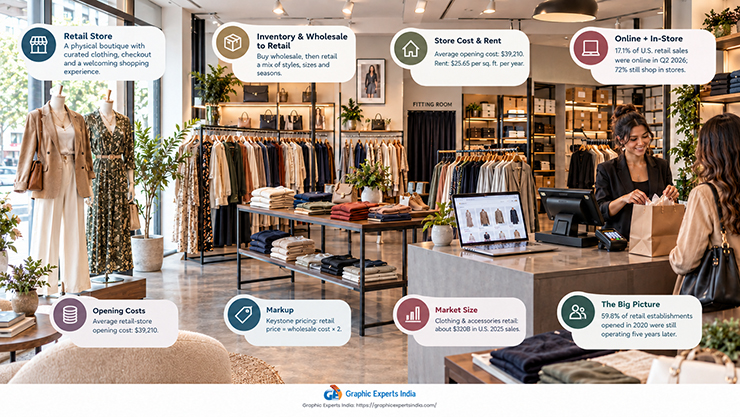
| Question | Short answer | Source |
|---|---|---|
| How large is US clothing retail? | Clothing and clothing accessories stores recorded roughly $320 billion in 2025 sales (sum of Census monthly estimates) | US Census Bureau, Monthly Retail Trade |
| What does it cost to open a store? | “The average cost of opening a retail store is $39,210” | Shopify, January 2026 |
| What does retail space rent for? | National shopping-centre asking rent $25.65 per square foot, vacancy 6.0% | Cushman & Wakefield, Q2 2026 |
| How do boutiques price? | Keystone pricing: retail price = wholesale cost × 2 | Shopify, September 2026 |
| Do new stores survive? | 59.8% of retail establishments opened in March 2020 were still operating five years later, against 51.4% across all industries | US Bureau of Labor Statistics, Business Employment Dynamics |
| How much sells online? | US e-commerce was 17.1% of retail sales in Q2 2026; 72% of consumers still shop in stores and 45% use AI during buying journeys | US Census Bureau, August 2026; IBM and NRF, January 2026 |
Should You Start a Clothing Brand or a Clothing Boutique?
A founder should start a clothing boutique when the advantage is curation, location and customer relationships, and a clothing brand when the advantage is an original product. A boutique buys finished garments from brands and wholesalers, marks them up and sells them; it carries inventory risk but no design, sampling or manufacturing cost.
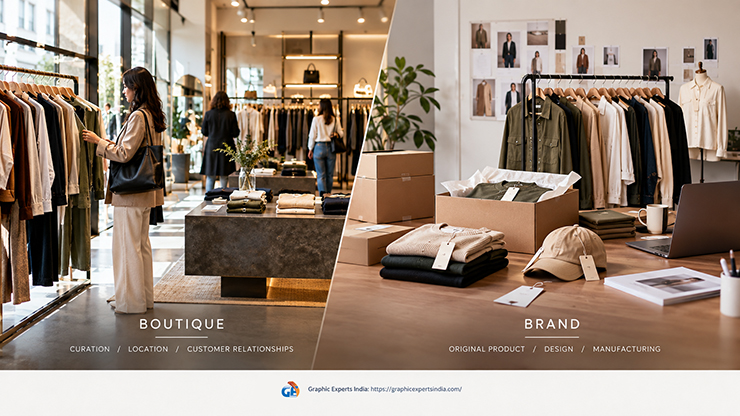
A brand designs and produces its own garments, with minimum order quantities of 50 to 500 units per style at US manufacturers (Maker’s Row, 9 May 2026) and a first collection budget of at least $12,000 for four styles (Sewport).
The two models also survive differently. Retail trade establishments opened in March 2020 had a 59.8% five-year survival rate, above the 51.4% rate for all private-sector establishments in the same cohort, according to the US Bureau of Labor Statistics’ Business Employment Dynamics data (Table 7, data through March 2025).
Many businesses combine the models over time: a boutique that develops a private-label line, or a brand that opens a store. This guide covers the boutique path; the brand path is the eleven-step roadmap linked above.
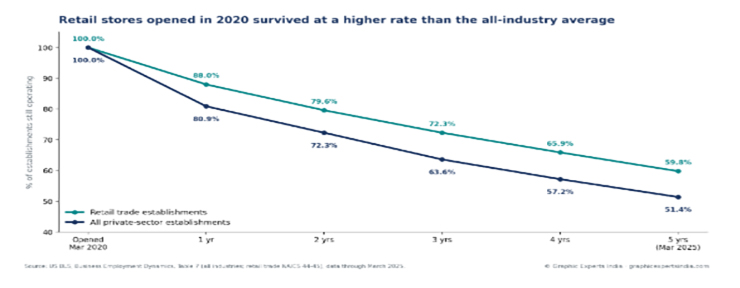
Figure 1. Survival of establishments opened in March 2020, retail trade versus all industries. Source: US Bureau of Labor Statistics, Business Employment Dynamics, Table 7.
How Do You Start a Clothing Business Step by Step?
To start a clothing business, follow the eight steps below in order. Each step names the decision and the published cost or rule attached to it.
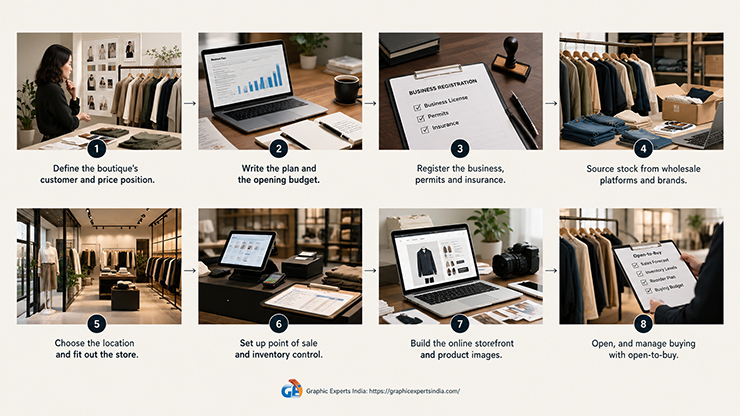
- Define the boutique’s customer and price position.
- Write the plan and the opening budget.
- Register the business, permits and insurance.
- Source stock from wholesale platforms and brands.
- Choose the location and fit out the store.
- Set up point of sale and inventory control.
- Build the online storefront and product images.
- Open, and manage buying with open-to-buy.
Step 1: Who Is the Boutique For?
A boutique is defined by the customer it curates for, stated as a person, a price band and an occasion. Unlike a brand, a boutique cannot differentiate on product, because every garment it carries is available to other retailers on the same wholesale platforms. The edit, the service and the location are the product.
A one-line positioning statement (“workwear and weekend pieces for women 30–50 in the $60–$180 range, in a walkable neighbourhood centre”) determines every buying and layout decision that follows.
Step 2: How Much Does It Cost to Open a Clothing Boutique?
Opening a clothing boutique costs about $40,000 on average, with a published range from $10,000 to more than $100,000 depending on location, size and opening inventory.
Shopify states that “the average cost of opening a retail store is $39,210” (8 January 2026) and, separately, that “studies estimate you’ll need an investment of around $40,000 to open a permanent store” (updated 16 December 2025). Lightspeed puts average retail start-up costs “around $48,000” (22 April 2025) and gives a boutique range of “$10,000 to $100,000 or more” (updated 11 July 2025).
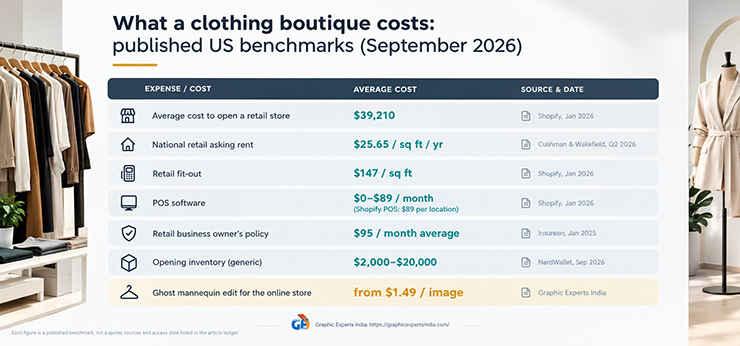
Figure 2. Published US benchmarks for a clothing boutique, September 2026. Each figure is a benchmark, not a quote.
The main line items of a clothing business budget have published benchmarks.
| Line item | Benchmark | Source |
|---|---|---|
| Rent | National shopping-centre asking rent $25.65 per square foot per year; vacancy 6.0% | Cushman & Wakefield, US Retail MarketBeat Q2 2026 |
| Fit-out | “The average fit-out cost for a retail store is $147 per square foot” | Shopify, January 2026 |
| Opening inventory | “$2,000 to $20,000” (generic small-business range) | NerdWallet, updated 8 September 2026 |
| Point of sale | “POS software ranges from $0 to $89 per month”; hardware setup “$0 and $2,000” | Shopify, January 2026 |
| Insurance | Retail general liability averages $42 per month; a retail business owner’s policy averages $95 per month | Insureon, January 2025 |
| Legal | LLC formation from $40 (Kentucky) to $500 (Massachusetts); trademark $350 per class | State fee schedules; USPTO |
| Cash reserve | “Budget 10% to 20% of their total estimated startup costs as a financial safety net” | NerdWallet, September 2026 |
A 1,000-square-foot boutique at the national asking rent pays $25,650 a year in base rent before common-area charges, which is why rent negotiation and store size are the two largest budget decisions.
The business-plan structure that lenders expect for a retail start-up is set out in the clothing brand business plan guide; the sections are the same for a boutique, with the collection plan replaced by an assortment and open-to-buy plan.
Step 3: What Permits, Registrations and Insurance Does a Clothing Store Need?
A US clothing store needs a registered business entity, a state sales-tax or seller’s permit, any local business licence, and liability insurance. The US Small Business Administration states that “the licenses and permits you need from the state, county, or city will depend on your business activities and business location” and that “you’ll have to research your own state, county, and city regulations” (updated 28 August 2026).
A seller’s permit is the document wholesale platforms ask for: California, for example, requires one for any business that intends “to sell or lease tangible personal property that would ordinarily be subject to sales tax if sold at retail,” at no fee (California Department of Tax and Fee Administration).
Entity and insurance costs are published. An LLC costs $40 to form in Kentucky and $500 in Massachusetts, which also charges a $500 annual report.
Retail stores pay an average of $42 per month for general liability insurance and $95 per month for a business owner’s policy, which bundles liability with property cover for stock and fixtures (Insureon, updated 3 January 2025). Register the seller’s permit before approaching wholesalers, because verification on the sourcing platforms in Step 4 depends on it.
Step 4: Where Does a Boutique Buy Its Clothes?
A boutique buys its clothes from wholesale marketplaces, brand showrooms and trade shows, and prices them at roughly twice wholesale. Three platform facts matter at the start.
- Faire offers retailers “net 60 payment terms,” so a store can “stock up on inventory now and pay up to 60 days later,” and “free returns on your first order with any new brand you try” (Faire Help Center). Minimums are set by each brand: “an order minimum specifies the minimum dollar amount a brand is willing to sell to a retailer,” and brands may set different minimums for first orders and reorders.
- FashionGo runs “a 2 step registration process that includes retailer verification”; full access requires “a valid official copy of Seller’s Permit,” except for retailers in the five states without sales tax (FashionGo Help Center).
- Keystone pricing is the default markup: “keystone pricing is a retail pricing strategy that sets a product’s retail price at two times its wholesale cost” (Shopify, 10 September 2026). A $30 wholesale dress retails at $60.
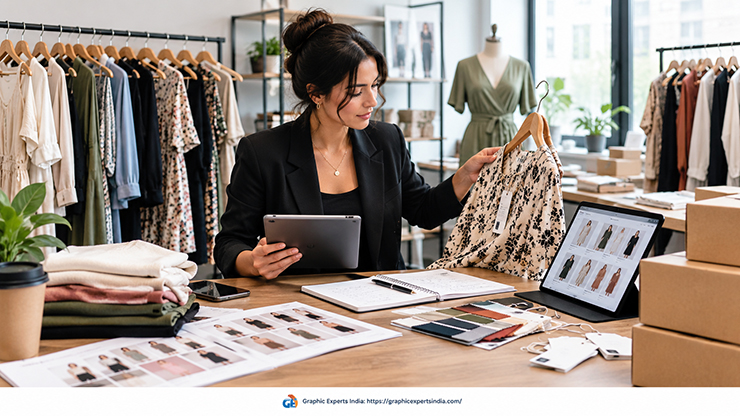
Wholesale marketplace Tundra shut down in 2023 and should not appear on a current sourcing list. Faire’s first-order return policy is the lowest-risk way to test a new brand: order the minimum, photograph it, sell it for 60 days and return what does not move.
Step 5: How Do You Choose a Location and Fit Out a Clothing Store?
To choose a boutique location, match the customer from Step 1 to the foot traffic of the centre or street, then size the store to the rent the plan can carry. National shopping-centre asking rent was $25.65 per square foot in the second quarter of 2026, up 2.2% year on year, with vacancy at 6.0%, according to Cushman & Wakefield’s US Retail MarketBeat (15 July 2026); local rents vary widely around that figure.
Fit-out averages “$147 per square foot” (Shopify, January 2026), and shelving runs “about $20–30 per linear foot” (Lightspeed, April 2025).
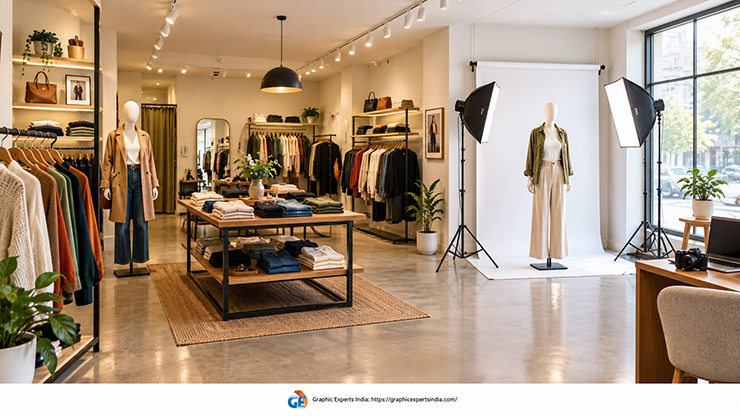
Plan a photography corner into the clothing business’s fit-out. A one-metre stretch of plain wall with a mannequin and a daylight window or two continuous lights is the entire studio a boutique needs for its online listings, and it costs less to build in than to rent later.
Step 6: Which Point of Sale and Inventory System Should a Boutique Use?
A boutique should choose a point-of-sale system that shares one inventory count between the shop floor and the online store. Two systems publish per-location pricing. Shopify POS Pro costs “$89 USD/month for each POS Pro location” on top of a Shopify plan (Basic $39 per month), with in-person card rates from 2.6% + 10¢ (shopify.com/pos/pricing).
Square offers a free plan and Square Plus at “$49/mo. per location” or Square Premium at “$149/mo. per location,” with in-person rates from 2.6% + 15¢ (squareup.com).
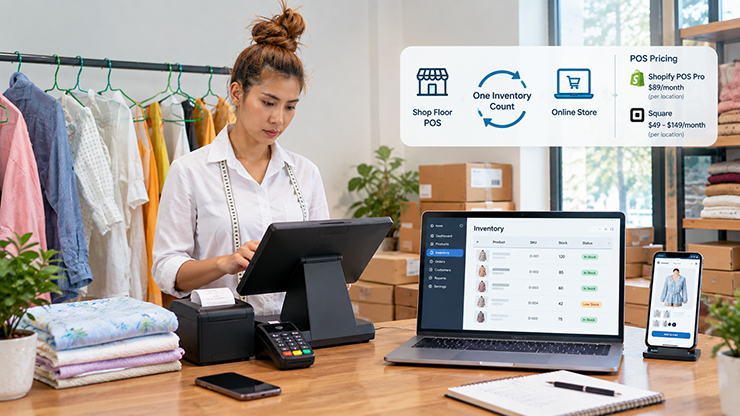
A clothing business’s inventory discipline is measured in turns. Publicly traded apparel retailers turned inventory 3.15 times on a trailing-twelve-month sales basis in the second quarter of 2026, according to CSIMarket, with the note that turnover had fallen “due to inventory build up.” Apparel companies hold inventory equal to 19.25% of sales in NYU Stern’s Damodaran working-capital dataset (January 2026).
A boutique that buys a season’s stock and sells it within the season sits near those figures; one that does not is financing dead stock.
Step 7: How Does a Boutique Build an Online Storefront That Sells?
A boutique builds an online storefront by listing the same inventory the shop holds, with product images edited to the platform’s specification, because shoppers research online before they visit and buy online when they cannot.
US e-commerce was 17.1% of retail sales in the second quarter of 2026 (US Census Bureau, 18 August 2026). In IBM’s study with the National Retail Federation of more than 18,000 consumers in 23 countries, “nearly three-quarters of surveyed consumers (72%) still shop in stores,” while “almost half (45%) turn to AI for help during their buying journeys,” including “using AI to research products (41%)” (7 January 2026).
A boutique with no product images online is invisible to both the search and the AI research that precede a store visit.
Product images are the storefront’s largest task and the one clothing businesses most often skip, because every SKU changes each season.
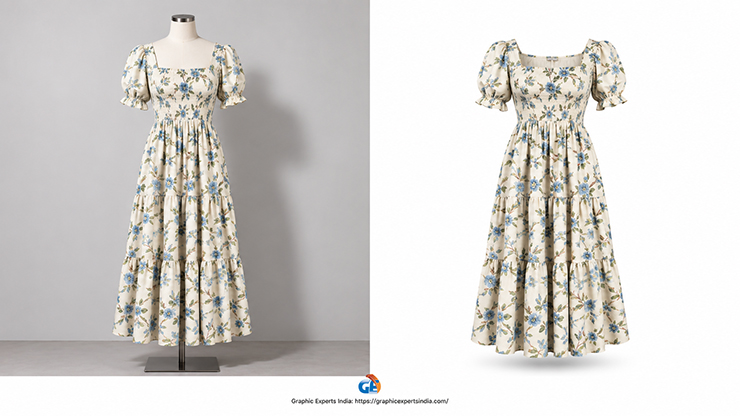
Published specifications set the standard: Shopify displays 2048 × 2048 pixel images best (Shopify Help Center); Google Merchant Center requires at least 500 × 500 pixels, recommends “around 1500×1500 pixels or above,” prohibits “watermarks, brand names, logos” and text overlays, advises “a solid white or transparent background,” and for apparel asks retailers to “provide images of products worn by people” (Google Merchant Center Help).
In Etsy’s buyer surveys, “90% of shoppers said the quality of the photos were ‘extremely important’ or ‘very important’ to a purchase decision” (Etsy Seller Handbook).
A clothing business’s photography workflow is repeatable. Shoot each new arrival on the shop mannequin in the photography corner from Step 5, then outsource the edit: ghost mannequin editing removes the mannequin and reconstructs the collar from $1.49 per image, and background removal to pure white starts at $0.39 per image at Graphic Experts India, each with a 24-hour average turnaround.
A studio product image from Squareshot costs from $50 per image by comparison. A week’s new arrivals, 30 pieces at two images each, is 60 images, or under $100 in editing. The mannequin shooting setup is in the ghost mannequin photography and editing guide.
Step 8: How Do You Manage Buying After Opening?
To manage buying after opening, plan purchases with an open-to-buy budget and track returns and sell-through by brand. Open-to-buy “calculates how much money or inventory a retailer has available to purchase new products after accounting for stock on hand and outstanding orders,” with the formula “OTB = (planned sales + planned markdowns + planned end-of-month inventory) − planned beginning-of-month inventory” (Shopify, updated 9 March 2026).
Returns must be planned too: retailers expected 15.8% of 2025 sales to be returned overall and 19.3% of online sales, according to the National Retail Federation and Happy Returns (15 October 2025). Online returns from a boutique’s own site fall when the product images match the garment; 28% of apparel returners said the “item didn’t look the way they thought it would” (PowerReviews, 2023).
What Mistakes Close New Clothing Stores?
New clothing businesses most often close on rent commitments made before demand is proven, over-buying the first season, and running without an online storefront. Each has a published counter-measure.
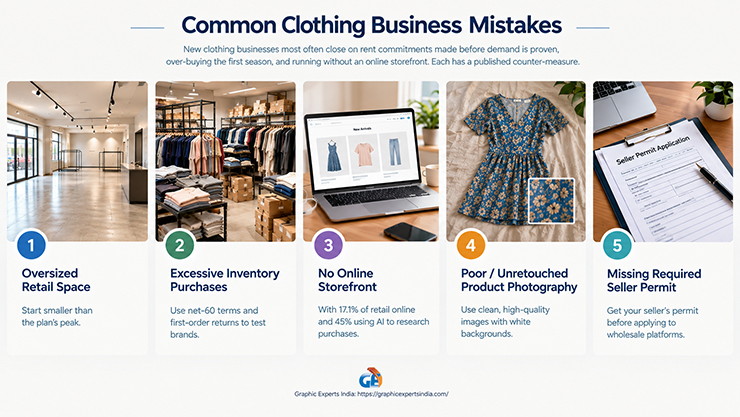
- Signing for too much space. At $25.65 per square foot, every 100 square feet costs $2,565 a year before fit-out at $147 per square foot. Start smaller than the plan’s peak.
- Over-buying. Use Faire’s net-60 terms and first-order returns to test brands, and hold inventory near the 19.25%-of-sales apparel benchmark.
- No online storefront. With 17.1% of retail online and 45% of consumers using AI to research purchases, an unlisted product does not exist to a growing share of the customer base.
- Unedited product images. Google Merchant Center rejects watermarked or text-overlaid images and recommends white backgrounds; 90% of Etsy shoppers rate photo quality as very or extremely important.
- Skipping the seller’s permit. Wholesale platforms verify it before granting full access.
What Do Founders Ask Most Often About Starting a Clothing Business?
A clothing boutique costs about $40,000 on average to open (“$39,210,” Shopify, January 2026), within a published range of $10,000 to more than $100,000 (Lightspeed). Starting a clothing brand rather than a store costs about $1,280 with print on demand or about $19,400 for a small cut-and-sew line.
Requirements depend on your state, county and city, according to the US Small Business Administration. Most clothing stores need a registered entity (LLC fees $40 to $500 by state), a state seller’s or sales-tax permit, which wholesale platforms such as FashionGo verify, and any local business licence.
Boutiques buy from wholesale marketplaces such as Faire, which offers net-60 payment terms and free returns on a first order with a new brand, from platforms such as FashionGo, which require a seller’s permit for full access, and from brand showrooms and trade shows. Retail price is typically twice wholesale.
Yes. An online-only clothing store needs a Shopify Basic plan from $29 per month billed annually, a seller’s permit, wholesale accounts and edited product images to platform specifications: 2048 × 2048 pixels on Shopify and at least 500 × 500 pixels, recommended 1500 × 1500, with a white or transparent background for Google Merchant Center.
Retail establishments opened in March 2020 had a 59.8% five-year survival rate (US Bureau of Labor Statistics). Profitability depends on keystone margins holding through markdowns, inventory turning near the 3.15 apparel-retail benchmark, and planned returns of 15.8% overall and 19.3% online (NRF, 2025).
Where Can a Clothing Boutique Get Its New Arrivals Photographed for the Online Store?
A clothing boutique can shoot new arrivals on its own mannequin and send the files to Graphic Experts India, which lists ghost mannequin editing from $1.49 per image, background removal from $0.39 per image and e-commerce retouching from $0.99 per image, each with a 24-hour average turnaround and a three-step quality check.
Graphic Experts India has provided Photoshop services since 2009 and edits to the Shopify, Amazon, eBay and Google Merchant Center specifications listed on its e-commerce product photo editing service page, where a free trial on sample images is returned within 24 hours with no credit card required.

Salim Ahmed is the CEO of Graphic Experts India, with over 25 years of expertise in photo editing, clipping path, image retouching, and eCommerce image editing services.