

To start a fitness clothing line, you choose a training niche, specify performance fabrics, find an activewear manufacturer whose minimum order you can fund, sample for fit under movement, label the garments to US textile rules, photograph them on a body in motion and launch to a fitness community.
A fitness clothing line, also called a gym clothing brand, activewear label or workout apparel line, is a clothing brand whose garments are engineered for stretch, moisture management and repeated washing.
This guide follows the general clothing-brand roadmap and changes the six steps that activewear changes: fabric, manufacturing minimums, fit testing, compliance, photography and marketing. The full eleven-step sequence is in the guide on how to start a clothing brand.
What Does Starting a Fitness Clothing Line Involve at a Glance?
Starting a fitness clothing line involves higher minimum order quantities, longer development timelines and a stricter photography brief than a basic tee brand, in exchange for a market growing at high single digits.
| Question | Short answer | Source |
|---|---|---|
| How big is the market? | Global activewear was valued at US$440.4 billion in 2025, projected to reach US$920.0 billion by 2033 at a 9.0% compound annual rate | Grand View Research, June 2026 |
| How fast is sportswear growing? | The global sportswear market is projected to grow from US$335 billion (2024) to US$460 billion (2029), about 6% a year | McKinsey & Company and WFSGI, Sporting Goods 2025, January 2025 |
| What is the minimum order? | Overseas factories commonly quote 100 to 1,000 pieces per style per colorway; one manufacturer cites 200–300 pieces per color for a standard yoga set and 500+ for seamless | Gembah, September 2026; CozyActive, March 2026 |
| How long does development take? | Five to eight months overseas for a straightforward style; eight to twelve for technical compression pieces | Gembah, September 2026 |
| Why do activewear buyers return? | Across apparel, 39% return for sizing and 28% because the item “didn’t look the way they thought it would” | PowerReviews, June 2023 survey of 25,452 US consumers |
| How must it be photographed on Amazon? | Adult apparel on-model; sports bras and leggings listed as on-model categories; pure white background; at least 1,600 px high | Amazon Clothing & Accessories imaging guidelines, Spring 2021 |
Why Start a Fitness Clothing Line in 2026?
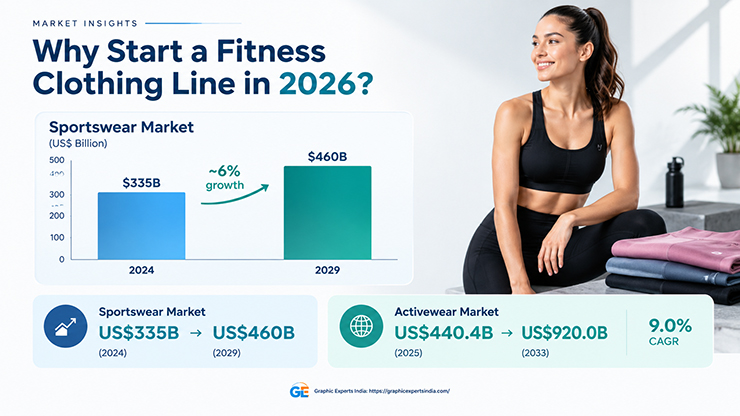
A fitness clothing line is worth starting in 2026 because activewear is growing faster than apparel overall and because large incumbents have been losing share to challenger brands.
The global activewear market was valued at US$440.4 billion in 2025 and is projected to reach US$920.0 billion by 2033, a 9.0% compound annual growth rate, with North America holding 38.1% of 2025 revenue, according to Grand View Research (June 2026). Women’s activewear is projected to grow at 9.6% a year over the same period in the same report.
McKinsey & Company and the World Federation of the Sporting Goods Industry put the global sportswear market at US$335 billion in 2024, rising to US$460 billion in 2029, growth of “about 6 percent a year,” in Sporting Goods 2025: The new balancing act (January 2025).
The same report found that large incumbents “ceded three percentage points of market share,” from 76% to about 73%, to challenger brands between 2019 and 2024. Consequently, a new gym clothing brand enters a category where the share of smaller brands is rising rather than shrinking.
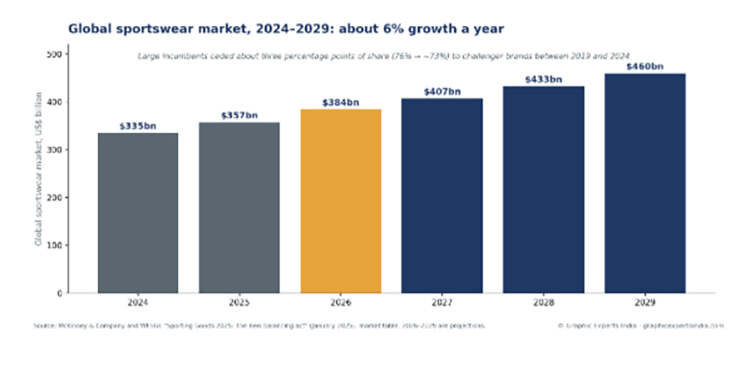
Figure 1. Global sportswear market, 2024–2029, from the McKinsey & Company and WFSGI Sporting Goods 2025 report (January 2025). 2026–2029 are projections.
The best-known challenger illustrates the model. Gymshark was “set up in 2012 by Ben Francis when he was 19, in his parents’ garage, having been taught to sew by his Mom,” according to General Atlantic’s announcement of its 2020 investment, which valued the company at “over £1 billion” (14 August 2020). Gymshark’s own account states that Francis “began sewing, screen-printing and delivering all Gymshark product himself. By hand.”
(The Official Gymshark Story, 6 April 2023). For the year to 31 July 2025, Gymshark reported revenue of £646 million and a 62.3% gross margin, as reported by TheIndustry.fashion (12 March 2026). The garage start is real; so is the thirteen-year climb behind the number.
How Do You Start a Fitness Clothing Line Step by Step?
To start a fitness clothing line, follow the general eleven-step clothing-brand roadmap and apply the six activewear-specific changes below at the steps where they occur.
- Choose a training niche and hero garment (roadmap Step 1).
- Specify performance fabric and construction (roadmap Step 5).
- Find an activewear manufacturer and fund the minimum order (roadmap Step 6).
- Sample and fit-test under movement (roadmap Step 7).
- Label and test for US compliance (roadmap Step 10).
- Photograph on-model and color-match every colorway (roadmap Step 8).
- Launch through fitness creators and communities (roadmap Step 11).
Step 1: Which Niche Should a Fitness Clothing Line Choose?
A fitness clothing line should choose one training discipline and one hero garment before designing a range, because fabric, fit and photography differ by discipline.
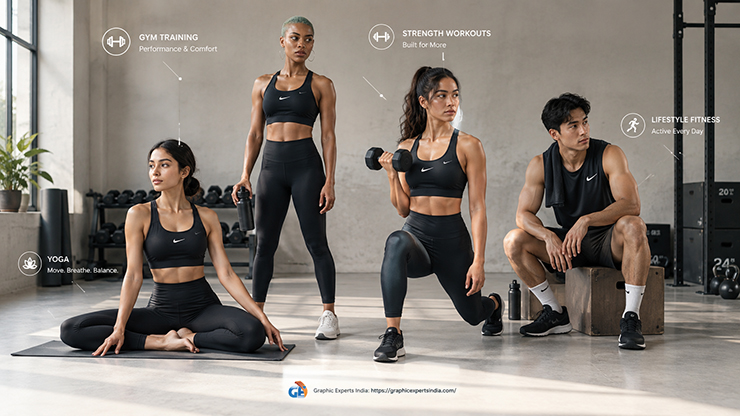
Lifting, running, yoga, cycling and team sport each impose different stretch, compression and coverage requirements, and a legging engineered for squats is not the legging a runner wants. A hero garment (one legging, one sports bra or one training short) concentrates the first production run, which matters when minimums are counted per colorway.
Women’s activewear is the faster-growing half of the market at a projected 9.6% compound annual rate to 2033 (Grand View Research, June 2026), and Gymshark’s first breakout product was a fitted men’s tracksuit, the Luxe, which “finally debuted at BodyPower 2013” after months of hand-made production (Gymshark, April 2023). Either path works; what does not work is a first collection that covers every discipline and every body.
Step 2: Which Fabrics Does a Gym Clothing Brand Need?
A gym clothing brand needs fabrics that stretch in four directions, move sweat away from the skin and hold their shape and color through repeated washing. Three fabric terms recur in every tech pack.
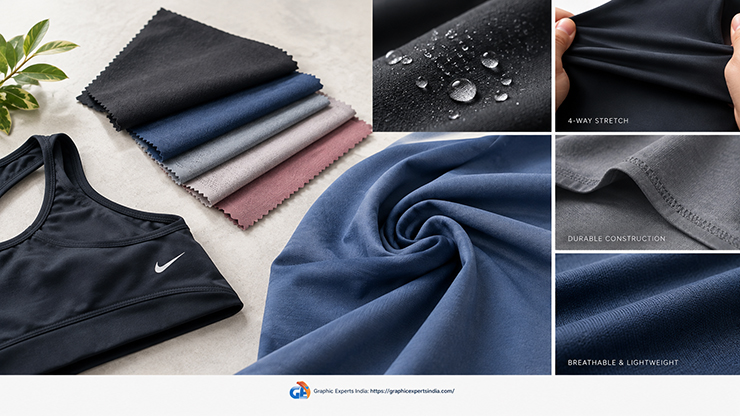
- Four-way stretch. A four-way stretch fabric “stretches in both directions – horizontally and vertically,” while a two-way stretch fabric “stretches in only one direction,” according to fabric supplier Spandex By Yard (26 November 2025). Four-way stretch comes from elastane (spandex) content: Gembah’s activewear manufacturing guide states that spandex content “typically runs 3 to 20 percent,” with 15 to 20 percent for real compression (3 September 2026).
- Moisture wicking. Wicking is “a mechanical process that depends on construction of the fabric,” in which a knit “actively pulls sweat away from the skin to the outer fabric surface, where it evaporates quickly,” as fabric maker Polartec describes its Power Dry base-layer fabric.
- Fibre blend. Nylon–spandex and polyester–spandex knits dominate; an 80% nylon, 20% spandex blend is a common swim and activewear construction “the nylon gives durability and water resistance, the spandex gives 4-way stretch” (Spandex By Yard). Small-quantity nylon–spandex tricot retails from about $5.00 per yard at the same supplier.
Fabric choice sets the photography brief. Matte compression knits, sheen finishes and heathered polyester each reflect light differently, and opacity under stretch is a claim shoppers test in the product images, which is why Step 6 calls for a movement shot and a fabric close-up.
Step 3: How Do You Find an Activewear Manufacturer and Meet the Minimum Order?
To find an activewear manufacturer, shortlist factories that already produce the hero garment’s construction, then compare their minimum order quantity per colorway against the launch budget. Activewear minimums run higher than basic apparel because performance fabrics are dyed and knitted in batches. Overseas factories “commonly quote 100 to 1,000 pieces per style per colorway,” according to Gembah (September 2026).
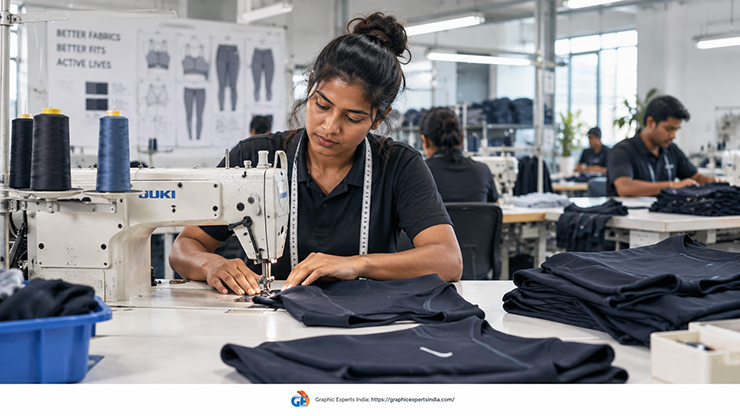
One activewear manufacturer, CozyActive, publishes examples of “200-300 pieces per color” for a standard yoga set and “500+ pieces per color” for seamless activewear, with higher minimums for custom-dyed fabric (24 March 2026). Sewport’s general guidance is that minimums range from 50 units “all the way into the 1000’s.”
Timelines are long. Gembah advises founders to “plan on five to eight months overseas for a straightforward style and eight to twelve months for technical compression pieces with custom fabric development.” Sewport prices a small four-piece line at “at least $12,000,” with tech packs at “$200–$300” per garment.
A founder who cannot fund 200 units per colorway should launch with one colorway per style, or use a private-label activewear supplier’s existing fabric to avoid dye minimums. The line-by-line launch budget, including the cut-and-sew scenario, is in the guide to how much it costs to start a clothing brand.
Step 4: How Do You Sample and Fit-Test Activewear?
To sample activewear, order a pre-production sample per style and test it on bodies in motion, not on a mannequin. Fit is the dominant reason apparel comes back: “nearly four in 10 (39%) consumers return apparel because they don’t like the way it fits,” and “28% do so because the item didn’t look the way they thought it would,” according to PowerReviews’ Apparel Shopping Trends survey of 25,452 US consumers (June 2023).
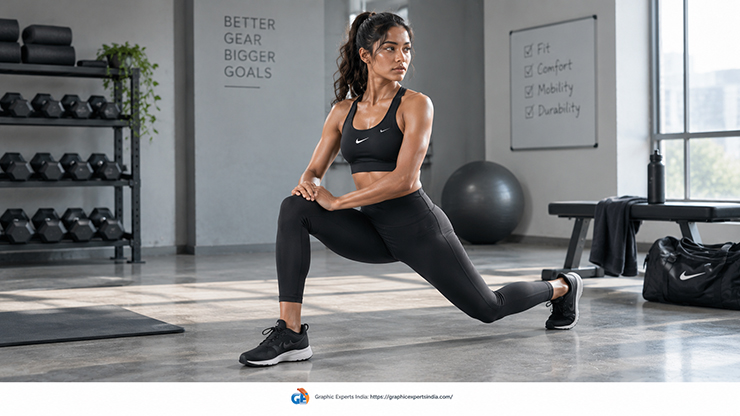
For activewear, the fit test must include squat depth, overhead reach, opacity under stretch, waistband roll and seam comfort after a full session. Samples cost “$50–$150” from Asian factories and “$200–$300” from US factories per Sewport; two rounds should be budgeted for a compression garment.
Record the fit findings as size-chart data. A published size chart with body measurements per size, plus on-model images that state the model’s height and the size worn, addresses the two largest return reasons at the product-page level.
Step 5: What Compliance Does a US Fitness Clothing Line Need?
A US fitness clothing line must label fibre content, care instructions, country of origin and manufacturer identity, and must meet the general apparel flammability standard. Three federal rules apply.
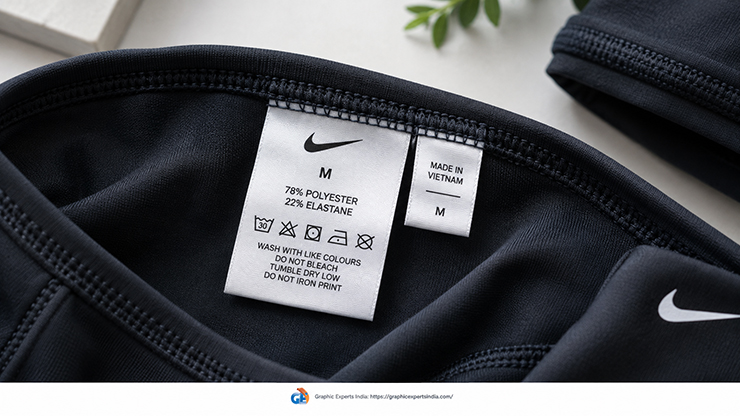
- Fibre content. The Textile Fiber Products Identification Act requires “mandatory content disclosure in the labeling, invoicing, and advertising of textile fiber products” (Federal Trade Commission). The FTC’s labelling guide requires “the generic fiber names and percentages by weight of each constituent fiber” in “descending order of predominance,” country of origin, and the manufacturer’s name or registered identification number, with a 3% tolerance on stated percentages.
- Care labelling. The FTC Care Labeling Rule (16 CFR Part 423) requires manufacturers and importers to provide “regular instructions to purchasers through care labels or other methods.”
- Flammability. The Consumer Product Safety Commission’s general wearing apparel standard (16 CFR Part 1610) “provides methods of testing the flammability of clothing and textiles intended to be used for clothing.” The regulation exempts fabrics made entirely from acrylic, modacrylic, nylon, olefin, polyester or wool, and plain-surface fabrics of 2.6 ounces per square yard or more; spandex is not on the exempt-fibre list, so a nylon–spandex blend does not automatically qualify for the fibre exemption and should be reviewed against the weight exemption or tested. Confirm the current rule text with the CPSC before the first production run.
Sustainability claims carry their own standards. OEKO-TEX Standard 100 is “a label for textiles tested for harmful substances” against “a list of over 1,000 harmful substances”; the Global Recycled Standard permits a consumer-facing logo only on products with at least 50% recycled content (Textile Exchange); bluesign’s certification mark is transitioning to the “bluepass” name by the end of 2027 (bluesign FAQ). A brand should only print a certification it holds.
Step 6: How Do You Photograph Activewear So It Sells?
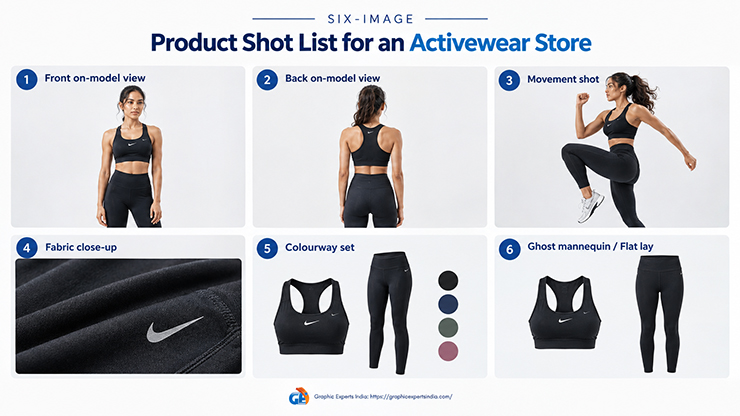
To photograph activewear so it sells, shoot every style on a body in motion, add a fabric close-up, and color-match every colorway to its reference in editing. Activewear is bought on fit, stretch and color, and each is judged from the images.
Amazon’s Clothing & Accessories imaging guidelines (Spring 2021 edition) require that “all adult apparel should be imaged on-model,” list sports bras and leggings among on-model categories, and add an athletic-specific note: “if the back detail of an athletic clothing product is a key selling feature, it is recommended to use the back detail as the Main image, rather than the front shot.” Main images need “a pure white background (RGB Value 255, HEX Value #FFFFFF)” and “at least 1,600 pixels in height.”
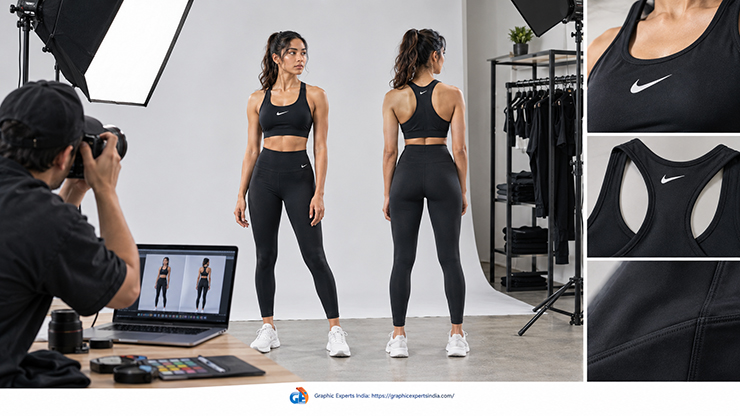
Figure 2. The six-image shot list for an activewear product page and what each image has to prove.
Published costs frame the shoot. Squareshot lists on-model images from $95 per image or $2,950 for a four-hour shoot, and product images from $50 per image (accessed 18 September 2026). Fitness-model day rates of $300 to $1,200 are cited by The Model Guide (5 March 2026) as an industry estimate.
A brand that runs its own shoot with a model from its training community and outsources the editing pays from $0.99 per image for e-commerce retouching and from $0.39 per image for background removal at Graphic Experts India; fabric and skin retouching for activewear is the “Model Skin” and “Fashion & Beauty” tier on the photo retouching services page.
Color accuracy is the activewear-specific edit. Activewear brands specify colors in the Pantone Fashion, Home + Interiors system, whose cotton (TCX) references cover 2,800 colors (Pantone). Studio lighting shifts saturated performance colors, and a legging that ships in a different teal from the one in the listing produces the “didn’t look the way they thought it would” return.
Color matching each colorway to its Pantone or approved-sample reference is listed from $0.99 per image on Graphic Experts India’s color correction service; the general technique is covered in the guide to how to color correct in Photoshop.
Step 7: How Do You Launch a Gym Clothing Brand?
To launch a gym clothing brand, seed the hero garment with creators inside the training niche and measure customer acquisition cost against gross profit per order.
Creator marketing is the dominant activewear launch channel and the benchmarks are published: in Influencer Marketing Hub’s Benchmark Report 2026 (4 May 2026, 600-plus respondents), 72.2% of marketers expected influencer budgets to increase by 50% or more, 65.9% expected payback within one month, and 31% included TikTok in their plans, more than double the share naming Instagram.
Nano and micro creators showed the strongest expansion intent, at 51.43% and 52.83% respectively. None of those figures is fitness-specific; treat them as an industry survey.
The acquisition maths is the same as for any clothing brand. Fashion and apparel e-commerce companies averaged a $66 customer acquisition cost between 2020 and 2025 (First Page Sage, updated 15 August 2025), and fashion stores converted 1.81% of visits in July 2026 (IRP Commerce).
A gym clothing brand recovers acquisition cost on repeat purchases across a discipline’s training year, which is why the niche in Step 1 and the fit work in Step 4 decide the outcome. Creator content should reuse the on-model shoot from Step 6; the fashion photography tips for beginners guide covers directing movement on set.
How Much Does It Cost to Start a Fitness Clothing Line?
Starting a fitness clothing line costs more than the $19,400 small cut-and-sew budget in the clothing-brand cost guide, because activewear minimums start at 100 to 300 pieces per colorway rather than 50, and technical fabrics add development rounds.
Using the published inputs above, a single-style, single-colorway launch of 200 leggings needs the fabric, a two-round sample budget ($100 to $600 per Sewport’s ranges), a tech pack ($200 to $300), the compliance labels and an on-model shoot; at Squareshot’s $2,950 four-hour rate or a community-model shoot with outsourced editing under $100 for 60 images.
The exact unit cost depends on the factory quote, which no public source states for a specific legging; obtain three quotes before setting a retail price, and target the 56.88% apparel-industry gross margin reported by NYU Stern’s Damodaran dataset (January 2026) at minimum, since activewear returns for fit are expensive to absorb.
What Do Founders Ask Most Often About Starting a Fitness Clothing Line?
A fitness clothing line costs more than a basic four-style cut-and-sew launch (about $19,400 in published-price budgets) because activewear factories commonly require 100 to 1,000 pieces per style per colorway and technical fabrics need extra sampling rounds at $50 to $300 per sample. Obtain three factory quotes for the hero garment before budgeting.
Gym clothes use nylon–spandex or polyester–spandex knits with four-way stretch and moisture-wicking construction. Spandex content typically runs 3 to 20 percent, with 15 to 20 percent for compression (Gembah, September 2026). An 80% nylon, 20% spandex blend is a common activewear and swim construction.
Overseas activewear factories commonly quote 100 to 1,000 pieces per style per colorway (Gembah, September 2026); one manufacturer cites 200–300 pieces per color for a standard yoga set and 500 or more for seamless garments (CozyActive, March 2026). Custom-dyed fabric raises the minimum further.
Gymshark was set up in 2012 by Ben Francis, then 19, in his parents’ garage in the UK; he sewed, screen-printed and delivered the first products himself. General Atlantic valued the company at over £1 billion in August 2020, and Gymshark reported £646 million in revenue for the year to 31 July 2025.
For adult activewear sold on Amazon, yes: Amazon’s Clothing & Accessories guidelines require adult apparel on-model, and list sports bras and leggings as on-model categories. Studio on-model images start at $95 per image; a self-run shoot with outsourced retouching from $0.99 per image is the lower-cost route.
Where Can a Fitness Clothing Line Get Its Product Photos Retouched and Color-Matched?
A fitness clothing line can outsource on-model retouching and colorway matching to Graphic Experts India, which lists e-commerce retouching from $0.99 per image, color correction and Pantone matching from $0.99 per image, background removal from $0.39 per image and ghost mannequin editing from $1.49 per image, each with a 24-hour average turnaround and a three-step quality check.
Send the raw files from the fit-test shoot as a free trial through the color correction services page and receive marketplace-ready, color-matched images within 24 hours, with no credit card required.

Salim Ahmed is the CEO of Graphic Experts India, with over 25 years of expertise in photo editing, clipping path, image retouching, and eCommerce image editing services.