

To write a product description for an online clothing store, state what the garment is in the first line, then give the fabric, the fit, the care and the size data in that order, and leave to the photographs what a photograph shows better than a sentence.
A product description for an online clothing store is the text on a product page that tells a shopper what a garment is made of, how it fits, how to care for it and which size to choose. Its job is to let the shopper buy without touching the garment.
This guide covers the seven-part structure, a template for each garment type, the title and description limits on Shopify, Etsy, Amazon and Google, the structured-data rules for product pages, and a pairing table that assigns each description element to the photograph that must show it, using sources read on 7 October 2026.
It is the copywriting child of the guide on how to start an online clothing store.
What Does Writing a Clothing Product Description Involve at a Glance?
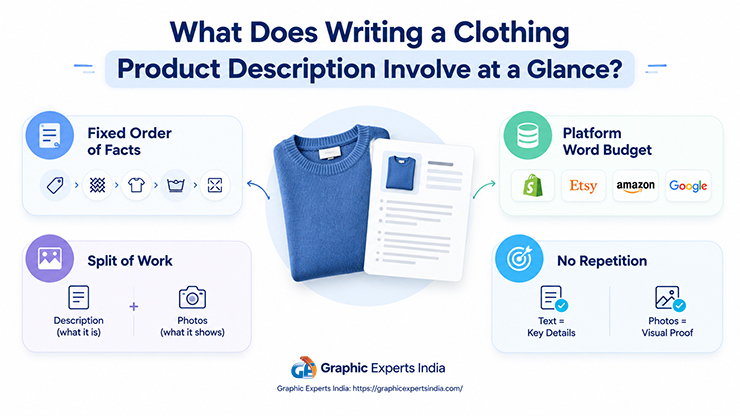
Writing a clothing product description involves a fixed order of facts, a word budget set by the platform, and a split of work between the description and the photographs, so that neither repeats the other.
| Question | Short answer | Source |
|---|---|---|
| What must the description contain? | Name, hook, fabric with fibre percentages, fit and measurements, care, size guidance, keywords | FTC Textile Rules; Shopify Help; Etsy Help |
| Why does it matter? | 39% of apparel returns are for fit and 28% because the item “didn’t look the way they thought it would” | PowerReviews, June 2023, n = 25,452 |
| Do shoppers read it? | “Many users were observed to simply skip or skim quickly over product descriptions”; 52% of sites add no descriptive text to product photos | Baymard Institute, 28 November 2018 |
| How long can a title be? | Amazon 75 characters (from 27 July 2026); Etsy 140; Google Merchant Center 150, about 70 visible | Amazon Seller Forums; Etsy Help; Google Help |
| How long can a description be? | Google Merchant Center 5,000 characters, key details in the first 160–500; Shopify search listing cut after 320 | Google Help; Shopify Help |
| What does Google’s product markup require? | name, image, offers with price and priceCurrency; description “strongly recommended” | Google Search Central |
Why Do Product Descriptions Matter for an Online Clothing Store?
Product descriptions matter for an online clothing store because the two largest reasons shoppers return clothing are both information failures. PowerReviews surveyed 25,452 US consumers in June 2023. In that survey, “nearly four in 10 (39%) consumers return apparel because they don’t like the way it fits.” A further “28% do so because the item didn’t look the way they thought it would.”
The National Retail Federation and Happy Returns estimated that “19.3% of online sales will be returned in 2025” (15 October 2025). Salsify’s October 2024 survey of 1,910 US and UK shoppers found that “71% returned items over inaccurate descriptions” and “54% dropped purchases due to conflicting information” (press release, 23 January 2025).
The description also has a reading problem. Baymard Institute reported that “many users were observed to simply skip or skim quickly over product descriptions, even when a question they had would have been answered by the description” (28 November 2018). The same research found that 56% of users’ first action on a product page was to explore the photographs.
Jakob Nielsen’s web-reading study found that “79 percent of our test users always scanned any new page they came across; only 16 percent read word-by-word” (Nielsen Norman Group, 30 September 1997). Consequently, a clothing description is written for a scanner who has already looked at the photographs, and each fact has to be findable in a second.
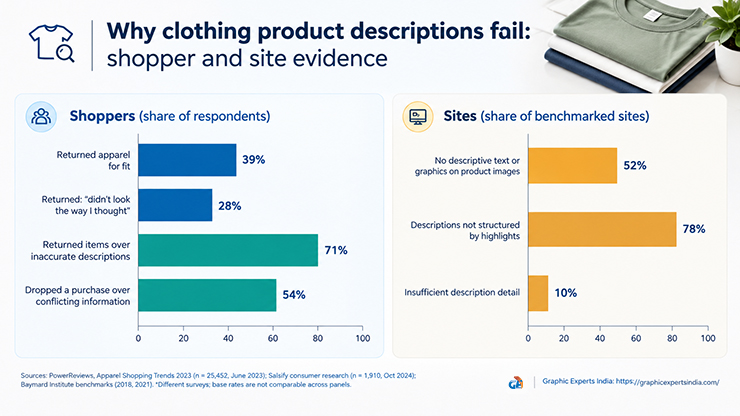
Figure 1. Why clothing listings fail shoppers. Shopper figures from PowerReviews (June 2023, n = 25,452) and Salsify (October 2024, n = 1,910); site figures from Baymard Institute benchmarks (2018 and 2021).
On the site side, Baymard found that “52% of sites don’t use descriptive text or graphics for their top-selling products” (28 November 2018) and that only 22% structure descriptions by feature highlights (24 April 2018). As a result, a store that writes scannable descriptions and pairs them with annotated photographs is ahead of roughly half the sites Baymard tested.
What Should a Product Description for Clothing Contain?
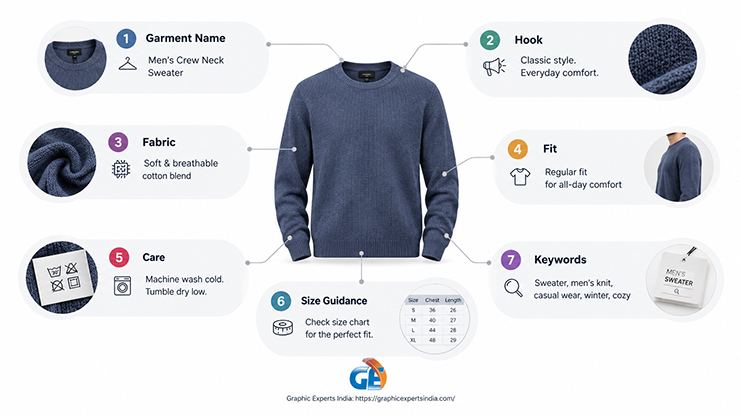
A product description for clothing should contain seven elements in a fixed order: the garment name, a one-line hook, the fabric, the fit, the care instructions, the size guidance and the search keywords.
Shopify’s help documentation states that “a product description explains what a product is and why it’s worth purchasing,” and lists “product specifications such as size, material, weight,” “suggested uses,” “benefits of the product, including evidence” and “engaging details” as content to consider (read 7 October 2026).
Etsy gives the order: “put essential information at the top, such as sizes, dimensions, colors, or ordering directions” (Etsy Seller Handbook, 26 August 2025).
| # | Element | What it states | Rule or source |
|---|---|---|---|
| 1 | Garment name | Brand, gender, garment type, defining attribute, color | Google Merchant Center example: “Sleeveless Polka Dot Skater Dress, Small, Black” |
| 2 | Hook | One sentence on the occasion or the problem the garment solves | Nielsen: “the inverted pyramid style, starting with the conclusion” |
| 3 | Fabric | Generic fibre names with percentages by weight, weight in gsm or oz, stretch, origin | FTC: fibres listed “in descending order of predominance” |
| 4 | Fit | Cut, rise or length, flat measurements, model’s height and size worn | PowerReviews: 39% of returns are fit |
| 5 | Care | Wash, bleach, dry, iron, warnings | FTC Care Labeling Rule: the five label elements |
| 6 | Size guidance | Body measurements per size; “runs small” or “true to size” | Etsy: “put essential information at the top, such as sizes, dimensions, colors, or ordering directions” |
| 7 | Keywords | The phrase a shopper types, once in the name and once in the first lines | Shopify: “readable, unique phrases that include some of your keywords” |
Two of the seven elements are regulated in the United States, which is why they belong in the description and not only on the sewn-in label.
The Federal Trade Commission’s textile rules require labels to carry “the fiber content, country of origin and identity of the manufacturer.” Fibre percentages by weight are listed “in descending order of predominance.” If “a written ad for a textile product makes any statement about a fiber,” the label’s fibre content “must appear in the ad, minus the percentages.”
Catalogue and internet descriptions “must include a clear and conspicuous statement that the item was either ‘made in U.S.A.,’ ‘imported’ or ‘made in U.S.A. and [or] imported’” (FTC, Textile and Wool Acts guidance, last modified 10 April 2026).
The Care Labeling Rule “requires manufacturers and importers to attach care instructions to clothing and some piece goods,” covering washing, bleaching, drying, ironing and warnings (FTC). Therefore a description that says “soft cotton blend” without fibre names, or omits the origin statement, is a compliance gap as well as a copy gap.
How Do You Write a Clothing Description Step by Step?
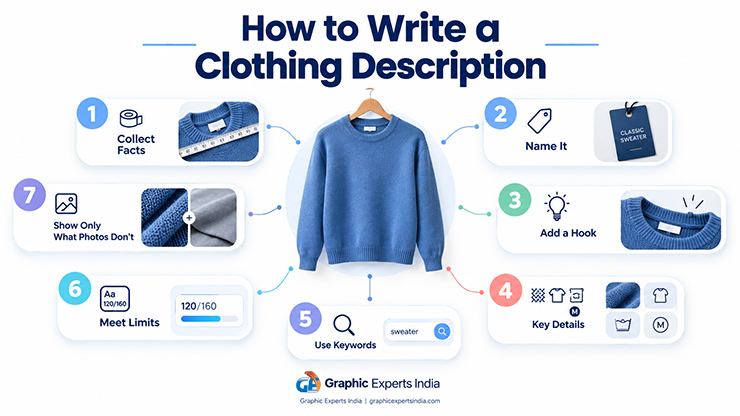
To write a clothing description, collect the facts from the garment and its label, draft the seven elements in order, cut to the platform’s limits, and delete every sentence a photograph already answers.
- Collect the facts. Read the sewn-in label for fibre percentages, origin and care. Measure the garment flat: chest, length, sleeve, waist, rise, inseam or hem, as the type requires. Record the model’s height and the size worn.
- Write the name line. Follow the Google Merchant Center pattern of product type plus attributes, kept consistent across variants, as in its example “Sleeveless Polka Dot Skater Dress, Small, Black.” Google adds: “Don’t use capital letters for emphasis. Capitalized text is common in spam and untrustworthy ads.”
- Write one hook sentence. Name the occasion or the problem the garment solves. Etsy tells sellers to “avoid repetition as well as subjective words (for example, ‘perfect’),” so the hook names a use, not a feeling.
- Write fabric, fit, care and size as separate short lines. Nielsen’s rules for scanned pages are “bulleted lists,” “one idea per paragraph” and “half the word count (or less) than conventional writing.”
- Place the keyword once in the name and once in the first two sentences. Etsy states that its search “considers keywords and phrases within your listing descriptions” (26 August 2025). Google Merchant Center asks for the key details “in the first 160 – 500 characters.”
- Cut to the platform budget. The limits are in the platform table below. Write the first 70 characters of the name and the first 160 characters of the description once, because every platform in the table shows at least that much.
- Delete what the photographs answer. Run the pairing table in the imagery section. A sentence about the sheen of the fabric is replaced by a detail shot; a sentence about the drape is replaced by an on-model shot. What remains is what a camera cannot capture: fibre percentage, weight, care, measurements and origin.
Which Fashion Product Description Template Fits Each Garment?
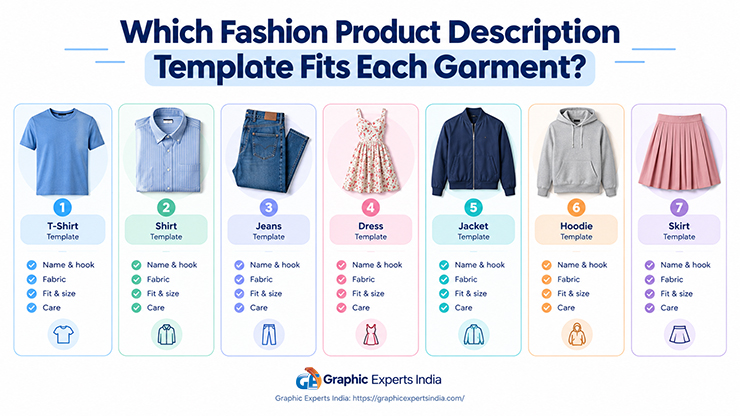
A fashion product description template changes by garment because each type has a different fit variable and a different fabric question. A tee is about weight and shrinkage, a dress about length and lining, jeans about rise and stretch, outerwear about insulation and layering room, and activewear about stretch and opacity.
The table gives the fill-in line for each element, with the variable in brackets.
| Element | T-shirt | Dress | Jeans | Outerwear | Activewear |
|---|---|---|---|---|---|
| Name line | [Brand] [Gender] [Weight] Cotton Crew-Neck T-Shirt, [Color] | [Brand] [Sleeve] [Fabric] [Length] Dress, [Color] | [Brand] [Fit] [Rise] Jeans, [Wash] | [Brand] [Insulation] [Length] [Parka/Puffer/Trench], [Color] | [Brand] [Fabric] [Rise] [Leggings/Shorts/Bra], [Color] |
| Hook | Built for [daily wear / layering / printing] | Cut for [occasion] with [one defining detail] | A [fit] jean that holds its shape | Rated for [season]; sized to layer over [garment] | Made for [activity] with [one tested feature] |
| Fabric line | [100% ring-spun cotton], [180 gsm], [pre-shrunk] | [fibre %], [lined / unlined], [sheer / opaque], [stretch] | [98% cotton, 2% elastane], [12 oz], [rigid / stretch] | Shell [fibre %]; insulation [type, fill weight]; lining [fibre %] | [fibre %], [weight], [four-way stretch], [opaque] |
| Fit line | [Regular / slim / oversized]; chest and length flat in size M; model [height], wears [size] | Length from shoulder [cm]; waist position; model [height], wears [size] | Rise, inseam and leg opening [cm]; [true to size / size down] | Shoulder, sleeve, length [cm]; fits over a [hoodie / blazer] | Rise and inseam [cm]; compression level; model [height], wears [size] |
| Care line | Machine wash cold, tumble dry low, do not bleach | [Dry clean / hand wash cold], line dry, cool iron | Wash inside out cold, line dry | Spot clean or [wash cold, gentle]; [tumble dry low] for down | Machine wash cold, no softener, line dry |
| Size guidance | Body chart; [true to size / size up for oversized] | Bust, waist, hip per size; [petite / tall] | Waist and hip per size; label-true note | Chest per size over a mid-layer | Waist and hip per size; [size down for compression] |
| Keyword pattern | [weight] cotton t-shirt [gender] | [fabric] [length] dress | [fit] [rise] jeans | [type] [season] jacket | [activity] leggings [feature] |
The template carries variables, not sentences. Two listings built on it share the order of facts and nothing else. Shopify advises merchants to “avoid directly copying text that’s provided to you by a manufacturer because that description might already be used by other websites” (read 7 October 2026).
What Do Good Clothing Product Description Examples Look Like?
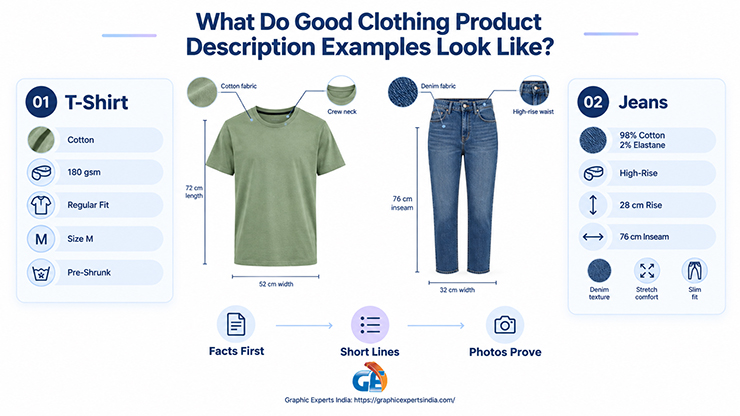
Good clothing product description examples lead with the garment, carry the measurable facts in short lines, and leave the sensory claims to the photographs. The two examples follow the template; brand, fabric and measurements are placeholders.
Example 1, a t-shirt. [Brand] Women’s Midweight Cotton Crew-Neck T-Shirt, Sage. A plain tee cut to layer under a shirt or wear alone. Fabric: 100% combed ring-spun cotton, 180 gsm, pre-shrunk. Fit: regular; chest 48 cm and length 64 cm measured flat in size M; the model is 173 cm and wears size S. Care: machine wash cold, tumble dry low, do not bleach. Sizing: true to size; see the body-measurement chart. Imported.
Example 2, jeans. [Brand] Slim High-Rise Jeans, Mid Indigo. A slim jean with a 28 cm rise and a 76 cm inseam that sits at the natural waist. Fabric: 98% cotton, 2% elastane, 11 oz stretch denim.
Fit: slim through the thigh with a 34 cm leg opening in size 28; the model is 178 cm and wears size 27. Care: wash inside out in cold water, line dry. Sizing: true to the label waist; between sizes, take the smaller. Made in U.S.A. and imported.
Both descriptions would be cut differently for Amazon and Etsy, and both assume photographs that show the color, the drape and the construction. The way large retailers lay out the same facts, with fit tools, visible return policies and size buttons, is documented in the guide on how top brands build product pages.
Which Image Must Show Each Description Element?
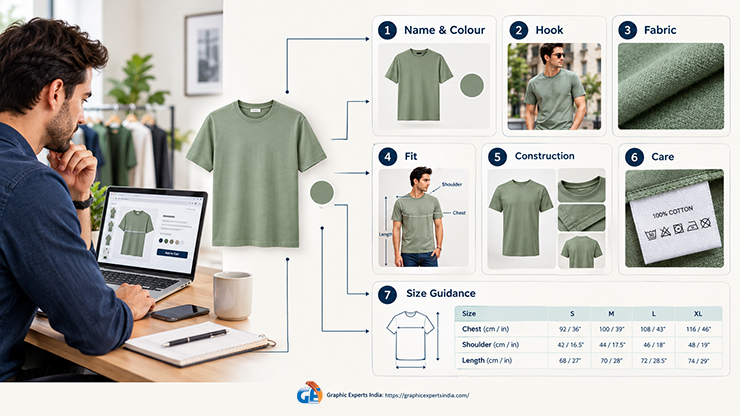
Each description element has one photograph type that shows it better than text, and assigning the pair in advance is what lets the description stay short.
Baymard found that “product images with descriptive text or graphics are well-performing additions that effectively communicate key product features that some users would otherwise miss” (28 November 2018). The description states the fact; the photograph confirms it.
| Description element | Photograph that must show it | What the photograph proves | What the description still states |
|---|---|---|---|
| Name and color | Main shot on white; one swatch per variant | The exact shade, matched across variants | The color name used in the variant attribute |
| Hook | On-model or lifestyle shot in context | How the piece is worn and with what | The occasion, in one sentence |
| Fabric | Macro detail shot at zoom resolution | Weave, rib, sheen, print registration | Fibre percentages, gsm or oz, stretch, origin |
| Fit | On-model shot in scale, front and side, with model height and size stated | Where hem, waist and shoulder sit on a known body | Flat measurements per size |
| Construction | Ghost mannequin (neck-joint) shot showing the inside collar and lining; back view | Interior finish, lining, label, back details | Lining fibre, closure type |
| Care | Close-up of the sewn-in care label | That the label exists and is legible | The five care instructions in words |
| Size guidance | Size chart graphic with units | Body measurements per size, in cm and inches | The “runs small” or “true to size” note |
Which Image Types Does a Clothing Listing Need?
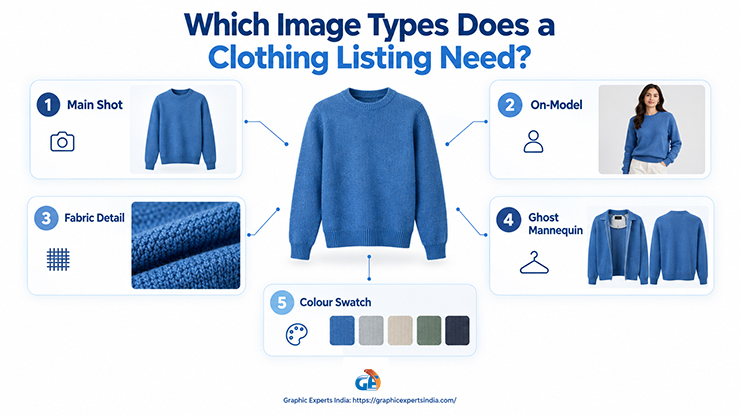
A clothing listing needs five photograph types to carry its description: a main shot, an on-model shot in scale, a fabric detail shot, a ghost mannequin or back view, and a color swatch per variant. Baymard’s 2026 benchmark found that 37% of sites lack in-scale product images and 23% lack human-model images for wearable products (updated 18 March 2026).
Google Merchant Center tells clothing advertisers to “show clothing on models” and to “show how your product looks on a real person.” A ghost mannequin shot, in which the mannequin is removed and the inside collar is reconstructed, is the one type that shows construction and lining without a model.
Whether a brand should show garments on AI-generated models, on a ghost mannequin or on real models is a separate decision covered in a forthcoming guide; the pairing table holds under all three. Graphic Experts India lists ghost mannequin and neck joint editing of self-shot photographs from $1.49 per image, with a 24-hour average turnaround.
How Do You Produce the Photographs Without a Studio?
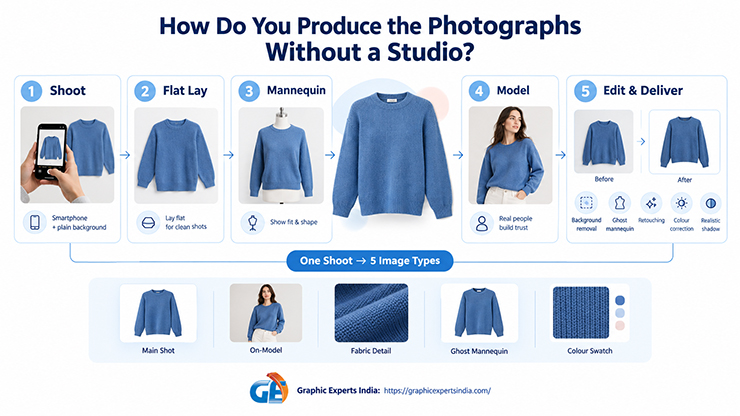
To produce the photographs without a studio, shoot every garment in one session on a phone against one plain background, flat, on a mannequin and on a person, and send the files out for editing. The edit turns the raw set into the five types.
Graphic Experts India lists background removal from $0.39 per image, ghost mannequin editing from $1.49, e-commerce retouching from $0.99, color correction and matching from $0.99 and shadow creation from $0.40, each with a 24-hour average turnaround and a three-step quality check.
A ten-style collection with five photographs per style is 50 files, which costs between $19.50 and $74.50 at the $0.39 to $1.49 range. The workflow from shot list to per-platform export sizes is on the ecommerce image editing service page.
What SEO Rules Apply to Product Descriptions for an Online Clothing Store?
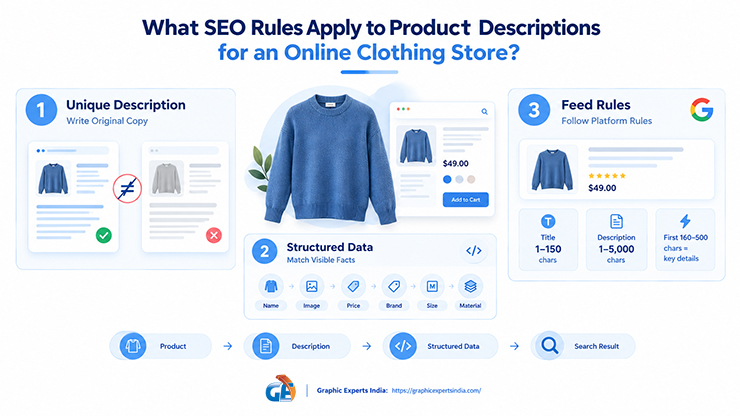
Three SEO rules apply to product descriptions for an online clothing store: the description must be unique to the store, the page must carry product structured data that matches the visible text, and the feed title and description must follow Google Merchant Center’s attribute rules.
Unique description. Shopify’s SEO documentation tells merchants to “avoid directly copying text that’s provided to you by a manufacturer because that description might already be used by other websites.” For a print-on-demand or wholesale store, the blank’s spec sheet is a source of facts, not a description.
Structured data. For Google merchant listings, the required Product properties are name, image and offers, and the nested Offer requires price and priceCurrency (Google Search Central, read 7 October 2026). Google states that “while the product description is not mandatory, it is strongly recommended to provide a description of the product in this property.”
It lists sku, gtin, brand, color, size, material, pattern and audience as recommended. It also notes that “product rich results only support pages that focus on a single product (or multiple variants of the same product).” Consequently, the seven elements map onto the recommended properties: the fabric line fills material, the color name fills color, the size line fills size, and the gender in the name line fills audience.
Feed attributes. Google Merchant Center’s title attribute accepts 1 to 150 characters. Google states that “users will usually notice only the first 70 or fewer characters of your title, depending on screen size.” Its description attribute accepts 1 to 5,000 characters.
The instruction is to “list the most important details in the first 160 – 500 characters.” Both prohibit price, sale dates, shipping and “your company’s name.”
The description must be “consistent with other details in the data source (for example, Title) and on your landing pages” (Google Merchant Center Help, read 7 October 2026). AI-generated descriptions belong in the separate structured_description attribute.
The required apparel attributes, color, size, gender and age_group, and each marketplace’s photo sizes, are in the guide to fashion eCommerce platforms and their product image requirements.
What Are the Title and Description Limits on Shopify, Etsy, Amazon and Google?
The title and description limits differ on every platform, and the tightest, Amazon’s 75-character title, took effect on 27 July 2026. The table gives each platform’s published figures as read on 7 October 2026.
| Platform | Title limit | Description or body limit | Source |
|---|---|---|---|
| Amazon | 75 characters including spaces, all categories except media, from 27 July 2026 (200 from 21 January 2025); same word no more than twice; !, $, ?, _, {, }, ^, ¬ and ¦ not allowed | Item Highlights: 125 characters, “searchable and visible with titles in search results” | Amazon Seller Forums, News_Amazon, 10 June 2026 and January 2025 |
| Etsy | 140 characters; “consider using less than 15 words”; no price or shipping; no “subjective words (for example, ‘perfect’)” | No published cap; search “considers keywords and phrases within your listing descriptions” | Etsy Help; Seller Handbook, 26 August 2025 |
| Shopify (search engine listing) | 70 characters before the title “might get cut off in search engine results” | 320 characters before the description might be cut off | Shopify Help, “Add and update products” |
| Google Merchant Center | 1–150 characters; about 70 visible; no price, sale, shipping or company name | 1–5,000 characters; key details in the first 160–500 | Google Merchant Center Help |
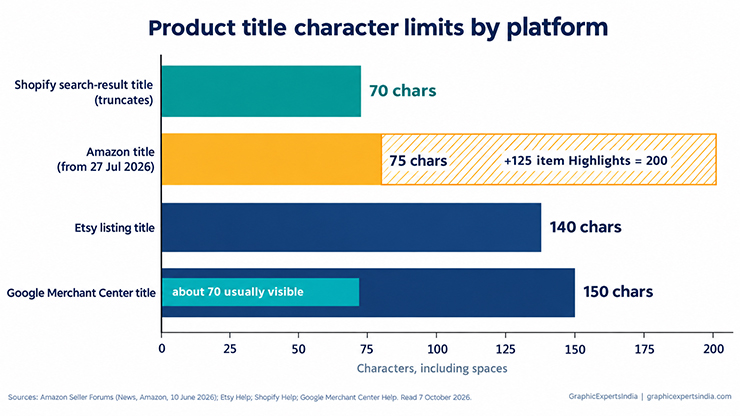
Figure 2. Title character budgets by platform, read 7 October 2026. Amazon’s 75-character limit applies from 27 July 2026; Google shows about 70 of its 150.
Two consequences follow. First, the visible title is about 70 to 75 characters everywhere. Amazon’s hard limit is 75, Shopify truncates after 70 and Google shows about 70 of 150. Etsy states that “shoppers will only see the first few words of a title in search results.”
Therefore the first 70 characters of the name line are written once, with brand, garment type, defining attribute and color inside them. Second, Amazon’s 75-character title plus its 125-character Item Highlights field totals 200 characters, the same as the single title limit that applied from January 2025. The content has been split, not shrunk.
Amazon’s advice is to “keep your key product information in the title and move additional details to Item Highlights.” After 27 July 2026, “any titles still over 75 characters will be updated to the AI recommendation gradually” (Amazon), so a seller who does not rewrite the title has it rewritten for them.
What Do Store Owners Ask Most Often About Clothing Product Descriptions?
Long enough to carry the seven elements and short enough to scan: the two examples in this guide run 69 and 82 words. Google Merchant Center allows 5,000 characters but asks for the key details in the first 160 to 500; Shopify’s search listing cuts after 320. Nielsen’s rule for scanned pages is “half the word count (or less) than conventional writing.” State every fact once, on its own line.
State the fibre percentages, the flat measurements per size, the model’s height and size worn, and the care instructions, because fit (39%) and “didn’t look the way they thought it would” (28%) are the two largest apparel return reasons in PowerReviews’ 2023 survey. Pair each line with the photograph that proves it: on-model in scale for fit, a detail shot for fabric, a swatch for color.
A seven-line template in a fixed order: name, hook, fabric, fit, care, size guidance, keyword. The variables change by garment type (weight and shrinkage for tees, length and lining for dresses, rise and stretch for jeans, insulation for outerwear, stretch and opacity for activewear), and the sentences are rewritten for every listing so no two descriptions on the store match.
Shopify advises against it. Its guidance is to “avoid directly copying text that’s provided to you by a manufacturer because that description might already be used by other websites.” Use the manufacturer’s spec sheet for the fibre content, weight and care facts, which the FTC requires to be accurate, and write the hook, fit and size lines from the garment and the photographs.
Amazon allows 75 characters including spaces from 27 July 2026, plus 125 characters of Item Highlights. Etsy allows 140 characters, with under 15 words recommended. Google Merchant Center allows 150 characters, of which about 70 are usually visible, and Shopify truncates search-result titles after 70. Put brand, garment type, defining attribute and color in the first 70.
Where Can an Online Clothing Store Get Product Photographs Edited to Match Its Descriptions?
An online clothing store can send a phone-shot garment set to Graphic Experts India and receive the five photograph types the pairing table requires.
Graphic Experts India lists e-commerce product photo editing from $0.39 per image, ghost mannequin editing from $1.49 per image, e-commerce retouching from $0.99 per image, color correction and matching from $0.99 per image and shadow creation from $0.40 per image. Each service carries a 24-hour average turnaround and a three-step quality check.
A free trial on sample images is available through the e-commerce product photo editing service page, returned within 24 hours with no credit card required.

Salim Ahmed is the CEO of Graphic Experts India, with over 25 years of expertise in photo editing, clipping path, image retouching, and eCommerce image editing services.