

Print on demand is a business model in which a supplier prints, packs and ships a product only after a customer has ordered it, so the seller holds no inventory. The seller owns the design and the storefront; the supplier owns the blanks, the printers and the shipping.
Printful defines it as “a business model in which a provider manufactures a product only after a customer places an order and then ships it to that customer under your brand” (Printful, 9 September 2026).
This guide explains how the print-on-demand business model works, how it differs from dropshipping and bulk production, and which suppliers publish their terms.
It then shows what margin one tee leaves and how to start a print-on-demand clothing brand in seven steps, using sources read on 7 October 2026. It is the print-on-demand chapter of the guide on how to start an online clothing store.
What Is Print on Demand at a Glance?
Print on demand at a glance is a no-inventory production model with published supplier prices, two-to-seven-day fulfilment and margins that most suppliers put between 20% and 50%.
| Question | Short answer | Source |
|---|---|---|
| What is print on demand? | A product is “printed and produced only when an order is placed” | Printful glossary |
| How much stock do you buy? | None: “$0 upfront—products are printed only after a customer orders” | Printful, 27 May 2025 |
| What does a POD tee cost? | Bella+Canvas 3001 from $11.69 (Printful) or $10.98 (Printify) | Printful, 14 May 2026; Printify, 21 April 2026 |
| How long does fulfilment take? | 2–5 business days (Printful); 2–7 business days (Printify) | Printful Help; Printify Help |
| What margin is normal? | “20% to 40% for most sellers”; a 40% margin is Printify’s 2026 benchmark | Printful, 21 September 2026; Printify, 21 April 2026 |
| What does a supplier plan cost? | Free tiers at Printful, Printify and Gelato; paid tiers $24.99, $39 and $29.99 a month | Supplier pricing pages, read 7 October 2026 |
| How big is the market? | Custom t-shirt printing $5.2 billion (2024) to $9.8 billion (2030), 11.5% CAGR | Grand View Research, November 2024 |
How Does the Print-on-Demand Business Model Work?
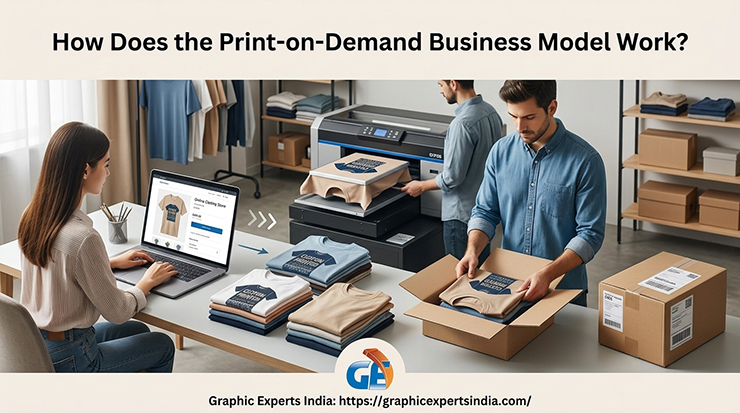
The print-on-demand business model works in four moves: the seller lists a design on a supplier’s blank, a customer orders, the order routes to the supplier automatically, and the supplier prints and ships it under the seller’s brand.
The supplier “prints, packs, and ships the item directly to the customer under your brand name,” and the seller keeps “the difference between your retail price and the production cost charged by the print-on-demand service” (Printful, 9 September 2026).
Shopify’s definition adds who does what. Print on demand is “a business model where products, such as clothing, accessories, or home décor, are designed by the seller and produced by the supplier once an order is received” (Shopify, 26 June 2026).
A print-on-demand store is therefore an ordinary online store whose products exist only as design files until an order arrives. The seller sets the retail price, writes the listing and markets the brand. The supplier charges a base price per item when the order is placed.
Consequently, the seller’s cash leaves the account only after the customer’s cash has arrived, which is the feature that separates print on demand from every stock-based model.
How Does Print on Demand Compare With Dropshipping and Bulk Production?
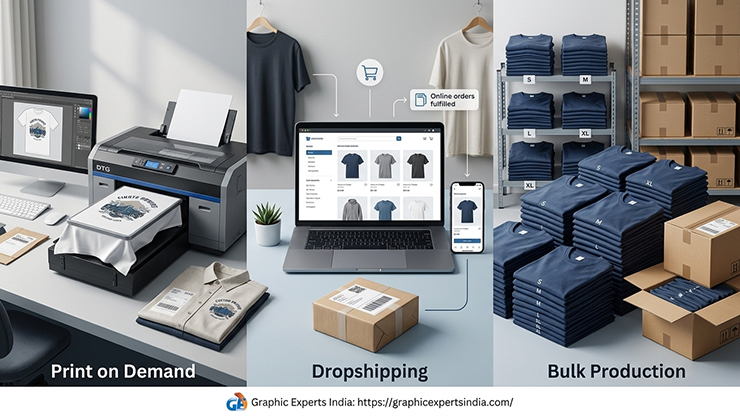
Print on demand is a form of dropshipping in which the supplier also decorates the product, while bulk production means buying decorated stock in advance. Shopify describes dropshipping as “a retail fulfillment method where online stores sell products without keeping them in stock” (Shopify, 21 November 2025).
It calls print on demand “a dropshipping business model that makes running a business more accessible” (Shopify, 26 June 2026). The difference is the design: a dropshipping clothing business resells a supplier’s existing garment, whereas a print-on-demand clothing brand sells its own artwork on a supplier’s blank.
In contrast, a bulk run buys finished stock at screen-printing prices and carries the unsold units.
| Attribute | Print on demand | Dropshipping (generic) | Bulk production (screen print) |
|---|---|---|---|
| Who designs the product | The seller | The supplier | The seller |
| Stock bought upfront | None (“$0 upfront”, Printful) | None | Full run; screen printers quote orders of 24+ pieces (Rolled Up Tees, March 2026) |
| Cost per tee | $10.98–$11.69 for a Bella+Canvas 3001 (Printify; Printful) | Supplier’s wholesale price | About $7–$12 per shirt at 50 units (Rolled Up Tees, 21 March 2026) |
| Time to ship | 2–5 business days (Printful); 2–7 (Printify) | Supplier dependent | Same day from own stock, after the run |
| Who holds unsold units | Nobody | Nobody | The seller |
| Brand on the parcel | Seller’s brand (Printful: “under your brand”) | Usually the supplier’s | Seller’s |
| Etsy category | “Designed by a seller” with a disclosed production partner | Prohibited unless the seller designed it | Handmade or designed by a seller |
Etsy’s rules make the design distinction formal. Its Creativity Standards define “Designed by a seller” as “sellers’ original designs that are produced or printed by a third party or offered as a digital download” (Etsy, updated 10 June 2025).
The same policy states that “sellers must disclose that an item is made by a production partner, and provide accurate information about where the item will ship from.” Etsy’s help centre lists Printful, Printify and Gooten as examples of production partners that “print and ship individual items only when ordered” (Etsy Help).
Which Print-on-Demand Suppliers Publish Their Terms?
Printful, Printify and Gelato publish plan prices, product discounts, store limits and fulfilment times on their own pages, which makes them the three suppliers a founder can compare without a sales call. Printful lists a Free plan at $0 a month and a Growth plan at $24.99 a month (printful.com/pricing, read 7 October 2026).
Growth becomes “Free when you reach $12K/year in sales.” It gives “Up to 33% off product pricing” and “25% off sample orders.” Printify lists Free at $0 with five stores per account and Premium “From $39/month” or “From $24.99/month billed yearly,” with “Up to 20% discount on all products” (printify.com/pricing, read 7 October 2026).
Gelato lists Free at $0 with two connected stores and Gelato+ at $29.99 a month, or $19.99 a month billed yearly, with “Up to 33%” off products (gelato.com/subscription-plans, read 7 October 2026).
Gelato produces in “250+ facilities in 32 countries.” Teelaunch names Shopify, Etsy, TikTok Shop and WooCommerce as integrations, but its home page states no plan price or production time, so its terms are not compared here.
| Term | Printful | Printify | Gelato |
|---|---|---|---|
| Free plan | $0 a month; 571 products; unlimited stores | $0 a month; 5 stores | $0; 2 stores |
| Paid plan | Growth $24.99 a month (free at $12K a year in sales) | Premium $39 a month, or $24.99 a month billed yearly | Gelato+ $29.99 a month, or $19.99 a month billed yearly |
| Product discount on paid plan | Up to 33% | Up to 20% on all products; up to 33% on new products | Up to 33% |
| Bella+Canvas 3001 base price | $11.69 (14 May 2026) | $10.98; $8.77 on Premium (21 April 2026) | Not published in a comparable blog figure |
| Fulfilment time | 2–5 business days; “Over 97% of orders ship within 5 business days” | “Most orders are shipped within 2-7 business days” | Not stated on the plans page |
| Production model | Own facilities plus partners | Network of third-party print providers | 250+ facilities in 32 countries |
| Sample orders | 20% discount; 1 to 5 sample orders a month by sales tier | “All sample orders must be placed at regular pricing” | Not stated on the plans page |
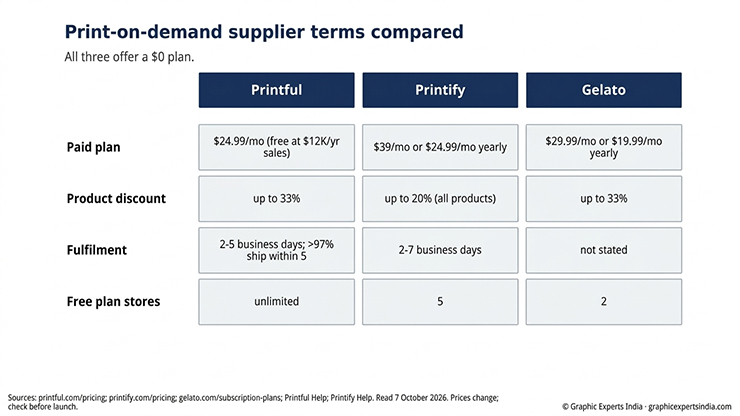
Figure 1. Published plan prices, discounts and fulfilment times at Printful, Printify and Gelato, read 7 October 2026. Prices change; check the supplier page before launch.
Which Printing Methods Do Print-on-Demand Suppliers Use?
Print-on-demand suppliers use four main decoration methods on clothing: direct-to-garment (DTG), direct-to-film (DTF), embroidery and sublimation. In DTG, “pigmented, water-based inks are applied directly to the garment’s surface and absorbed by the fibers” (Printify Help).
DTF means “printing designs onto a special PET film and then transferring them to a product using adhesive powder and heat” (Printify Help). Embroidery is “designs stitched onto garments using thread and a needle,” and sublimation “uses high heat and pressure to apply dyes onto the product” (Printify Help).
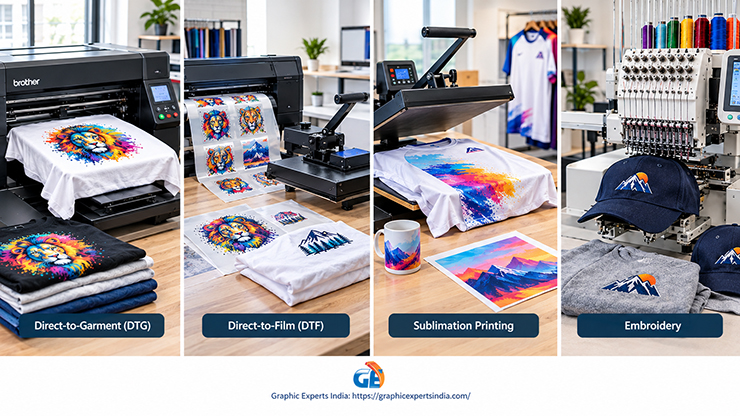
Printful sells DTF under the name DTFlex and notes that in embroidery “color options are limited to the available thread shades” (Printful Help).
| Method | How it works | Best for | Published limit |
|---|---|---|---|
| DTG | Water-based ink printed into the fabric | Cotton tees; multi-colour and photographic artwork | Printful requires files of at least 150 DPI, as PNG, in sRGB IEC61966-2.1 |
| DTF | Design printed on PET film, transferred with adhesive powder and heat | Cotton and synthetic blends; sharp edges | “No setup fees per color” (Rolled Up Tees) |
| Embroidery | Thread stitched into the garment | Logos, text, caps, left-chest placements | Thread colours only; raised texture |
| Sublimation | Dye bonded under heat and pressure | All-over prints on polyester | Polyester and coated items only |
What Profit Margin Does a Print-on-Demand Business Make?
A print-on-demand business typically makes a gross margin of 20% to 50% on each item, with the exact figure set by the retail price the seller chooses above the supplier’s base price. Printful states that “print-on-demand profit margins usually range from 20% to 40% for most sellers” (Printful, 21 September 2026).
The same supplier states that “most t-shirt businesses see average profit margins between 30% and 50%” and that “most sellers keep a net profit of $3 to $8 per shirt after core costs” (Printful, 14 May 2026).
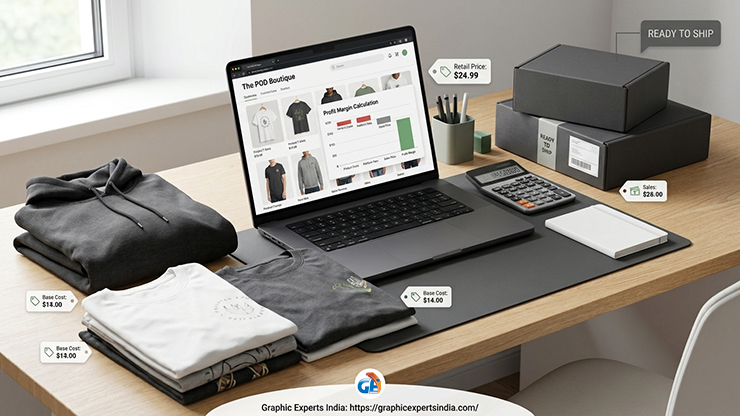
Printify states that “a 40% profit margin has become the standard recommendation for custom t-shirt businesses in 2026” (Printify, 21 April 2026). Its pricing formula is “Retail price = Total cost ÷ (1 – desired profit margin %).” The margin itself is “(Retail price − Total cost) / Retail price × 100” (Printful, 21 September 2026).
How Does One Tee Compare on Print on Demand Versus a 50-Unit Screen-Print Run?
One Bella+Canvas 3001 tee sold at $25 leaves $12.28 of gross profit on Printful and $12.99 on Printify, while the same tee from a 50-unit screen-print run leaves $11.97 to $16.97, depending on where the print shop’s price falls.
The table below uses the published base prices, the Shopify Basic card rate of 2.9% + 30¢ (shopify.com/pricing, read 7 October 2026) and the screen-print range of “$7–$12 per shirt” at 50 pieces (Rolled Up Tees, 21 March 2026). The $25 retail price is an assumption.
| Route | Cost per tee | Cash paid before the first sale | Gross profit per tee at $25 | Margin | Shirts to recover the upfront cash |
|---|---|---|---|---|---|
| Print on demand, Printful | $11.69 | $0 | $12.28 | 49% | 0 |
| Print on demand, Printify | $10.98 | $0 | $12.99 | 52% | 0 |
| Screen print, 50 units at $7 | $7.00 | $350 | $16.97 | 68% | 15 |
| Screen print, 50 units at $12 | $12.00 | $600 | $11.97 | 48% | 26 |
Three results follow from the table. First, the screen-print advantage only exists at the low end of the quoted range: at $12 per shirt, the bulk run earns less per tee than either print-on-demand supplier and ties up $600.
Second, a 50-unit run at $7 earns $848.50 if every shirt sells, against $614.00 for 50 Printful orders, so the extra $234.50 is the payment for carrying the stock and the sizing risk.
Third, the cash break-even of 15 to 26 shirts means the run recovers its upfront payment only after a third to a half of the stock sells; the remaining 24 to 35 shirts carry the profit.
As a result, print on demand is the lower-risk route for an untested design, and a bulk run is the higher-margin route for a design that has already sold. The channel fees that sit on top of these figures are compared in the guide on how to sell t-shirts online.
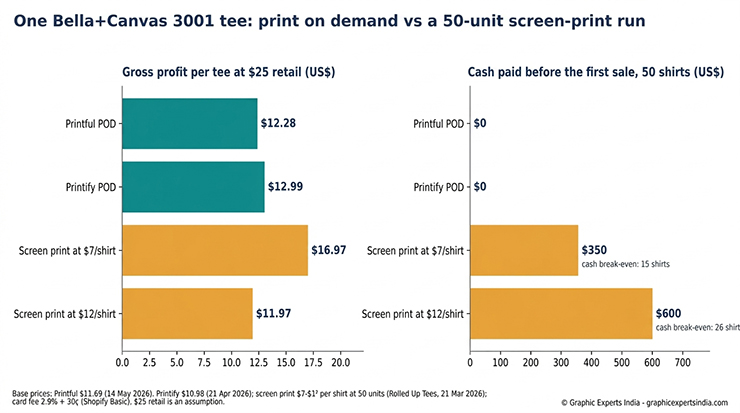
Figure 2. Gross profit per tee and cash paid upfront for one Bella+Canvas 3001 at a $25 retail price. Base prices from Printful and Printify; screen-print range from Rolled Up Tees; card rate from Shopify Basic.
How Do You Start a Print-on-Demand Clothing Brand Step by Step?
To start a print-on-demand clothing brand, design to the supplier’s file specification, choose a supplier, connect it to a sales channel, order and photograph a sample, build lifestyle images from it, then price and launch with the marketplace disclosures in place.
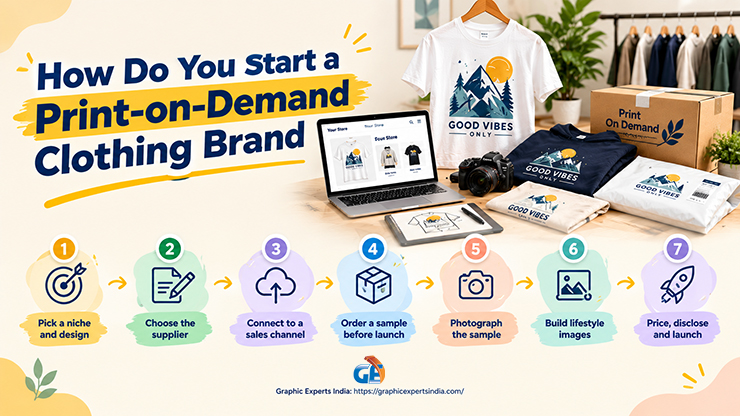
- Pick a niche and design to the file specification.
- Choose the print-on-demand supplier.
- Connect the supplier to a sales channel.
- Order a sample before launch.
- Photograph the sample instead of relying on the mockup.
- Build lifestyle images from the one sample.
- Price, disclose and launch.
Step 1: How Do You Pick a Niche and Design for a POD Clothing Brand?
To pick a niche and design for a print-on-demand clothing brand, choose an audience you can reach without paid advertising and prepare artwork that meets the supplier’s print-file rules. Printful requires that “for most Printful products, your print file has to be at least 150 DPI,” saved as a PNG file (Printful).
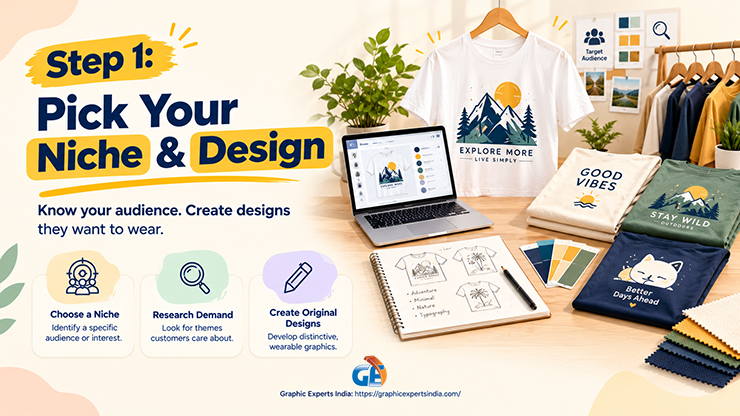
The file must be created “in the sRGB color profile, specifically sRGB IEC61966-2.1,” because “our printers then convert your submitted file into CMYK format” (Printful). That conversion is the first reason a mockup can differ from the printed shirt: the on-screen file is sRGB and the ink is CMYK.
The design should also exist as a vector where it carries a logo, so the same mark scales from a left-chest embroidery to a full-front DTG print.
Step 2: How Do You Choose a Print-on-Demand Supplier?
To choose a print-on-demand supplier, compare base price, fulfilment time, print method and sample policy for the exact blank you plan to sell, then order the same design from two suppliers and keep the better print.
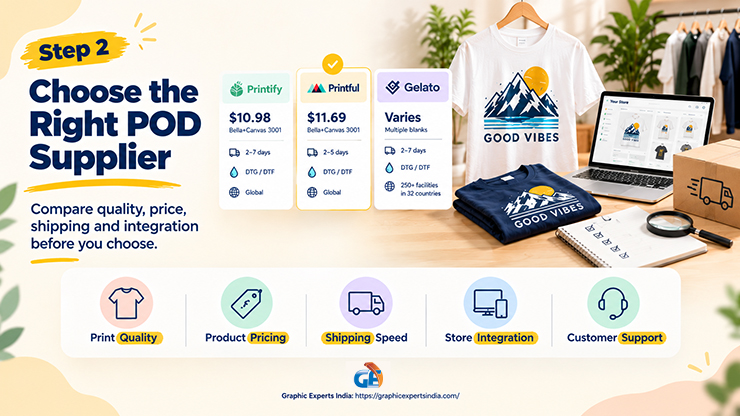
On the published figures, Printify’s $10.98 Bella+Canvas 3001 is $0.71 cheaper than Printful’s $11.69. Printful states a tighter fulfilment window of two to five business days, with “Over 97% of orders ship within 5 business days,” against Printify’s two to seven (Printful Help; Printify Help).
Printify routes each order to a third-party print provider, so quality can vary by provider. Gelato’s “250+ facilities in 32 countries” suit a brand that sells across regions. Therefore, the right supplier depends on whether price, speed or geography matters most to the brand.
Step 3: Which Sales Channels Integrate With Print-on-Demand Suppliers?
Print-on-demand suppliers integrate with Shopify, Etsy, Amazon, TikTok Shop, eBay, WooCommerce, Wix and Squarespace through native apps, so an order placed on any of these channels reaches the supplier without manual entry.
Printful’s integration guide names 22 options, including Shopify, Etsy, Amazon, eBay and TikTok Shop (Printful, 9 September 2024).
Printify’s integrations page lists Etsy, Shopify, TikTok Shop (“currently US only”), Amazon, eBay, WooCommerce, Wix, Squarespace, BigCommerce, PrestaShop and Big Cartel (printify.com/integrations, read 7 October 2026). The channel fees apply on top of the supplier’s base price.
| Channel | Published seller cost | Source (read 7 October 2026) |
|---|---|---|
| Shopify | Basic $39 a month, or $29 a month billed yearly; 2.9% + 30¢ per online card payment | shopify.com/pricing |
| Etsy | $0.20 listing fee; 6.5% transaction fee on price plus shipping; 3% + $0.25 payment processing (US) | etsy.com/legal/fees |
| TikTok Shop | 6% referral fee on menswear and womenswear (schedule effective 31 October 2024) | TikTok Shop Seller University |
| Amazon | Professional plan $39.99 a month plus a referral fee of 5%, 10% or 17% on clothing by price band | sell.amazon.com/pricing |
A print-on-demand store on Shopify carries the monthly plan as its only fixed cost; the same products on Etsy carry a per-listing fee and a transaction fee but no subscription.
Step 4: Why Should You Order a Sample Before Launching a POD Store?
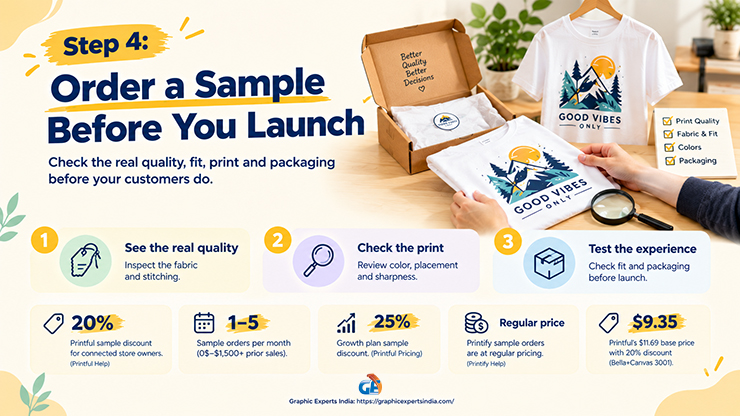
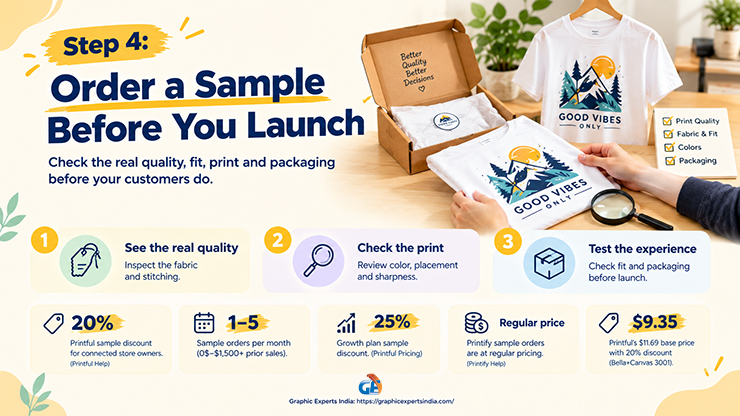
A founder should order a sample before launching a print-on-demand store because the sample is the only way to see the printed colour, the fabric and the placement before a customer does. Printful offers sample orders at a “20% discount” to “e-commerce store owners with a connected store” (Printful Help).
The allowance is one sample order a month at $0 in prior-month sales, rising to five a month at $1,500 or more, each of up to three or five items. The Growth plan raises the sample discount to 25% (printful.com/pricing).
Printify states that “all sample orders must be placed at regular pricing” and that “design appearance can vary based on the fabric or material used” (Printify Help). At Printful’s $11.69 base price, a 20% sample discount brings one Bella+Canvas 3001 to $9.35 before shipping.
Step 5: How Do You Photograph a POD Sample Instead of Using the Mockup?
To photograph a print-on-demand sample, shoot the real garment flat and on a person against one plain background, then have the files edited to the marketplace standard, because the supplier’s mockup is the same image every other seller of that blank receives.
Printful’s Mockup Generator is “completely free,” covers every product in its catalogue, and lets a seller “put your apparel on diverse models, place products in different scenes” (printful.com/mockup-generator). A mockup therefore shows the design on a stock photograph of the blank; it does not show the printed shirt.
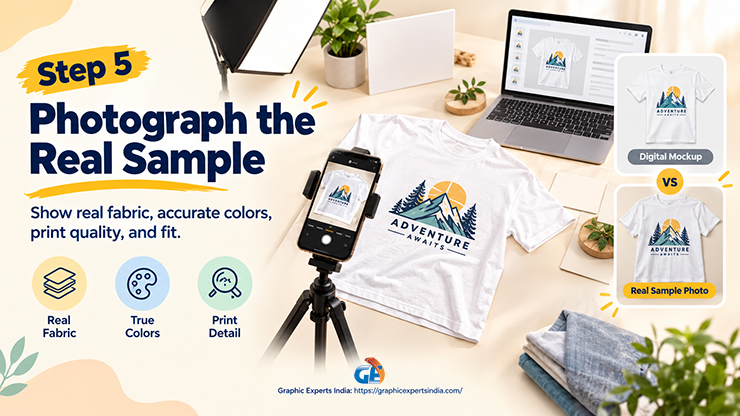
| What the image must show | Supplier mockup | Photograph of the real sample |
|---|---|---|
| Design placement and scale on the blank | Yes | Yes |
| Printed colour after the sRGB-to-CMYK conversion | No; the mockup renders the sRGB file | Yes |
| Print texture, hand feel and fabric drape | No | Yes |
| The brand’s own model, styling and setting | No; shared catalogue models and scenes | Yes |
| Uniqueness against other stores selling the same blank | No; identical source image | Yes |
| Amazon main image: on-model, pure white background, 85% fill | Only if the chosen mockup meets each rule | Yes, after background removal |
| Cost per finished image | $0 | Phone shoot plus editing from $0.39 per image |
The marketplace rules favour the photograph. Amazon’s apparel imaging guidelines state that “all adult apparel should be imaged on-model” (Amazon, Spring 2021).
The same guidelines require that “MAIN images must have a pure white background (RGB Value 255, HEX Value #FFFFFF)” and that “the product must fill at least 85% of the image area.” In Etsy’s buyer surveys, “90 percent of shoppers said the quality of the photos were ‘extremely important’ or ‘very important’ to a purchase decision” (Etsy Seller Handbook).
PowerReviews found that 28% of apparel returners said the “item didn’t look like I thought it would” (survey of 25,452 US consumers, June 2023). Graphic Experts India cuts a phone-shot sample onto a pure white or transparent background from $0.39 per image through its background removal service, with a 24-hour average turnaround.
The choice between AI-generated models, ghost mannequin and real models for a clothing brand is a separate decision, covered in a forthcoming guide to ghost mannequin vs on-model photography.
Step 6: How Do You Build Lifestyle Images From One Sample?
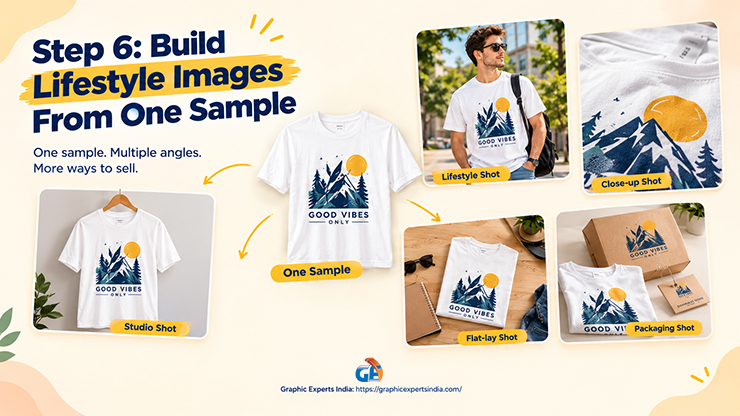
To build lifestyle images from one sample, photograph the garment once and have it composited into new backgrounds, scenes and colourways, so that one sample produces the full listing set without a second shoot.
Image manipulation covers placing the cut-out garment into a street, studio or seasonal scene, recolouring the blank to show the other colour options the supplier offers, and swapping the design on a photographed shirt so each new artwork gets a real-fabric image.
Graphic Experts India lists image manipulation from $1.00 per image on its image manipulation service page, with a three-step quality check. A ten-design catalogue with three images each is 30 images, or $30.00 at that rate, returned within 24 hours on average.
The specific job of changing the clothes shown in an existing photo, and how AI clothes changers compare with professional editing, has its own guide in this series.
Step 7: How Do You Price, Disclose and Launch a POD Clothing Brand?
To price a print-on-demand garment, divide the total cost by one minus the target margin, then check the result against the channel fee and the market. Printify’s formula, “Retail price = Total cost ÷ (1 – desired profit margin %),” turns an $11.69 base plus a $1.03 Shopify card fee into a $21.20 retail price at a 40% margin (Printify, 21 April 2026; calculation).
On Etsy, the listing must sit in the “Designed by a seller” category with the production partner disclosed in the listing and the shop’s About section (Etsy, updated 10 June 2025; Etsy Help). Launch with the sample photographs on the product page, the mockups limited to colour variants not yet sampled, and the first reorder decision tied to sales data rather than to a mockup’s appeal.
What Are the Pros and Cons of Print on Demand?
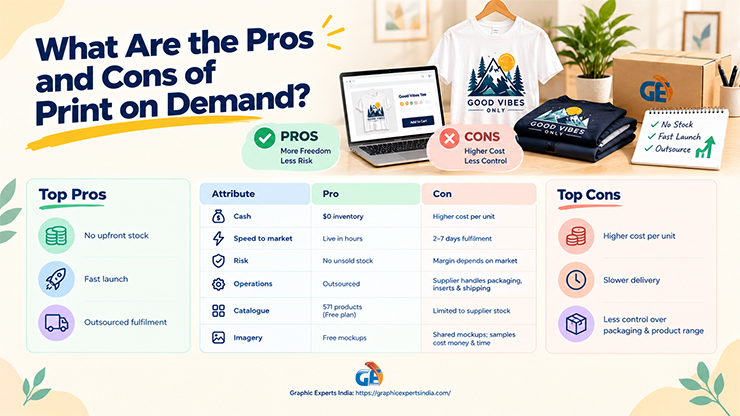
The pros of print on demand are zero upfront stock, fast launch and outsourced fulfilment; the cons are a higher cost per unit than bulk, slower delivery and less control over packaging and product range. Printful’s own list of advantages reads “No upfront investment,” “Quick to launch,” “Creative freedom” and “Low risk and low startup costs” (Printful, 9 September 2026).
Its list of disadvantages reads “Slightly lower profit margins,” “Slower delivery,” “Less control over packaging” and “Product variety may be limited,” because one-off printing costs more per unit than a bulk run.
Shopify’s list adds “Limited control over shipping: You may not be able to set shipping costs or customize the delivery experience” and “Customization constraints: Print-on-demand services are often unable to accommodate complex design requests” (Shopify, 26 June 2026).
| Attribute | Pro | Con |
|---|---|---|
| Cash | $0 inventory versus “$20,000–$50,000 for initial stock” in a traditional line (Printful, 27 May 2025) | Base price per unit above a bulk unit cost |
| Speed to market | Store live in hours; products are files | Fulfilment of 2–7 business days before shipping starts |
| Risk | No unsold stock | Margin depends on retail price the market accepts |
| Operations | Printing, packing and shipping outsourced | Packaging, inserts and shipping carrier set by the supplier |
| Catalogue | 571 products on Printful’s free plan | Limited to what the supplier stocks |
| Imagery | Free mockups for every product | Mockups are shared across all sellers; samples cost money and time |
What Do Founders Ask Most Often About Print on Demand?
A print on demand business is a store that sells its own designs on supplier-owned blanks, with the supplier printing and shipping each item after the customer pays. Printful’s glossary defines the model as one where products are “printed and produced only when an order is placed.” The business owns the designs, the brand and the customer relationship, and pays the supplier’s base price per unit sold.
Print on demand is profitable per unit at the margins suppliers publish: Printful states “20% to 40% for most sellers” and “$3 to $8 per shirt” net, and Printify recommends a 40% margin for 2026. On a $25 Bella+Canvas 3001, the gross profit is $12.28 at Printful’s $11.69 base after a Shopify card fee. Marketing cost, returns and channel fees decide whether the business as a whole is profitable.
Print on demand is a form of dropshipping in which the seller supplies the design and the supplier decorates the blank before shipping. Shopify defines dropshipping as selling “products without keeping them in stock” and calls print on demand “a dropshipping business model.” A generic dropshipper resells the supplier’s product; a print-on-demand seller sells artwork on it.
A print-on-demand business can start with no supplier subscription, since Printful, Printify and Gelato all list free plans, and no stock, since items are printed per order. The paid costs are optional: a sales channel such as Shopify Basic at $29 a month billed yearly or Etsy at $0.20 per listing, one sample at about $9.35 after Printful’s 20% discount, and photo editing from $0.39 per image.
Yes. Etsy allows print-on-demand items under “Designed by a seller” when the seller discloses the production partner, and both Printful and Printify integrate with Etsy and Amazon. Amazon’s apparel listings require on-model main images on a pure white background, so a photographed sample, not a supplier mockup, is the safer main image.
Where Can a Print-on-Demand Brand Get Its Sample Photos Edited?
A print-on-demand brand can send phone photographs of its sample to Graphic Experts India and receive marketplace-ready images the next day.
Graphic Experts India lists background removal from $0.39 per image, image manipulation for lifestyle composites and colourway changes from $1.00 per image, e-commerce retouching from $0.99 per image and ghost mannequin editing from $1.49 per image.
Each service carries a 24-hour average turnaround and a three-step quality check. A free trial on sample images is available through the background removal service page, with no credit card required.

Salim Ahmed is the CEO of Graphic Experts India, with over 25 years of expertise in photo editing, clipping path, image retouching, and eCommerce image editing services.