

A clothing brand business plan is a written document that states what garments a label will sell, to whom, through which channels, at what cost and margin, and how the launch will be funded.
A business plan for a fashion line, clothing line or apparel company follows the same nine-section format the US Small Business Administration recommends for lenders and investors, with an apparel-specific collection plan and production workflow added.
This guide explains which format to choose, what to write in each of the nine sections, how to build the financial projections with a worked unit-economics example, where to find a free clothing brand business plan template or example, and which mistakes weaken a fashion business plan. It is the planning step in the guide on how to start a clothing brand.
What Is a Clothing Brand Business Plan?
A clothing brand business plan is the document that turns a design idea into a fundable, operable business by stating the customer, the collection, the production route, the sales channels and the numbers in one place. The US Small Business Administration recognises two formats.
The traditional plan is “very detailed, takes more time to write” and is the one that “lenders and investors commonly request,” according to the SBA’s guide to writing a business plan (accessed 14 September 2026). The lean start-up plan is a one-page summary built on nine boxes: key partnerships, key activities, key resources, value proposition, customer relationships, customer segments, channels, cost structure and revenue streams.
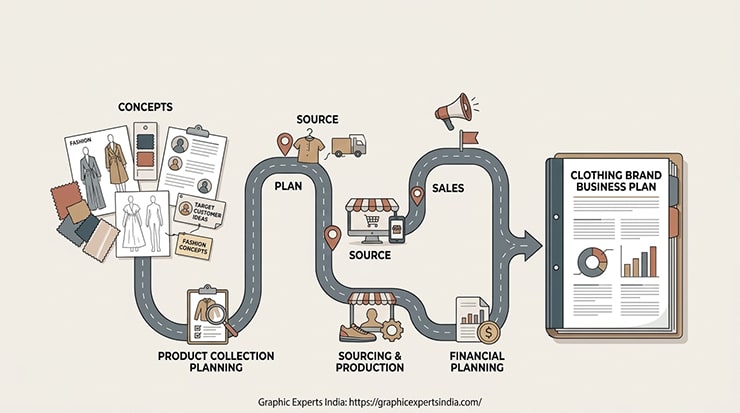
A fashion plan differs from a generic small-business plan in three places. It must list the collection (styles, sizes, colorways, price points). It must state the production model and its minimum order quantities. Moreover, It must include the product-imagery workflow, because for an online clothing brand the images are the product page. The nine sections below follow the SBA’s traditional structure with those additions.
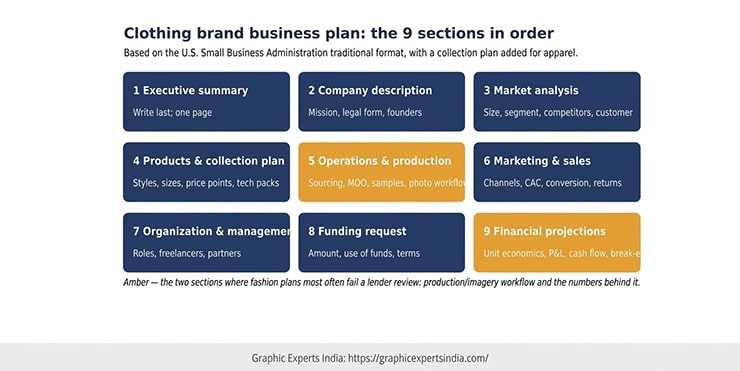
Figure 1. The nine sections are in order. Amber marks the two sections, operations and financials, that carry the apparel-specific detail a lender checks first.
Which Format Should a Clothing Brand Use: Traditional or Lean Start-up?
A clothing brand should use the traditional format if it will seek a loan, an investor or a wholesale account, and the lean start-up format if it is self-funded and testing demand with print on demand.
The SBA states that the traditional plan is the one lenders and investors commonly request, and that the lean plan suits a founder whose “business is relatively simple” or who plans “to regularly change and refine” the plan.
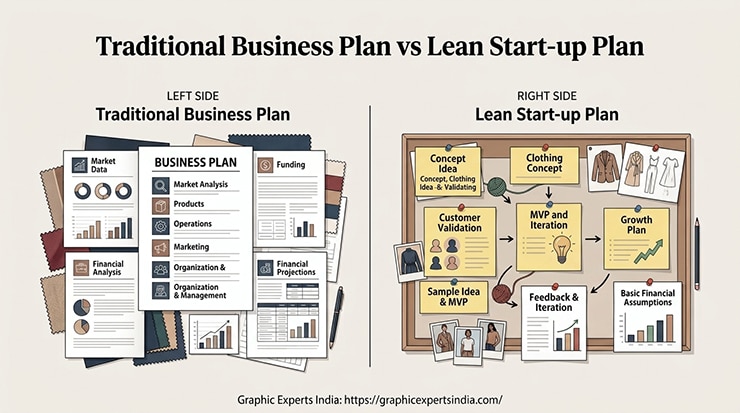
In practice, many founders write both. The lean canvas fits on one page and forces the value proposition and customer segment into a sentence each. The traditional plan then expands the same answers into the nine sections a bank or factory will read.
Because a cut-and-sew first run costs “at least $12,000” for a four-piece line according to Sewport, any brand that needs outside money for production needs the traditional format.
What Sections Does a Clothing Brand Business Plan Include?
A clothing brand business plan includes nine sections: executive summary, company description, market analysis, products and collection plan, operations and production, marketing and sales, organization and management, funding request and financial projections.
The first eight of these match the SBA’s traditional plan; the collection plan replaces the SBA’s generic “service or product line” heading. What follows is what to write in each.
1. What Goes in the Executive Summary?
The executive summary states the brand, the customer, the first collection, the sales channel, the funding required and the year-one revenue target in under one page. Write it last, after the numbers exist.
A reader who stops here should know the niche (“seamless base layers for women who run trails, $60–$90”), the model (print on demand or cut-and-sew), the ask (“$25,000 for the first 8-piece run”) and the expected margin.
2. What Goes in the Company Description?
The company description states the legal entity, ownership, location, founding date and mission. Include the entity type and where it is registered; forming a limited liability company costs $40 in Kentucky and $500 in Massachusetts on the two states’ published fee schedules.
State whether the brand name has been cleared and filed as a trademark; the USPTO base filing fee is $350 per class under the schedule effective 18 January 2025, and clothing is Class 25.
3. What Goes in the Market Analysis?
The market analysis sizes the market, names the segment, profiles the customer and lists direct competitors. Use current, cited figures and state the date of each. Global apparel revenue is estimated at US$1.92 trillion in 2026, with women’s apparel the largest segment at US$1.00 trillion and a 2.60% compound annual growth rate to 2030, according to Statista Market Insights’ Apparel Worldwide outlook (2026).
Growth is slow: “the global fashion industry will once again post low single-digit growth in 2026,” McKinsey & Company and The Business of Fashion wrote in The State of Fashion 2026 (17 November 2025).
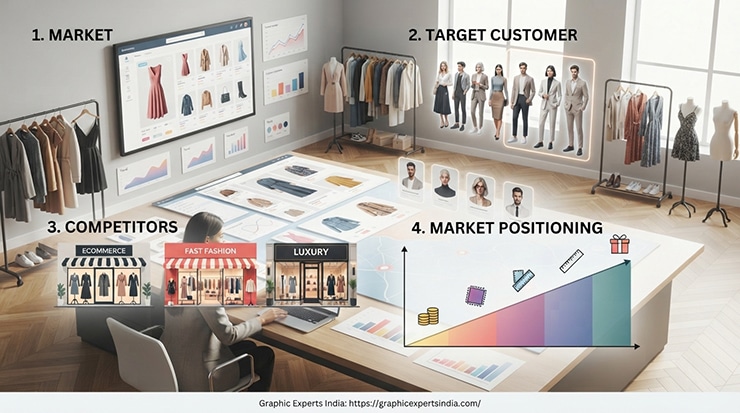
State the online share, because it determines the channel section. Online sales were 35.2% of the top 1,000 US apparel and accessories retailers’ combined sales in 2023, according to Digital Commerce 360 (updated 17 September 2024), and US e-commerce overall was 17.1% of retail sales in the second quarter of 2026 per the US Census Bureau (18 August 2026). Then name three to five competitors, their price points and their weakest point on fit, material, price or presentation.
4. What Goes in the Products and Collection Plan?
The collection plan lists every style in the first collection with its sizes, colorways, materials, target retail price, target landed cost and gross margin. A small first line is often four styles; Sewport prices a four-piece line at “at least $12,000,” an eight-piece line at $25,000 and a sixteen-piece line at $50,900.
Each style needs a tech pack, which costs “$200–$300” per garment from a freelance technical designer according to Sewport, or can be built in software such as Techpacker at $35 per user per month.
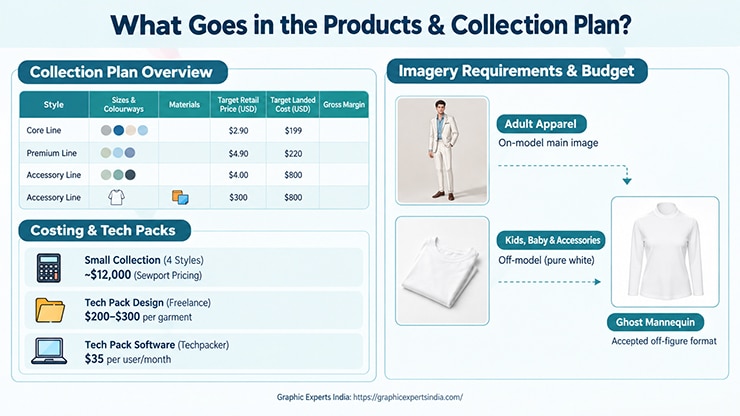
Include the imagery requirement per style in this section, because it changes the budget. Amazon’s Clothing & Accessories imaging guidelines (Spring 2021 edition) require adult apparel main images on-model and kids, baby and accessory images off-model on a pure white background at 1,600 pixels or more, and prohibit visible mannequins; ghost mannequin images are an accepted off-figure format.
A plan that lists “on-model” against adult styles and “ghost mannequin” against the rest lets the operations section price the shoot correctly.
5. What Goes in the Operations and Production Section?
The operations section states the production model, the suppliers, the minimum order quantities, the sampling timeline, the fulfilment method and the product-imagery workflow. US clothing manufacturers typically require 50 to 500 units per style and 25 to 200 units per colorway, according to Maker’s Row (9 May 2026).
Samples cost “$200–$300” each from US factories and “$50–$150” from Asian factories per Sewport. Print on demand removes the MOQ: Printful states “$0” inventory and a unit cost of “$10–$25 per unit” (27 May 2025).
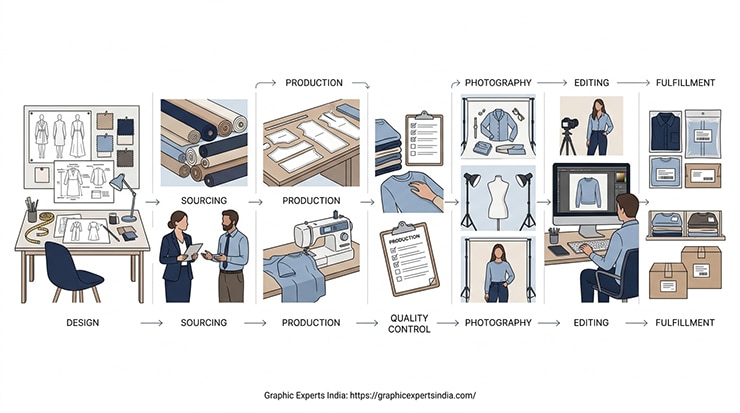
The imagery workflow is the operations line most fashion plans omit. State how each style will be photographed (flat lay, ghost mannequin or on-model), by whom, at what cost, and how the raw files become channel-ready images. Two published price points frame the choice. Studio production starts at $50 per product image or $95 per on-model image on Squareshot’s public price list.
Outsourced editing of self-shot photos starts at $0.39 per image for background removal and $1.49 per image for ghost mannequin editing at Graphic Experts India, with a 24-hour average turnaround; the difference between the two methods is compared image by image in the guide on how much it costs to start a clothing brand. Name the vendor, the per-image price and the turnaround in the plan so the launch timeline includes editing lead time.
6. What Goes in the Marketing and Sales Section?
The marketing and sales section names the channels, the customer acquisition cost the plan assumes, the conversion rate, the return rate and the launch calendar. Three benchmarks belong here.
Fashion and apparel e-commerce companies averaged a $66 customer acquisition cost across 80-plus First Page Sage clients from 2020 to 2025 (First Page Sage, updated 15 August 2025); Shopify’s 2021 data for fashion and accessories brands with fewer than four employees put it at $129 (Shopify, 29 July 2024).
Fashion clothing and accessories stores converted 1.81% of visits in July 2026 (IRP Commerce market data, UK-weighted panel). An estimated 19.3% of US online sales were returned in 2025 (National Retail Federation and Happy Returns, 15 October 2025).
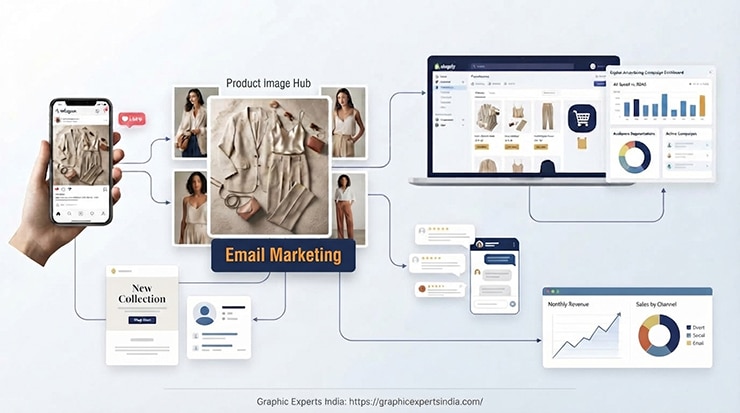
Returns belong in the marketing section because imagery drives them. In PowerReviews’ Apparel Shopping Trends survey of 25,452 US consumers (June 2023), 39% of returners cited sizing, 28% said the “item didn’t look like I thought it would” and 13% said the item “didn’t match the description.”
A plan that budgets for consistent, color-accurate product images can defend a lower return-rate assumption than the category average; the color correction services page describes Pantone and brand-reference color matching from $0.99 per image, which is the specific process that keeps a listed color honest across a colorway.
List the channel fees the sales forecast must absorb: Shopify Basic at $39 per month monthly or $29 annually with a 2.9% + 30¢ card rate; Etsy at $0.20 per listing, 6.5% per transaction and 3% + $0.25 processing; Amazon at $39.99 per month plus a 17% referral fee on clothing above $20 (all from the platforms’ pricing pages, accessed 14 September 2026).
7. What Goes in the Organization and Management Section?
The organization and management section names who does what: design, production management, marketing, customer service, finance and the freelancers or vendors who fill the gaps.
For a one-founder label, list the outsourced roles explicitly (technical designer, factory or print-on-demand supplier, photographer, photo editor, accountant) with their engagement terms. A lender reads this section to see whether one person is carrying every function.
8. What Goes in the Funding Request?
The funding request states the amount, the use of funds by line item, the type of funding sought and the repayment or return terms. Tie every line to the budget: production ($12,000 for a four-piece run per Sewport), tech packs, samples, legal ($350 trademark; $40–$500 LLC), store ($358–$478 in year one), imagery and launch marketing.
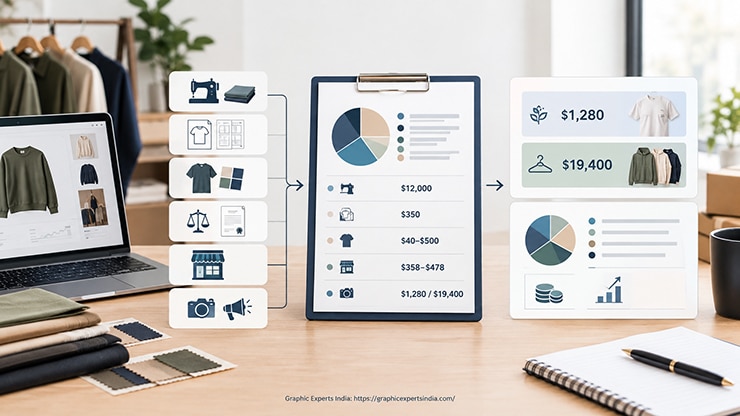
Two illustrative year-one totals built from those published figures are $1,280 for a print-on-demand launch and $19,400 for a four-style cut-and-sew line.
9. What Goes in the Financial Projections?
The financial projections contain unit economics per style, a monthly sales forecast, a profit-and-loss statement, a cash-flow statement and a break-even point, covering five years with quarterly or monthly detail in year one. The SBA asks for “a prospective financial outlook for the next five years” and, for the first year, “quarterly — or even monthly — projections” (SBA, page updated 8 September 2026).
The benchmark for the margin line is public: apparel companies averaged a 56.88% gross margin, a 9.11% pre-tax operating margin and a 3.85% net margin as of January 2026 in Professor Aswath Damodaran’s dataset at NYU Stern (35 firms). A plan that projects a 70% net margin will not survive a reader who knows that figure.
How Do You Build the Financial Projections for a Clothing Brand?
To build the financial projections, start from one garment’s unit economics, multiply by a forecast of orders per month, then layer fixed costs to find break-even. The worked example below uses published inputs for a $35 print-on-demand t-shirt.
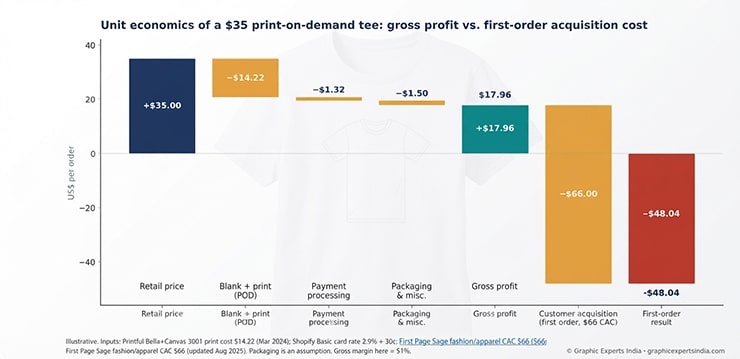
Figure 2. Unit economics of a $35 print-on-demand tee. Illustrative; inputs are cited in the table.
| Line | Value | Basis |
|---|---|---|
| Retail price | $35.00 | Assumption |
| Blank plus print | −$14.22 | Printful, Bella+Canvas 3001 print cost low end, March 2024 |
| Payment processing | −$1.32 | Shopify Basic card rate 2.9% + 30¢ |
| Packaging and inserts | −$1.50 | Assumption |
| Gross profit per order | $17.96 | 51.3% gross margin |
| Customer acquisition (new customer) | −$66.00 | First Page Sage, fashion/apparel average, August 2025 |
| First-order result | −$48.04 |
The example shows why the projections must model repeat purchases. At a $66 acquisition cost, the brand needs roughly 3.7 orders from each new customer to recover acquisition on gross profit alone, before fixed costs.
Three levers change the picture: a higher average order value (two tees per order halves the acquisition cost per unit), a lower blended acquisition cost as organic and repeat traffic grow, and a lower return rate, since each return at 19.3% of online orders reverses the gross profit and adds return shipping.
Fixed costs to layer on top are the store subscription ($29 to $39 per month), insurance ($45 per month average per Insureon) and any retainer for design or editing. Break-even is the month in which cumulative gross profit exceeds cumulative fixed costs plus the launch outlay from the funding request.
Two drafting rules keep this section credible. First, state every assumption next to its number, as the table above does. Second, run a downside case: halve the conversion rate from 1.81% and raise the return rate, and show the plan still reaches break-even, or state the extra funding required.
Where Can You Find a Clothing Brand Business Plan Template or Example?
A free clothing brand business plan template is available from the US Small Business Administration, Shopify and LivePlan, and each serves a different stage.
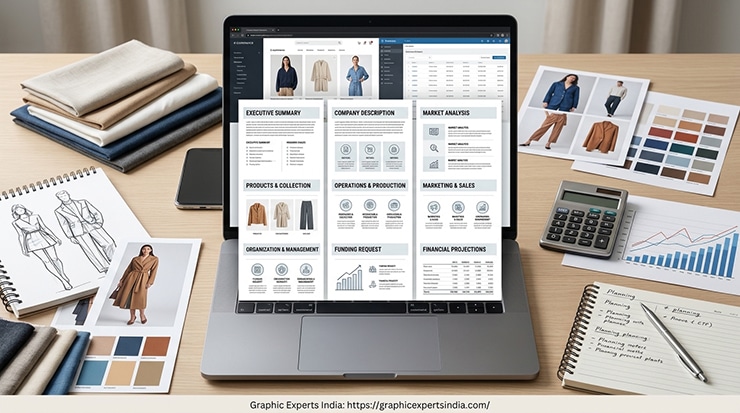
- US Small Business Administration publishes both the traditional and lean start-up formats, with example plans for each, at sba.gov/business-guide/plan-your-business/write-your-business-plan. Use it for a loan application.
- Shopify offers a free downloadable template with seven sections (executive summary, company overview, products or services, market analysis, marketing plan, logistics and operations plan, financial plan) at shopify.com/blog/business-plan-template (updated 27 August 2026). Use it for an online-first brand.
- LivePlan hosts a “Clothing E-Commerce Site Business Plan” sample for a fictional company, Liquid Culture, organised as executive summary, opportunity, execution, company and financial plan (liveplan.com, sample business plans, clothing and fashion brand). The full sample sits behind a sign-up. Use it to see how an apparel plan reads end to end.
Whichever template is used, add the two apparel sections above that generic templates lack: the collection plan with imagery format per style, and the operations line for the product-photo workflow with a named vendor, per-image price and turnaround.
What Mistakes Weaken a Fashion Business Plan?
A fashion business plan is weakened most often by uncited market figures, missing unit economics, an unrealistic margin, no return-rate assumption and an operations section that omits imagery. Each has a direct fix.
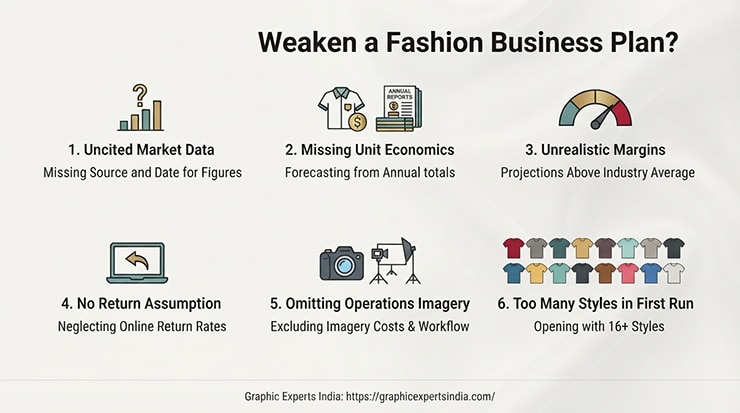
- Uncited or stale market data. Cite the source and date for every figure, as the market analysis section above does. A US$1.92 trillion global market figure without “Statista, 2026” next to it reads as a guess.
- Annual totals without per-unit numbers. Build the forecast from one garment’s unit economics upward.
- A net margin above the industry. Apparel companies averaged a 3.85% net margin in January 2026 (NYU Stern, Damodaran). A projection far above that needs an explanation.
- No return assumption. Online returns were an estimated 19.3% of sales in 2025 (NRF and Happy Returns). Model them, and show the imagery investment that supports a lower figure.
- Imagery left out of operations. The photo and editing workflow, its cost per image and its lead time belong in the plan; a 60-image first catalogue costs about $3,000 studio-produced or under $100 self-shot and edited, and that difference belongs in the funding request.
- Too many styles in the first run. Sewport’s figures scale from $12,000 for four pieces to $50,900 for sixteen; a plan that opens with sixteen styles quadruples the capital at risk before demand is proven.
What Do Founders Ask Most Often About Clothing Brand Business Plans?
A traditional clothing brand business plan “can be dozens of pages long,” while the lean start-up format is “typically only one page,” according to the US Small Business Administration. Length follows the funding ask: a loan or investor request needs the full nine sections; a self-funded print-on-demand test needs the one-page canvas.
A business plan is not legally required, but lenders and investors “commonly request” the traditional format, according to the US Small Business Administration. A self-funded founder still benefits from the unit-economics and return-rate sections, because those two numbers decide whether a $35 garment is profitable after a $66 acquisition cost.
A clothing brand plan needs unit economics per style, a sales forecast, a profit-and-loss statement, a cash-flow statement and a break-even calculation, covering the five-year outlook the SBA asks for with quarterly or monthly detail in year one. Benchmark the gross margin against the 56.88% apparel industry average (NYU Stern, January 2026).
Yes. The US Small Business Administration publishes traditional and lean templates with examples; Shopify offers a free seven-section download (updated August 2026); Live Plan hosts a clothing e-commerce sample plan. Add a collection plan and a product-imagery workflow line, which generic templates omit.
The marketing section should name the channels, the assumed customer acquisition cost ($66 to $129 in published fashion benchmarks), the conversion rate (1.81% for fashion stores in July 2026 per IRP Commerce), the return-rate assumption (19.3% of online sales in 2025 per NRF) and the launch calendar with the product imagery each campaign needs.
Where Can a Clothing Brand Get the Imagery Line of Its Plan Priced?
A clothing brand can price the imagery line of its operations section from Graphic Experts India’s published rates: background removal from $0.39 per image, ghost mannequin editing from $1.49 per image and e-commerce retouching from $0.99 per image, each with a 24-hour average turnaround and a three-step quality check.
Founders who need a vendor name, per-image price and turnaround for the plan can request a free trial on sample images through the ghost mannequin service page and use the returned files as the imagery standard in the collection plan.

Salim Ahmed is the CEO of Graphic Experts India, with over 25 years of expertise in photo editing, clipping path, image retouching, and eCommerce image editing services.