

Fashion e-commerce platforms are the hosted storefronts and marketplaces a clothing brand sells through, and the practical differences between them are the monthly plan, the fee per order and the product image specification each one enforces.
This guide compares five storefront platforms (Shopify, WooCommerce, BigCommerce, Wix and Squarespace), four marketplaces (Amazon, Etsy, eBay and Walmart) and Google Merchant Center on those three dimensions, using each platform’s own pricing and help pages as read on 29 September 2026.
It is not a ranking: the right platform depends on whether the brand needs an owned store, marketplace reach or both, and the image specification is the constraint that turns out to be shared by all of them.
The platform choice is Step 3 of the guide on how to start an online clothing store.

What Do Fashion eCommerce Platforms Have in Common at a Glance?
Fashion e-commerce platforms share three things: an entry price near $29 to $39 per month for storefronts and $0 to $39.99 for marketplaces, a card or referral fee per order, and a product image rule set that converges on square, high-resolution, clean-background images with apparel shown on a person.
| Question | Short answer | Source |
|---|---|---|
| What does a storefront cost? | Shopify, BigCommerce and Squarespace entry plans are $29 per month billed annually or $39 monthly; WooCommerce is free with hosting from $25 per month | Platform pricing pages |
| What do marketplaces charge? | Amazon $39.99 per month plus 17% referral on clothing over $20; Etsy $0.20 per listing plus 6.5%; eBay 15% final value fee on clothing; Walmart 15% referral on apparel over $20, no monthly fee | Platform fee pages |
| What image size is safe everywhere? | A 3000-pixel square master exports to every platform’s recommendation (Shopify 2048, Etsy 2000, Walmart 2200, Wix 3000, Google ~1500) | Platform help pages |
| Which platforms require apparel on a person? | Amazon (adult apparel on-model) and Google Merchant Center (“worn by people”); Baymard finds 23% of sites still omit human-model images | Amazon guidelines; Google; Baymard 2026 |
| What background is required? | Pure white (RGB 255) on Amazon and Walmart; white or transparent recommended by Google; no watermarks or overlays on eBay, Google or Walmart | Platform help pages |
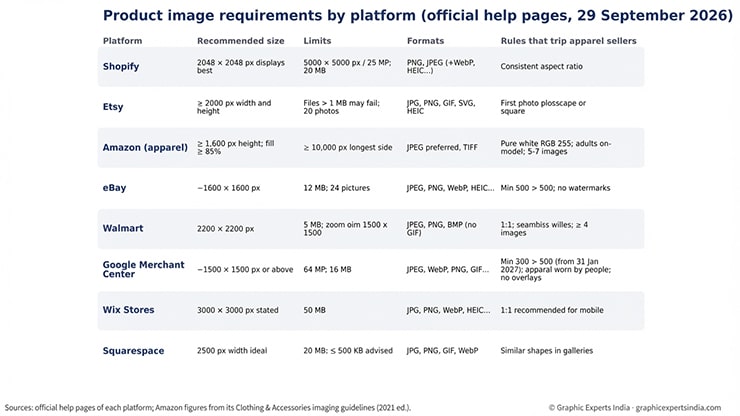
Figure 1. Product image requirements by platform, from official help pages read on 29 September 2026.
What Is a Fashion eCommerce Platform?
A fashion e-commerce platform is software that hosts a clothing brand’s product catalogue, product pages, checkout and payments, either as the brand’s own storefront or as a shared marketplace.
Storefront platforms (Shopify, WooCommerce, BigCommerce, Wix, Squarespace) give the brand its own domain, design and customer data in exchange for a subscription and a card-processing fee.
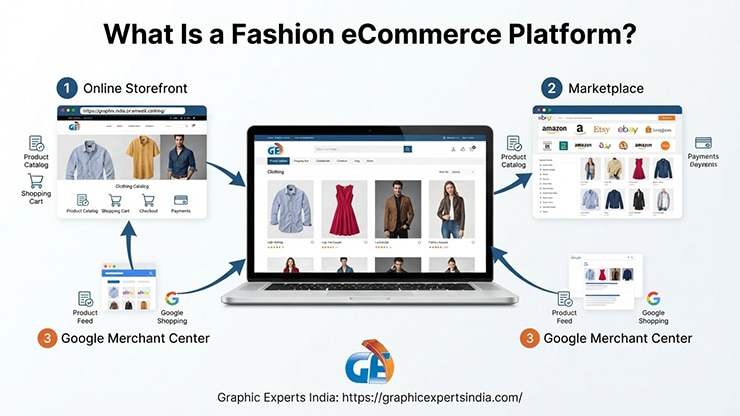
Marketplaces (Amazon, Etsy, eBay, Walmart) supply the traffic and take a percentage of each sale, and they publish the image standards the brand must meet to list at all. Google Merchant Center is neither: it is the product feed that puts a store’s items into Google Shopping, and it has its own image rules.
The image requirement is the one dimension every platform shares, because every platform renders the same product photo in a grid, a page and a zoom view. Consequently, a clothing brand that produces one master image set to the strictest specification can list on any of them.
The sections below give the plan, the fee and the image rule for each, then the master specification that satisfies all of them.
How Do the Storefront Platforms Compare on Price, Fees and Images?
The five storefront platforms cost between $25 and $39 per month at entry level, charge about 2.9% + 30¢ per card transaction on their own payment systems, and differ mainly in their recommended image size and their apparel features.
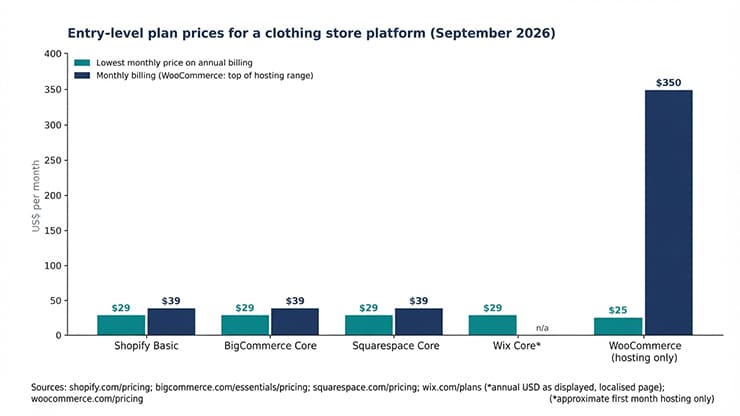
Figure 2. Entry-level plan prices, September 2026. Wix shown as displayed on a localised page in USD; WooCommerce shows its stated hosting range.
What Does Shopify Cost, and What Are Its Image Rules?
Shopify’s Basic plan costs $39 per month billed monthly or $29 per month billed annually, with a 2.9% + 30¢ online card rate and a 2% fee for third-party payment providers; Grow is $105 or $79, Advanced $399 or $299, and new stores get three days free then $1 per month for three months (shopify.com/pricing).
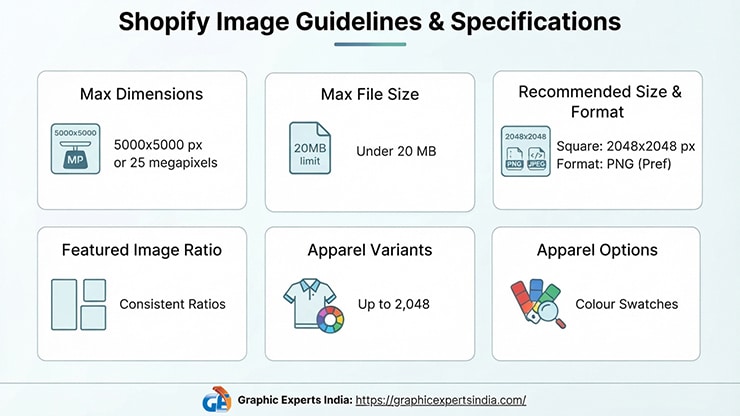
Product images can be “any size up to 5000 x 5000 px, or 25 megapixels” and under 20 MB, and “for square product images, a size of 2048 x 2048 px usually displays best”; PNG is preferred, followed by JPEG, and featured images should share “a consistent aspect ratio” (Shopify Help Center).
For apparel, a product can carry up to 2,048 variants across three options, and color variant options can display as swatches on themes that support them (Shopify Help Center).
What Does WooCommerce Cost, and What Are Its Image Rules?
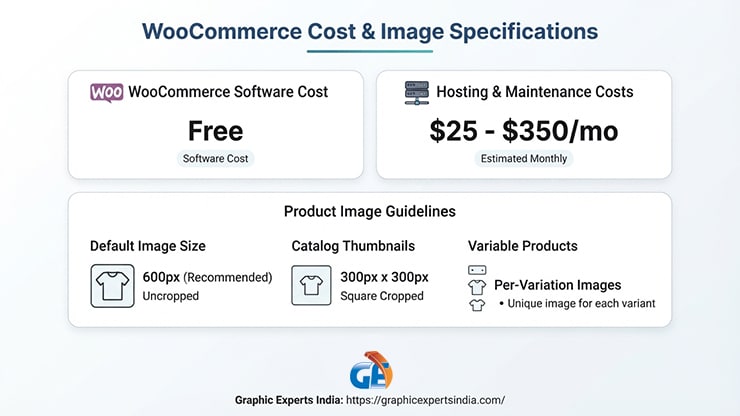
WooCommerce is “the free, open-source ecommerce platform for WordPress,” with hosting at “$25 – $350/month for most stores” and WooPayments card fees of 2.90% + $0.30 on US domestic cards (woocommerce.com/pricing; WooPayments fee page).
Its image handling is theme-driven: the single product image “defaults to 600px width” and “is always uncropped by default,” catalogue thumbnails default to 300 pixels square-cropped, and store owners can choose 1:1, custom or uncropped thumbnail ratios (WooCommerce developer documentation).
WooCommerce publishes no recommended upload size, so the master-file rule below applies. Variable products carry per-variation images and stock, and native color swatches arrived in WooCommerce 10.9 behind a feature flag for block themes (WooCommerce developer blog, 3 June 2026).
What Does BigCommerce Cost, and What Are Its Image Rules?
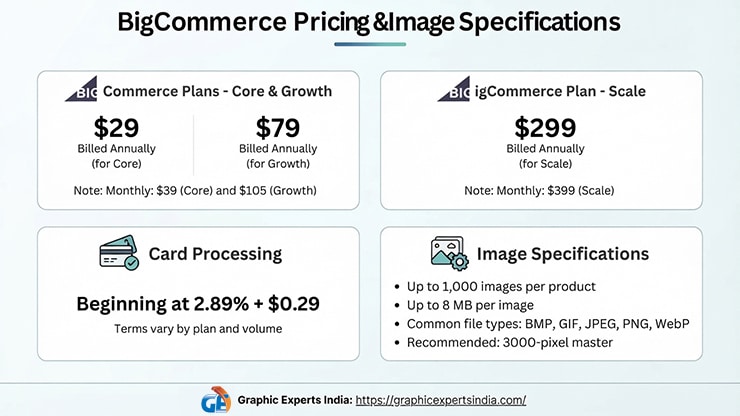
BigCommerce’s Core plan is $39 per month billed monthly or $29 annually for stores up to $30,000 in trailing-twelve-month sales; Growth is $105 or $79 and Scale $399 or $299, and card processing “begins at 2.89% + $0.29 per transaction” (bigcommerce.com/essentials/pricing).
BigCommerce’s API documentation states that each product image “can be up to 8 MB,” supports BMP, GIF, JPEG, PNG, WBMP, XBM and WebP, and allows up to 1,000 images per product.
BigCommerce’s help-centre recommendation for image dimensions could not be read at the time of writing, so the 3000-pixel master rule below is the safe assumption.
What Does Wix Cost, and What Are Its Image Rules?
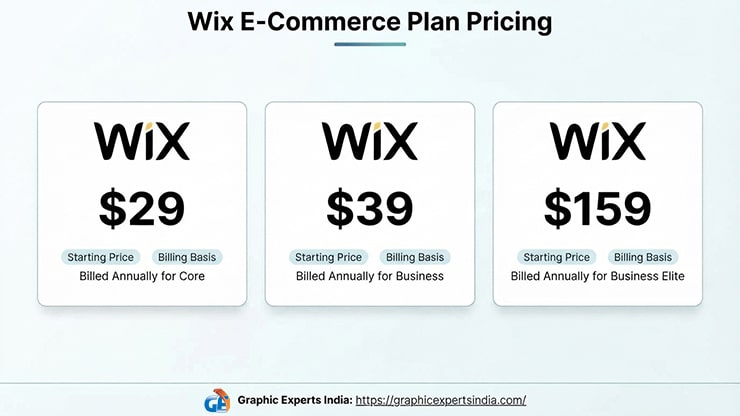
Wix’s e-commerce-enabled plans are Core, Business and Business Elite, displayed on its plans page at $29, $39 and $159 per month on annual billing in USD (wix.com/plans, localised page; confirm US pricing before publishing).
Wix Stores states a “minimum resolution: 3000 x 3000 pixels” for product images, supports 16:9, 3:2, 4:3, 1:1, 3:4, 2:3 and 9:16 ratios, and recommends 1:1 for mobile; image files can be up to 50 MB in JPG, PNG, WebP, HEIC and other formats (Wix Help Center).
Wix’s 3000-pixel figure is the largest stated recommendation among the storefront platforms.
What Does Squarespace Cost, and What Are Its Image Rules?
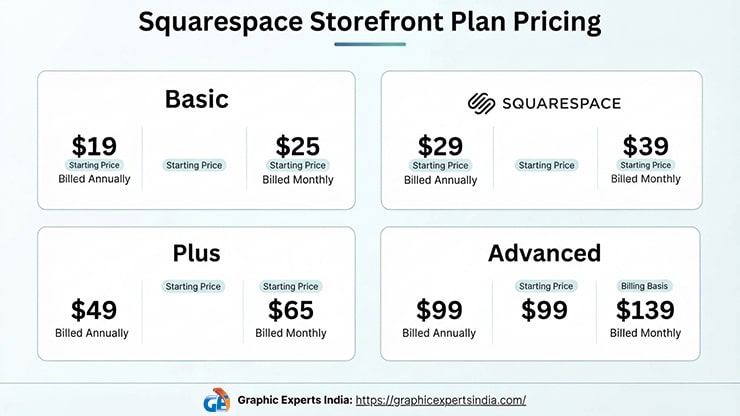
Squarespace’s plans are Basic at $19 per month annually or $25 monthly, Core at $29 or $39, Plus at $49 or $65 and Advanced at $99 or $139; Basic carries a 2% online-store transaction fee and the others 0%, with card processing at 2.9% + 30¢ on Basic and Core (squarespace.com/pricing).
Squarespace’s image guidance states that “a width of 2500 pixels is ideal for most images,” sets a 20 MB limit, recommends files of 500 KB or less for loading speed, accepts only .jpg, .gif, .png and .webp, and notes that gallery images “display best if all images have a similar shape” (Squarespace Help Center, updated 22 June 2026).
How Do the Marketplaces Compare on Fees and Image Requirements?
The four marketplaces charge between 6.5% and 17% of each clothing sale and publish stricter image rules than storefronts, because a marketplace grid places every seller’s photo next to every other’s.
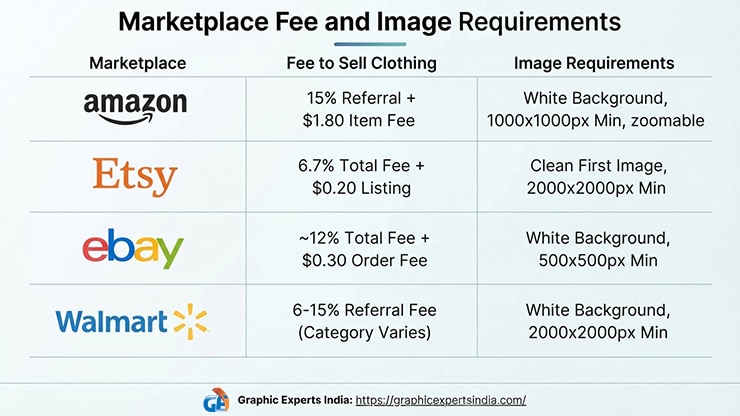
| Marketplace | Fee to sell clothing | Image requirement (official pages) |
|---|---|---|
| Amazon | Professional plan $39.99 per month; Clothing & Accessories referral fee 5% up to $15, 10% from $15 to $20, 17% above $20; $0.30 minimum | Main image pure white RGB 255, product filling at least 85% of the frame, at least 1,600 pixels high, JPEG preferred; adult apparel on-model, kids and accessories off-model; visible and ghost mannequins prohibited in the main image; 5 to 7 images (Clothing & Accessories imaging guidelines, Spring 2021) |
| Etsy | $0.20 listing fee; 6.5% transaction fee on price plus shipping; US payment processing 3% + $0.25; Offsite Ads 15% or 12% | “At least 2000 pixels” in width and height recommended; first photo at least 635 pixels and landscape or square; files over 1 MB may not upload; JPG, PNG, GIF, SVG, HEIC; up to 20 photos and 2 videos per listing (Etsy Help) |
| eBay | Clothing, Shoes & Accessories final value fee 15% on sales up to $2,000 and 9% above; $0.30 or $0.40 per-order fee | Minimum 500 × 500 pixels, recommended about 1600 × 1600; up to 24 pictures; 12 MB each; no badges, logos, copyright notices or watermarks; white backgrounds recommended (eBay Help) |
| Walmart Marketplace | No setup or monthly fee; Apparel & Accessories referral fee 5% up to $15, 10% from $15 to $20, 15% above $20 | 2200 × 2200 pixels; minimum 1500 × 1500 for zoom; 1:1 aspect ratio; seamless white RGB 255 background; JPEG, PNG or BMP under 5 MB; at least four images per listing (Walmart Marketplace Learn, updated 12 May 2026) |
Amazon’s rule set is the strictest and the most apparel-specific. It is also the one most often failed by print-on-demand sellers, because the supplier mockup is neither on-model nor 1,600 pixels high.
Walmart’s 2200-pixel requirement is the largest fixed dimension of the four. Etsy’s 1 MB upload ceiling is the opposite constraint: a 2000-pixel JPEG must be compressed to pass. A master file at 3000 pixels handles all three cases with one export per platform.
What Does Google Merchant Center Require From Clothing Product Images?
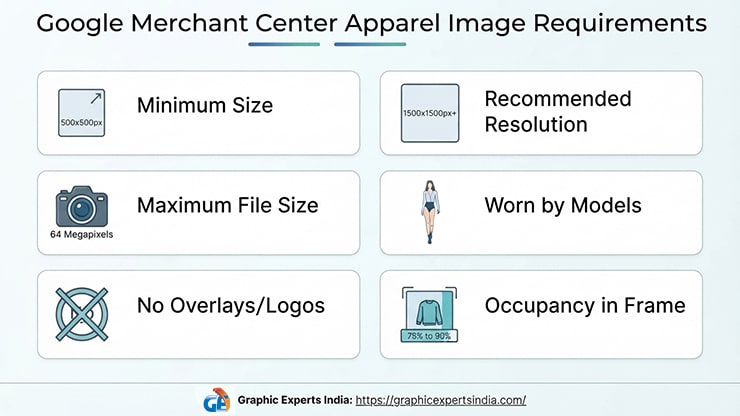
Google Merchant Center requires product images of at least 500 × 500 pixels for all products from 31 January 2027, recommends “images around 1500×1500 pixels or above,” caps files at 64 megapixels and 16 MB, and for apparel states: “Provide images of products worn by people for clothing (apparel) products,” adding that a full-body image should not crop the model’s head or feet (Google Merchant Center Help).
Google prohibits promotional elements and overlays, “for example, watermarks, brand names, logos (unless it’s an inherent part of the product itself),” borders, placeholders and generic images, and asks that the product occupy no less than 75% and no more than 90% of the frame.
Google also requires four attributes for apparel products in free listings and in Shopping ads in the United States and five other countries: size, color, gender and age_group (Google Merchant Center attribute specifications).
A clothing brand’s product feed therefore needs a color-accurate image per colorway and a size value per variant, which ties the image workflow to the data workflow: the image labelled “teal” has to be the teal the customer receives.
What One Image Specification Satisfies Every Fashion Platform?
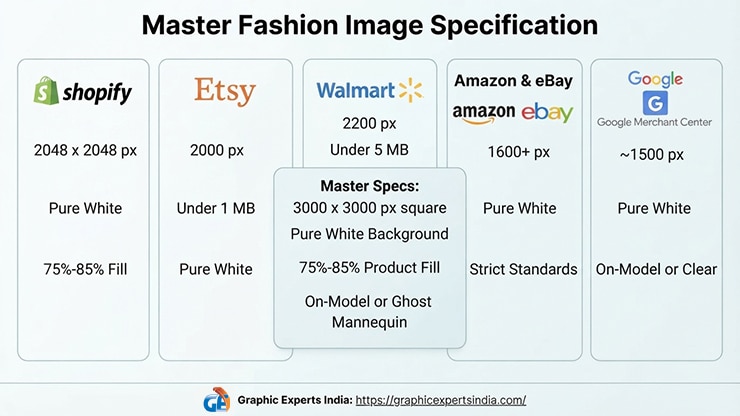
One master specification satisfies every platform in this guide: a square image at 3000 × 3000 pixels or larger, in sRGB, on a pure white RGB 255 background for the main image, with the garment filling 75% to 85% of the frame, no text or logo overlays, and, for adult apparel, an on-model version alongside the flat or ghost-mannequin version.
From that master, the exports are mechanical: 2048 pixels for Shopify, 2000 pixels under 1 MB for Etsy, 2200 pixels under 5 MB for Walmart, 1600 pixels or more for Amazon and eBay, and about 1500 pixels for Google.
The specification also fixes the shoot. Baymard Institute’s 2026 benchmark found that 37% of sites lack “in scale” images and 23% do not provide human-model images for wearable products, and its 2020 study found 25% of sites with insufficient image resolution or zoom (Baymard, updated 18 March 2026; 2 April 2020).
Shooting at 3000 pixels on a model removes all three failures at once. The production route is a cost choice: studio product images from $50 per image and on-model from $95 per image (Squareshot); or a self-run shoot with background removal from $0.39 per image and ghost mannequin editing from $1.49 per image at Graphic Experts India, whose e-commerce product photo editing service lists the Amazon, Shopify, eBay, Walmart and Etsy specifications it edits to.
The Amazon-specific conventions, including the 85% fill and the zoom threshold, are explained in the guide to Amazon photo editing.
Which Fashion eCommerce Platform Should a Clothing Brand Choose?
A clothing brand should choose an owned storefront for margin and customer data, add the marketplace whose fee structure fits its price point, and let the image specification be the same across both. The decision reduces to four published facts.
- Price point under $20. Amazon’s and Walmart’s referral fees fall to 5% or 10% below $20, while Etsy’s 6.5% plus processing and eBay’s 15% do not change; a low-priced tee brand pays least on Amazon or Walmart.
- Price point over $20. Amazon charges 17% and Walmart 15% above $20; Etsy’s 6.5% plus 3% + $0.25 processing is lower, and an owned Shopify store pays 2.9% + 30¢ plus the subscription.
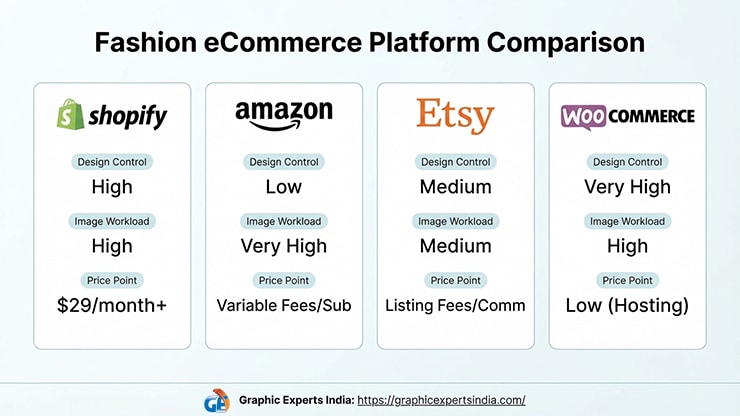
- Design control. Storefront platforms allow the brand’s own domain and layout; Wix and Squarespace are template-led, Shopify and BigCommerce app-led, WooCommerce code-led.
- Image workload. Every option requires the same master set; only Amazon adds the on-model rule for adult apparel, and only Etsy adds the 1 MB ceiling.
The market-share figures often quoted for these platforms come from third-party estimates whose underlying data is not public, so this guide does not use them; the plan prices, fees and image rules above are what a founder can verify on the platforms’ own pages.
What Do Founders Ask Most Often About Fashion eCommerce Platforms?
Shopify, BigCommerce and Squarespace cost the same at entry level ($29 per month annually, $39 monthly) and WooCommerce is free with hosting; the choice depends on design control and apps for size charts and swatches. Every platform needs the same 3000-pixel, white-background, on-model image set, so the image workload does not decide it.
Shoot a 3000 × 3000 pixel master and export per platform: 2048 pixels for Shopify, at least 2000 pixels under 1 MB for Etsy, 2200 pixels for Walmart, at least 1,600 pixels high for Amazon, about 1600 for eBay and around 1500 for Google Merchant Center. Wix Stores states 3000 pixels as its own figure.
On Amazon, yes for adult apparel: its Clothing & Accessories guidelines require adult apparel on-model and kids’ items off-model. Google Merchant Center asks for apparel “worn by people.” Other platforms do not require it, but Baymard found 23% of sites omit human-model images for wearables, and 28% of apparel returns are “didn’t look the way I thought it would.”
Below $20, Amazon and Walmart charge 5% or 10% referral fees; above $20, Etsy’s 6.5% plus 3% + $0.25 processing is lower than Amazon’s 17%, Walmart’s 15% and eBay’s 15%. Amazon also charges $39.99 per month for a Professional account; Walmart has no monthly fee.
Yes, if the master image meets the strictest rule set: square, 3000 pixels or larger, pure white RGB 255 background, no overlays, garment filling 75% to 85% of the frame, plus an on-model version for adult apparel. Each platform’s version is then an export, not a new shoot.
Where Can a Clothing Brand Get One Image Set Edited for Every Platform?
A clothing brand can send one master set of product photos to Graphic Experts India, which edits to Amazon, Shopify, eBay, Walmart and Etsy specifications, with background removal to pure white from $0.39 per image, ghost mannequin editing from $1.49 per image and e-commerce retouching from $0.99 per image, each with a 24-hour average turnaround and a three-step quality check.
A free trial on sample images is available through the background removal service page, returned within 24 hours with no credit card required.

Salim Ahmed is the CEO of Graphic Experts India, with over 25 years of expertise in photo editing, clipping path, image retouching, and eCommerce image editing services.