

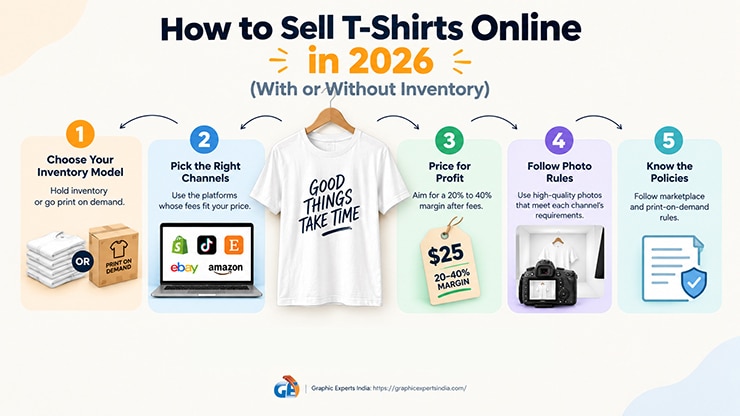
To sell t-shirts online, you choose between holding inventory and print on demand, pick the channels whose fees fit your price, price each shirt for a 20% to 40% margin after those fees, produce photos that meet each channel’s rules, and follow the marketplace policies that govern print-on-demand sellers.
Selling t-shirts online, whether as a tee brand, a designer selling on artist marketplaces or a creator selling merch, is the distribution half of a t-shirt business; making the shirts is covered in the guide on how to start a t-shirt business.
This guide covers where to sell, what each channel takes from a $25 shirt, how to sell without inventory, the policies that apply, and the photo rules, with every figure taken from the platforms’ own pages on 29 September 2026.
What Does Selling T-Shirts Online Involve at a Glance?
Selling t-shirts online involves choosing among five channel types, each with a published fee, and one of two inventory models, each with a published cost structure.
| Question | Short answer | Source |
|---|---|---|
| How big is the market? | The custom t-shirt printing market was US$5.2 billion in 2024, estimated at US$6.3 billion in 2026 and US$9.8 billion by 2030 | Grand View Research, November 2024 |
| What does Etsy take? | $0.20 per listing, 6.5% of price plus shipping, and 3% + $0.25 US payment processing; 5.6 million active sellers | Etsy fees and payments policies; Etsy 10-K for 2025 |
| What does Amazon take? | 17% referral on clothing over $20 plus $39.99 per month | sell.amazon.com/pricing |
| What does a print-on-demand tee cost? | Bella+Canvas 3001 from $11.69 at Printful and $10.98 at Printify | Printful, May 2026; Printify, April 2026 |
| What margin should a tee earn? | “20% to 40% for most sellers” (Printful); a 40% margin is “a solid benchmark” (Printify) | Printful, September 2026; Printify, April 2026 |
| Can you sell print on demand on Etsy? | Yes, if the design is yours and the production partner is disclosed on the listing | Etsy Seller Policy and Help |
Where Can You Sell T-Shirts Online?
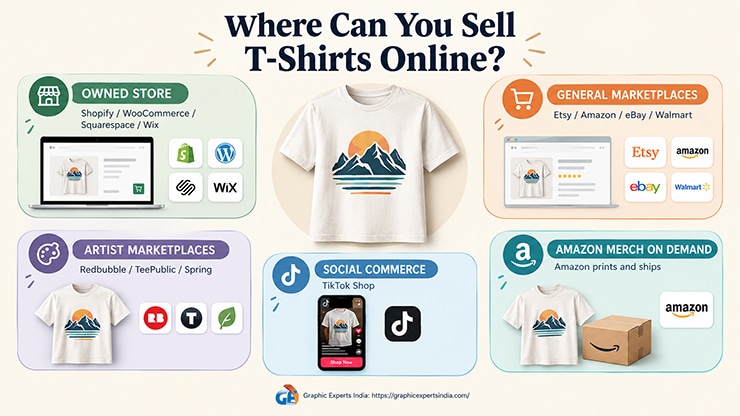
T-shirts can be sold online through five channel types: an owned store, general marketplaces, artist print-on-demand marketplaces, social commerce, and Amazon’s Merch on Demand programme. The channels differ in who sets the price, who prints the shirt and what each takes per sale.
- Owned store (Shopify, WooCommerce, Squarespace, Wix): you set the price and keep the customer data; Shopify Basic costs $29 per month billed annually or $39 monthly with a 2.9% + 30¢ card rate (shopify.com/pricing).
- General marketplaces (Etsy, Amazon, eBay, Walmart): the platform supplies traffic and takes a percentage; fees and image rules are compared in the guide to fashion eCommerce platforms and their product image requirements.
- Artist marketplaces (Redbubble, TeePublic, Spring): the platform prints, ships and sets the base price; you earn a markup or a flat amount per shirt.
- Social commerce (TikTok Shop): a 6% referral fee applied to menswear and womenswear categories under the schedule effective 31 October 2024 (TikTok Shop Seller University); a later schedule was not published at the time of writing.
- Amazon Merch on Demand: Amazon prints and ships and pays a royalty; the current royalty rates and design-slot tiers are published only inside the programme account.
What Does Each Channel Take From a $25 T-Shirt?
On a $25 t-shirt, per-order platform and payment fees range from about $1.03 on an owned Shopify store to $4.25 on Amazon, before subscriptions, shipping and advertising.
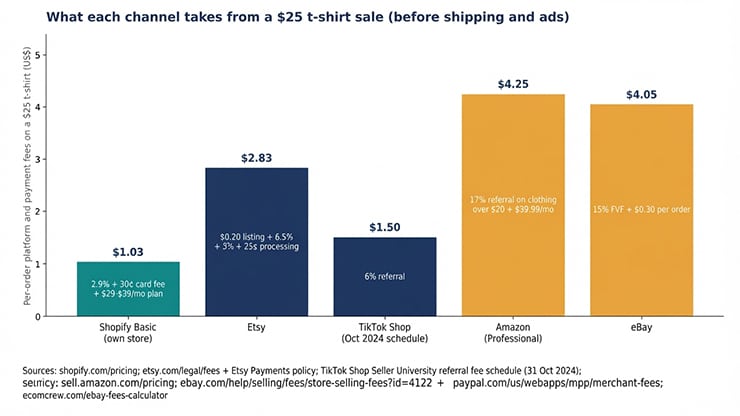
Figure 1. Per-order fees on a $25 t-shirt by channel, from each platform’s published fee schedule on 29 September 2026. Shopify and Amazon also charge monthly subscriptions.
| Channel | Fee rule | Fee on a $25 shirt |
|---|---|---|
| Shopify Basic (own store) | 2.9% + 30¢ card rate; plan $29–$39 per month | $1.03 plus the plan |
| TikTok Shop | 6% referral (schedule effective 31 October 2024) | $1.50 |
| Etsy | $0.20 listing + 6.5% transaction + 3% + $0.25 processing | $2.83 |
| eBay | 15% final value fee on clothing up to $2,000 + $0.30 per order | $4.05 |
| Amazon | 17% referral on clothing over $20; Professional plan $39.99 per month | $4.25 plus the plan |
Fees compound with production cost. A print-on-demand Bella+Canvas 3001 costs $11.69 at Printful (14 May 2026) or $10.98 at Printify (21 April 2026) before shipping. On Amazon, a $25 shirt therefore leaves about $9.06 after the $11.69 blank and the $4.25 fee, before the monthly plan, shipping and advertising; on an owned store it leaves about $12.28 before the plan.
Printful’s guidance is that “print-on-demand profit margins usually range from 20% to 40% for most sellers” (updated 21 September 2026), and Printify calls a 40% margin “a solid benchmark for a sustainable custom t-shirt business in 2026” (21 April 2026), pricing by the formula “Retail price = Total cost ÷ (1 – desired profit margin %).”
How Do You Sell T-Shirts Online Without Inventory?
To sell t-shirts online without inventory, connect a print-on-demand supplier to your store or list on an artist marketplace, so that each shirt is printed after it is ordered. Two structures exist, and they differ in who controls the price.
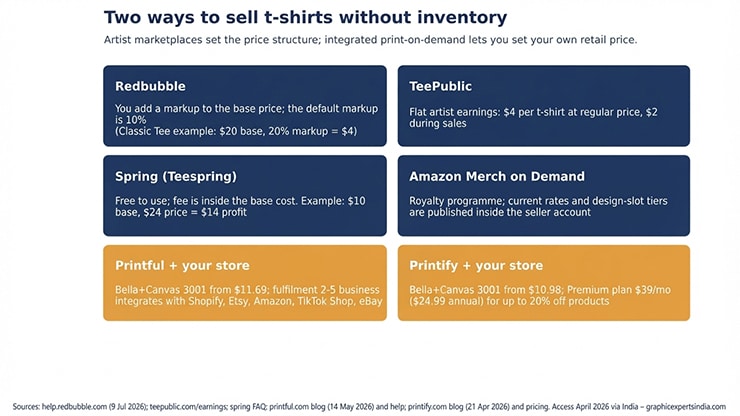
Figure 2. Two ways to sell t-shirts without inventory: artist marketplaces that set the base price, and integrated print on demand where you set the retail price.
Artist marketplaces
Artist marketplaces Set the base price and pay a margin. Redbubble’s “markup defaults to 10%, but you are free to raise or lower that amount”; its worked example is a Classic T-Shirt at a $20 base with a 20% markup, giving a $4 margin at a $24 retail price (Redbubble Help, updated 9 July 2026).
TeePublic pays flat artist earnings of $4 per t-shirt at regular price and $2 during sales (teepublic.com/earnings).
Spring is free to use, with its fee “included in the base cost of the product”; its example is a $10 base and a $24 selling price, leaving $14 (spri.ng FAQ). These channels bring their own audiences and remove fulfilment, in exchange for margins the seller does not control.
Integrated print on demand
Integrated print on demand connects a supplier to a store or marketplace you run. Printful integrates with Shopify, WooCommerce, Wix, Squarespace, Etsy, TikTok Shop, Amazon and eBay; Printify lists Etsy, TikTok Shop, eBay and Amazon among marketplaces and Shopify, Squarespace, Wix, WooCommerce, BigCommerce and others among stores (printful.com; printify.com/integrations).
Fulfilment takes “2–5 business days across most production techniques” at Printful, with over 97% of orders shipping within five business days (Printful Help); Printify states “most orders are shipped within 2-7 business days” (Printify Help).
Printful’s plans are free or $24.99 per month for Growth, which is free once sales reach $12,000 a year; Printify’s Premium plan is $39 per month or $24.99 billed yearly, for up to 20% off products.
The seller who wants inventory later can start here: print on demand carries “$0 upfront” per Printful, and the designs that repeat can move to a screen-printed run at a 24-shirt minimum, as described in the t-shirt business guide.
Which Policies Apply to Selling Print-on-Demand T-Shirts on Etsy?
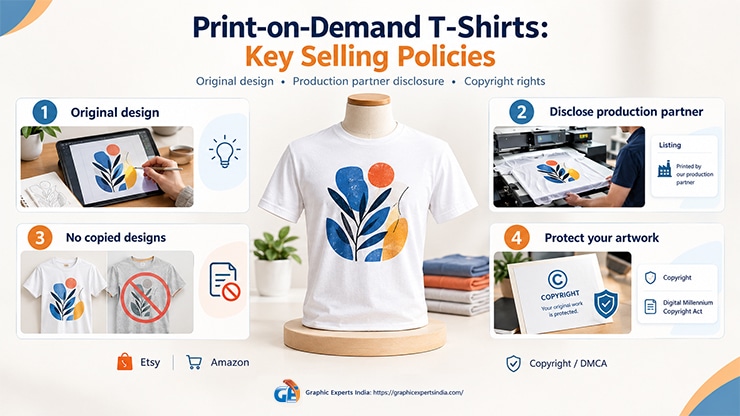
Etsy allows print-on-demand t-shirts if the design is the seller’s own and the production partner is disclosed on the listing. Etsy’s Seller Policy states: “If you work with a production partner, you must disclose that production partner in your relevant listings.”
A production partner is “a company or individual (who’s not part of your Etsy shop) that physically produces items based on your own, original designs from start to finish,” and Etsy names print-on-demand companies such as Printful and Printify as one category (Etsy Help, “Working with Production Partners on Etsy”).
Etsy’s drop-shipping page draws the line: using production partners “is allowed on Etsy, as long as the items being sold are the seller’s original design (or the buyer’s customization),” and selling products the seller “did not design and buyers did not personalize” violates policy.
Etsy’s Creativity Standards (updated 10 June 2025) classify such listings as “Designed by a seller: Sellers’ original designs that are produced or printed by a third party or offered as a digital download.” The marketplace had 86.5 million active buyers and 5.6 million active sellers at 31 December 2025, according to Etsy’s annual report, so the disclosure requirement is the price of access to that audience.
Amazon has no equivalent designer test but requires the seller to hold the rights to the artwork; on any channel, a design’s copyright can be registered for $45 as a single work by a single author (US Copyright Office fee schedule), and infringing listings can be removed through the notice-and-takedown system created by section 512 of the Digital Millennium Copyright Act (copyright.gov).
What Photos Do You Need to Sell T-Shirts Online?
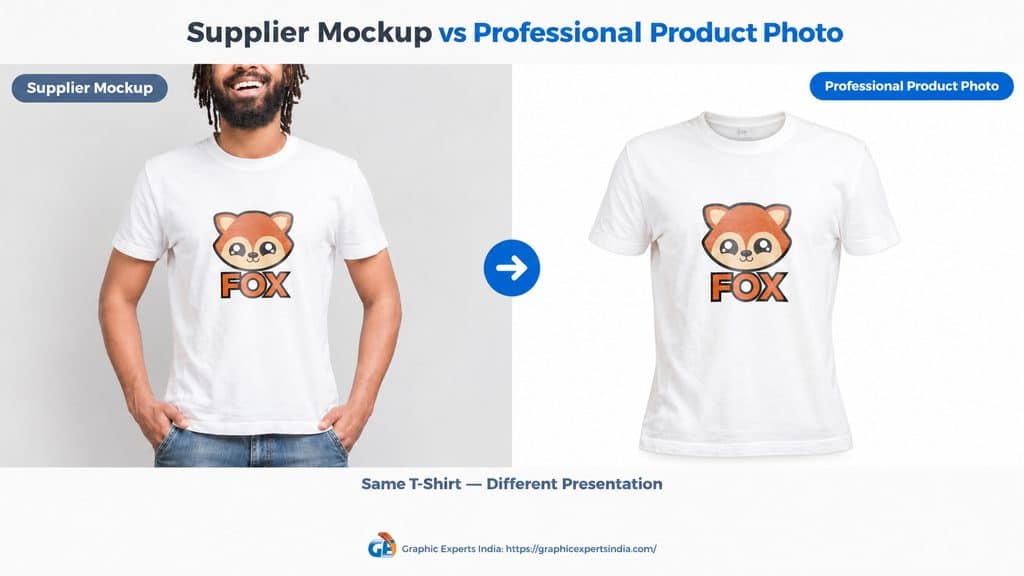
To sell t-shirts online, each design needs at least one real product photo on a white background, and for Amazon, an on-model image, in addition to any supplier mockup.
Amazon’s Clothing & Accessories imaging guidelines (Spring 2021 edition) require that “all adult apparel should be imaged on-model,” that main images have “a pure white background (RGB Value 255, HEX Value #FFFFFF)” and are “at least 1,600 pixels in height,” and they prohibit visible and ghost mannequins in the main image.
Etsy recommends listing photos of “at least 2000 pixels” in width and height, with the first photo landscape or square and files under 1 MB (Etsy Help). In Etsy’s buyer surveys, “90 percent of shoppers said the quality of the photos were ‘extremely important’ or ‘very important’ to a purchase decision” (Etsy Seller Handbook).
A print-on-demand mockup fails the Amazon rule and matches every competitor’s listing, because every seller on the platform uses the same supplier template.
The fix is one sample order per design, shot flat and on a person against a plain background, then edited: background removal to pure white from $0.39 per image and ghost mannequin editing from $1.49 per image at Graphic Experts India, with a 24-hour average turnaround, against studio product images from $50 and on-model images from $95 per image at Squareshot.
The mannequin setup is in the ghost mannequin photography and editing guide, and creative lifestyle setups for social channels are in the guide to t-shirt photography ideas for apparel photoshoots.
How Do You Get Sales Once the Shirts Are Listed?
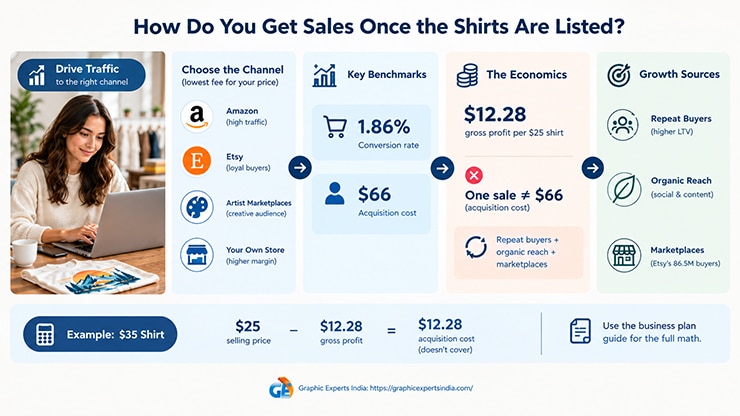
To get sales, drive traffic to the channel with the lowest fee for your price, and measure it against the category’s conversion and acquisition benchmarks.
Fashion clothing and accessories stores converted 1.86% of visits in August 2026 (IRP Commerce market data), and fashion and apparel e-commerce companies averaged a $66 customer acquisition cost between 2020 and 2025 (First Page Sage, updated 15 August 2025).
At $12.28 gross on a $25 shirt sold from an owned store, one new customer’s first order does not cover a $66 acquisition cost; the economics rely on repeat buyers, organic reach and marketplace traffic, which is why the artist marketplaces and Etsy’s 86.5 million buyers remain attractive despite their fee and margin structures.
The acquisition arithmetic, with a worked $35 example, is in the clothing brand business plan guide.
What Do Founders Ask Most Often About Selling T-Shirts Online?
Connect a print-on-demand supplier such as Printful (Bella+Canvas 3001 from $11.69) or Printify (from $10.98) to a Shopify, Etsy, Amazon or TikTok Shop listing, or upload designs to an artist marketplace such as Redbubble, TeePublic or Spring, which print and ship each order and pay a markup or a flat amount per shirt.
It depends on price. On a $25 shirt, an owned Shopify store takes about $1.03 per order plus the plan, TikTok Shop $1.50, Etsy $2.83, eBay $4.05 and Amazon $4.25 plus $39.99 per month. Etsy adds 86.5 million active buyers; Amazon adds the strictest photo rules.
Printful states that print-on-demand margins “usually range from 20% to 40% for most sellers”; Printify calls 40% a solid benchmark. A $25 print-on-demand shirt leaves about $9 to $12 after the blank and channel fees, before shipping and advertising, so profit depends on repeat customers and low-fee channels.
Yes. Etsy allows production partners, including print-on-demand services, as long as the items are the seller’s original design, and its Seller Policy requires the production partner to be disclosed in the relevant listings. Listings fall under Etsy’s “Designed by a seller” creativity standard.
For Amazon, yes: adult apparel must be imaged on-model on a pure white background at 1,600 pixels or more. Everywhere else, real photos differentiate a listing from the identical supplier mockups other sellers use, and 90% of Etsy shoppers rate photo quality as very or extremely important. Editing starts at $0.39 per image.
Where Can a T-Shirt Seller Get Listing Photos Edited?
A t-shirt seller can shoot one sample per design and send the files to Graphic Experts India, which lists background removal from $0.39 per image, ghost mannequin editing from $1.49 per image and e-commerce retouching from $0.99 per image, each with a 24-hour average turnaround and a three-step quality check, edited to Amazon, Etsy, Shopify, eBay and Walmart specifications.
A free trial on sample images is available through the e-commerce product photo editing service page, returned within 24 hours with no credit card required.

Salim Ahmed is the CEO of Graphic Experts India, with over 25 years of expertise in photo editing, clipping path, image retouching, and eCommerce image editing services.