

Amazon allows AI-generated product images, but a 2026 rule requires sellers to disclose when an image contains a photorealistic AI-generated person.
Since an Amazon Seller Central announcement in July 2026, any listing image, video or A+ Content module that shows a photorealistic person created entirely by AI must be tagged with the metadata keyword contains-synthetic-performer before it is added, in every Amazon store worldwide.
The rule is a disclosure requirement, not a ban — and it is why editing real product photos remains the safest route to a compliant listing.
This guide explains what the 2026 policy covers, where the compliance line sits for main images, and how the AI-tool landscape looks, profiled from each vendor’s own documentation. For the full rule set, see Amazon Product Image Requirements 2026.
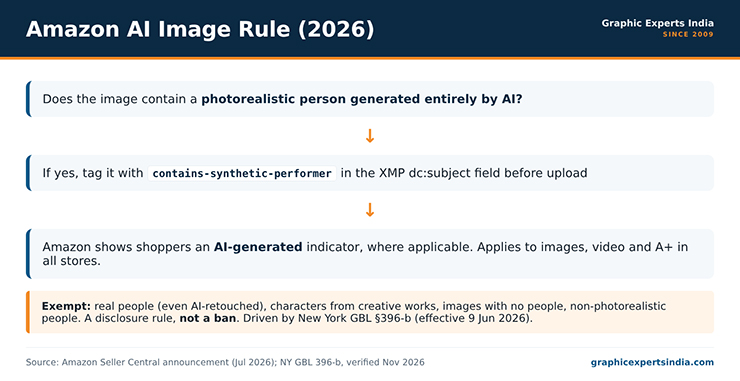
Figure 1. Amazon’s 2026 AI-image disclosure rule and its exemptions.
Does Amazon allow AI-generated product images?

Yes, Amazon allows AI-generated and AI-assisted product images, with two conditions. First, the finished image must still meet every image site standard — the main image needs a pure white background, an 85% fill, and no prohibited text or graphics, exactly as a photographed image does.
Second, the image must truthfully represent the product the buyer receives; AI may not invent features, colors or contents the real product lacks.
AI is therefore a production method, not an exemption from the rules. An AI tool that removes a background or builds a lifestyle scene is doing the same job as a human editor, and the output is judged by the same standard.
The accuracy requirement is the one AI most often breaks, because a generative model will happily render a product detail that does not exist.
What is Amazon’s 2026 AI-image disclosure rule?

Amazon’s 2026 rule requires sellers to tag any image, video or A+ Content asset that contains a photorealistic person generated entirely by AI.
According to Amazon’s Seller Central announcement in July 2026, sellers must add the keyword contains-synthetic-performer to the image’s XMP metadata, in the dc:subject field, using an IPTC-compatible metadata editor, before the asset is added to a listing. Amazon then displays an indicator to shoppers, where applicable, noting that the image includes AI-generated people.
| The 2026 rule | Detail |
|---|---|
| What must be tagged | Images, videos and A+ Content with photorealistic AI-generated people |
| How to tag | Keyword contains-synthetic-performer in the XMP dc:subject field |
| When | Before the asset is added to the listing |
| Where it applies | All Amazon stores worldwide |
| What Amazon does | Shows a shopper-facing “AI-generated” indicator where applicable |
| Penalty for the rule | A disclosure requirement, not a ban |
The tagging step is easy to miss because it lives in the image file’s metadata, not in Seller Central’s upload screen. A seller who generates a model image in an AI tool and uploads it untagged is out of compliance even though the image itself looks fine.
What is exempt from the AI tagging rule?

Four kinds of image do not need the tag. Real people do not need it, even when their photo was retouched or edited with AI tools.
Characters from films, television, streaming, video games or other creative works are exempt, such as cover or poster art. Images with no people in them need no tag. Images where any people are clearly illustrated or non-photorealistic are also exempt.
The practical line is “photorealistic AI person, invented.” A product photographed with a real model, then cleaned up with AI retouching, stays untagged because the person is real. A fully synthetic model that looks like a real human triggers the rule.
This distinction matters for apparel especially, where the choice between synthetic and real models is now a compliance decision as well as a creative one — the trade-offs are covered in the apparel guide to AI models vs real models.
Why does the rule exist? The New York law behind it

Amazon’s tagging requirement follows a New York state law. New York General Business Law §396-b, effective 9 June 2026, requires a conspicuous disclosure whenever an advertisement contains a “synthetic performer” — a digital asset created or modified by generative AI that gives the impression of a real human.
The law sets a civil fine of $1,000 for a first violation and $5,000 for each subsequent one, and places the obligation on the advertiser, which for a marketplace listing is the seller or brand owner. Amazon applied the disclosure marketplace-wide rather than only to New York, so the tag is now a global expectation for Amazon sellers.
Where AI images break the main-image rules

The main image is where AI output fails most often, for three reasons. A generative tool can render a background that is almost but not exactly pure white, missing the 255, 255, 255 requirement. It can add a reflection, a prop or a surface that was never part of the product.
And it can subtly alter the product’s shape or finish, breaking the accurate-representation rule. Because the main image carries Amazon’s strictest standard, an AI image used there faces the highest chance of suppression — review the full main image requirements before using any generated image in that slot.
Secondary images are more forgiving. A lifestyle scene or an infographic background generated by AI can work well, because those slots allow backgrounds, text and graphics. Even there, the truthful-representation rule and the AI-person tag still apply.
The AI image tool landscape in 2026

AI image tools for e-commerce fall into three groups, described here from each vendor’s own documentation rather than from any test run by Graphic Experts India. Background and scene tools, such as Photoroom and Pixelcut, remove backgrounds and place products into generated lifestyle settings.
Model-generation tools, such as ZMO.ai and Lalaland.ai, create synthetic on-model apparel images — the category most affected by the 2026 tagging rule. General image generators, such as Adobe Firefly inside Photoshop, produce or extend imagery under their own usage terms.
Each tool states its own capabilities and pricing on its site, and those change often, so confirm the current terms before committing. The constant across all of them is that the tool’s output still has to pass Amazon’s site standards and the accuracy test — the tool does not certify compliance, the seller does.
Why human-edited real photos stay compliant

Editing a real product photograph sidesteps the two failure modes AI introduces. A real photo of the actual product cannot misrepresent features the product has, and a human editor corrects the background to exactly 255, 255, 255 rather than approximating it.
Because the person in a photographed-on-model shot is real, the image needs no synthetic-performer tag. This is the route Graphic Experts India takes: start from the seller’s real product photography and edit to Amazon’s standard, so the gallery is compliant by construction rather than by disclosure.
The service hub is amazon photo editing, with photo retouching for corrective work that keeps the image accurate. Editing starts at $0.39 per image, turnaround averages 24 hours, every file clears a three-step quality check, and the first edits are free with no credit card. Graphic Experts India has edited e-commerce product images since 2009.
Frequently asked questions
Yes. Amazon allows AI-generated and AI-assisted images if they meet every image site standard and truthfully represent the product. Since July 2026, images containing photorealistic AI-generated people must also be tagged with the contains-synthetic-performer metadata keyword before upload.
Add the keyword contains-synthetic-performer to the image’s XMP dc:subject field with an IPTC-compatible metadata editor before adding the image to your listing. This applies to any image, video or A+ Content asset showing a photorealistic AI-generated person, in all Amazon stores.
No. Real people do not need the tag even when their photo was edited or retouched with AI tools. The tag is required only for photorealistic people generated entirely by AI, not for real models whose images were enhanced.
The 2026 rule is a disclosure requirement, not a ban. Untagged AI-person images are non-compliant, and any AI image that fails the site standards or misrepresents the product can be suppressed, but using AI itself is permitted.
The requirement follows New York General Business Law §396-b, effective 9 June 2026, which mandates disclosure of “synthetic performers” in advertising and fines advertisers for non-disclosure. Amazon applied the tag across all its stores rather than only in New York.

Salim Ahmed is the CEO of Graphic Experts India, with over 25 years of expertise in photo editing, clipping path, image retouching, and eCommerce image editing services.