

Amazon’s secondary images — every slot after the main image — are where a listing explains and sells, because they allow backgrounds, text and graphics that the main image forbids.
The main image wins the click; lifestyle, infographic, scale and 360 images answer the questions that turn the click into a purchase. This guide covers each secondary image type, its job, and the rules it still has to follow.
Secondary images carry most of a listing’s persuasion, yet many sellers leave the slots empty or fill them with repeat angles. For how the whole gallery fits together, see Amazon Product Image Best Practices 2026.
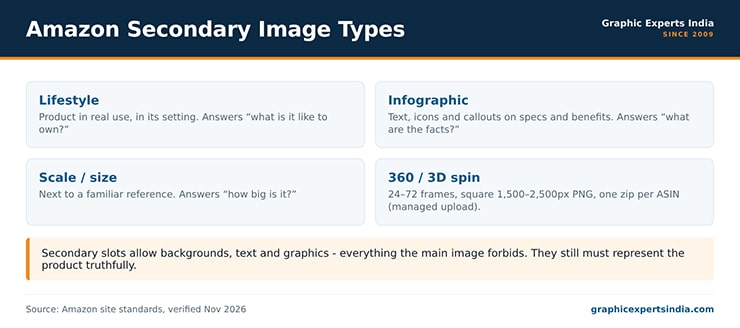
Figure 1. The four secondary image types and what each one answers.
What are Amazon secondary images allowed to do?
Secondary images may use lifestyle backgrounds, text overlays, infographics, icons and graphics — everything the main image prohibits. The only slot bound to the pure-white, product-only standard is the main image; from the second slot onward, the canvas is open.

That freedom is the point: the Baymard Institute finds 37% of shoppers want images that show the product in scale and 23% want to see it in a human context, and those are needs a plain white-background shot cannot meet.
Two rules still apply across every slot. The image must truthfully represent the product, and any photorealistic AI-generated person in it must be tagged under Amazon’s 2026 disclosure rule. Within those limits, the secondary slots are the listing’s selling space.
What makes a good lifestyle image?
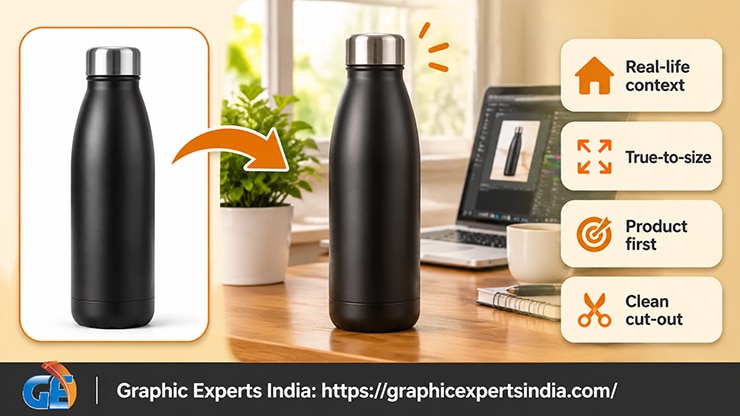
A lifestyle image shows the product in real use, in the setting where a buyer would use it. Its job is to answer “what is it like to own this?” — the question a white-background shot cannot address.
A good lifestyle image uses a real context, shows the product at its actual size relative to its surroundings, and keeps the product the clear subject rather than losing it in a busy scene.
Lifestyle images are often composites: the product is shot cleanly, then placed into a generated or photographed scene. Image manipulation builds these composites, and a clean clipping path is what lets the product drop into any scene with a crisp edge.
The same compositing skill that builds a product lifestyle scene builds a clothing advertisement — the apparel guide to how to make a clothing advertisement covers that application.
What belongs in an infographic image?
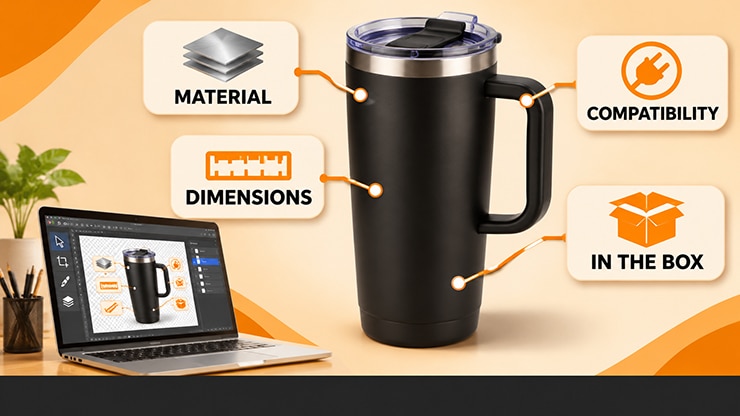
An infographic image overlays text, icons and callouts on or beside the product to state its specifications and benefits. It answers “what are the facts?” — dimensions, materials, compatibility, what is in the box.
Because a secondary slot allows text, the infographic is where the selling claims that are banned from the main image belong. Keep each infographic to a few callouts, use large type that survives the thumbnail size, and anchor every claim to something true about the product.
Infographics also feed Amazon’s systems. Clear, factual callouts give Amazon’s search and its AI shopping assistant usable detail to surface, so an infographic that states materials and dimensions does double duty for the human shopper and the algorithm.
The cut-outs an infographic needs — product isolated on transparent or white — come from the same clipping-path step as the lifestyle composites.
How do scale and size images work?
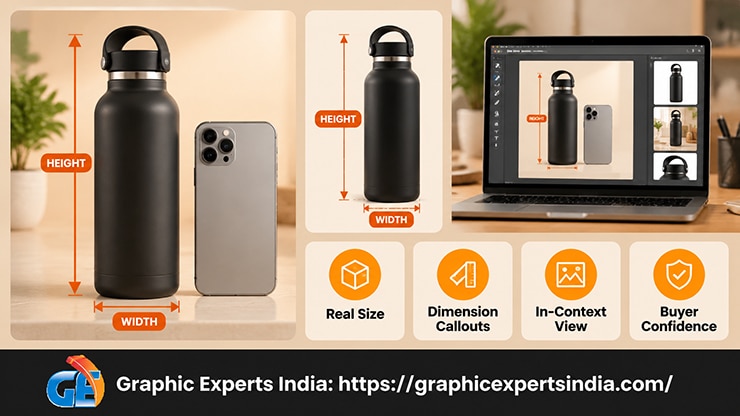
A scale image shows the product’s real size by placing it next to a familiar reference — a hand, a common object, or a labelled dimension.
It answers “how big is it?”, which 37% of shoppers told Baymard they want resolved visually rather than from the dimensions text. A scale shot prevents the most common size disappointment, where a buyer imagines a product larger or smaller than it is and returns it.
Two formats both work. A dimension callout overlays measured lines on the product against a plain background. An in-context shot places the product beside a recognisable object.
The in-context version is stronger because it requires no mental conversion from numbers to size. Either belongs in the first seven slots, since only those show on the live listing — the slot plan is in How Many Images Can an Amazon Listing Have?.
What are Amazon’s 360 and 3D image specs?

A 360 spin lets a shopper rotate the product, and Amazon handles it as a separate asset from the gallery stills. A spin is a sequence of frames shot at even intervals around the product — typically 24 to 72 frames, with 72 giving the smoothest rotation — cropped square at 1,500 to 2,500 pixels per side and saved as PNG.
The frames are delivered as one zipped package per ASIN through Amazon’s managed or partner process, rather than uploaded in the ordinary Seller Central image screen.
3D and 360 views raise buyer engagement because they let a shopper inspect a product the way they would in a shop. They suit products whose form sells them — furniture, footwear, hardware, anything a buyer turns over in their hands.
Because the spin is a production job with a strict frame and naming spec, it is normally shot and prepared by a specialist rather than assembled ad hoc.
How Graphic Experts India builds secondary images

Every secondary type starts from a clean cut-out, and that is the foundation Graphic Experts India provides.
A hand-drawn clipping path isolates the product so it can sit in a lifestyle composite, carry infographic callouts, or scale against a reference object; image manipulation builds the composited scenes themselves. One source shoot becomes the main image plus a full set of secondary slots, edited to match.
Clipping path and image manipulation are priced per image — manipulation from $1.00 — with a 24-hour average turnaround, a three-step quality check, and the first edits free with no credit card.
Graphic Experts India has produced e-commerce secondary imagery since 2009. For the category-specific rules that shape which secondary images a listing needs, see category image requirements.
Frequently asked questions
Yes. Only the main image must use a pure white background with no text or graphics. Secondary images may use lifestyle backgrounds, infographics, text overlays and icons, which is why they carry most of the listing’s selling and explaining.
An infographic image overlays text, icons and callouts on or beside the product to state specifications and benefits — dimensions, materials, compatibility, what is in the box. It belongs in a secondary slot because the main image forbids text, and it also feeds Amazon’s search and AI with factual detail.
Typically 24 to 72 frames shot at even intervals around the product, with 72 giving the smoothest rotation. Frames are cropped square at 1,500 to 2,500 pixels, saved as PNG, and delivered as one zip per ASIN through Amazon’s managed process rather than the normal upload screen.
A scale image shows the product’s real size using a familiar reference — a hand, a common object, or a labelled dimension. It answers “how big is it?” visually, which 37% of shoppers in Baymard’s testing said they want, and it reduces size-related returns.
Yes. Any secondary image containing a photorealistic AI-generated person must be tagged with the contains-synthetic-performer metadata keyword under Amazon’s 2026 rule, and every secondary image must still truthfully represent the product.

Salim Ahmed is the CEO of Graphic Experts India, with over 25 years of expertise in photo editing, clipping path, image retouching, and eCommerce image editing services.