

To start an online clothing store, you choose a niche and sourcing model, pick a platform and domain, register the business and set your tax, shipping and returns policies, photograph and edit every product to the platform’s specification, build product pages and a checkout that show the total cost upfront, and launch with email flows and measurement in place.
An online clothing store, also called an e-commerce clothing business or online boutique, is a store that sells garments through its own website or a marketplace rather than a physical shop.
This guide covers the eight steps in order, with the published prices, platform rules and research current as of 29 September 2026, and it treats product imagery as the step that most directly decides whether visitors buy. It is the online-first route through the wider guide on how to start a clothing brand.

What Does Starting an Online Clothing Store Involve at a Glance?
Starting an online clothing store involves a platform from $29 per month, a set of product images that meet each channel’s size and background rules, a checkout that avoids the reasons 70% of carts are abandoned, and a returns plan for the roughly one in five online orders that come back.
| Question | Short answer | Source |
|---|---|---|
| How much apparel sells online? | Online sales were 35.2% of the top 1,000 US apparel and accessories retailers’ combined sales in 2023; US e-commerce overall was 17.1% of retail in Q2 2026 | Digital Commerce 360; US Census Bureau |
| What does the platform cost? | Shopify Basic $29 per month billed annually or $39 monthly; a domain from about $9 per year | shopify.com/pricing; shopify.com/domains |
| What do visitors do first on a product page? | 56% of users’ first action is exploring the product images | Baymard Institute, April 2020 |
| How often are carts abandoned? | 70.22% on average across 50 studies; “extra costs too high” is the top reason at 40% | Baymard Institute, list updated 22 September 2025 |
| How often do fashion visitors buy? | Fashion clothing and accessories stores converted 1.86% of visits in August 2026 | IRP Commerce market data |
| How many online orders come back? | An estimated 19.3% of US online sales were returned in 2025 | National Retail Federation and Happy Returns, October 2025 |
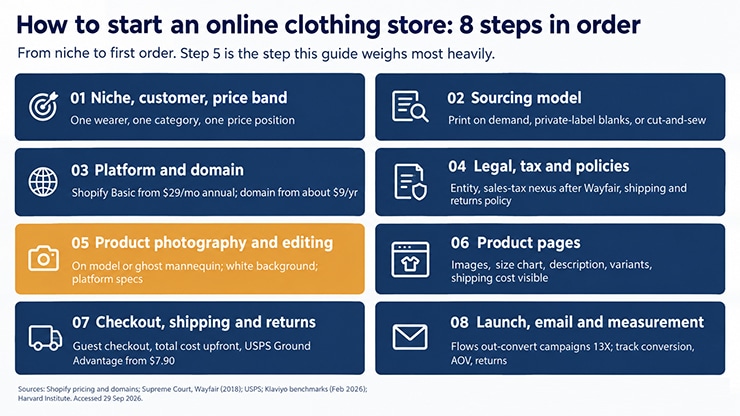
Figure 1. The eight steps in order. Step 5, product photography and editing, is the step this guide weights most heavily.
Why Start an Online Clothing Store Rather Than a Shop?
An online clothing store is the lower-capital, faster-to-open form of a clothing business, and it is where a growing share of apparel is bought. Online sales were 35.2% of the top 1,000 US apparel and accessories retailers’ combined in-store and online sales in 2023, at $108.19 billion, according to Digital Commerce 360 (updated 17 September 2024).
US e-commerce as a whole reached $340.2 billion in the second quarter of 2026, 17.1% of total retail sales, according to the US Census Bureau (18 August 2026).
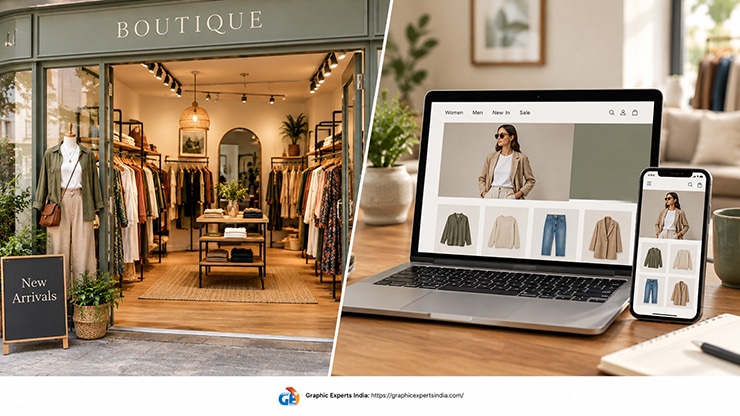
The capital difference is large. A physical clothing boutique costs about $40,000 on average to open (“$39,210,” Shopify, January 2026), while an online store on print on demand can launch for about $1,280 in published-price budgets.
The trade-off is that an online store cannot let the customer touch the garment. Consequently, the product images do the work the fitting room does in a shop, and 56% of users make exploring those images their first action on a product page, according to Baymard Institute (2 April 2020).
Founders choosing between the two models can compare them in the guide on how to start a clothing business or boutique.
How Do You Start an Online Clothing Store Step by Step?
To start an online clothing store, follow the eight steps below in order. Each step names the decision, the published cost or rule, and the specification to meet.
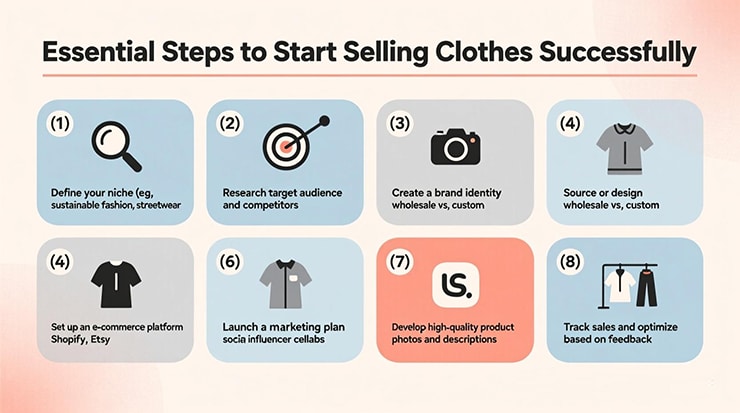
- Define the niche, customer and price band.
- Choose a sourcing model.
- Choose the platform and register a domain.
- Register the business and set tax, shipping and returns policies.
- Photograph and edit every product to specification.
- Build product pages that answer fit, color and cost.
- Build a checkout that shows total cost upfront.
- Launch with email flows and measurement.
Step 1: How Do You Define the Niche for an Online Clothing Store?
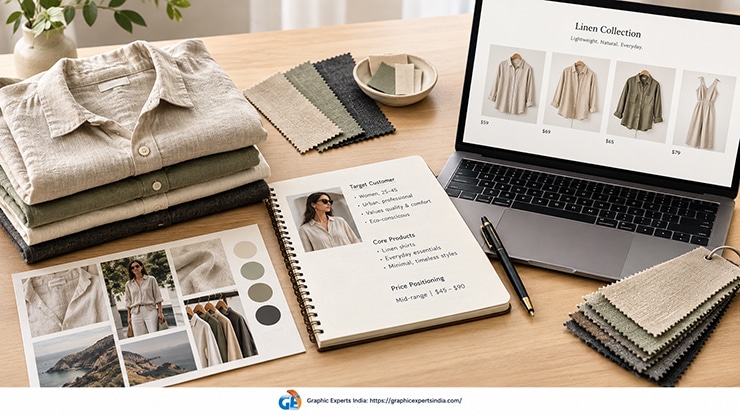
To define the niche, name one wearer, one garment category and one price band before choosing products or a platform. Online, the niche is what makes a store findable and remembered, because the storefront itself is a template shared with millions of others.
A statement such as “linen shirts for men who work from home, $60–$90” decides the sourcing model in Step 2, the imagery style in Step 5 and the email content in Step 8. The validation methods from the clothing-brand guide apply without change: a waitlist page, a print-on-demand test listing or a single market stall, each read for what sells before stock is bought.
Step 2: Which Sourcing Model Should an Online Clothing Store Use?
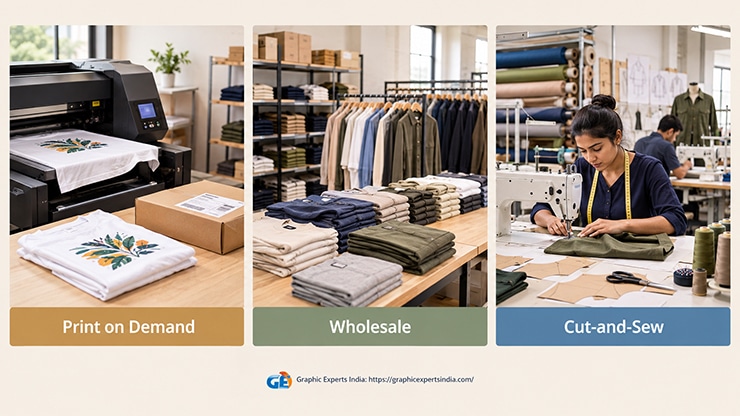
An online clothing store should start with the sourcing model that matches its capital and its need for control: print on demand for no inventory, wholesale or private-label blanks for curated stock, and cut-and-sew for original garments.
Print on demand carries “$0 upfront—products are printed only after a customer orders,” according to Printful’s guide to the cost of starting a clothing line (27 May 2025), which also notes that platform subscriptions of about $29 to $299 per month still apply.
Wholesale sourcing prices at roughly twice cost under keystone pricing and can be tested on Faire’s net-60 terms, as covered in the boutique guide. Cut-and-sew requires 50 to 500 units per style at US manufacturers and a first collection budget of at least $12,000 for four styles (Maker’s Row; Sewport).
The sourcing model sets the photography workload. Print on demand supplies a mockup per design but no real photo; wholesale stock arrives with the brand’s images, which the store usually may not reuse without permission; cut-and-sew garments arrive with nothing. In all three cases the store owns the job of producing channel-compliant images in Step 5.
Step 3: Which Platform and Domain Should an Online Clothing Store Use?
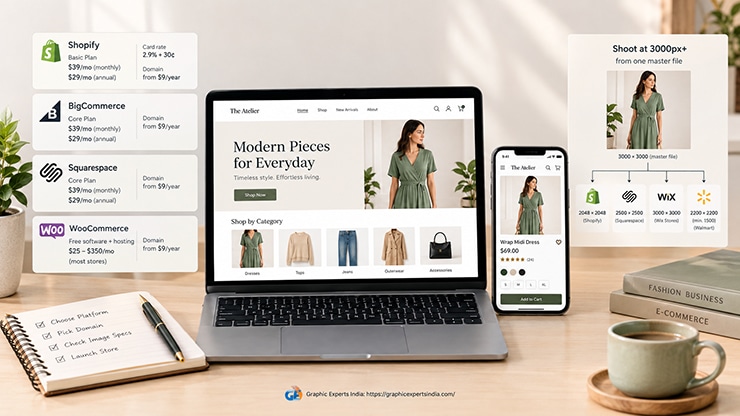
An online clothing store should use a hosted platform whose entry plan it can afford for a year and whose image specifications it can meet from one master set of photos. Shopify’s Basic plan costs $39 per month billed monthly or $29 per month billed annually, with a 2.9% + 30¢ online card rate; new stores get three days free, then $1 per month for three months (shopify.com/pricing, accessed 29 September 2026).
Domains on Shopify “typically start at $9 USD/year” (shopify.com/domains). BigCommerce Core and Squarespace Core are priced at the same $29 annual and $39 monthly points; WooCommerce is free software with hosting at “$25 – $350/month for most stores” (woocommerce.com/pricing).
The choice affects images more than founders expect. Shopify displays 2048 × 2048 pixel product images best; Squarespace calls 2500 pixels wide ideal; Wix Stores states 3000 × 3000; Walmart Marketplace requires 2200 × 2200 with a 1500-pixel minimum for zoom.
A store that shoots at 3000 pixels or larger on the long side can export every platform’s version from the same master file. The full comparison of plans, fees and image rules is in the guide to fashion eCommerce platforms and their product image requirements.
Step 4: What Legal, Tax, Shipping and Returns Setup Does an Online Store Need?
An online clothing store needs a registered entity, a sales-tax plan that accounts for economic nexus, a shipping promise it can keep, and written shipping, returns and privacy policies. Four published rules define the baseline.
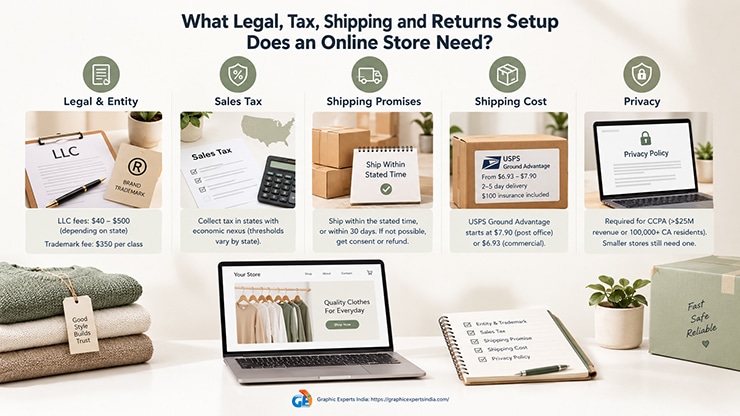
- Sales tax. Since South Dakota v. Wayfair (21 June 2018), a state may require an out-of-state seller to collect sales tax without a physical presence; the South Dakota law upheld in that case applied to sellers delivering “more than $100,000 of goods or services into the State or engage in 200 or more separate transactions.” Thresholds now vary by state; South Dakota’s current rule, for example, is gross revenue above $100,000 with no transaction test (South Dakota Department of Revenue).
- Shipping promises. The FTC’s Mail, Internet, or Telephone Order Merchandise Rule (16 CFR Part 435) requires a reasonable basis to ship within the stated time, or within 30 days if none is stated; if a delay cannot be met, “you must seek the customer’s consent to the delayed shipment” or “promptly refund all the money the customer paid you.”
- Shipping cost. USPS Ground Advantage prices “start at $7.90 at a Post Office location” and “from $6.93 for Commercial Pricing,” with two-to-five-day delivery and $100 of insurance included (usps.com, prices effective 12 July 2026).
- Privacy. The California Consumer Privacy Act applies to for-profit businesses above $25 million in revenue or handling the personal information of 100,000 or more California residents, among other tests, and requires a posted privacy policy (California Office of the Attorney General). Smaller stores still need a privacy policy because platforms and payment providers require one.
Entity and trademark fees are unchanged from the brand guide: an LLC from $40 in Kentucky to $500 in Massachusetts, and a $350 USPTO base fee per class for the brand name.
Step 5: How Do You Photograph and Edit Products for an Online Clothing Store?
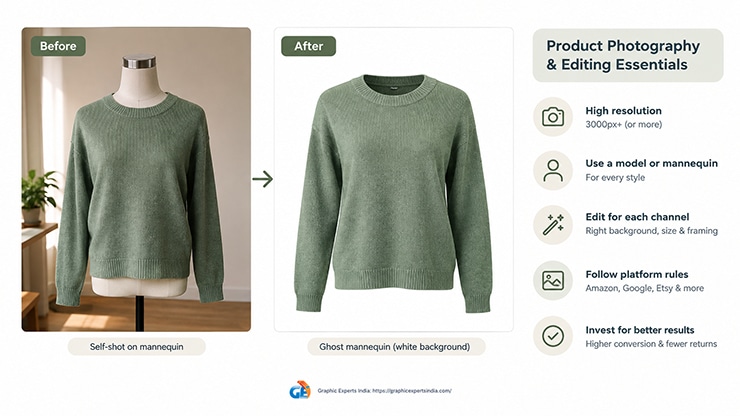
To photograph products for an online clothing store, shoot every style once against a neutral background on a model or mannequin at 3000 pixels or larger, then edit the master files to each channel’s background, size and framing rules.
The evidence for investing here is consistent across sources. Baymard Institute found that 56% of users’ first action on a product page is exploring the images, that 25% of e-commerce sites provide insufficient image resolution or zoom, and, in its 2026 benchmark, that 37% of sites lack “in scale” images and 23% do not provide human-model images for wearable products (Baymard, April 2020 and March 2026).
In Etsy’s buyer surveys, “90% of shoppers said the quality of the photos were ‘extremely important’ or ‘very important’ to a purchase decision” (Etsy Seller Handbook).
Channel rules decide the format. Amazon’s Clothing & Accessories imaging guidelines (Spring 2021 edition) require that “all adult apparel should be imaged on-model,” that kids, baby and accessories be off-model, that main images have “a pure white background (RGB Value 255, HEX Value #FFFFFF)” with the product filling at least 85% of the frame at 1,600 pixels or more in height, and they list visible and ghost mannequins among main-image prohibitions while allowing a minimum of five and maximum of seven images.
Google Merchant Center asks stores to “provide images of products worn by people for clothing (apparel) products,” recommends images around 1500 × 1500 pixels, prohibits overlays such as watermarks and logos, and sets a 500 × 500 pixel minimum for all products from 31 January 2027.
Three production routes have published prices, and the cost gap between them is the largest in the whole launch budget.
- Studio production: product images from $50 per image or $750 for a two-hour shoot; on-model images from $95 per image or $2,950 for a four-hour shoot (Squareshot, accessed 29 September 2026).
- Self-shot plus outsourced editing: background removal to pure white from $0.39 per image, ghost mannequin editing from $1.49 per image and e-commerce retouching from $0.99 per image at Graphic Experts India, each with a 24-hour average turnaround.
- Supplier mockups only: free, but not compliant with Amazon’s on-model rule for adult apparel and identical to every other seller’s images.
A 12-SKU launch at five images per SKU is 60 images: $3,000 studio-produced, or under $100 self-shot and edited. The shooting setup for the mannequin route is in the ghost mannequin photography and editing guide, and the platform specifications Graphic Experts India edits to are listed on its e-commerce product photo editing service page.
Step 6: What Does a Clothing Product Page Need to Answer?
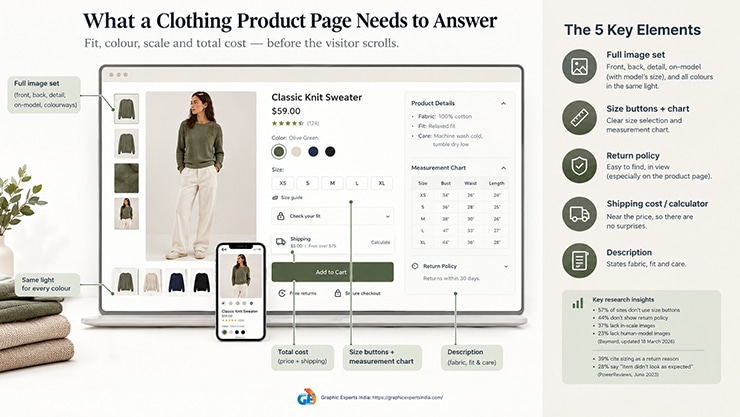
A clothing product page needs to answer fit, color, scale and total cost before the visitor scrolls, because those are the questions the fitting room would have answered.
Baymard’s 2026 product-page benchmark reports that 57% of sites do not use buttons for size selection, 44% do not display return-policy information on the product page, 37% lack in-scale images and 23% lack human-model images for wearables (Baymard, updated 18 March 2026).
Each gap maps to a return reason: 39% of apparel returners cited sizing and 28% said the “item didn’t look the way they thought it would,” in PowerReviews’ survey of 25,452 US consumers (June 2023).
The page therefore needs five elements: a full image set (front, back, detail, on-model with the model’s size stated, and every colorway shot in the same light), size buttons with a measurement chart, the return policy in view, shipping cost or a calculator near the price, and a description that states fabric, fit and care.
Baymard found that 64% of users looked for shipping costs on the product page before adding to cart, and that 43% of sites show none there (Baymard, June 2017). The product-page practices of the largest fashion retailers, from ASOS’s fit assistant to Everlane’s cost breakdown, are analysed in the guide to how top fashion brands sell online.
Step 7: How Do You Build a Checkout That Does Not Lose the Order?
To build a checkout that keeps the order, show the total cost before the checkout starts, allow guest checkout, and keep the form short. The average documented cart abandonment rate is 70.22% across 50 studies, according to Baymard Institute (list updated 22 September 2025).
Among US shoppers who abandoned for a reason other than browsing, 40% cited “extra costs too high (shipping, tax, fees),” 20% delivery too slow, 19% not trusting the site with card information, 18% being required to create an account and 17% a checkout that was too long or complicated (same source).
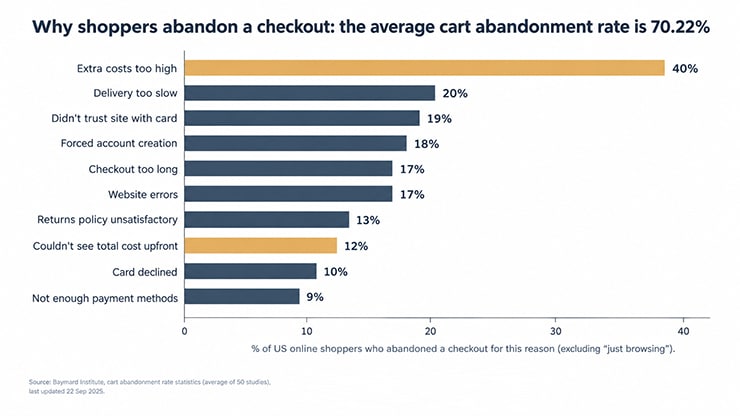
Figure 2. Why US shoppers abandon a checkout. Source: Baymard Institute, average of 50 studies, list updated 22 September 2025.
Two of the top five reasons are cost visibility, which a clothing store controls directly: a shipping rate shown on the product page and a clear duties or tax line at the first checkout step remove them. Baymard estimates that better checkout design can raise conversion by 35.26% for the average large e-commerce site (same source).
Delivery speed is the second reason; USPS Ground Advantage’s two-to-five-day window stated on the page sets the expectation the FTC rule then requires the store to keep.
Step 8: How Do You Launch and Measure an Online Clothing Store?
To launch an online clothing store, switch on automated email flows before the first paid traffic, then track conversion rate, average order value and return rate weekly.
Automated flows out-perform campaigns by a wide margin: in Klaviyo’s 2026 benchmarks across more than 205,000 brands, clothing and accessories flows had a 2.15% placed-order rate against 0.12% for campaigns, and across all industries “flow-based emails deliver 3x higher click rates (5.58% vs. 1.69%) and 13x higher placed order rates than campaigns” (Klaviyo, 24 February 2026).
A welcome flow, an abandoned-checkout flow and a post-purchase flow are the three to build first.
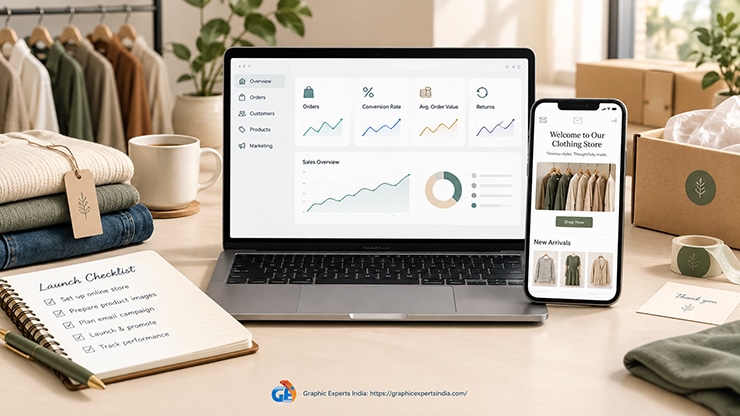
Benchmarks for the three metrics are published. Fashion clothing and accessories stores converted 1.86% of visits in August 2026 at a £78.24 average order value in IRP Commerce’s UK-weighted panel. Online returns ran at an estimated 19.3% of sales in 2025 (National Retail Federation and Happy Returns, 15 October 2025).
Paid acquisition should be sized against the $66 average fashion customer acquisition cost reported by First Page Sage (updated 15 August 2025); the unit-economics arithmetic is in the clothing brand business plan guide. Reuse the Step 5 images in every email and ad: the master set is the store’s largest creative asset.
How Much Does It Cost to Start an Online Clothing Store?
Starting an online clothing store costs about $1,280 in year one on print on demand and about $19,400 for a small cut-and-sew line, in budgets built line by line from published price lists in the guide to how much it costs to start a clothing brand.
The online-specific lines are the platform ($358 to $478 a year on Shopify Basic including a domain), payment processing (2.9% + 30¢ per order), shipping (from $6.93 commercial per parcel) and imagery ($21 to $840 depending on route).
None of those lines is large; the budget risk sits in inventory, which is why Step 2 recommends a no-inventory model until a design has repeat sales.
What Mistakes Cause New Online Clothing Stores to Fail?
New online clothing stores most often fail on cost surprises at checkout, imagery that does not meet channel rules, unplanned returns and buying inventory before demand. Each has a published counter-measure.
- Hidden costs at checkout. 40% of abandoners cite extra costs (Baymard). Show shipping on the product page.
- Mockups instead of photos. Amazon requires adult apparel on-model; Google Merchant Center asks for apparel worn by people; 56% of users go straight to the images. Shoot one sample per style.
- No in-scale or human-model images. 37% and 23% of sites respectively fail these (Baymard, 2026), and 28% of apparel returns are “didn’t look the way I thought it would” (PowerReviews).
- Returns unplanned. 19.3% of online sales come back (NRF, 2025). Price the return policy and show it on the page.
- Stock before demand. Print on demand at “$0 upfront” (Printful) validates a design before a 50-to-500-unit run.
What Do Founders Ask Most Often About Starting an Online Clothing Store?
About $1,280 in year one on print on demand (platform $358, domain included, legal $390, samples $60, photo editing $21, ads $450) and about $19,400 for a small cut-and-sew line, in budgets built from published prices. Shopify Basic is $29 per month billed annually; a domain starts at about $9 per year.
Shopify, BigCommerce and Squarespace entry plans all cost $29 per month billed annually or $39 monthly; WooCommerce is free with hosting from $25 per month. The deciding factors are the card rate, apps for size charts and swatches, and image specifications, which range from 2048 pixels (Shopify) to 3000 pixels (Wix Stores).
Requirements depend on state, county and city. Most US online stores form an LLC ($40 in Kentucky to $500 in Massachusetts), register for sales tax where they have economic nexus after the 2018 Wayfair decision, and publish shipping, returns and privacy policies that platforms and payment providers require.
Each product needs a front image on a pure white background, a back view, a detail shot, an on-model image with the model’s size stated, and every colorway in the same light. Amazon requires adult apparel on-model at 1,600 pixels or more; Google Merchant Center recommends about 1500 × 1500 pixels and apparel worn by people.
Fit and expectation. 39% of apparel returners cite sizing and 28% say the item did not look as expected (PowerReviews, 2023 survey of 25,452 US consumers). Size buttons with measurements, on-model images with stated sizes and color-accurate editing address both reasons at the product page.
Start with email flows, which convert at 2.15% placed-order rate for clothing brands against 0.12% for campaigns (Klaviyo, February 2026), then paid social sized against the $66 average fashion customer acquisition cost (First Page Sage, 2025). Product images from the launch shoot supply the creative for both.
Where Can an Online Clothing Store Get Product Photos Edited to Every Platform’s Specification?
An online clothing store can send self-shot product photos to Graphic Experts India, which edits to Amazon, Shopify, eBay, Walmart and Etsy specifications from one master set, with background removal from $0.39 per image, ghost mannequin editing from $1.49 per image and e-commerce retouching from $0.99 per image, each with a 24-hour average turnaround and a three-step quality check.
A free trial on sample images is available through the e-commerce product photo editing service page, returned within 24 hours with no credit card required.

Salim Ahmed is the CEO of Graphic Experts India, with over 25 years of expertise in photo editing, clipping path, image retouching, and eCommerce image editing services.