

Amazon’s main product image requirements are the strictest rules on the entire listing: the main image must show the product for sale alone, on a pure white background (RGB 255, 255, 255), filling at least 85% of the frame, with no text, logos, watermarks, borders or props.
The main image is the one buyers see in search results, so Amazon enforces these rules harder here than anywhere else in the gallery. Break one and Amazon can suppress the image or the whole listing.
This guide takes the main image rule by rule — one requirement per section — and shows the single editing step that fixes each one. For the broader cluster, start with Amazon Product Image Requirements 2026.
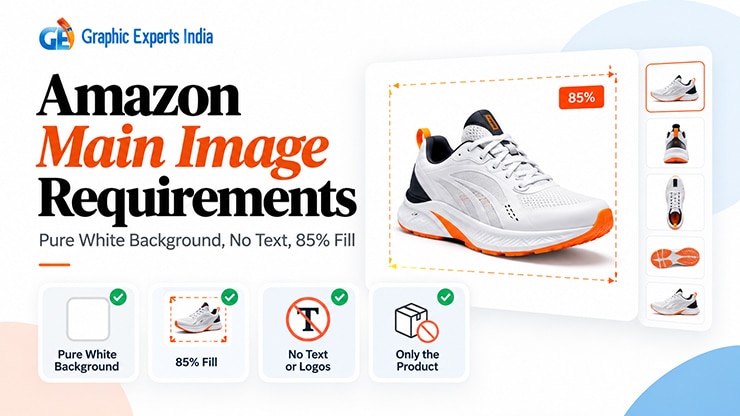
Amazon main image rules at a glance
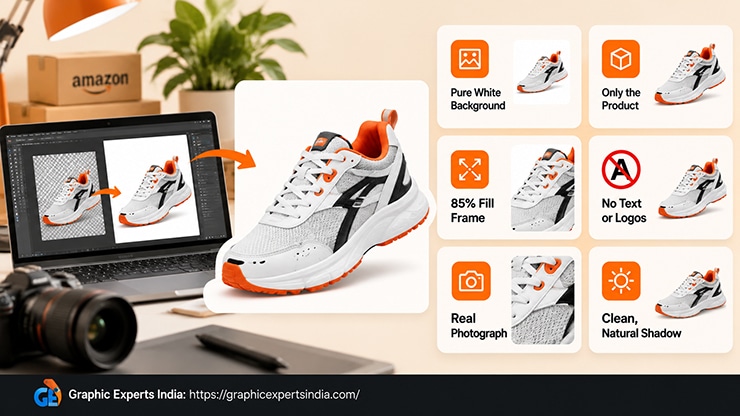
| Rule | Pass | Fail |
|---|---|---|
| Background | Pure white, RGB 255, 255, 255 | Grey, gradient, lifestyle scene, textured surface |
| What’s in frame | The product being sold, alone | Props, accessories not included, multiple unrelated items |
| Fill | Product fills ≥ 85% of the frame | Product small and floating in white space |
| Text & graphics | None | Logos, watermarks, badges, “SALE” text, borders |
| Image type | Real professional photograph | Drawing, render, illustration, mockup, placeholder |
| Shadows | Clean or natural-looking only | Distracting, cut-off, or fake-looking shadows |
What background does the Amazon main image require?
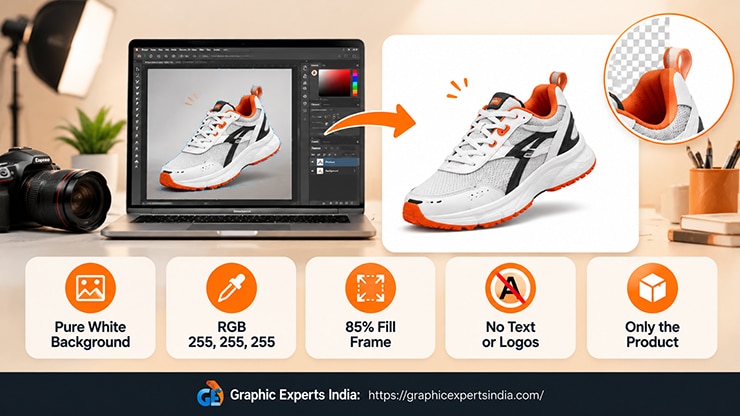
The main image background must be pure white, defined by Amazon as the RGB value 255, 255, 255. Nothing less than true white qualifies. A background that reads as 250, 250, 248 — a common result of studio lighting — shows on Amazon’s white page as a faint grey rectangle around the product, and it can trip the compliance check.
Pure white is almost never captured in-camera, because lighting a product evenly enough to blow the background to 255, 255, 255 without overexposing the product itself is difficult. The reliable route is to shoot on any clean surface and correct the background afterwards.
Background removal deletes whatever was behind the product and drops in a true-white canvas; where the product has fine or complex edges, a hand-drawn clipping path cuts the subject cleanly so the white sits flush against the edge with no halo.
What can appear in the main image?
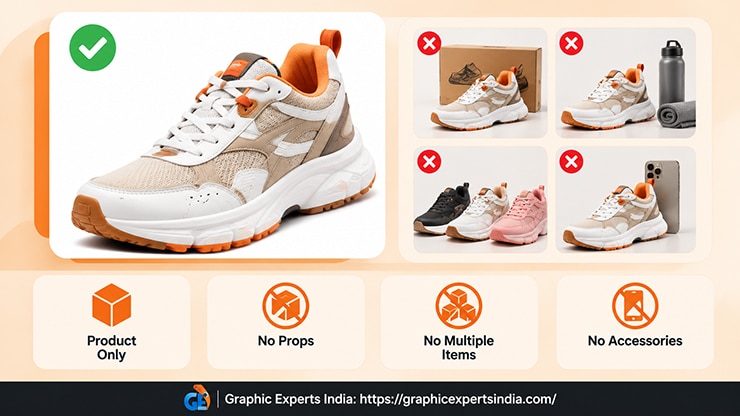
Only the product for sale. The main image may not include accessories, props, or additional items that are not part of the purchase. A phone case photographed with a phone inside it implies the phone ships too; Amazon treats that as a misrepresentation. A single-unit listing may not show a multi-pack, and a listing may not show a product variation the buyer is not purchasing.
The rule exists because the main image sets the buyer’s expectation of what arrives in the box. Removing stray props is part of the same cut-out step that cleans the background, so a product shot with incidental items can be isolated to the product alone without reshooting.
Can the Amazon main image have text or logos?
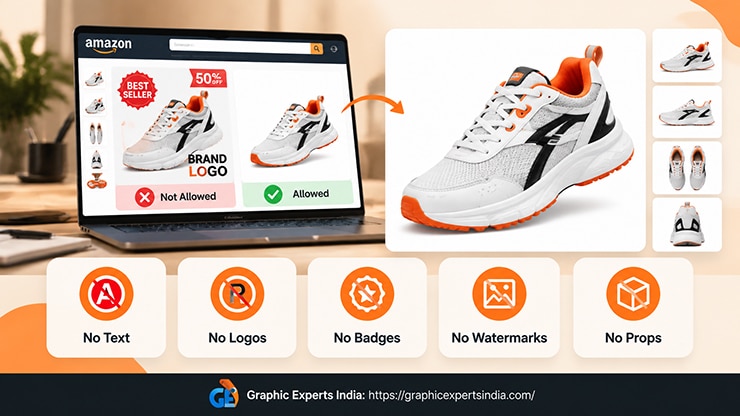
No. The main image may not carry text, logos, watermarks, borders, colour blocks, or inset badge images, over the product or in the background. That rules out “best seller” banners, price stickers, guarantee seals, size callouts, and your own brand logo added as an overlay.
A logo that is physically printed on the product is fine, because it is part of the product; a logo added in design software is not.
Text and graphics are not banned from the listing — only from the main image. Feature callouts, comparison charts, size guides and infographics belong in the secondary gallery slots, where Amazon permits them. Moving selling text off the hero and into the gallery is the standard fix, and it keeps the main image clean enough to pass while the gallery does the persuading.
How much of the frame must the product fill?
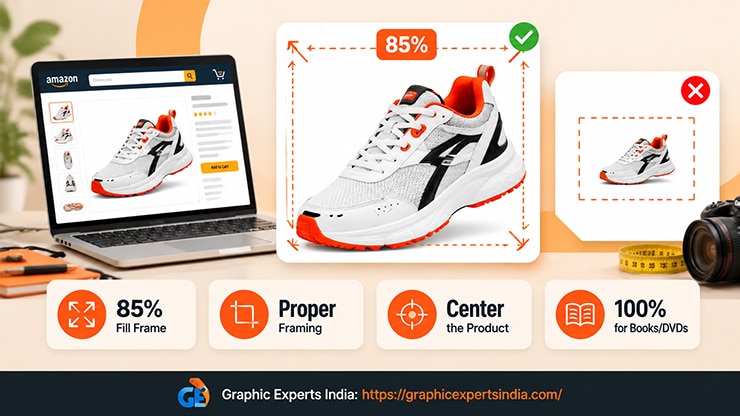
The product must fill at least 85% of the image frame. A product that sits small inside a large white field is hard to read at the thumbnail size used in search results, where the click is won or lost. Filling 85% makes the item recognisable before the shopper reads anything.
The fix is framing and scaling, not reshooting: once the product is isolated on white, it is scaled and centred so its longest dimension reaches the 85% mark while a small margin of white remains around it. Books, music and DVD titles are the exception — their main image uses the front cover art filling 100% of the frame.
What are the rules on shadows and reflections?
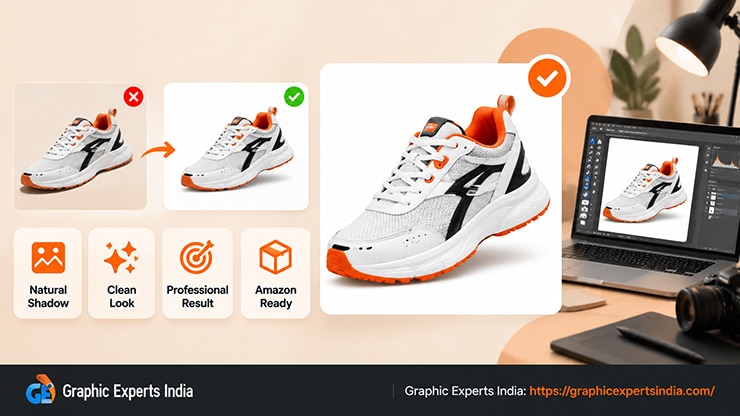
Amazon does not require a shadow, but the main image must look like a clean, professional photograph, which means any shadow must look natural rather than harsh, cut off, or obviously fake.
A heavy or distracting shadow, or one that extends past the product in a way that implies a surface, can make a main image read as unprofessional and weaken it in search.
Two approaches both pass. A pure cut-out with no shadow sits cleanly on white and is the safest option. A subtle natural or drop shadow grounds the product so it does not appear to float. Shadow making rebuilds a realistic shadow after the background is replaced, so the product looks photographed on a surface rather than pasted onto white.
Does the main image have to be a real photo?
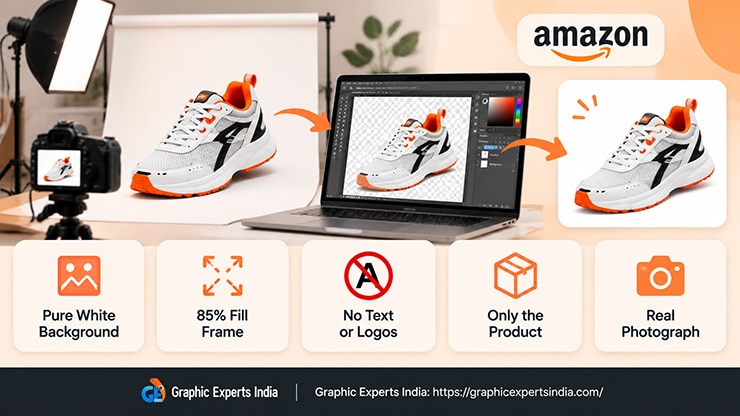
Yes. The main image must be a professional photograph of the actual product. Drawings, illustrations, computer renders, mockups and placeholder graphics are not accepted as main images. AI-assisted editing is permitted, but the finished main image must still look like, and truthfully represent, the real product — the AI-generated image policy covers where that line sits in 2026.
Amazon’s underlying requirement is accuracy: the main image must represent the product the buyer will receive. Colour, proportion and detail must match the physical item, which is why retouching for Amazon stays corrective — cleaning dust, fixing lighting, truing colour — rather than altering what the product actually is.
Are the main image rules different for clothing?
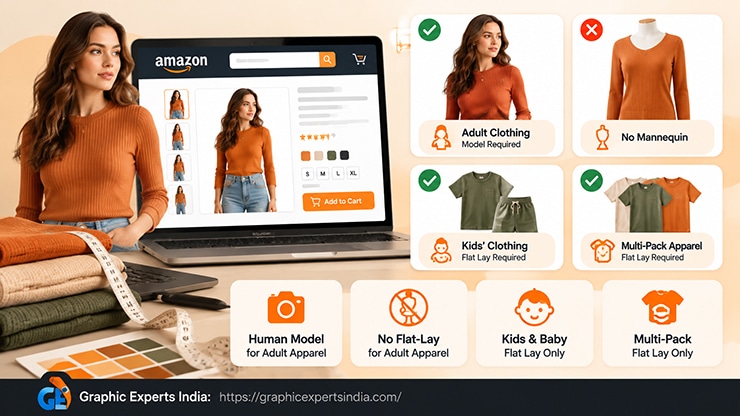
Yes, and this is where apparel sellers are caught out. Men’s and women’s clothing must be shown on a human model in the main image.
A flat-lay or mannequin shot is not accepted as the main image for adult apparel, and Amazon’s apparel standard allows no ghost-mannequin exception in that slot. Kids’ and baby clothing, plus multi-pack apparel, are the opposite — they must be shot flat, off the model. The full set of category-specific rules is in Amazon Image Requirements by Category.
How Graphic Experts India makes a compliant main image
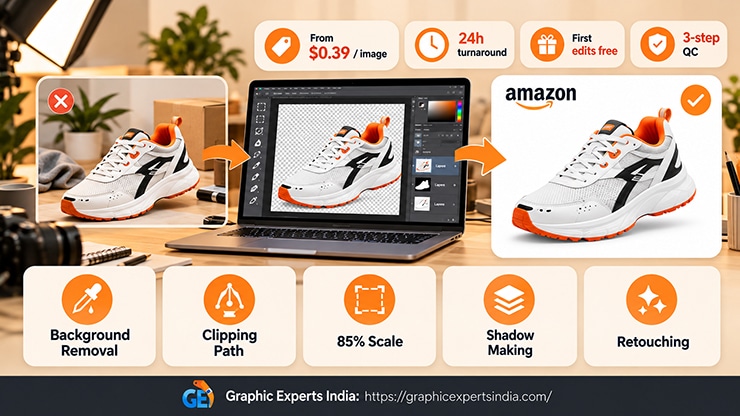
Each main-image rule maps to one editing step, and Graphic Experts India runs all of them. Background removal and clipping path produce the pure-white 255, 255, 255 canvas and strip stray props, isolating the product alone. Scaling sets the 85% fill.
Shadow making grounds the product with a realistic shadow instead of a fake one. Corrective retouching keeps the photo accurate to the real item.
Background removal starts at $0.39 per image and shadow making from $0.40, turnaround averages 24 hours, every file clears a three-step quality check, and the first edits are free with no credit card. Before you prepare files, check the full image size and file specs so the finished main image is also zoom-ready.
Frequently asked questions
The main image must show the product for sale alone on a pure white background (RGB 255, 255, 255), filling at least 85% of the frame. It must be a real professional photograph with no text, logos, watermarks, borders or props, and at least 1,000 pixels on the longest side.
Pure white, defined as RGB 255, 255, 255 (hex #FFFFFF). Off-white backgrounds that measure anything below 255 on any channel can read as grey against Amazon’s white page and may fail the site standard.
Not as an overlay. A logo added in design software counts as a prohibited graphic on the main image. A logo physically printed on the product is allowed, because it is part of the item the buyer receives.
No. A clean cut-out with no shadow passes. If you want the product grounded, a subtle natural or drop shadow is allowed, but a harsh, cut-off or fake-looking shadow weakens the image and can read as unprofessional.
The most common causes are a background that is not true 255, 255, 255 white, text or a logo on the image, a product filling less than 85% of the frame, visible props, or an illustration used instead of a real photo. Correcting the specific element and re-uploading restores the image.

Salim Ahmed is the CEO of Graphic Experts India, with over 25 years of expertise in photo editing, clipping path, image retouching, and eCommerce image editing services.