

Branding a clothing company is the work of deciding what the brand stands for, who it is for and how it looks, sounds and photographs, then applying those decisions identically across every garment, page, parcel and post. Knowing how to start a successful clothing brand therefore means more than knowing how to draw a logo.
The logo is one asset inside a brand identity system that also contains a positioning statement, an audience, a story, a name, a color palette, typography, a voice and a packaging standard.
This guide explains each component in build order, then adds the one most clothing brands leave undocumented: a photography style guide that keeps product images consistent across seasons and colorways.
It closes with consistency metrics, a go-to-market note and three brand systems documented by the brands themselves. All sources were read on 14 October 2026. The logo itself is covered in the parent guide on Clothing Brand Logo Design.
What Does Building a Clothing Brand Involve at a Glance?
Building a clothing brand involves nine documented decisions; the evidence below shows why the imagery decision carries a cost when skipped.
| Question | Short answer | Source |
|---|---|---|
| What are brand guidelines? | “Brand guidelines are rules a business creates for how it presents itself to the public,” covering logos, typography, color palette, imagery, audience, voice and tone, and grammar | Shopify, 21 February 2025 |
| Does consistency pay? | In a 2021 vendor survey of more than 450 respondents, the most common estimate was that consistent branding would lift revenue by 10–20%; 60% reported dealing with off-brand content | Lucidpress (now Marq), 2021 |
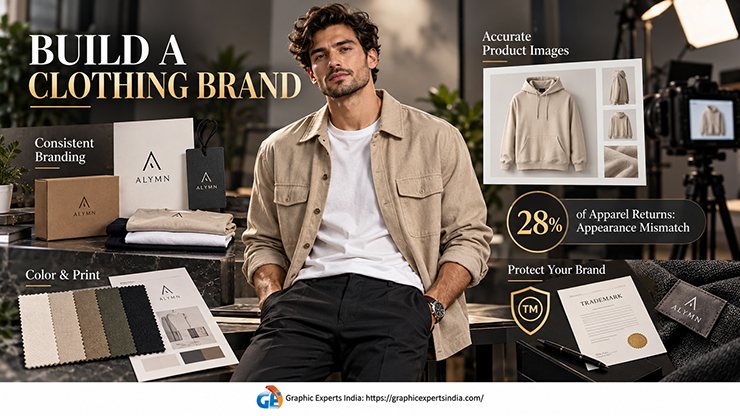
| Why does imagery matter most for clothing? | 28% of apparel returns happen because the item “didn’t look the way they thought it would” | PowerReviews, June 2023, n = 25,452 |
| How many stores get imagery wrong? | 23% of benchmarked sites provide no human-model image; 37% provide no in-scale image | Baymard Institute, updated 18 March 2026 |
| What does Google want from clothing images? | “Show clothing on models. Show how your product looks on a real person.” | Google Merchant Center Help |
| Why do printed colors drift? | Print files are built in sRGB and “our printers then convert your submitted file into CMYK format” | Printful |
| What does protecting the name cost? | $350 per class, USPTO base application fee, effective 18 January 2025 | USPTO |
What Is Branding a Clothing Company Beyond the Logo?
Branding a clothing company beyond the logo is the creation of a brand identity system: written rules that govern every expression of the brand, from the positioning statement to the crop of a product photograph.
Shopify defines brand guidelines as “rules a business creates for how it presents itself to the public,” and lists the sections most guides contain as logos, typography, color palette, imagery, audience, voice and tone, and grammar and style conventions (Shopify, 21 February 2025).
A clothing brand needs two additions to that list that a software company does not: a garment color standard that survives the move from screen to fabric, and a photography standard that shows the garment the same way every season.
A system matters more than a single asset because a clothing brand produces hundreds of images a year across product pages, marketplaces, social feeds and advertising, and each one is a chance to look like a different company.
Lucidpress’s 2021 State of Brand Consistency report, based on more than 450 respondents, asked respondents how much revenue would increase if the brand were consistent, and the most common answer was 10–20%; the same survey found that 60% of companies deal with off-brand content (Lucidpress, 2021). That figure comes from a vendor survey rather than a controlled study, so it is a reported range, not a promise.
How Do You Write a Positioning Statement for a Clothing Brand?
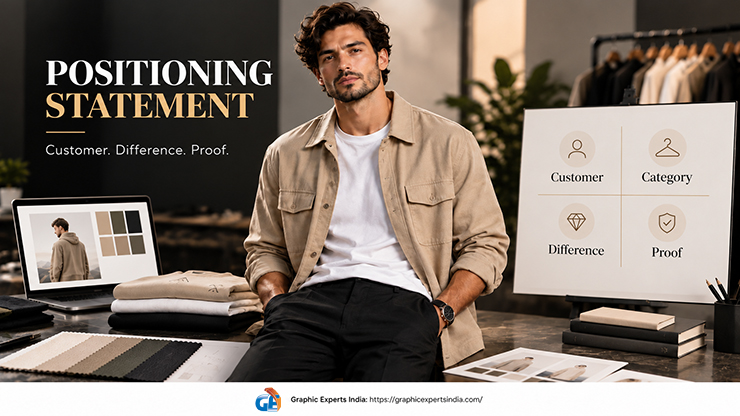
To write a positioning statement for a clothing brand, complete one sentence that names four things: the target customer, the category the brand competes in, the one difference that matters to that customer, and the reason the customer should believe it.
A working template reads: “For [customer], [brand] is the [category] that [point of difference], because [reason to believe].” The sentence is internal; its job is to settle later arguments about colors, prices, models and photography by referring back to who the brand is for.
Two components do most of the work. The point of difference must be something a same-category competitor cannot claim with the same evidence, which rules out “quality” and “style” on their own. The reason to believe must be a fact the brand can show: a fabric weight, a factory, a cost breakdown, a guarantee.
Everlane’s reason to believe is a published number. Its about page states: “We believe our customers have a right to know how much their clothes cost to make,” and illustrates the point with a $30 Everlane t-shirt set against $55 at traditional retail (everlane.com/about, read 14 October 2026). The statement later opens the clothing brand business plan, where it is tested against costs and margins.
Who Is the Audience, and How Precisely Should a Clothing Brand Define It?
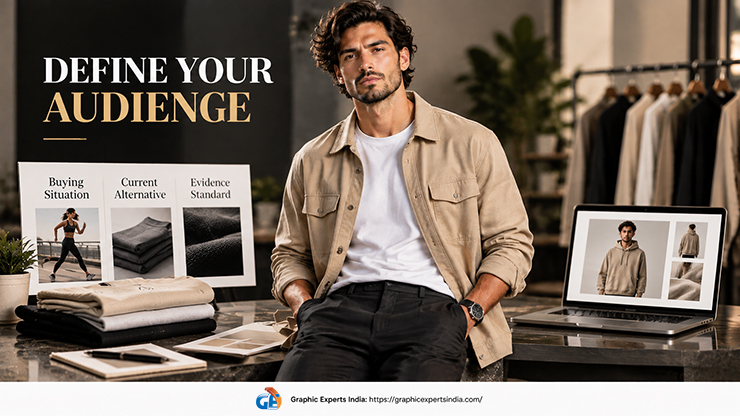
The audience of a clothing brand should be defined precisely enough that a photographer, a copywriter and a packaging supplier would each make the same choice without asking.
“Women 25 to 40” fails that test; “women who run before work and wear the same leggings to the office” passes it, because it tells the photographer to shoot movement, the copywriter to lead with fabric recovery, and the supplier that a mailer must survive a gym bag.
Three inputs sharpen the definition: the buying situation, meaning the occasion and the problem the garment solves; the current alternative, meaning the brand or habit the new label displaces; and the evidence standard, meaning what the customer needs to see before trusting a fit or fabric online.
The third matters disproportionately for clothing, because Baymard Institute finds that 56% of users’ first action on a product page is exploring the images (Baymard, 2 April 2020). An audience that judges by images needs consistent images, so the photography style guide below is written against the audience definition.
How Do You Build a Brand Story for a Clothing Line?
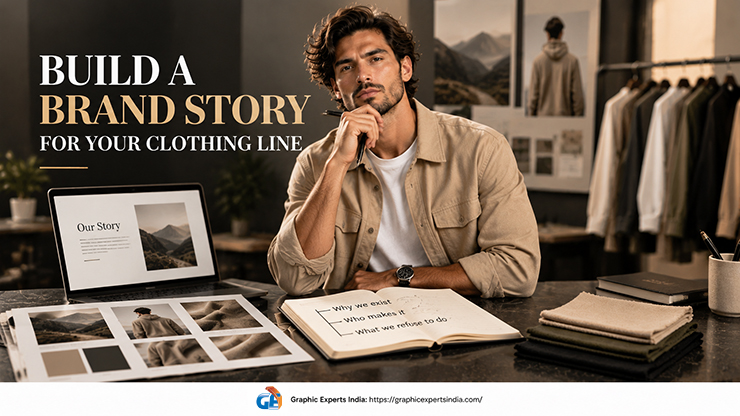
To build a brand story for a clothing line, record three verifiable facts about why the brand exists, who makes the garments and what the brand refuses to do, then write them in the brand voice. A story that cannot be checked is copy; a story made of facts is a reason to believe.
Patagonia’s regional mission page states “We’re in business to save our home planet” (patagonia.com.hk, read 14 October 2026), and the company’s core values page, updated in 2022, lists Quality as “Build the best product, provide the best service and constantly improve everything we do” and Environmentalism as “Protect our home planet” (patagonia.com/core-values). Each line repeats on a hangtag, a product page and a job advertisement without rewording.
Nike’s mission page reads, in capitals, “BRING INSPIRATION AND INNOVATION TO EVERY ATHLETE* IN THE WORLD,” with the footnote “*If you have a body, you are an athlete” (about.nike.com/en/mission, read 14 October 2026). The footnote is the story: it defines the audience as everyone in nine words.
Where the founder’s own experience is the story, it belongs in the first person on the about page and nowhere else, so that product copy stays in the brand voice.
How Do You Choose a Name When Branding a Clothing Company?
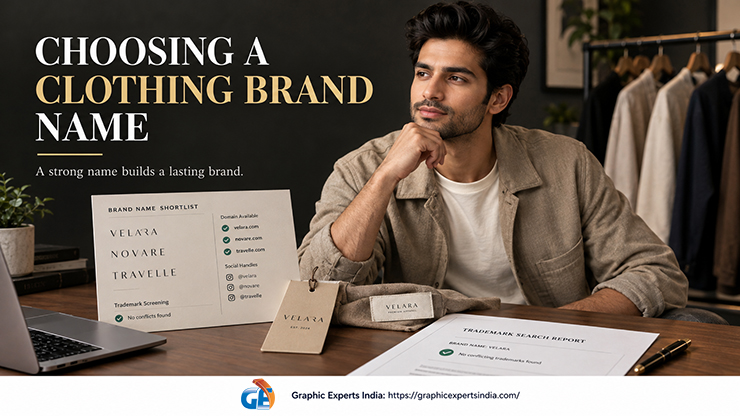
To choose a name when branding a clothing company, generate candidates against the positioning statement, check each as a domain, a social handle and a trademark, and keep the one that survives all three and still sounds like the brand story. The trademark check is the one founders skip.
The United States Patent and Trademark Office states: “The base application filing fee for each class of goods or services in a Section 1 or Section 44 application is $350 if the application meets the requirements” (USPTO, fee schedule effective 18 January 2025). Clothing falls in International Class 25. Rules differ by country, and this article states fees, not legal advice.
A name also has to work inside the visual system that follows: long names force small type on a woven label, and names that describe one product category limit the second collection. The full process, from generators to the Class 25 filing, is covered in the guide to clothing brand name ideas.
How Does the Logo Fit into the Clothing Brand Design System?
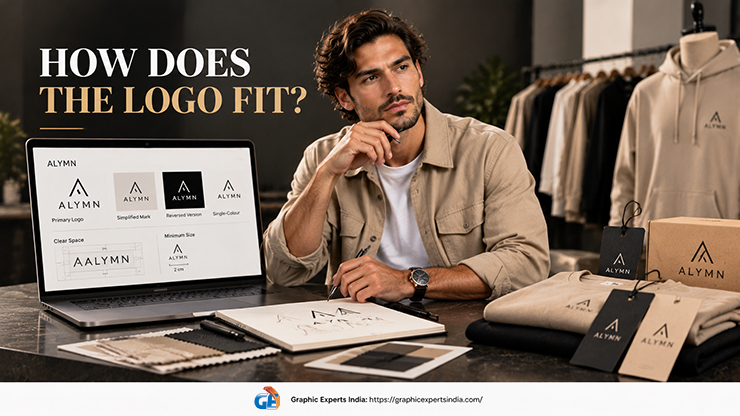
The logo fits into the clothing brand design system as one asset with several mandated versions, not as the system itself. A clothing brand needs at minimum a primary logo, a simplified mark for the neck label and favicon, a single-color version for embroidery and a reversed version for dark garments.
Each version has a minimum size, a clear-space rule and a list of permitted backgrounds, and the guidelines record which version appears on the woven label, hangtag, mailer, website header and social avatar.
Production readiness separates a logo from a picture of one. Embroidery digitisers and screen printers need a vector file; a logo that exists only as a PNG cannot be scaled to a full back print or stitched at 2 cm without redrawing.
Graphic Experts India converts raster logos to editable vector files at $4.48 per image through its raster to vector conversion service, with a 24-hour average turnaround.
How Do You Choose and Control a Color Palette for a Clothing Brand?
To choose and control a color palette for a clothing brand, pick a small set of brand colors, specify each one in every system the brand will use, and record which color appears on which surface.
A clothing palette needs five specifications per color, because the same color appears on screen, on printed packaging, in thread, in dyed fabric and in a photograph: an sRGB or hex value, a CMYK value, a Pantone textile reference, the embroidery supplier’s shade number, and one color-corrected reference image approved per colorway.
The drift between those systems is where clothing brands lose consistency. Printful’s print-file guidance states: “Create your print file in the sRGB color profile, specifically sRGB IEC61966-2.1,” and then: “Our printers then convert your submitted file into CMYK format” (Printful, read 14 October 2026).
That conversion is why a saturated blue on a mockup prints duller on a shirt; a white-balance shift between shoots separates a dyed fabric from its photograph the same way.
Pantone’s Color of the Year 2026 is PANTONE 11-4201 Cloud Dancer, described by Pantone as “a lofty white that serves as a symbol of calming influence” (pantone.com, read 14 October 2026); even a white has a reference number.
Keeping each color consistent on screen after the shoot is a color correction in Photoshop task that the style guide below makes a standing rule.
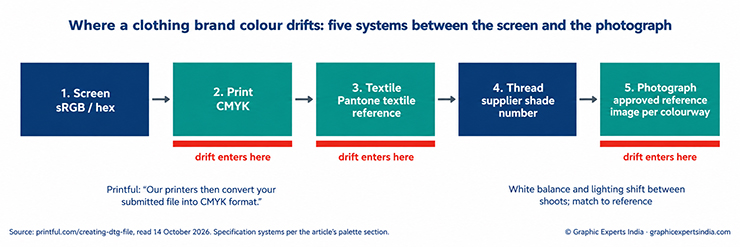
Figure 1. The five places one brand color must be specified for a clothing brand, and where drift enters. Printful’s sRGB-to-CMYK statement from printful.com/creating-dtg-file, read 14 October 2026.
Which Typography Rules Does a Clothing Brand Need?
A clothing brand needs three typography rules: a primary typeface for headlines and the wordmark, a secondary typeface for body copy on the website and packaging, and a fallback that renders on marketplaces and email clients that cannot load custom fonts. The guideline records weights, minimum sizes per surface and wordmark tracking, and bans everything else.
Clothing adds two physical constraints. Woven labels render fine serifs poorly, so the label wordmark is often a heavier weight than the website version. The product description, which carries most of the body type a customer reads, follows its own structure of fit, fabric, measurements and care, documented in the guide on how to write product descriptions for an online clothing store.
How Do You Define a Brand Voice for a Clothing Company?
To define a brand voice for a clothing company, write three adjectives the voice is, three it is not, and ten example sentences that show the difference on real surfaces: a product title, a size note, a shipping email, a return reply, a caption. Shopify lists “voice and tone” and “grammar and style conventions” as separate sections (21 February 2025): voice is constant, tone changes with the situation.
A clothing brand voice is tested most on its words for bodies, sizes and fit, which decide whether a customer feels described or judged. The guideline fixes the size and fit vocabulary and the words for the model’s measurements, and reuses them in every listing. PowerReviews’ June 2023 survey of 25,452 US consumers found that 39% return apparel because of fit, and fit is described in words before it is tried on (PowerReviews, 2023).
What Should Clothing Brand Packaging Communicate?
Clothing brand packaging should communicate the same identity as the product page at the moment the customer first touches the brand. For an online label the parcel is the first physical contact, so the mailer, tissue, hangtag, care card and return slip are brand surfaces and follow the same color, type and logo rules as the website, with insert copy in the brand voice.
Packaging also carries the return. The National Retail Federation and Happy Returns estimated that “19.3% of online sales will be returned in 2025” (NRF, 15 October 2025), so roughly one parcel in five travels back, and a resealable mailer and a return slip in the brand voice are part of the system. Packaging is also photographed, so its colors must photograph as the brand palette.
What Is a Photography Style Guide and Why Does a Clothing Brand Need One?
A photography style guide is the section of the brand guidelines that fixes how every garment is photographed, retouched and color-matched, so an image shot in October belongs beside one shot in March. Clothing brands need one because the photograph is the product until the parcel arrives.
Baymard Institute’s product-page benchmark, updated 18 March 2026, finds that “up to 62% of sites have a ‘mediocre’ or worse Product Page UX,” that 37% lack in-scale images and that 23% provide no human-model image (Baymard, 2026). Google’s apparel best-practice page instructs sellers to “Show clothing on models.
Show how your product looks on a real person,” to “Use a solid white or transparent background,” and adds: “It’s best to use a minimum image width of 1500 pixels” (Google Merchant Center Help, read 14 October 2026).
The sections below turn those requirements and the brand’s identity into one page a photographer, an editor and a listing manager can each check, borrowing from the product-page practices documented in the guide to how top fashion brands present products online.
How Should the Style Guide Specify Framing and Backgrounds?
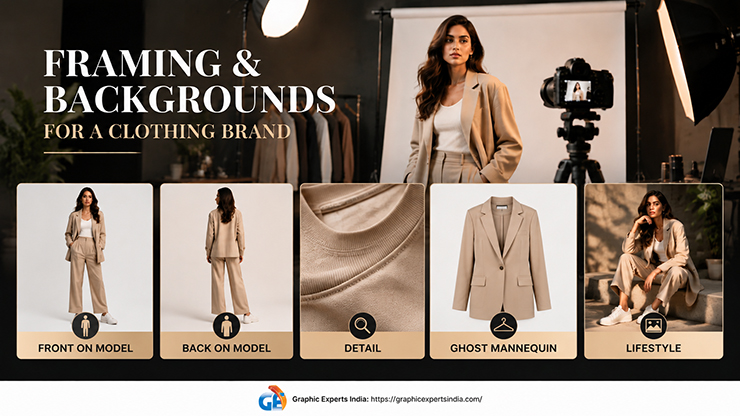
The style guide should specify framing and backgrounds as fixed values for each of five shot types: front on model, back on model, detail, flat or ghost mannequin, and lifestyle. For each, it records the crop, camera height, focal length and background. Google’s page states:
“If you’re using a full-body image, avoid cropping the model’s head or feet,” which sets the full-body crop for the marketplace main image (Google Merchant Center Help). Main images take the solid white or transparent background Google recommends; lifestyle images take a short list of approved settings that match the audience definition.
How Should the Style Guide Direct Models?
The style guide should direct models with the same precision it gives the camera: the pose set per shot type, expression, hand positions, hair and make-up standard, and the size range photographed. It should also record which products are shown on a person, on a ghost mannequin and flat, because a model shows fit and drape, a ghost mannequin shows construction, and a flat shows print placement.
The trade-off between on-model, ghost mannequin and AI-generated imagery is covered in a separate guide on AI models versus ghost mannequin versus real models. Levi Strauss & Co.’s note on its 2023 AI-model test states that “human models and collaborators are core to that experience” (levistrauss.com, 28 March 2023); a style guide should state the brand’s own position as plainly.
What Retouching Standard Should the Style Guide Set?
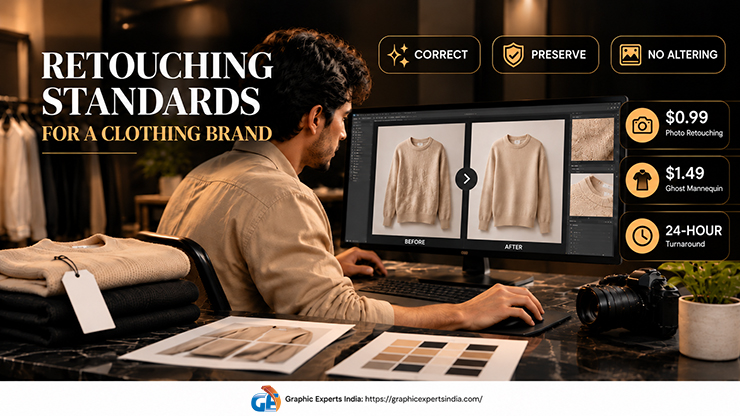
The retouching standard the style guide should set is a written list of what is corrected, preserved and prohibited, applied to every image before publication. Corrected: exposure, white balance, dust, lint, creases, stray threads, mannequin removal. Preserved: fabric texture, seam lines, print detail, skin texture.
Prohibited: body reshaping, color changes away from the approved reference, and design features the shipped garment does not have.
Graphic Experts India applies a three-step quality check to e-commerce photo retouching priced from $0.99 per image, with ghost mannequin editing from $1.49 per image and a 24-hour average turnaround, and the style guide can be handed to the editing team as the brief, so the standard travels with the images.
How Does the Style Guide Keep Color Consistent Across Seasons and Colorways?
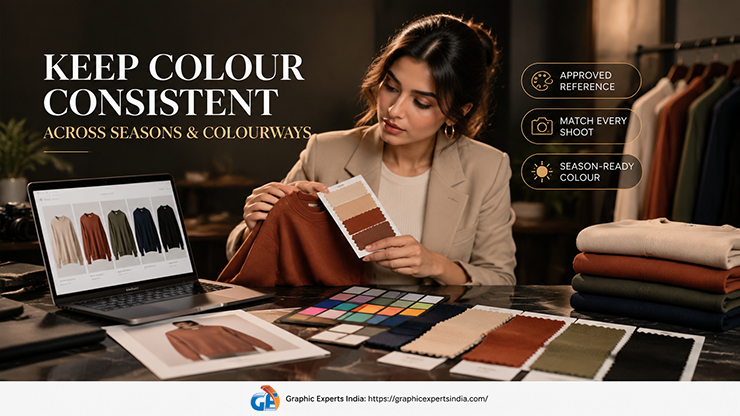
The style guide keeps color consistent across seasons and colorways by naming one approved reference image per colorway and requiring every later image of that colorway to be matched to it. The reference is shot under the specified lighting, checked against the garment and its textile reference, and stored under the colorway code.
Each new shoot of the same fabric, whether a restock in a different studio or a new silhouette in the same dye lot, is corrected to the reference rather than to the photographer’s eye. Graphic Experts India performs that match as color correction from $0.99 per image, which for a 100-SKU seasonal drop is $99 for the color pass.
What Does a One-Page Photography Style Guide Look Like?
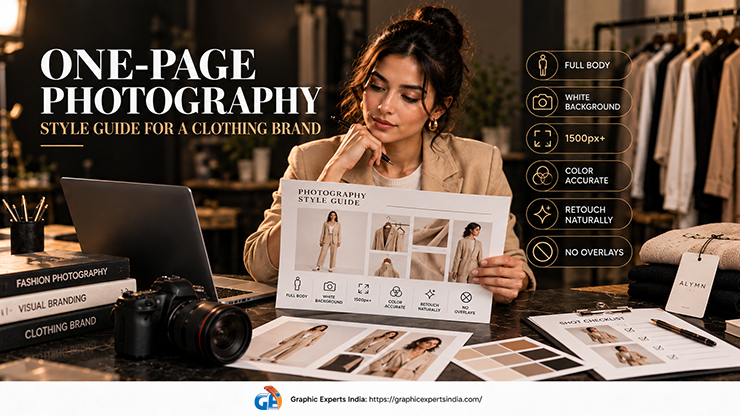
A one-page photography style guide looks like the table below: one row per parameter, with the specification, the reason and the person who checks it. The specifications are examples for a brand selling on its own store and on Google Shopping; a brand fills in its own values.
| Parameter | Specification (example) | Why | Who checks |
|---|---|---|---|
| Main image subject | Garment on a model, full body, head and feet in frame | Google: “Show clothing on models”; “avoid cropping the model’s head or feet” | Photographer |
| Background, main image | Solid white (#FFFFFF) or transparent PNG | Google: “Use a solid white or transparent background” | Editor |
| Minimum image size | 1500 px on the short side; master at 3000 px | Google: “minimum image width of 1500 pixels”; zoom resolves fabric | Listing manager |
| Shot set per SKU | Front, back, detail, flat or ghost mannequin, one lifestyle | Baymard: 37% of sites lack in-scale images; 23% lack a human-model image | Listing manager |
| Model size range | Sizes photographed stated in the guide; model height and size worn recorded | Fit is the top return reason at 39% (PowerReviews) | Producer |
| Lighting | Fixed key and fill positions; color temperature recorded; grey card in frame 1 | Keeps white balance constant across shoots | Photographer |
| Color reference | One approved image per colorway, matched to the textile reference | 28% of returns: item “didn’t look the way they thought it would” | Editor |
| Retouching | Correct exposure, dust, creases; preserve texture; no reshaping, no color change from reference | Image must show the garment that ships | Editor, three-step check |
| File naming | SKU_colorcode_shottype_version | Lets any image be traced to its reference | Listing manager |
| Marketplace overlays | None on main images; logos and text only on owned-channel variants | Google disallows promotional overlays on main images | Listing manager |
| Review cadence | Every new colorway before listing; full audit each season | Catches drift before it reaches the product page | Brand owner |
How Do You Measure Brand Consistency for a Clothing Brand?
Brand consistency for a clothing brand is measured with four seasonal checks: an asset audit counting the share of live product images that meet the main-image rules; a color audit comparing every colorway image against its reference; a voice audit sampling ten listings and ten customer emails against the voice guide; and a returns-reason audit tagging each return and tracking the share attributed to appearance.
The fourth check is where inconsistency becomes money. Assume a brand ships 1,000 online orders a month. At the NRF and Happy Returns estimate of 19.3% of online sales returned in 2025, that is about 193 returns a month. If 28% of those follow PowerReviews’ “didn’t look the way they thought it would” reason, that is about 54 returns a month, or about 648 a year, attributable to a gap between image and garment.
Both rates are US averages from different surveys and the volume is an assumption, so 54 is an illustration, not a forecast. Against it, a color-correction pass at $0.99 per image on a 100-SKU catalogue costs $99. The comparison does not prove that consistent imagery removes those returns; it sizes what is at stake.
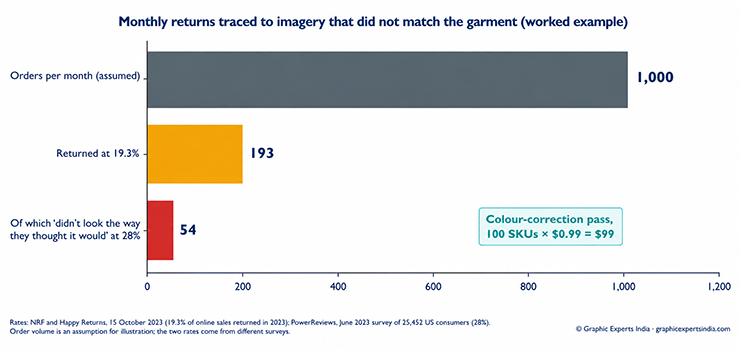
Figure 2. From 1,000 assumed monthly orders to the returns attributable to the item not looking as expected. Rates from NRF and Happy Returns (15 October 2025) and PowerReviews (June 2023); order volume is an assumption.
How Does Brand Identity Carry into the Go-to-Market Plan?
Brand identity carries into the go-to-market plan as the fixed input every channel decision is checked against: the audience selects the channels, the voice writes the captions and ads, the palette and typography build the templates, and the photography style guide supplies the images every channel reuses.
A launch that starts from channels produces a feed where each post looks like a different brand; one that starts from the guidelines produces the repetition that makes a new label recognisable.
The channel plan, budgets and launch sequence are set out in the guide to clothing brand marketing strategy, which assumes the identity system in this article exists. The practical hand-off is a shared asset library holding the logo versions, color values in all five systems, font files, templates and the reference image per colorway.
Which Clothing Brands Show a Consistent Brand System?
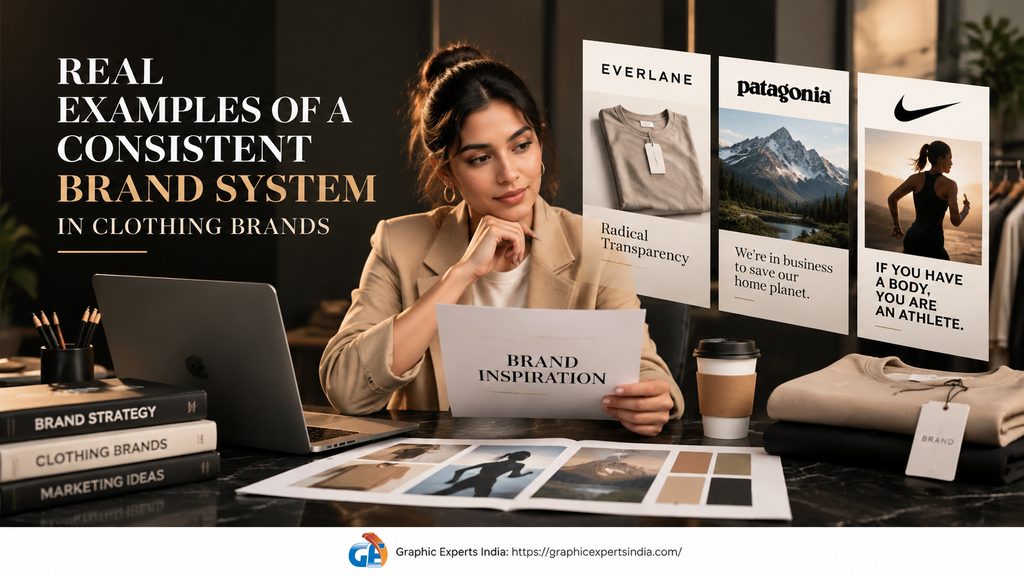
Three clothing brands show a consistent brand system in statements they publish themselves, which is the only evidence this guide uses for examples.
| Brand | Published element | What it fixes | Source |
|---|---|---|---|
| Everlane | “We believe our customers have a right to know how much their clothes cost to make”; a $30 t-shirt against $55 at traditional retail | A reason to believe stated as a number, repeated on product pages | everlane.com/about, read 14 October 2026 |
| Patagonia | “We’re in business to save our home planet”; core values including Quality: “Build the best product, provide the best service and constantly improve everything we do” | A mission and values short enough to repeat verbatim on every surface | patagonia.com.hk mission page; patagonia.com/core-values, updated 2022 |
| Nike | “BRING INSPIRATION AND INNOVATION TO EVERY ATHLETE* IN THE WORLD”; “*If you have a body, you are an athlete” | An audience definition in one footnote | about.nike.com/en/mission, read 14 October 2026 |
The common feature is brevity: each statement is short enough that no copywriter needs to paraphrase it. Everlane names its practice, “It’s a new way of doing things. We call it Radical Transparency,” so a policy can be cited in two words.
None of the three publishes performance data tied to these statements, so they are presented as practices, not measured results. Patagonia’s 2011 “Don’t Buy This Jacket” newspaper advertisement, documented in the guide to fashion advertising, carries the same environmental position into a paid placement.
What Do Founders Ask Most Often About Building a Clothing Brand?
To start a successful clothing brand, write the positioning statement and audience definition first, build the identity system around them, and document a photography style guide before the first shoot. The logo, palette, voice and images all depend on who the brand is for. Protect the name with a $350-per-class USPTO filing in Class 25, and test the identity in a business plan before production.
A logo is one visual asset; branding is the full system of positioning, audience, story, name, color, typography, voice, packaging and photography rules the logo sits inside. Shopify names logos as one of seven guideline sections alongside typography, color palette, imagery, audience, voice and tone, and grammar conventions (21 February 2025). For clothing, imagery carries the most commercial weight.
Develop the palette by choosing a small set of colors and specifying each in sRGB or hex, CMYK, a Pantone textile reference, a thread shade number and an approved photograph. Printful’s guidance states that print files are created in “sRGB IEC61966-2.1” and that “our printers then convert your submitted file into CMYK format,” which is why screen and print differ. Record the conversion once and reuse it.
Good clothing brand design ideas beyond the logo include a named color per colorway with a reference photograph, a heavier woven-label version of the wordmark, a packaging set in the palette, a fixed shot list per SKU, and an about page that states the story in verifiable facts. Each is a rule that repeats, which is what makes a brand recognisable across hundreds of images.
The cost depends on order volume, but the rates are published: 19.3% of US online sales were estimated to be returned in 2025 (NRF and Happy Returns), and 28% of apparel returns are because the item “didn’t look the way they thought it would” (PowerReviews, 2023). On an assumed 1,000 orders a month, that is about 54 appearance-related returns monthly, against a $99 color-correction pass for 100 SKUs.
Where Can a Clothing Brand Get Its Photography Style Guide Applied to Every Image?
A clothing brand can send its photography style guide and raw images to Graphic Experts India and receive files retouched and color-matched to its reference per colorway.
Graphic Experts India lists e-commerce retouching from $0.99 per image, color correction from $0.99 per image, ghost mannequin editing from $1.49 per image, background removal from $0.39 per image and logo vector conversion at $4.48 per image.
Each service carries a 24-hour average turnaround and a three-step quality check, and the company has served e-commerce retailers, photographers and apparel brands since 2009. A free trial on sample images is available through the photo retouching service page, with no credit card required.

Salim Ahmed is the CEO of Graphic Experts India, with over 25 years of expertise in photo editing, clipping path, image retouching, and eCommerce image editing services.