

A clothing brand name is the word or phrase that identifies one apparel label’s goods and separates them from every other label’s goods. A good brand name for a t shirt business is short, pronounceable, legally distinctive and still available as a domain, a social handle and a trademark.
This guide states the criteria, gives six naming frameworks with original examples, lists 66 name ideas by style, provides a screening checklist, and explains how to register a clothing brand name in the United States from USPTO and WIPO pages read on 14 October 2026.
Every name idea here is an unverified suggestion that must be searched before use. The name is one half of a brand identity; the mark is the other half, covered in the parent guide to Clothing Brand Logo Design.
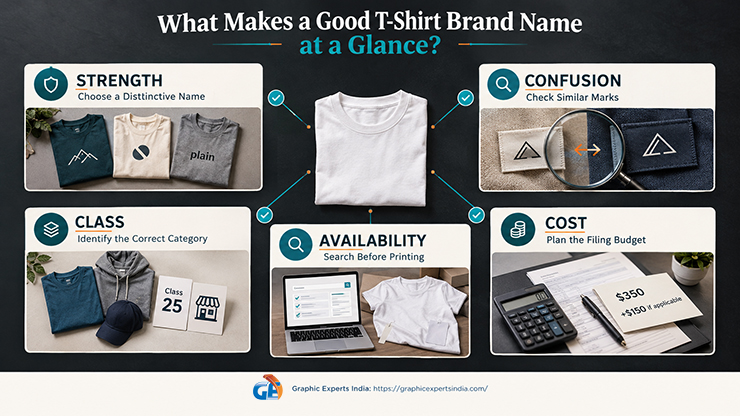
What Makes a Good T-Shirt Brand Name at a Glance?
A good t-shirt brand name at a glance is one that passes five checks before any shirt is printed: strength, confusion, class, availability and cost.
| Question | Short answer | Source |
|---|---|---|
| Which names are legally strongest? | “Strong trademarks are suggestive, fanciful, or arbitrary.” Descriptive and generic names are weak | USPTO, Strong trademarks, 30 November 2023 |
| What is the most common reason a name is refused? | Likelihood of confusion with a live mark: “the most common reason for refusing registration” | USPTO, Likelihood of confusion, 30 November 2023 |
| Which class covers t-shirts? | International Class 25, “Clothing, footwear, headwear”; a store selling them is Class 35 | WIPO Nice Classification, 13th edition, version 2026 |
| What does a US application cost? | $350 per class base fee, effective 18 January 2025 | USPTO, Trademark fee information |
| Can a brand file before selling? | Yes, on an intent-to-use basis; registration waits until use is proven, at $150 per class | USPTO, Basis; Trademark fee information |
| Does a state business name or a domain protect the name? | No. Each “Does not create a registered trademark” | USPTO, Trademark basics for small businesses |
What Makes a Good Clothing or T-Shirt Brand Name?
A good clothing or t-shirt brand name meets four criteria: it is short, it is pronounceable on first reading, it is legally distinctive, and it is available as a .com domain, a social handle and a trademark. The first two are design judgements; the last two are database checks, and the checks eliminate more names than taste does.
Legal distinctiveness has a published scale of five groups (USPTO, Strong trademarks, 30 November 2023). “Fanciful trademarks are invented words”, such as Exxon® for petroleum. “Arbitrary trademarks are actual words that have no association with the underlying goods or services”, such as Apple® for computers.
“Suggestive trademarks are words that suggest some quality of the goods or services”, such as Coppertone®. Descriptive marks (“Creamy” for yogurt) and generic terms (“Bicycle” for bicycles) sit at the weak end. The page concludes: “Strong trademarks are suggestive, fanciful, or arbitrary.
Weak trademarks are descriptive or generic.” Consequently “Heavyweight Tee Co.” is easy to understand and hard to protect; an invented word is the reverse.
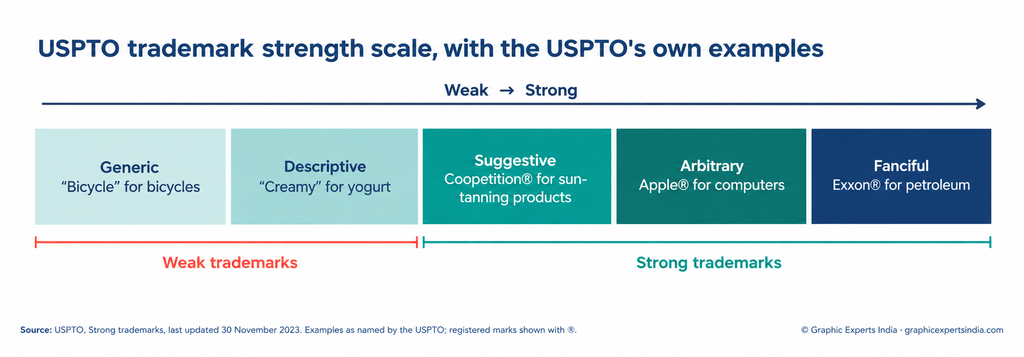
Figure 1. The five USPTO categories of trademark strength, from generic to fanciful, with the examples named on the USPTO Strong trademarks page (last updated 30 November 2023).
The chosen name then has to carry a wordmark, a neck label and a social profile, decisions covered in the guide to branding a clothing company.
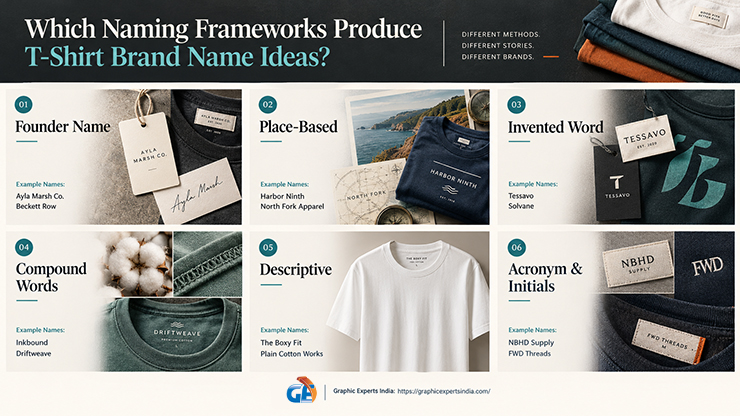
Which Naming Frameworks Produce T-Shirt Brand Name Ideas?
Six naming frameworks produce most t shirt brand name ideas: founder name, place, invented word, compound, descriptive and acronym. The table gives the construction rule, the usual USPTO strength category and nine or ten original examples each.
Every example is an unverified idea generated for this guide; none has been searched against any trademark, business, domain or social database, and each must be screened before use.
| Framework | How to build it | Usual USPTO category | Unverified example ideas |
|---|---|---|---|
| Founder name | Pair a surname or first name with a trade word such as Co., Supply, Studio or & Sons; swap in the real founder’s name | Arbitrary (strong) | Ayla Marsh Co. · Dunmore & Sons · J. Okafor Studio · Hale Brothers · Reyes Atelier · Lindqvist Supply · Tomas Verity · Oyelaran Goods · Beckett Row |
| Place | Take a street, river, harbour or neighbourhood the founder is tied to and add a material or trade word; a place the goods actually come from risks a geographic-descriptiveness refusal | Suggestive to descriptive | Harbor Ninth · Mile End Thread · Kettle Falls Co. · North Fork Apparel · Dockside Twelve · Salt Marsh Supply · Elm Street Standard · Bayline Goods · Riverbend Cotton |
| Invented word | Blend two syllables with a clear vowel pattern, cap at three syllables, and test that three people spell it the same way after hearing it once | Fanciful (strongest) | Tessavo · Lumbrix · Oakhavi · Zephrane · Kordovi · Nimbral · Solvane · Brindlo · Ferrowen · Quintrel |
| Compound | Join two ordinary words so the pair means something the single words do not; hint at texture, time or weather without describing a shirt | Suggestive (strong) | Inkbound · Saltstitch · Coldpress Cotton · Bluehour Supply · Wildcrest · Stonewake · Driftweave · Lowtide Union · Northloom · Thread & Ember |
| Descriptive | State what the product is; suits a blank-apparel supplier that values clarity over exclusivity and will rely on a distinctive logo | Descriptive (weak) | Heavyweight Tee Co. · Plain Cotton Works · The Boxy Fit · Everyday Blank Co. · Slow Stitch Studio · Pocket Tee Supply · Soft Ground Cotton · Garment Dyed Goods · The Oversize Shop |
| Acronym or initials | Shorten a phrase that carries the brand’s idea to three to five letters that read aloud without a pause; prints small, needs repetition to be remembered | Arbitrary to fanciful | NBHD Supply · AM/PM Cotton · OSFA Club · FWD Threads · BRKT Supply · L8R Cotton · DIY Dept · W.R.N. Goods · TLDR Tees |
Which Name Ideas Fit Each Clothing Brand Style?
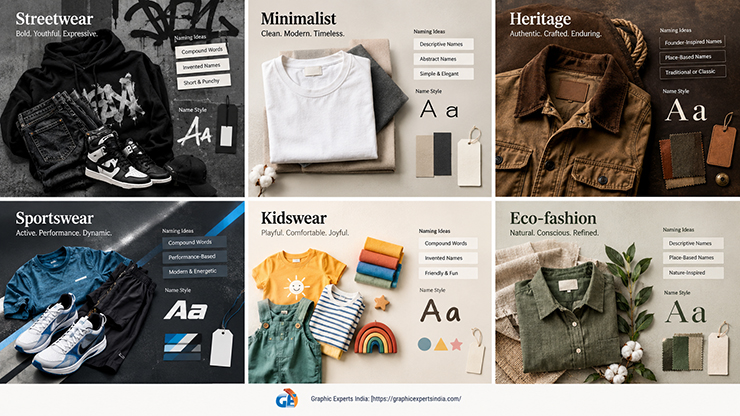
The 66 name ideas below are grouped by the six styles most new apparel labels fall into, with the framework noted so the structure can be reused with different words. All 66 are unverified ideas that must pass the screening checklist in the next section before a label is printed, a domain bought or an application filed.
| Style | Framework | Unverified name ideas |
|---|---|---|
| Streetwear | Compound | Inkbound · Lowtide Union · Blockrun · Nightshift Supply |
| Streetwear | Place | Curbside Dept. · Ninth Harbor · Tenement Press |
| Streetwear | Invented / acronym | Static Youth · Greyline Crew · Offcut Club · Vandal Script |
| Minimalist | Invented | Tessavo · Solvane · Oneform · Studio Nul |
| Minimalist | Descriptive | Plain Cotton Works · Monday Blank · Halftone Basics · Unit Cotton |
| Minimalist | Compound | Quiet Weight · Bare Loom · Formless |
| Heritage | Founder name | Dunmore & Sons · Hale Brothers · Reyes Atelier · Beckett Row |
| Heritage | Place | Kettle Falls Co. · Elm Street Standard · Coal Harbor Mercantile · Ironbridge Cloth |
| Heritage | Compound | Old Mill Standard · Foundry Row · Lindqvist Supply |
| Sportswear | Compound | Northloom · Stonewake · Secondwind Co. · Pacebound |
| Sportswear | Invented | Strideform · Haltline · Rucksport |
| Sportswear | Descriptive | Kinetic Yard · Tempo Nine · Fieldset Athletic · Driftweave |
| Kids | Invented | Brindlo · Nimbral · Doodleweight |
| Kids | Compound | Puddlejump Co. · Tiny Loom · Mudpie Cotton · Wobble & Co. |
| Kids | Place / descriptive | Little Harbor Tees · Sprout Row · Pocketful Kids · Scribble Supply |
| Eco | Compound | Saltstitch · Fallow Thread · Loam & Linen · Orchard Weave |
| Eco | Descriptive | Slow Stitch Studio · Soft Ground Cotton · Undyed Studio · Rainfed Cotton |
| Eco | Invented / other | Second Field · Hempline Supply · Mended Co. |
One caution applies to the eco rows: words such as “organic” and “recycled” describe the goods, so they are weak as trademarks and make a factual claim the supply chain must support.
How Do You Screen a Brand Name Before You Commit to It?
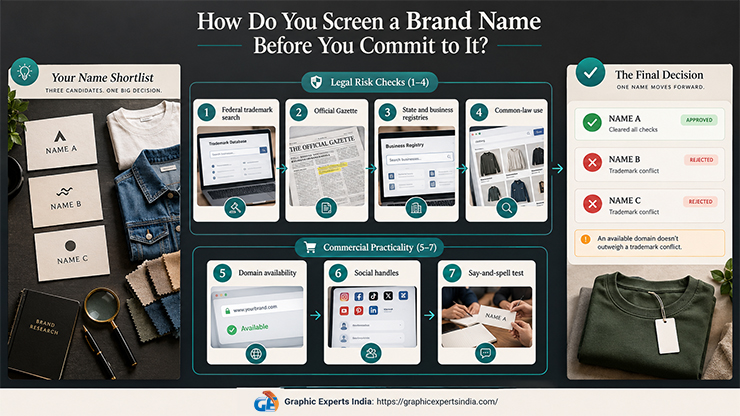
To screen a brand name before committing to it, run each shortlisted name through seven checks in the order below and drop the name at the first disqualifier. The USPTO sets the floor: “At a minimum, be sure to check our database and the TMOG for federal applications and registrations” (USPTO, Comprehensive clearance search, 30 November 2023).
The same page lists state trademark and business registries, domain name registries and search engines as further sources; the social-handle and say-and-spell rows are commercial checks added here.
| Check | Tool | What disqualifies the name |
|---|---|---|
| 1. Federal trademark search | USPTO Trademark Search at tmsearch.uspto.gov; “basic mode” for a first pass, “expert mode” to filter live and dead cases and by class | A live application or registration for the same or a similar name in Class 25 or Class 35, including sound-alikes and alternate spellings |
| 2. Official Gazette | Trademark Official Gazette (TMOG), the USPTO’s weekly publication of marks approved for publication | A newly published mark for similar goods that has not yet reached the register |
| 3. State and business registries | The USPTO’s state trademark links page; each state’s business-entity search | A registered state trademark or an active business entity with the same name in apparel |
| 4. Common-law use | Two or more search engines; marketplace and social searches for the name plus “shirt”, “apparel”, “clothing” | An unregistered brand already selling clothing under the name, since “an owner can use their common law rights to take legal action against you” |
| 5. Domain | The registrar of choice and the ICANN lookup tool linked from the USPTO clearance page | The exact .com taken by an active apparel site; a parked .com is a cost decision, not a legal one |
| 6. Social handles | Direct handle search on each platform the brand will use | The exact handle held by an active clothing account; a near variant with an underscore is a risk, not a block |
| 7. Say-and-spell test | Three people hear the name once and write it down | Two or more different spellings, or a pronunciation that differs from the spelling |
Checks 1 to 4 are legal and checks 5 to 7 are commercial. A name that fails check 1 is not rescued by an available domain; a name that fails only check 5 can run on a domain with a “wear” or “shop” suffix.
How Do You Register a Clothing Brand Name as a Trademark in the United States?
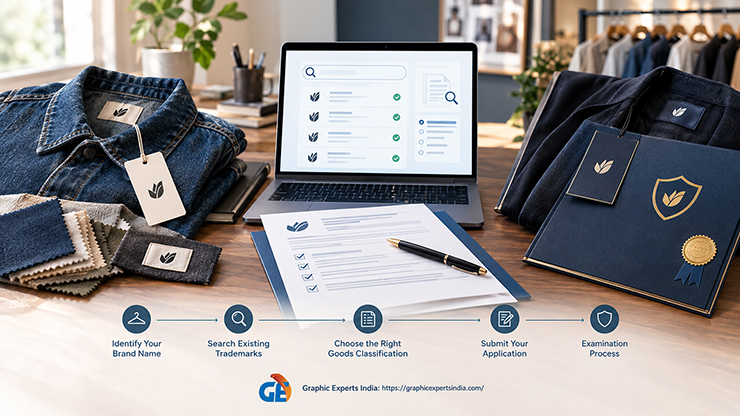
To register a clothing brand name as a trademark in the United States, search the federal database, choose the class or classes, choose a filing basis, file with the USPTO and respond to the examining attorney until the mark registers.
A registration gives no “rights to the word or phrase in general, only to how that word or phrase is used with your specific goods or services” (USPTO, What is a trademark, 30 November 2023). The facts below come from USPTO and WIPO pages; they are not legal advice, and rules differ outside the United States.
How Do You Search the USPTO Trademark Database?
To search the USPTO trademark database, open the cloud-based Trademark Search system at tmsearch.uspto.gov, enter the name and its variants, and review every live result in Class 25 and Class 35.
The USPTO introduced the system on 18 September 2023 to replace TESS, with “a simplified, basic search interface as well as a more advanced search interface for more complex searching” (USPTO news, 18 September 2023); its handout says to “Use”basic mode” for baseline functionality” and to “Turn on”expert mode” to tag results and access other features”.
Two sentences set the scope: “Only live trademark applications and registrations can prevent your trademark from being registered”, and “Even if you don’t hire an attorney, it’s important to do a search yourself” (USPTO, Federal trademark searching, 16 April 2024).
Which Trademark Class Covers T-Shirts and Which Covers a Clothing Store?
International Class 25 covers t-shirts and International Class 35 covers the retail service of selling them. The USPTO assigns every category of goods or services “a number from 1 to 45, also known as an international class” and uses “black short-sleeved t-shirts” as its Class 25 example (USPTO, Goods and services, 25 March 2025).
The Nice Classification, 13th edition, version 2026, states that “Class 25 includes mainly clothing, footwear and headwear for human beings” and lists “tee-shirts” as basic number 250155; its Class 35 note covers “the bringing together, for the benefit of others, of a variety of goods” so that customers can “conveniently view and purchase those goods” through “retail stores, wholesale outlets” and online (WIPO).
Therefore a brand that makes shirts files in Class 25, and a brand that also runs a multi-brand store adds Class 35 at a second base fee.
What Is the Difference Between “Use in Commerce” and “Intent to Use”?

The difference between “use in commerce” and “intent to use” is whether the brand is already selling under the name on the filing date. Under Section 1(a), the applicant states that “you are currently using your mark in commerce with your goods and/or services” and files one specimen per class showing that use (USPTO, Basis, 3 March 2021).
Under Section 1(b), the applicant states that “you have a bona fide intention to use your mark in commerce with your goods and/or services in the near future”.
Then “your mark will not be registered until you convert the application to one based on use in commerce” by filing an allegation of use. Intent to use secures a pre-launch brand’s filing date at the cost of a later fee.
How Much Does It Cost to Register a T-Shirt Brand Name?
A t-shirt brand name costs $350 per class to file with the USPTO, plus $150 per class to prove use if the application was filed on an intent-to-use basis.
The base application fee “for each class of goods or services in a Section 1 or Section 44 application is $350” under the fee rule effective 18 January 2025, which replaced the former TEAS Plus and TEAS Standard fees (USPTO, Trademark fee information; Summary of 2025 trademark fee changes). Attorney fees are additional.
| Fee or basis | Amount | When it applies | Source |
|---|---|---|---|
| Base application, Section 1 or 44 | $350 per class | Every application; Class 25 alone is $350, Class 25 plus Class 35 is $700 | USPTO fee information, 18 January 2025 |
| Insufficient information surcharge | $100 per class | Application missing required information | USPTO fee information |
| Free-form goods description surcharge | $200 per class | Describing goods in the free-form box instead of the Trademark ID Manual; a further $200 per extra 1,000 characters | USPTO fee information |
| Use in commerce, Section 1(a) | No extra fee | Mark already in use on the filing date; one specimen per class | USPTO, Basis |
| Intent to use, Section 1(b) | $150 per class allegation of use | Filed before use; registration waits for the allegation of use | USPTO, Basis; fee information |
| Extension of time to file statement of use | $125 per class | Each six-month extension requested after the notice of allowance | USPTO fee information |
| Ten-year maintenance | $325 declaration of use + $325 renewal, per class | “every 10 years, regardless of the underlying basis of the registration” | USPTO, How much does it cost, 18 January 2025 |
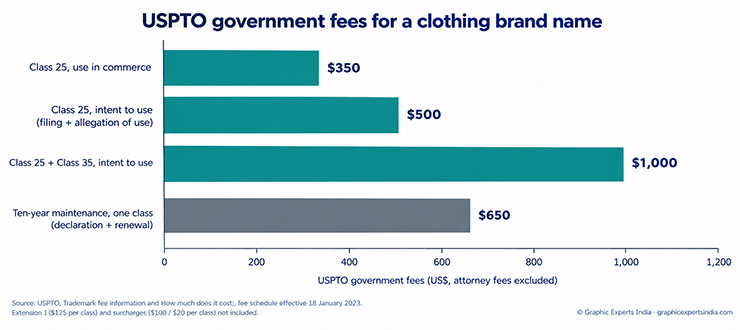
Figure 2. Government fees for a US clothing trademark under four filing scenarios, built from the USPTO fee schedule effective 18 January 2025. Attorney fees excluded.
Two calculations follow. A brand that files Class 25 on a use basis pays $350 in government fees. A pre-launch brand that files Class 25 and Class 35 on an intent-to-use basis pays $700 at filing and $300 at the allegation of use, $1,000 in total.
On timing, initial review “may take a number of months”, and an intent-to-use applicant has “six months from the date of the notice of allowance” to file the statement of use (USPTO, Trademark process, 11 August 2026). A foreign-domiciled applicant “must have an attorney who is licensed to practice law in the United States”.
The trademark line sits inside the launch budget in the guide to how to start a clothing brand.
Why Do Trademark Applications for Clothing Names Get Refused?

Trademark applications for clothing names get refused most often because the name is confusingly similar to a live mark for related goods. The USPTO states: “This is known as a likelihood of confusion, and it’s the most common reason for refusing registration” (USPTO, Likelihood of confusion, 30 November 2023).
“Trademarks don’t have to be identical to be confusingly similar”: they may be similar in “sound, appearance, or meaning”, and the page pairs “T. Markey” with “Tee Marquee”. “Goods or services could be related if they are identical, similar or competitive”, so a hoodie label and a t-shirt label are related.
A second ground is descriptiveness: the USPTO will “refuse to register your trademark if it’s generic or functional for your goods or services” (USPTO, Trademark process). The eco and descriptive names above face both risks.
Is Registering a Business Name the Same as Registering a Trademark?
Registering a business name is not the same as registering a trademark. The USPTO states that “A trade name is simply the name of your business” and that “You register your trade names with your state to conduct business there” (USPTO, How trademarks and trade names differ).

Its small-business guidance states that trade name registration “Does not create a registered trademark” and that domain name registration likewise “Does not create a registered trademark”.
Rights do exist without registration: “common law” rights “are based on use of the trademark in commerce within a particular geographic area”, whereas federal registration “creates rights throughout the entire United States and its territories” with a “Legal presumption that you own the trademark and have the right to use it” (USPTO, Why register your trademark, 17 May 2024). Before registration the brand may use “TM”; afterwards, “use an ® with the trademark” (USPTO, What is a trademark).
Rules and fees differ outside the United States. The UK Intellectual Property Office charges £205 to apply online in one class and £60 for each additional class (GOV.UK, read 14 October 2026). The European Union Intellectual Property Office charges a basic online fee of €850 for one class, €50 for the second and €150 for each further class (EUIPO, read 14 October 2026).
How Do You Turn a Brand Name into a Print-Ready Wordmark?
To turn a brand name into a print-ready wordmark, set the cleared name in a typeface, adjust the letter spacing, and convert the artwork to a vector file so it prints at any size on a label, a chest print or a shop sign. Screen printers, embroiderers and sign makers ask for an .ai, .eps or .svg file.
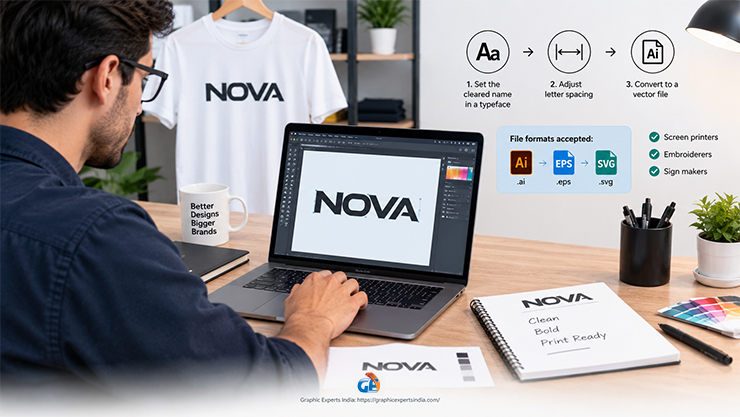
Graphic Experts India converts a raster wordmark to a vector file through its raster to vector service at $4.48 per logo, with a 24-hour average turnaround and a three-step quality check. Drawing the full mark so that a t-shirt logo prints well is covered in the separate t-shirt logo design guide in this cluster.
What Do Founders Ask Most Often About T-Shirt Brand Names?
A good brand name for a t-shirt business is short, easy to pronounce and spell, legally distinctive and available as a domain, handle and trademark. On the USPTO’s scale, “Strong trademarks are suggestive, fanciful, or arbitrary” and “Weak trademarks are descriptive or generic”, so an invented or unrelated word is easier to protect than a name that describes the shirts.
Search the USPTO’s Trademark Search system at tmsearch.uspto.gov for the name and its sound-alikes in Classes 25 and 35, then check the Trademark Official Gazette, state registries, search engines, domain registries and social platforms. The USPTO notes that “Only live trademark applications and registrations can prevent your trademark from being registered.”
A US federal application costs a base fee of $350 per class under the USPTO fee schedule effective 18 January 2025. Clothing is Class 25; a retail store is Class 35. An intent-to-use application adds $150 per class when use is proven, and an extension costs $125 per class. Maintenance every ten years costs $325 plus $325 per class. Attorney fees are additional.
Yes. An intent-to-use application under Section 1(b) requires “a bona fide intention to use your mark in commerce with your goods and/or services in the near future” and secures the filing date. The USPTO states that “your mark will not be registered until you convert the application to one based on use in commerce” by filing an allegation of use with a specimen.
Registration is not required to use a name; “common law” rights arise from use “within a particular geographic area” (USPTO). Federal registration adds nationwide rights, a legal presumption of ownership and the ® symbol. Registering a business name with a state or buying a domain “Does not create a registered trademark”, so neither substitutes for a USPTO filing.
Where Can a Clothing Brand Get Its Wordmark Converted to Vector?
A clothing brand can send a sketched or raster wordmark to Graphic Experts India and receive a vector file ready for screen printing, embroidery and signage.
Graphic Experts India lists logo vector conversion at $4.48 per logo and background removal from $0.39 per image, each with a 24-hour average turnaround and a three-step quality check, and has served apparel brands since 2009.
A free trial on a sample file is available through the vector conversion services page, returned within 24 hours with no credit card required.

Salim Ahmed is the CEO of Graphic Experts India, with over 25 years of expertise in photo editing, clipping path, image retouching, and eCommerce image editing services.