

Marketing a clothing brand means choosing a position, an audience and a channel mix, then funding each channel in proportion to what a customer costs to acquire and what that customer earns back over repeat orders.
A clothing brand marketing strategy is the written version of those choices: positioning, target customer, channels, budget split, launch calendar and the metrics that decide where next month’s money goes.
This guide builds the plan in six steps, benchmarks each channel, shows the production asset every channel depends on, and derives a budget split from verified figures, using sources read on 7 October 2026.
It is the marketing chapter of the wider guide on how to start a clothing brand.

What Is a Clothing Brand Marketing Strategy?
A clothing brand marketing strategy is a plan that states who the brand sells to, why that customer should choose it over the alternatives, which channels reach that customer, how much each channel receives, and which numbers judge the result.
A marketing plan adds the calendar, the budget lines and the owners. An apparel brand has one feature a software or food brand lacks: the product is bought on how it looks. Every channel therefore consumes the same raw material, photographs and video of the garments, so the production of that material sits inside the strategy rather than beside it.
The context is a slow market: McKinsey and The Business of Fashion wrote that “a McKinsey analysis projects that the global fashion industry will once again post low single-digit growth in 2026” (The State of Fashion 2026, 17 November 2025).
What Does Marketing a Clothing Brand Involve at a Glance?
Marketing a clothing brand involves one positioning decision, a channel mix built around owned channels first, a budget sized against a published acquisition cost, and a single product shoot that feeds every channel.
| Question | Short answer | Source |
|---|---|---|
| What does a fashion customer cost to acquire? | $66 average across 80-plus First Page Sage clients (2020–2025); $129 for fashion and accessories brands with fewer than four employees (Shopify’s 2021 data) | First Page Sage, 15 Aug 2025; Shopify, 29 Jul 2024 |
| How often do fashion store visitors buy? | 1.86% of visits converted in Fashion Clothing & Accessories in August 2026 | IRP Commerce market data |
| Which channel converts best per send? | Automated email flows: 2.15% placed-order rate for clothing and accessories against 0.12% for campaigns | Klaviyo, 24 Feb 2026 |
| What do SMS flows earn? | $2.31 revenue per recipient for clothing and accessories flows against $0.32 for campaigns | Klaviyo SMS benchmarks, modified 24 Sep 2026 |
| What does a fashion search ad cost? | $4.44 average cost per click and a 4.50% conversion rate in Apparel / Fashion & Jewelry | LocaliQ, 1 Jun 2026 |
| How much of revenue goes to marketing? | 7.7% of company revenue, with paid media 30.6% of that budget | Gartner CMO Spend Survey, 12 May 2025 |
| Why does photography belong in the strategy? | 78% of shoppers say a photo from another customer is the most valuable image type; 28% of apparel returns are “didn’t look the way they thought it would” | PowerReviews, 2024 and 2023 |
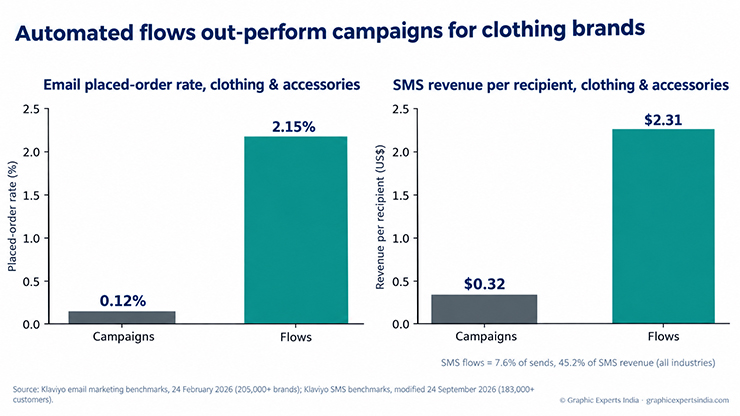
Figure 1. Automated flows against one-off campaigns for clothing and accessories brands: email placed-order rate and SMS revenue per recipient. Source: Klaviyo email benchmarks (24 February 2026) and SMS benchmarks (modified 24 September 2026).
How Do You Build a Clothing Brand Marketing Plan Step by Step?
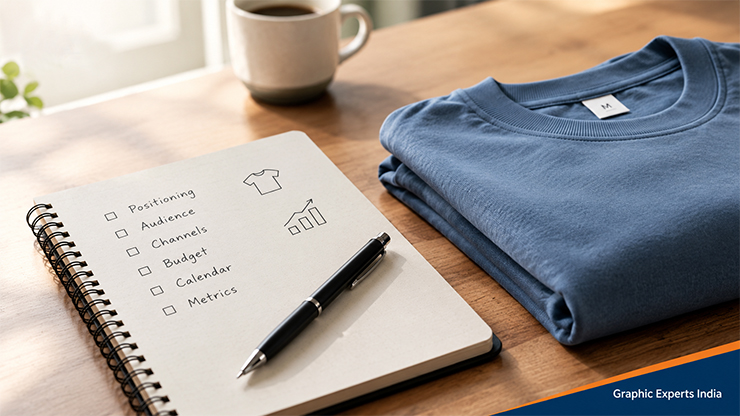
To build a clothing brand marketing plan, fix the positioning, define the audience, choose the channel mix, size the budget against acquisition cost, set a calendar around collections, and agree the metrics before the first dollar is spent.
Step 1: How Do You Position a Clothing Brand?
To position a clothing brand, write one sentence that names the customer, the occasion, the product and the reason to choose this label over the nearest alternative. If a marketplace listing could carry the same sentence, the position is not yet specific. McKinsey’s 2026 consumer research found “70 percent telling us that they plan to spend less and 80 percent indicating value-seeking behavior” (McKinsey, 11 February 2026).
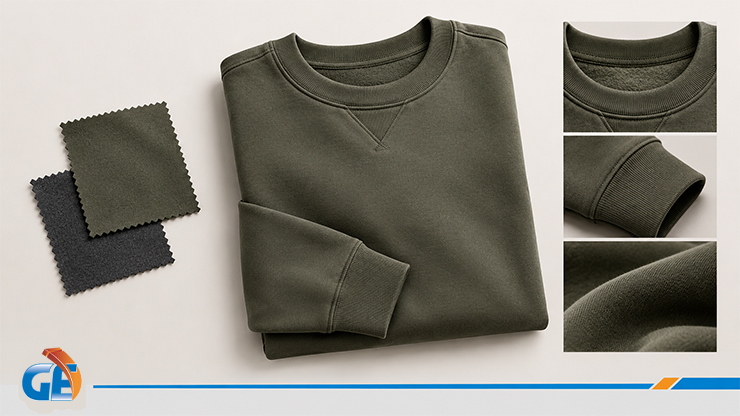
Value in that finding is a reason the customer can repeat to a friend, such as a fit for a body type, a fabric, a cause or a community; McKinsey adds that “nine in ten consumers cite being part of a like-minded community as a top driver of brand connection.” Turning the sentence into a name, logo and identity is the subject of the planned guide on branding a clothing company.
Step 2: How Do You Define the Audience for a Clothing Brand?
To define the audience, describe one buyer by age range, where they already shop, which platform they use for discovery, and what they returned last time and why.
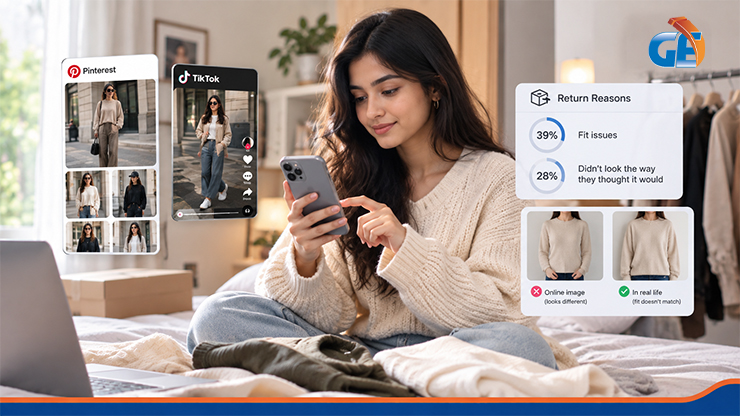
The platform choice falls out of the description. Pinterest reports “640 million monthly active users” and a split of “70% women and 30% men” (Pinterest Business, read 7 October 2026). TikTok’s fashion research states that “64% of TikTok users have discovered new fashion products on TikTok” (TikTok Marketing Science, 2023 research by Material, cited on TikTok for Business).
Both are platform-published figures. The return question supplies the first message: 39% of apparel returners cite fit and 28% say the item “didn’t look the way they thought it would” (PowerReviews, survey of 25,452 US consumers, June 2023).
Step 3: How Do You Choose the Channel Mix for a Clothing Brand?
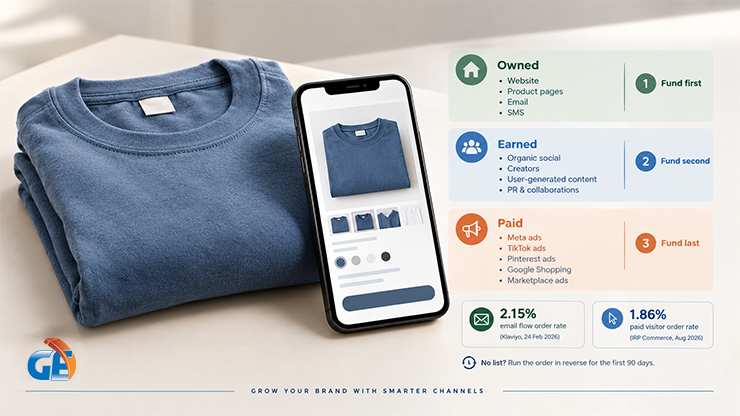
To choose the channel mix, rank channels by cost per order and by how much of the result the brand keeps, then fund owned channels first, earned channels second and paid channels last.
Owned channels are the website, product pages, email and SMS. Earned channels are organic social, creators, user-generated content, PR and collaborations. Paid channels are Meta, TikTok and Pinterest ads, Google Shopping and marketplace advertising.
The ranking follows from the benchmarks: an email flow to an existing subscriber places an order 2.15% of the time for clothing brands (Klaviyo, 24 February 2026), whereas a paid-for visitor buys 1.86% of the time (IRP Commerce, August 2026). A brand with no list runs the order in reverse for its first ninety days.
Step 4: How Do You Size a Marketing Budget for a Clothing Brand?
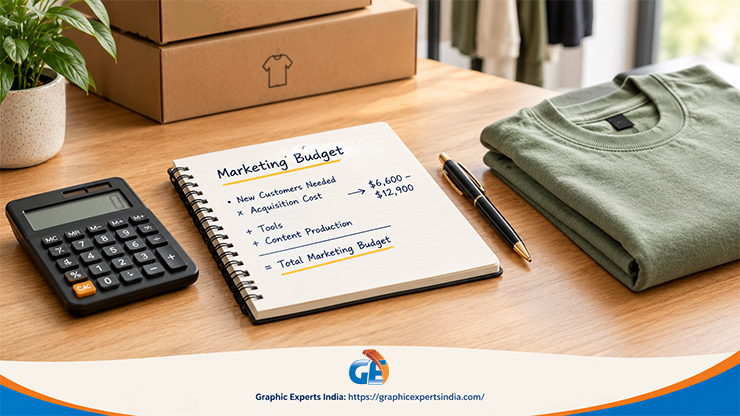
To size the budget, multiply the new customers the sales forecast needs by a published acquisition cost, then add tools and content production. First Page Sage reports a $66 average customer acquisition cost for fashion and apparel e-commerce across “80+ clients between 2020 and 2025” (updated 15 August 2025).
Shopify’s 2021 data for fashion and accessories brands with fewer than four employees put the figure at $129 (Shopify, 29 July 2024). A plan that needs 100 new customers a month therefore budgets $6,600 to $12,900 for acquisition alone.
For scale, Gartner’s survey of 402 marketing leaders found that “marketing budgets for 2025 remain flat at 7.7% of overall company revenue,” with paid media at 30.6% of those budgets (Gartner, 12 May 2025). Those are large-company figures; a launch-stage label spends a higher share because revenue is small.
Step 5: How Do You Build a Marketing Calendar for a Clothing Line?
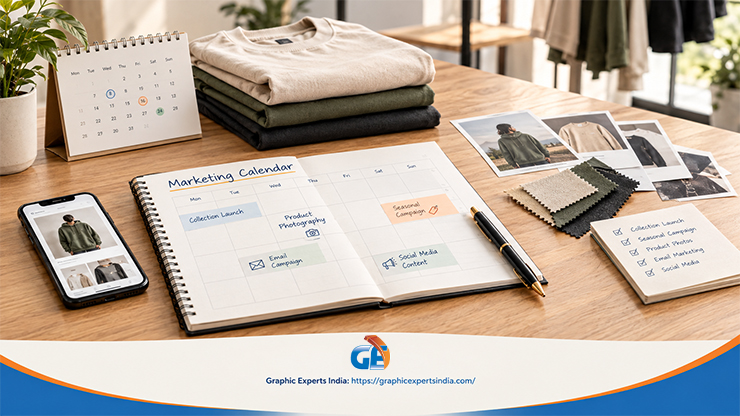
To build the calendar, anchor every campaign to a collection drop or a season, schedule the product shoot at least three weeks before the drop, and reserve two weeks after it for creator and customer content to arrive.
The calendar has three layers: the collection layer (two to six drops a year for a small label), the retail layer (back-to-school, Black Friday and Cyber Monday, holiday gifting, end-of-season sales) and the content layer (shoot, edit, email build and ad launch, scheduled backwards from each launch date). The industry shifts that move those dates are tracked in the planned guide on fashion industry trends in 2026.
Step 6: How Do You Measure a Clothing Brand Marketing Strategy?
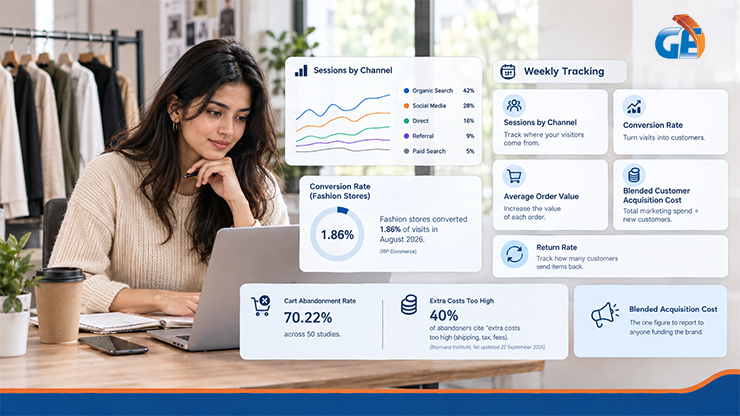
To measure the strategy, track five numbers weekly: sessions by channel, conversion rate, average order value, blended customer acquisition cost and return rate. Fashion stores converted 1.86% of visits in August 2026 (IRP Commerce).
The documented average cart abandonment rate is 70.22% across 50 studies, and 40% of abandoners cite “extra costs too high (shipping, tax, fees)” (Baymard Institute, list updated 22 September 2025). Blended acquisition cost, total marketing spend divided by new customers, is the one figure to report to anyone funding the brand.
Which Marketing Channels Work for a Clothing Brand?
The marketing channels that work for a clothing brand are the ones the plan can feed with imagery and measure by cost per order: the website and product pages, email and SMS, organic social, creators and user-generated content, paid social and Google Shopping, marketplaces, PR and collaborations, and retention.
How Should a Clothing Brand Market Through Its Own Website and Product Pages?
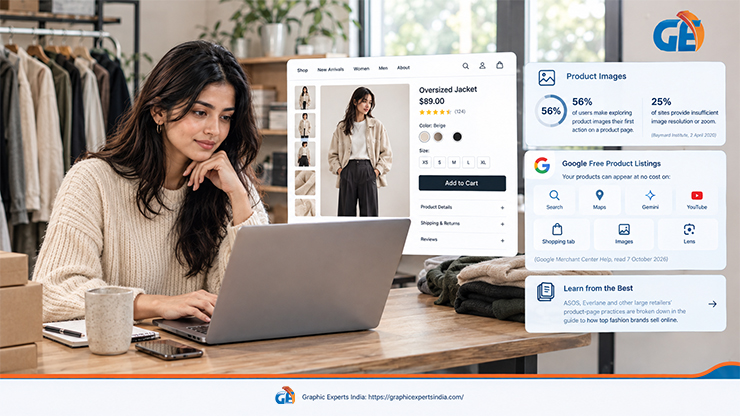
A clothing brand should treat its product pages as the first marketing channel, because every other channel sends traffic there and the page decides whether the 1.86% conversion benchmark is met. Baymard Institute found that 56% of users make exploring the product images their first action on a product page, and that 25% of sites provide insufficient image resolution or zoom (Baymard, 2 April 2020).
Google’s free product listings extend the page at no media cost. With a free listing, “the products you sell can appear at no cost on Google Search, Google Maps, Gemini, YouTube, the Shopping tab, Google Images, and Google Lens” (Google Merchant Center Help, read 7 October 2026), provided the feed carries a return policy, shipping settings and the required attributes.
The product-page practices of ASOS, Everlane and other large retailers are broken down in the guide to how top fashion brands sell online.
How Do Email and SMS Marketing Work for a Clothing Brand?
Email and SMS work for a clothing brand through automated flows triggered by behaviour, which out-perform one-off campaigns on every published measure.
Klaviyo’s 2026 email benchmarks, drawn from more than 205,000 brands, report a 2.15% placed-order rate for clothing and accessories flows against 0.12% for campaigns (Klaviyo, 24 February 2026). Across all industries, “flow-based emails deliver 3x higher click rates (5.58% vs. 1.69%) and 13x higher placed order rates than campaigns.”
Klaviyo’s SMS benchmarks, drawn from more than 183,000 customers, show flows converting at 1.9% against 0.27% for campaigns, and clothing and accessories SMS flows earning $2.31 revenue per recipient against $0.32 (Klaviyo, modified 24 September 2026).
As a result, the first three automations to build are a welcome flow, an abandoned-checkout flow and a post-purchase flow, each reusing the product-page images. The store setup that captures the first subscribers is covered in the guide on how to start an online clothing store.
How Do You Promote a Clothing Brand on Social Media Organically?
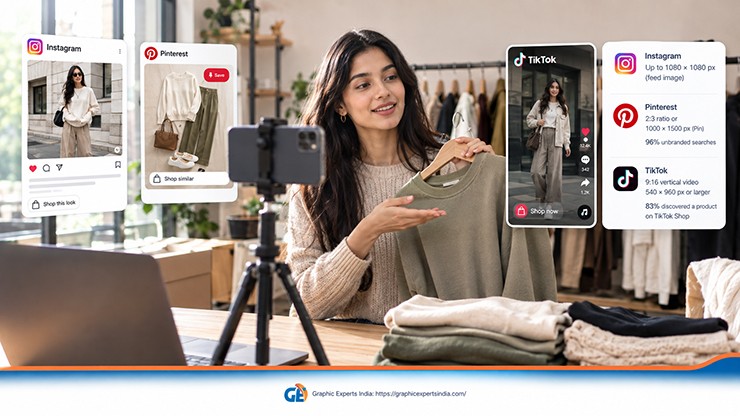
To promote a clothing brand on social media organically, publish on the one or two platforms where the defined audience discovers clothing, post the garments on real people in real settings, and make each post shoppable.
Instagram uploads feed images at “up to 1080×1080 pixels” (Instagram Help Center, read 7 October 2026). Pinterest recommends a “2:3 aspect ratio, or 1000 x 1500 pixels” for Pins (Pinterest Help) and reports that “96% of top searches are unbranded, showing Pinners are open to new ideas” (Pinterest Business, read 7 October 2026). TikTok recommends vertical 9:16 video at 540 × 960 pixels or larger (TikTok Ads Help).
Its newsroom cites a GlobalData study in which “83% of all shoppers say they have discovered a new product on TikTok Shop” (TikTok Newsroom, 13 June 2025). The platform-by-platform playbook is the subject of the guide on how to promote a clothing brand on social media.
How Do Creators and User-Generated Content Market a Clothing Brand?
Creators and user-generated content market a clothing brand by supplying the image type shoppers trust most: the garment on a real customer.
PowerReviews’ survey of 15,870 US consumers found that “nearly eight in 10 shoppers say a photo from another customer is most valuable” (78%), against 17% for professional brand photos (PowerReviews, fielded December 2023). Influencer Marketing Hub reported that “around 80% UGC creator costs fall below $500” (Influencer Marketing Hub, 19 August 2026).
Shopify Collabs tracks creator sales by link or code, and “there’s a 2.9% processing fee applied to every automatic commission payment” (Shopify Help, read 7 October 2026). Therefore a small label can start with gifted product plus commission rather than fixed fees.
Creator photos arrive with mixed lighting and colour, so the budget should include colour-matching the best of them before they reach a product page or an ad. Turning creator footage into paid creative is the subject of the planned guide on how to make a clothing advertisement.
How Do Paid Social and Google Shopping Ads Work for Fashion Brands?
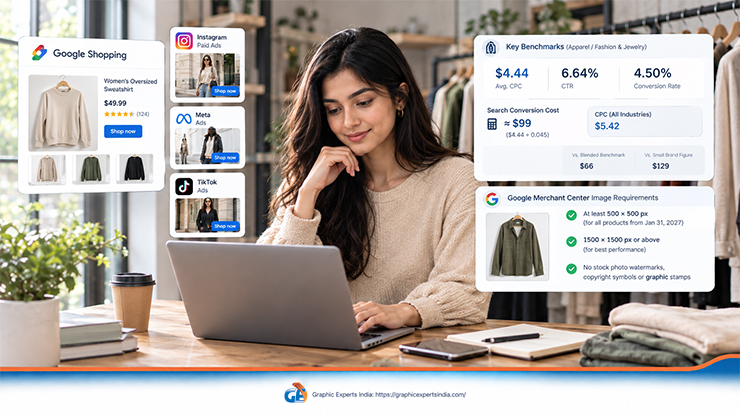
Paid social and Google Shopping work for fashion brands as the scalable layer on top of owned and earned channels, and both are priced per click, so the product-page conversion rate decides whether they pay back.
LocaliQ’s 2026 benchmarks put Apparel / Fashion & Jewelry at a $4.44 average cost per click, a 6.64% click-through rate and a 4.50% conversion rate, against $5.42 per click across all industries (LocaliQ, 1 June 2026). At those figures a search conversion costs about $99 ($4.44 ÷ 0.045), above the $66 blended benchmark and below the $129 small-brand figure.
Google Shopping ads draw image, title and price from the same Merchant Center feed as the free listings. Google requires images of “at least 500 x 500 pixels for all products beginning January 31, 2027,” recommends “1500×1500 pixels or above to ensure best performance in all listing formats,” and rejects “stock photo watermarks, copyright symbols, or graphic stamps” (Google Merchant Center Help, read 7 October 2026).
Meta and TikTok catalogue ads also serve the feed image as the ad. Ad formats, creative examples and Google Ads setup for apparel are covered in the child guide on fashion advertising.
How Do Marketplaces Fit a Clothing Brand Marketing Strategy?
Marketplaces fit a clothing brand marketing strategy as a discovery channel that trades margin for traffic: the marketplace brings the shopper, and the brand pays a referral fee instead of an advertising bill. Amazon charges a $39.99 monthly Professional plan plus a 5%, 10% or 17% referral fee on apparel by price band. TikTok Shop’s clothing referral fee was 6% under its 31 October 2024 schedule (fees read 7 October 2026).
A 17% Amazon fee on a $40 garment is $6.80, far below the $66 acquisition benchmark, but it recurs on every order, including repeat orders the brand would otherwise own. Marketplaces also enforce stricter image rules: Amazon requires adult apparel on-model on pure white at 1,600 pixels or more, and Etsy recommends at least 2000 pixels. The fee tables and image rules, including eBay’s, are compared in the guide to fashion ecommerce platforms.
How Do PR and Collaborations Promote a Clothing Brand?
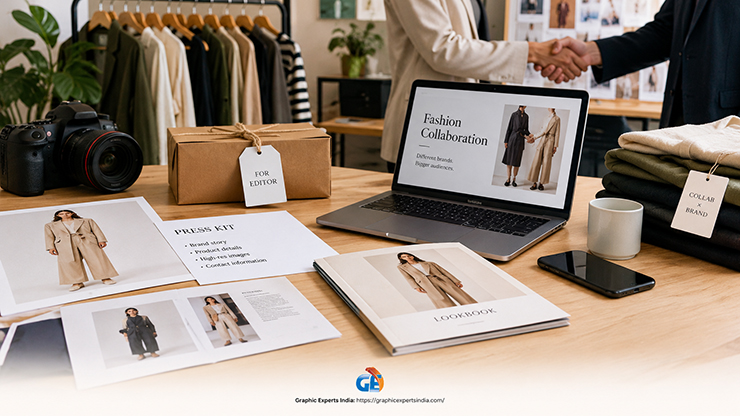
PR and collaborations promote a clothing brand by borrowing an audience the brand has not yet earned: a publication’s readers, another brand’s customers or a retailer’s foot traffic. The channel has no reliable published conversion benchmark, so it is measured by referral sessions and orders in the two weeks after a placement.
Three forms suit a small label. Product seeding sends samples to editors and stylists with a one-page sheet and a press folder. A co-branded capsule with a non-competing brand splits production cost and doubles the list that hears about the drop.
Every form depends on press-ready imagery: packshots on white, on-model images with model size and fabric credits, and a lookbook in one downloadable folder. The shoot setups that produce lookbook-quality images on a small budget are described in the guide to fashion photography tips.
How Do Retention and Returns Fit a Clothing Brand Marketing Plan?
Retention and returns decide whether acquisition ever pays back, because at a $66 to $129 acquisition cost the first order rarely covers itself. Online returns ran at an estimated 19.3% of sales in 2025 (National Retail Federation and Happy Returns, 15 October 2025).
Among apparel returners, 39% cite fit and 28% say the item “didn’t look the way they thought it would” (PowerReviews, June 2023). Both reasons are addressed before the order ships: on-model images with the model’s size stated, colour-accurate editing so the garment that arrives matches the screen, and a size chart with measurements.
Post-purchase email and SMS flows then carry the retention load at the 2.15% and 1.9% placed-order rates Klaviyo reports. The copy that sets accurate expectations is the subject of the guide on how to write product descriptions for an online clothing store.
Why Are Visual Assets the Foundation of a Clothing Brand Marketing Strategy?
Visual assets are the foundation of a clothing brand marketing strategy because every channel consumes the same photographs and video, and one product shoot, edited once to each channel’s rules, supplies all of them. The matrix maps the image types from one shoot to the channels that use them.
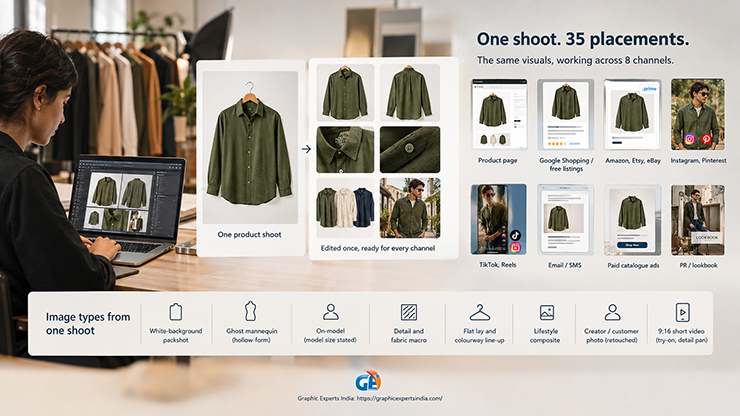
| Image type from one shoot | Product page | Google Shopping / free listings | Amazon, Etsy, eBay | Instagram, Pinterest | TikTok, Reels | Email / SMS | Paid catalogue ads | PR / lookbook |
|---|---|---|---|---|---|---|---|---|
| White-background packshot (front, back) | Yes | Yes (main image) | Yes (main image) | — | — | Yes | Yes (feed image) | Yes |
| Ghost mannequin (hollow-form) | Yes | Yes | Yes | — | — | Yes | Yes | — |
| On-model, model size stated | Yes | Yes (apparel) | Yes (Amazon requires) | Yes | Still frames | Yes | Yes | Yes |
| Detail and fabric macro | Yes | — | Yes (secondary) | Yes | B-roll | Yes | — | Yes |
| Flat lay and colourway line-up | Yes | — | Yes | Yes | — | Yes | Yes | — |
| Lifestyle composite | — | — | Yes (secondary) | Yes | — | Yes | Yes | Yes |
| Creator / customer photo (retouched) | Yes | — | — | Yes | Yes | Yes | Yes | — |
| 9:16 short video (try-on, detail pan) | Yes | — | Yes (video slot) | Yes | Yes | GIF frame | Yes | — |
One style shot in the six studio types produces six master files, and the matrix places them 35 times across the eight channel groups. A 20-style collection is 120 masters and 700 placements, which is why the edit, not the shoot, is the production cost that scales.
Channel-ready editing costs from $0.39 per image for background removal and from $0.99 per image for e-commerce retouching at Graphic Experts India, listed on its ecommerce image editing service page.
How Do You Keep a Clothing Catalogue Visually Consistent Across Channels?
To keep a catalogue consistent, shoot every style in the same light at the same distance, fix one white point and one crop ratio in the edit, and apply the same shadow and colour correction to every colourway. Consistency is a conversion input: 28% of apparel returns are “didn’t look the way they thought it would” (PowerReviews, June 2023).
Colour correction costs from $0.99 per image and ghost mannequin editing from $1.49 per image at Graphic Experts India, each with a 24-hour average turnaround. Whether to show garments on AI-generated models, a ghost mannequin or real models is the subject of a planned comparison guide; the hollow-form technique is explained on the ghost mannequin neck joint services page.
How Should a Clothing Brand Retouch Creator and Customer Photos?
A clothing brand should retouch creator and customer photos lightly, correcting colour, exposure and distractions while keeping the person, the setting and the fit as shot, because the value of the image is that it is real. The 78% of shoppers who rate a customer photo as the most valuable image type (PowerReviews, 2024 report) are responding to authenticity.
Retouching for this purpose costs from $0.99 per image at Graphic Experts India through its photo retouching service, returned within an average of 24 hours and checked in three steps.
How Should a Clothing Brand Split Its Marketing Budget and Measure Each Channel?
A clothing brand should split its marketing budget so that paid acquisition receives about half, creators and content production about a third, and tools and testing the remainder, and judge every line against the $66 to $129 acquisition range and the 1.86% conversion benchmark. The model below is derived from the verified figures in this guide; three inputs are assumptions and are labelled.
The arithmetic. At a 1.86% conversion rate (IRP Commerce, August 2026), 1,000 visits produce 18.6 orders. At a $66 acquisition cost (First Page Sage, 2025) those orders may cost $1,228, or $1.23 per visit; at $129 (Shopify, 2021 data) they may cost $2,399, or $2.40 per visit. Payback then depends on margin and repeat orders.
At an assumed $70 average order value (assumption; IRP’s August 2026 fashion figure is £78.24) and the 56.88% apparel gross margin in Aswath Damodaran’s January 2026 industry data, gross profit per order is $39.82. Consequently a $66 customer needs 1.7 orders to pay back and a $129 customer needs 3.2, before returns at 19.3% are deducted.
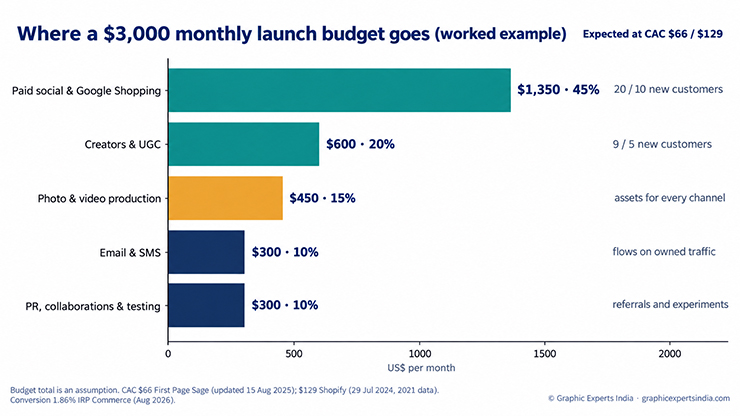
Figure 2. A worked budget split for a $3,000 monthly launch budget, with the customers each line is expected to produce at the $66 and $129 acquisition benchmarks. Sources: First Page Sage (2025), Shopify (2024), IRP Commerce (Aug 2026), LocaliQ (2026), Klaviyo (2026). Budget total is an assumption.
| Budget line | Share | Amount on $3,000 (assumption) | What it buys | Expected result at $66 / $129 CAC | Primary KPI |
|---|---|---|---|---|---|
| Paid social and Google Shopping | 45% | $1,350 | Catalogue ads on Meta, TikTok or Pinterest; Shopping campaigns | 20 / 10 new customers | Cost per order; return on ad spend |
| Creators and UGC | 20% | $600 | Gifted product, commissions, one or two paid nano creators (80% of UGC creator costs fall below $500) | Content for ads plus 9 / 5 customers | Cost per order; assets delivered |
| Photo and video production | 15% | $450 | One shoot per drop plus editing (about 300 images at $0.99 to $1.49 per image) | Six master types per style | Assets per style; edit turnaround |
| Email and SMS | 10% | $300 | Platform fee and SMS credits for welcome, abandoned-checkout and post-purchase flows | Flow placed-order rate 2.15% (email) / 1.9% (SMS) | Revenue per recipient |
| PR, collaborations and testing | 10% | $300 | Seeding samples, press folder, one new-channel test per month | Measured by referral sessions | Sessions and orders from referrals |
The paid line produces 10 to 20 customers a month at the published benchmarks, so a launch-stage brand cannot buy its way to volume and must grow the list and the creator pool at the same time. The production line is the smallest cash line and feeds the other four.
The revenue, margin and acquisition assumptions belong in the marketing section of the clothing brand business plan, so budget and forecast are reconciled monthly.
What Do Founders Ask Most Often About Marketing a Clothing Brand?
Start with channels that cost production time rather than media money: a product page built to the Baymard findings, organic posts on one platform, gifted product to nano creators (80% of UGC creator costs fall below $500), and free Google product listings, which show products “at no cost” across Search, Shopping, Images and Lens. Add email flows as soon as the first subscribers arrive.
The best-evidenced strategy funds owned channels first and paid channels last. Klaviyo’s 2026 data shows automated email flows placing orders at 2.15% for clothing brands against 0.12% for campaigns, and SMS flows earning $2.31 per recipient against $0.32. Paid acquisition at the $66 to $129 fashion benchmarks then scales what the product page and the flows already convert.
Size the budget from customers needed times acquisition cost rather than from a revenue percentage. Fashion benchmarks are $66 (First Page Sage, 2025) and $129 (Shopify, 2021 data for brands with fewer than four employees), so 100 new customers a month implies $6,600 to $12,900 in acquisition spend plus production and tools. Gartner’s 2025 survey puts established companies at 7.7% of revenue.
Ideas that produce assets and a list at the same time work best: a pre-launch waitlist with a welcome flow, a limited first drop with a fixed window, gifted product to ten nano creators whose photos are retouched and reused on product pages and in ads, a co-branded capsule with a non-competing label, and a press folder with white-background packshots and on-model images ready for seeding.
Choose the one or two platforms where the audience discovers clothing, post the garments on real people, follow each platform’s format (Instagram 1080-pixel squares, Pinterest 2:3 at 1000 × 1500, TikTok 9:16 video), and make posts shoppable. TikTok reports that 64% of its users have discovered fashion products on the platform; Pinterest reports that 96% of its top searches are unbranded. Both are platform-published figures.
Where Can a Clothing Brand Get Campaign and Catalogue Images Edited for Every Channel?
A clothing brand can send the raw files from one product shoot to Graphic Experts India and receive channel-ready exports for product pages, Google Shopping, marketplaces, social and ads.
Graphic Experts India lists e-commerce product photo editing from $0.39 per image, e-commerce retouching from $0.99 per image, colour correction from $0.99 per image and ghost mannequin editing from $1.49 per image.
Each service carries a 24-hour average turnaround and a three-step quality check, from a company serving apparel brands since 2009. A free trial on sample images is available through the ecommerce image editing service page, with no credit card required.

Salim Ahmed is the CEO of Graphic Experts India, with over 25 years of expertise in photo editing, clipping path, image retouching, and eCommerce image editing services.