

To promote a clothing brand on social media, you pick the two or three platforms where your buyers already browse, prepare product images and short videos in each platform’s native format, publish on a weekly plan built around three or four content pillars, seed garments to creators under disclosure rules, boost the posts that earn saves and shares, and read the results against sales rather than likes.
Social media promotion for a clothing brand is the use of Instagram, TikTok, Pinterest and similar networks to show garments to buyers and send them to a store.
This guide to how to promote a clothing brand on social media covers a step-by-step plan, each platform’s published formats and shopping features, content pillars and cadence, and creator seeding under the FTC Endorsement Guides.
It then covers paid boosting, how one product shoot becomes 20 social assets, and measurement, using sources read on 7 October 2026. It is the social media chapter of the wider clothing brand marketing strategy guide.
Promoting a clothing brand on social media involves three platforms with different formats, one set of product images edited to fit all of them, a posting plan, creator partnerships that follow disclosure rules, and a measurement loop tied to store sales.
| Question | Short answer | Source |
|---|---|---|
| Which image shape does Instagram accept in the feed? | Aspect ratio “within a 4:5 to 1.91:1 range”; Reels and Stories recommended at 9:16 | Meta for Developers, Instagram Platform reference, read 7 October 2026 |
| What is the Pinterest Pin size? | “a 2:3 aspect ratio, or 1000 x 1500 pixels”; video Pins 6 to 15 seconds recommended | Pinterest Business Help, read 7 October 2026 |
| What does TikTok recommend for vertical video? | 9:16, minimum 540 × 960 pixels, bitrate at or above 516 kbps | TikTok Ads Help, updated June 2026 |
| What does TikTok Shop charge a clothing brand? | 6% referral fee on menswear and womenswear categories | TikTok Shop Seller University, schedule effective 31 October 2024 |
| How large is Pinterest’s audience? | 640 million monthly active users, up 11% year on year | Pinterest Q2 2026 results, 4 August 2026 |
| When must a creator disclose a gift or payment? | When a connection “might materially affect the weight or credibility of the endorsement” | 16 CFR §255.5, effective 26 July 2023 |
| How much does editing one shoot into 20 assets cost? | $17.48 at Graphic Experts India’s listed prices (4 cut-outs, 8 composites, 8 colorways) | Calculation in the asset section below |
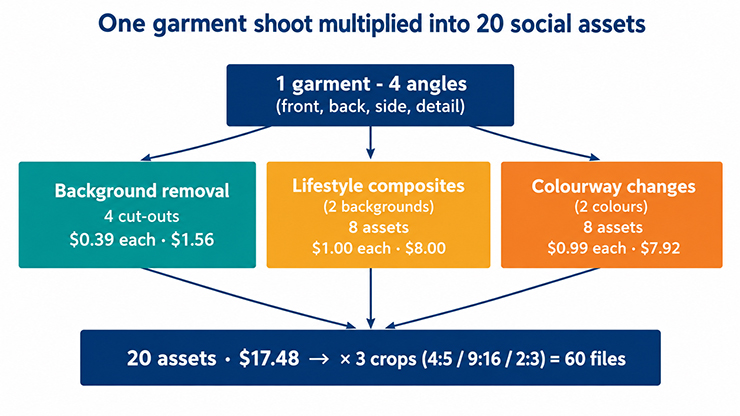
Figure 1. How four angles of one garment become 20 social assets through background removal, lifestyle composites and colorway edits. Prices: Graphic Experts India, read 7 October 2026.
To promote a clothing brand on social media, work through the seven steps below in order, because each step produces the input the next one needs.
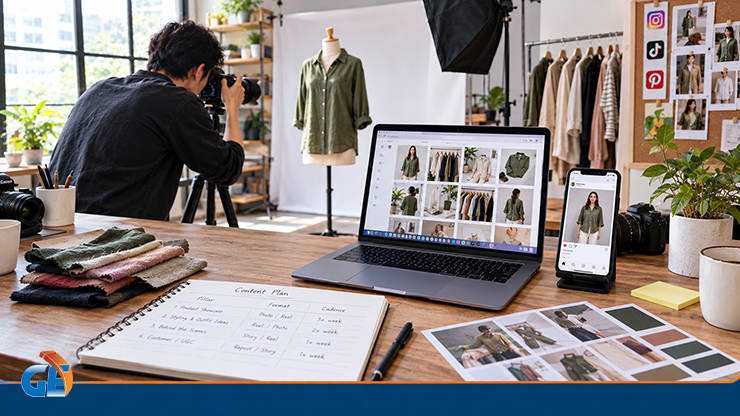
- Choose two or three platforms by where the buyer browses: Instagram for feed and Reels, TikTok for short video and TikTok Shop, Pinterest for planned purchases.
- Shoot every style once on a model or mannequin, from four angles, against one plain background.
- Edit the master images into platform formats: cut-outs, lifestyle composites and colorways, then crop to 4:5, 9:16 and 2:3.
- Set three or four content pillars and a weekly cadence you can sustain for six months.
- Seed garments to creators with a written disclosure requirement and collect the user-generated content.
- Boost the posts that earn saves and shares with a small paid budget.
- Measure reach, saves, link clicks and store conversion against a baseline each month.
The steps assume a store and a price list already exist; the production side sits in the guide on how to start a clothing brand.
How Do You Promote a Clothing Brand on Instagram?
To promote a clothing brand on Instagram, publish feed images at 4:5, Reels and Stories at 9:16, and connect the account’s shopping tools to the store catalogue so that every garment in a post can be tagged.
Meta’s developer reference states that feed images must have an aspect ratio “within a 4:5 to 1.91:1 range,” a width between 320 and 1440 pixels, JPEG format and an 8 MB limit (Meta for Developers, read 7 October 2026). Instagram’s Help Centre states that photos are uploaded “at the best quality resolution possible (up to 1080×1080 pixels).”
Consequently, a 4:5 feed image exported at 1080 pixels wide is 1080 × 1350 pixels, the tallest shape the feed allows.
Reels run from 3 seconds to 15 minutes at up to 300 MB, with a “required aspect ratio … between 0.01:1 and 10:1 but we recommend 9:16” (Meta for Developers, read 7 October 2026). Stories are capped at 60 seconds and 100 MB for video. Meta recommends 9:16 “to avoid cropping or blank space.”
For a clothing brand this means two masters per garment: a 4:5 still for the feed and a 9:16 vertical for Reels and Stories.
Instagram’s shopping tools let a business account tag catalogue products in posts, Reels and Stories. The eligibility rules sit behind a login on Meta’s business help pages, so confirm them inside Commerce Manager before planning a tagged-post calendar. The shooting side, from lighting to model direction, is in the guide to fashion photography tips.
How Do You Market Clothes on TikTok?
To market clothes on TikTok, post vertical 9:16 video that shows the garment moving on a person, use carousel posts for flat product sets, and list the catalogue on TikTok Shop so a viewer can buy inside the video.
The platform’s ad specifications recommend 9:16 at a minimum of 540 × 960 pixels and accept 1:1 and 16:9 (TikTok Ads Help, updated June 2026). Files may run to 10 minutes and 500 MB and need a bitrate “more than or equal to 516 kbps.”
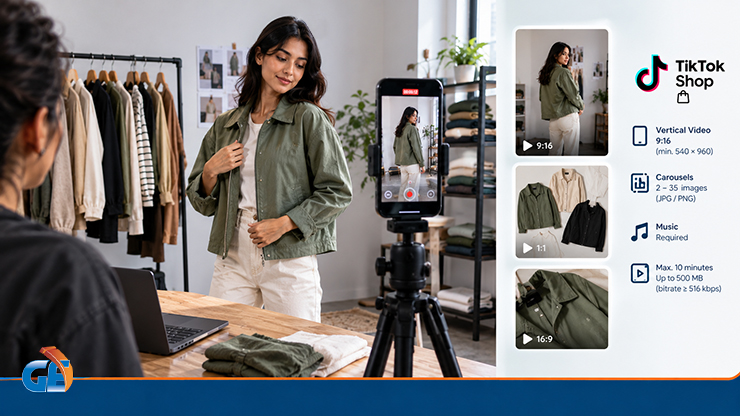
Carousels allow “min 2 – max 35 images” in JPG or PNG, with music required (TikTok Ads Help, updated September 2026). The same shapes serve unpaid posts, so one 9:16 export covers both.
The platform publishes its own commerce figures. In a June 2025 newsroom post, TikTok Shop stated that “83% of all shoppers say they have discovered a new product on TikTok Shop” and that “70% have discovered a new brand” (TikTok Newsroom, 13 June 2025; survey research the company commissioned from GlobalData).
The same post said “over a third of all TikTok Shop US purchases each month in 2024 went to small businesses.” A clothing brand selling through the Shop pays a 6% referral fee on all menswear and womenswear categories under the schedule effective 31 October 2024 (TikTok Shop Seller University).
As a result, a $40 top sold through a video pays $2.40 in referral fee before payment processing. That rate is lower than the Etsy or Amazon fees compared in the guide on how to sell t-shirts online.
How Does Pinterest Work for Fashion Brands?
Pinterest works for fashion brands as a search engine for planned purchases: a 2:3 vertical Pin links to a product page, a product Pin pulls live price and stock from the store, and Pinterest Trends shows when searches for a garment type start rising.
Pinterest’s Business Help states, “We recommend using a 2:3 aspect ratio, or 1000 x 1500 pixels,” in PNG or JPEG (read 7 October 2026). Video Pins run from 4 seconds to 15 minutes, with “6 to 15 seconds” recommended.
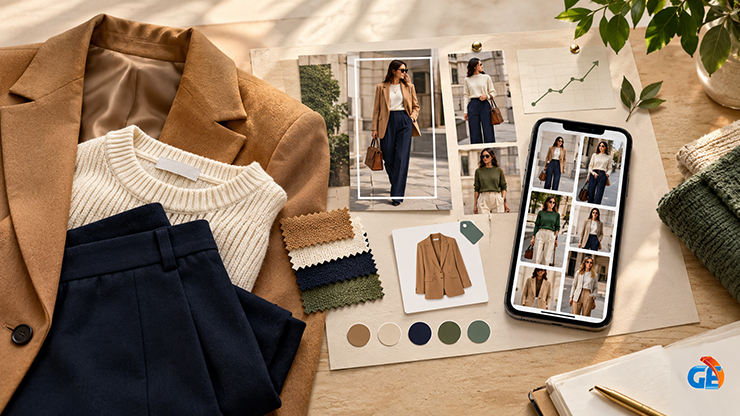
Pinterest’s creative best practices add that “your logo or brand name should be clearly visible on every ad” and advise brands to “make your products the star, and show people using them in realistic settings” (Pinterest Business, read 7 October 2026).
Product Pins are the shopping feature. Pinterest describes them as “a type of rich Pin that feature the most up-to-date price, availability, product title and description from your site” (Pinterest Business Help). They require a Pinterest business account, a site where the product is directly purchasable, and either page markup or a catalogue upload (Pinterest Business Help, read 7 October 2026).
Pinterest reported 640 million global monthly active users, up 11% year on year, and “our 11th consecutive quarter of double digit user growth” in its second-quarter 2026 results (Pinterest, Inc., 4 August 2026).
Its audience page states that Gen Z is “50% of our global user base” and that “96% of top searches are unbranded” (business.pinterest.com/audience, Pinterest’s own figures, read 7 October 2026). Therefore a new clothing brand with no brand searches can still be found through garment-type searches such as “linen shirt dress.”
The catalogue feed behind product Pins also powers Google Shopping and Meta catalogues. Its image rules are compared in the guide to fashion ecommerce platforms and their image requirements.
What Content Pillars and Posting Cadence Should a Clothing Brand Use?
A clothing brand should run three or four content pillars on a weekly cadence it can hold for six months, because a sustained plan outperforms a launch burst that stops. The pillars below are a plan, not a measured rule; none of the three platforms publishes a required posting frequency on the pages read for this guide.
| Pillar | What it shows | Example formats | Share of posts (plan) |
|---|---|---|---|
| Product | The garment itself: fabric, fit, colorways, on-model and flat | 4:5 feed image, 2:3 Pin, 9:16 try-on video | 40% |
| Process | Sampling, fabric sourcing, packing orders, the studio | Stories, behind-the-scenes short video | 20% |
| People | Customers and creators wearing the garment | Reposted UGC with permission and disclosure | 25% |
| Proof | Reviews, size guidance, care instructions, restock notices | Carousel, pinned comment, Story highlight | 15% |
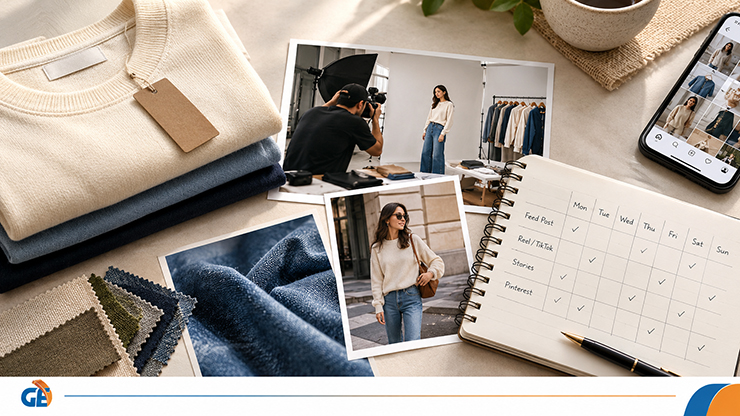
A weekly plan built on those pillars might be three feed posts, three Reels or TikToks, daily Stories and five to ten Pins scheduled in advance, because Pinterest content is searched rather than scrolled.
Pinterest Trends supports that scheduling: the tool “displays a historic view (up to the last two years) of the top search, save, and shopping trends” and lets a brand “see whether a trend is seasonal” (Pinterest Business Help, read 7 October 2026).
In contrast, the process and people pillars belong on TikTok and Instagram, which reward posting close to the moment. The product pillar depends on the image library described later; how the large retailers show fit, scale and color is analysed in the guide to how top fashion brands sell online.
How Do You Work With Creators and User-Generated Content for a Clothing Brand?
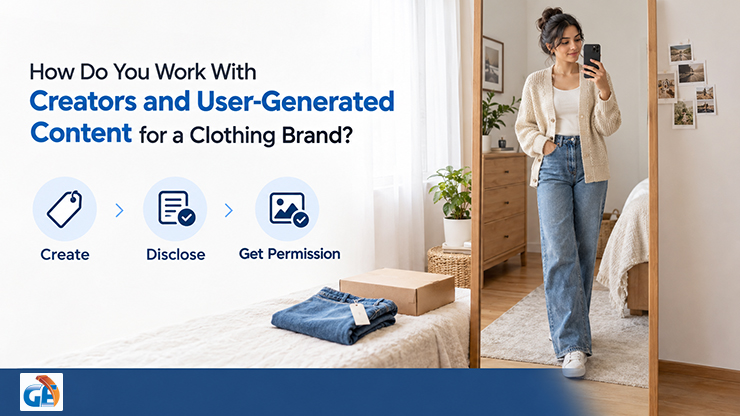
To work with creators, send the garment, agree in writing what the creator will post and how the relationship will be disclosed, and keep the right to reuse the content on the clothing brand’s own channels. The disclosure rule is federal guidance in the United States.
The FTC’s Endorsement Guides were revised in 2023 and codified at 16 CFR Part 255 with effect from 26 July 2023. They state: “When there exists a connection between the endorser and the seller of the advertised product that might materially affect the weight or credibility of the endorsement, and that connection is not reasonably expected by the audience, such connection must be disclosed clearly and conspicuously” (16 CFR §255.5).
The same rule defines “clear and conspicuous” as a disclosure that is “difficult to miss (i.e., easily noticeable) and easily understandable by ordinary consumers” (16 CFR §255.0(f)).
The FTC’s guidance for influencers, updated 3 December 2024, sets the practical bar. A material connection includes a “financial, employment, personal, or family relationship” with a brand and extends to “free or discounted products or other perks” (FTC, Disclosures 101 for Social Media Influencers).
On placement, the FTC says, “Place it so it’s hard to miss,” and “Don’t mix your disclosure into a group of hashtags or links.” For video, “the disclosure should be in the video and not just in the description” (FTC, Disclosures 101).
The FTC also warns, “Don’t assume that a platform’s disclosure tool is good enough.” A gifted-garment post therefore needs the creator’s own “ad” or “gifted” wording as well as the platform’s paid-partnership label.
User-generated content earns its place because shoppers use it. In PowerReviews’ survey of 8,153 US consumers fielded in April 2023, “60% of consumers turn to user-generated imagery to learn about products they’ve never purchased before” and “77% of consumers trust user-generated imagery when making purchase decisions” (PowerReviews, 11 May 2023).
A clothing brand can repost that imagery with the creator’s written permission and the same disclosure the creator used. Light, color-true retouching of a creator’s phone photo keeps it usable beside studio images; Graphic Experts India lists that work from $0.99 per image on its photo retouching service page.
A clothing brand should pay to boost a post only after the post has earned saves, shares or link clicks above the account’s average, because paid reach multiplies whatever the creative already does. The boost is a small budget behind an existing post, run for a week to an interest or lookalike audience, with the product page as the destination.
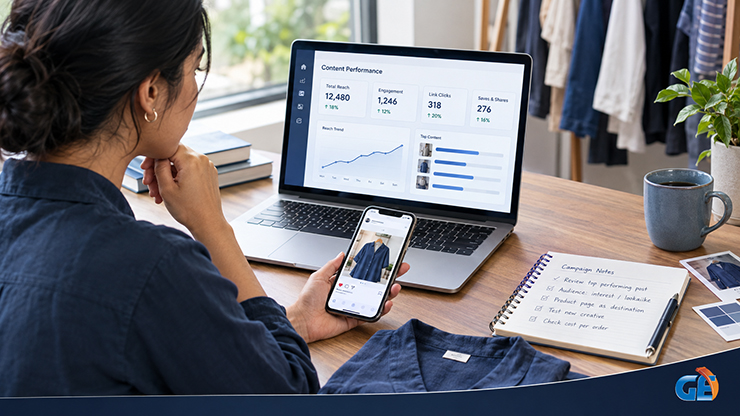
The acquisition cost it has to beat is the $66 fashion average reported by First Page Sage (updated 15 August 2025). Consequently, a $66 boost that produces one tracked order matches the benchmark, and one that produces two beats it.
Boosting is the entry point to a wider paid program of catalogue retargeting, video shopping ads and Google Shopping campaigns. Formats, budgets and examples, including Google Ads for fashion brands, are covered in the guide to fashion advertising ideas.
How to make a clothing advertisement whose creative converts is a separate topic in this series. Both depend on the same master images as the organic posts.
One product shoot becomes 20 social assets when four angles of one garment are edited three ways: cut out onto white, composited into two lifestyle backgrounds, and recolored into two extra colorways, before any cropping to platform shapes. The multiplication is arithmetic, and the cost comes from Graphic Experts India’s listed prices (read 7 October 2026).
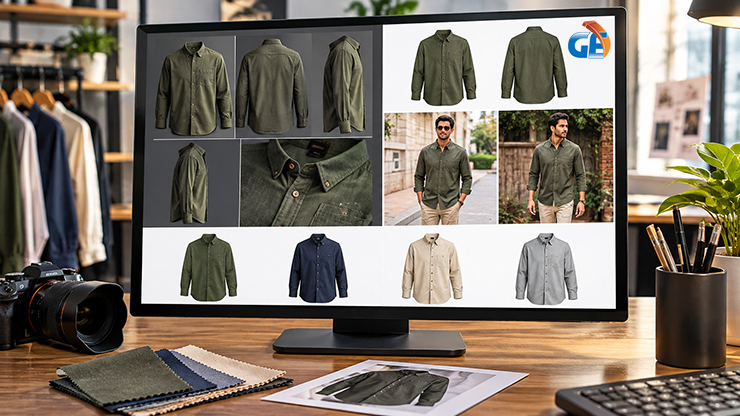
| Edit | Input | Output assets | Unit price | Line cost |
|---|---|---|---|---|
| Background removal to white | 4 angles | 4 cut-outs | $0.39 | $1.56 |
| Lifestyle composite (2 backgrounds) | 4 cut-outs × 2 | 8 composites | $1.00 | $8.00 |
| Colorway change (2 extra colors) | 4 cut-outs × 2 | 8 colorways | $0.99 | $7.92 |
| Total | 4 photographs | 20 assets | $17.48 |
Each asset is then cropped to 4:5 for the Instagram feed, 9:16 for Reels, Stories and TikTok, and 2:3 for Pinterest, a free export step that yields 60 platform-ready files.
For comparison, 20 separate studio images at Squareshot’s listed $50 per product image would cost $1,000 (Squareshot pricing, read 29 September 2026). A clothing brand with ten styles repeats the table ten times: 40 photographs in, 200 assets out, for $174.80 in editing.
How Do Background Swaps Multiply a Clothing Shoot?
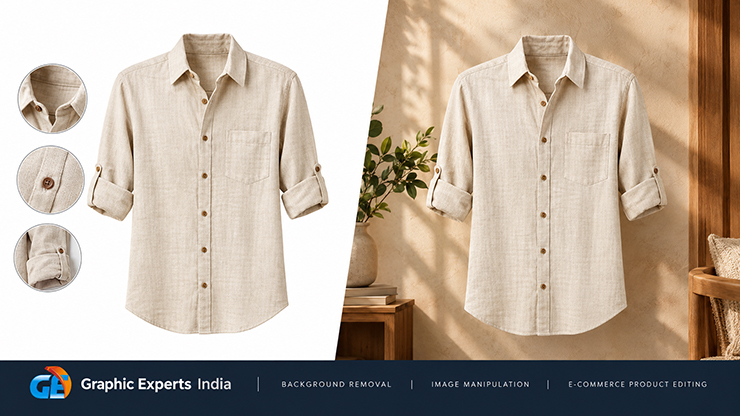
Background swaps multiply a shoot because a garment cut out once can be placed on any background without a reshoot. The cut-out is the base layer: the garment is isolated from the studio background with a clean edge, which costs from $0.39 per image at Graphic Experts India with a 24-hour average turnaround.
The white version serves the product pillar and the store listing. The same cut-out placed into a street scene, a bedroom or a seasonal set becomes a lifestyle composite, which Graphic Experts India lists from $1.00 per image as image manipulation.
The edge quality of the first cut-out decides how every composite looks, so check hair, knit edges and sheer fabric on the first batch; the technique is described on the background removal service page.
How Do Color Variants Multiply a Clothing Shoot?
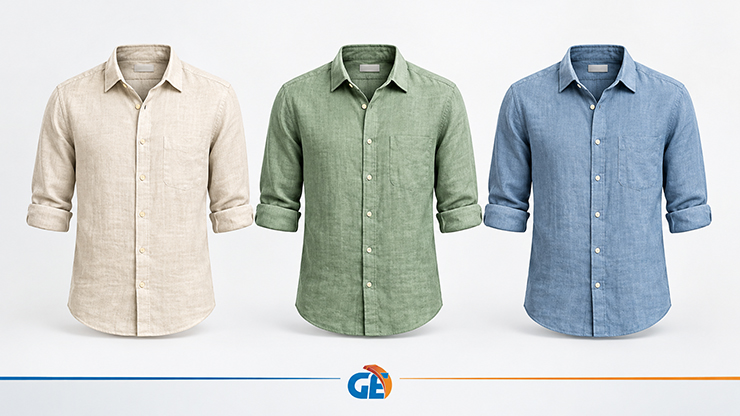
Color variants multiply a shoot because a garment that ships in three colors needs to be photographed in only one, provided the other two are recolored to a physical reference. Color correction and color matching are listed from $0.99 per image at Graphic Experts India.
The editor matches the new colorway to a fabric swatch or Pantone code, not to a screen, so that the social image, the product page and the garment that arrives agree. The reason is return data. In PowerReviews’ survey of 25,452 US consumers, 28% of apparel returners said the “item didn’t look the way they thought it would” (PowerReviews, 2023).
Online returns ran at an estimated 19.3% of sales in 2025 (National Retail Federation and Happy Returns, 15 October 2025). A colorway that is one shade off on Instagram creates that return. Changing the garment a model wears, or placing it in a new scene, is an image manipulation job; the image manipulation service page lists those from $1.00 per image.
Whether to show garments on an AI model, a ghost mannequin or a real model, and how AI clothes changers compare with professional editing, are separate topics in this series.
Which Image Specs Should Each Social Asset Be Exported To?
Each social asset should be exported to the platform’s published shape from a master at least 1080 pixels on the short side, because every platform recompresses on upload. The specifications below are from the platforms’ own pages, read 7 October 2026.
| Placement | Aspect ratio | Pixel size | Limits | Source |
|---|---|---|---|---|
| Instagram feed image | 4:5 to 1.91:1 | 1080 × 1350 at 4:5 (320 min, 1440 max width) | JPEG, 8 MB, sRGB | Meta for Developers |
| Instagram Reels | 9:16 recommended | up to 1920 pixels wide | 3 s to 15 min, 300 MB, 23–60 fps | Meta for Developers |
| Instagram Stories | 9:16 recommended | up to 1920 pixels wide (video) | 3 s to 60 s, 100 MB video, 8 MB image | Meta for Developers |
| TikTok video | 9:16 recommended (1:1, 16:9 accepted) | 540 × 960 minimum | up to 10 min, 500 MB, ≥ 516 kbps | TikTok Ads Help, June 2026 |
| TikTok carousel | 9:16, 1:1 or 1.91:1 | 720 × 1280, 640 × 640 or 1200 × 628 | 2 to 35 images, JPG/PNG, music required | TikTok Ads Help, September 2026 |
| Pinterest Pin | 2:3 | 1000 × 1500 | PNG or JPEG, 20 MB desktop / 32 MB app | Pinterest Business Help |
| Pinterest video Pin | 1:1 or vertical (taller than 1.91:1, shorter than 1:2) | — | 4 s to 15 min, 6–15 s recommended, 2 GB | Pinterest Business Help |
One editing pass therefore ends with three crops of each asset, named by platform and colorway. Pinterest’s advice to keep the “logo or brand name … clearly visible” applies to the 2:3 crop in particular, because a Pin is saved and re-shared away from the clothing brand’s profile.
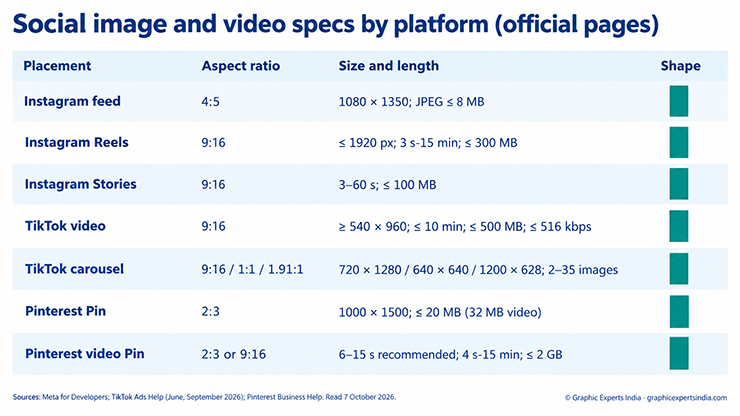
Figure 2. Published image and video specifications by placement. Sources: Meta for Developers, TikTok Ads Help (June and September 2026), Pinterest Business Help, read 7 October 2026.
To measure social media promotion for a clothing brand, track four numbers per platform each month (reach, saves or shares, link clicks and attributed orders) and compare the orders against a conversion benchmark and a cost benchmark.
Fashion clothing and accessories stores converted 1.86% of visits in August 2026 in IRP Commerce’s UK-weighted panel. The cost benchmark is the $66 fashion customer acquisition cost reported by First Page Sage (updated 15 August 2025).

As a result, 1,000 link clicks would be expected to produce about 19 orders at the benchmark rate. A clothing brand that spent $1,254 or more on content and boosting to get them is paying the benchmark acquisition cost or above.
Saves and shares are the leading indicators, because a saved garment post or Pin is a stated purchase intention that a like is not. Returns belong in the measurement too: orders that come back above the 19.3% industry estimate point to a colorway or fit image problem, not a logistics one.
The targets for each number, and how they roll into a monthly revenue plan, are set in the clothing brand business plan guide.
It depends on the buyer. Instagram suits a clothing brand whose customers browse a feed and buy from tagged posts. TikTok suits a brand that can show garments moving on a person and sell through TikTok Shop at a 6% referral fee. Pinterest suits garments searched by type, since 96% of its top searches are unbranded. Most new labels start with two platforms and one image library.
No platform read for this guide publishes a required frequency, so set a cadence you can hold for six months rather than a launch burst. A workable plan is three feed posts, three Reels or TikToks, daily Stories and five to ten scheduled Pins per week, built on product, process, people and proof pillars. Measure saves and link clicks monthly and adjust.
Publish 4:5 product images and 9:16 Reels on a fixed schedule, tag catalogue products so each post can be shopped, seed garments to small creators with written disclosure, repost their content with permission, and boost the posts that earn saves. Reels and tagged products reach non-followers; the image library of cut-outs, composites and colorways supplies the volume.
Yes, in the United States. The FTC’s guidance says a material connection includes “free or discounted products or other perks.” Under 16 CFR §255.5 such a connection must be “disclosed clearly and conspicuously.” The FTC advises placing the disclosure where it is “hard to miss,” not inside a group of hashtags, and inside the video itself rather than only in the description.
Editing one four-angle shoot into 20 assets costs $17.48 at Graphic Experts India’s listed prices: four background removals at $0.39, eight composites at $1.00 and eight colorways at $0.99. Ten styles cost $174.80. Studio production of 20 images at Squareshot’s $50 per image rate would cost $1,000. Creator gifting adds the garment’s cost and shipping per creator.
A clothing brand can shoot four angles of each style and send the files to Graphic Experts India. Graphic Experts India lists background removal from $0.39 per image, image manipulation for lifestyle composites from $1.00 per image, color correction from $0.99 per image and ghost mannequin editing from $1.49 per image.
Each service carries a 24-hour average turnaround and a three-step quality check from a company serving apparel brands since 2009. A free trial on sample images is available through the background removal service page, returned within 24 hours with no credit card required.

Salim Ahmed is the CEO of Graphic Experts India, with over 25 years of expertise in photo editing, clipping path, image retouching, and eCommerce image editing services.