

To start a clothing brand, you choose a niche, validate demand, write a business plan, build the brand identity, design and sample a collection, pick a production model, photograph the garments, open a store, register the business and launch.
A clothing brand, also called a clothing line or apparel label, is a business that designs garments under its own name and sells them to a defined customer. This guide walks through the 11 steps in the order a new label meets them, with the published prices and platform rules current as of September 2026.
It covers what it costs to start a clothing brand, how to write a clothing brand business plan, how to photograph and edit product photos so listings convert, and which mistakes cause new apparel businesses to fail.
gure 1. The 11-step roadmap. Steps 1–7 happen before a single unit is sold; steps 8–11 decide whether it sells.
What Does Starting a Clothing Brand Involve at a Glance?
Starting a clothing brand involves 11 steps, a budget between roughly $1,280 and $19,400 for a first collection, and three to nine months of lead time depending on the production model. The table below summarises the facts a founder needs before reading further.
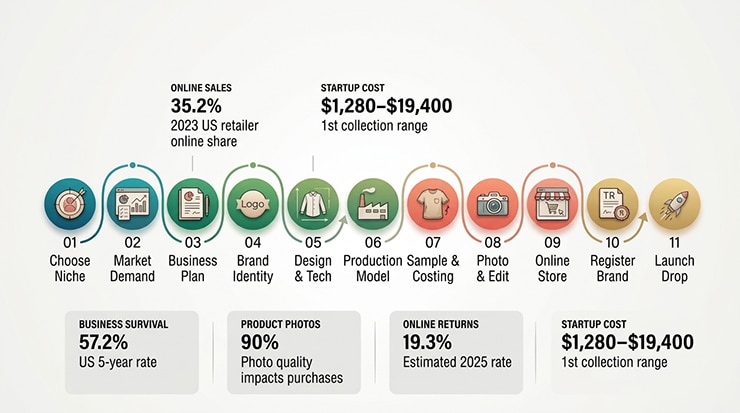
| Question | Short answer | Source |
|---|---|---|
| How big is the market? | Global apparel revenue is estimated at US$1.92 trillion in 2026 | Statista Market Insights, Apparel Worldwide, 2026 |
| How much sells online? | Online sales were 35.2% of the top 1,000 US apparel and accessories retailers’ combined sales in 2023 | Digital Commerce 360, updated September 2024 |
| How much does it cost to start? | About $1,280 for a print-on-demand launch to about $19,400 for a four-style cut-and-sew line (illustrative budgets built from published price lists) | See how much it costs to start a clothing brand |
| How many new businesses survive? | 57.2% of US establishments born in the year to March 2020 were still operating five years later | US Bureau of Labor Statistics, Business Employment Dynamics, Table 7 |
| What do shoppers judge first? | 90% of Etsy shoppers rated photo quality “extremely important” or “very important” to a purchase decision | Etsy Seller Handbook, buyer survey |
| How many online orders come back? | An estimated 19.3% of US online sales were returned in 2025 | National Retail Federation and Happy Returns, October 2025 |
Why Start a Clothing Brand in 2026?
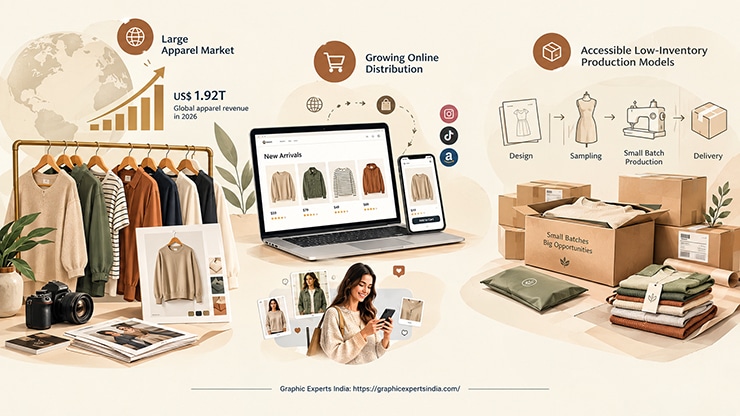
A clothing brand is worth starting in 2026 because the apparel market is large, online distribution is mature, and low-inventory production models remove most of the historical capital barrier.
Global apparel revenue is estimated at US$1.92 trillion in 2026, growing at a 2.60% compound annual rate to 2030, according to Statista Market Insights’ Apparel Worldwide outlook (2026). Women’s apparel is the largest segment at US$1.00 trillion in the same estimate.
Growth is slow, and the industry’s own leaders expect it to stay slow. “The global fashion industry will once again post low single-digit growth in 2026,” McKinsey & Company and The Business of Fashion wrote in The State of Fashion 2026 (17 November 2025).
In the same report’s executive survey, 46% of respondents expected conditions to worsen in 2026, up from 39% a year earlier. Consequently, a new clothing brand wins by taking share inside a niche rather than by riding market growth.
Online channels carry a growing share of that market. US e-commerce sales reached $340.2 billion in the second quarter of 2026, 17.1% of total retail sales, according to the US Census Bureau’s Quarterly Retail E-Commerce Sales report (18 August 2026).
In apparel specifically, online sales were 35.2% of the top 1,000 US apparel and accessories retailers’ combined in-store and online sales in 2023, according to Digital Commerce 360 (updated 17 September 2024). Therefore most new clothing brands launch online first, which is why product imagery and platform image rules appear early in this guide.
How Do You Start a Clothing Brand Step by Step?
To start a clothing brand, follow the 11 steps below in order. Each step names the decision to make, the documents or assets it produces, and the published cost where one exists.
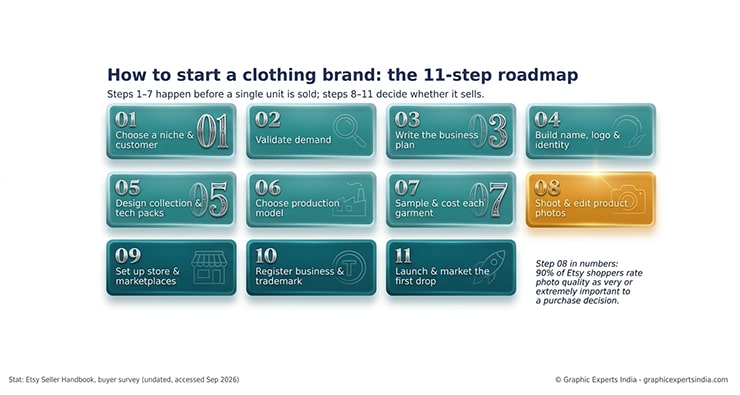
- Choose a niche and a target customer.
- Validate demand before producing anything.
- Write a clothing brand business plan.
- Build the brand name, logo and identity.
- Design the first collection and create tech packs.
- Choose a production model.
- Sample and cost each garment.
- Photograph and edit the products.
- Set up the online store and marketplaces.
- Register the business and protect the brand.
- Launch and market the first drop.
Step 1: How Do You Choose a Niche and Target Customer for a Clothing Brand?
To choose a niche, define one customer, one garment category and one price band, then confirm that the combination is under-served.
A niche statement for a clothing brand names the wearer (for example, “women who run trails”), the product focus (“seamless base layers”) and the price position (“$60–$90”). Broad statements such as “streetwear for everyone” fail because every marketing and production decision that follows depends on a narrow answer.
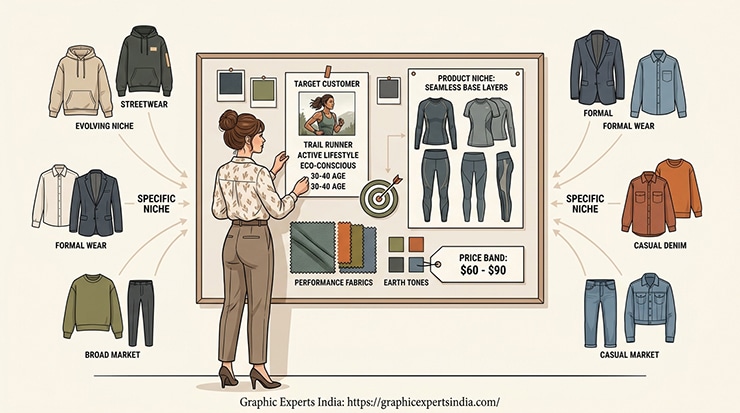
The State of Fashion 2026 (McKinsey & Company and The Business of Fashion, November 2025) describes an industry where growth is low and competition is concentrated, which rewards specialists over generalists.
In practice, a founder should be able to name three existing brands the target customer already buys and state what the new label will do differently on fit, material, price or story.
Step 2: How Do You Validate Demand Before Producing Anything?
To validate demand, sell or pre-sell a small quantity before committing to a production run. Three low-cost validation methods exist for a clothing brand.
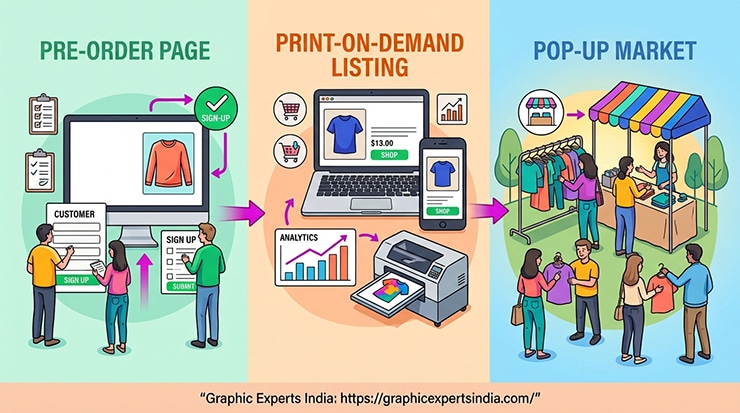
- Run a pre-order or waitlist page for one hero style and measure sign-ups against ad spend.
- List a print-on-demand version of the design, which requires no inventory, and read the conversion data.
- Sell at one physical market or pop-up and record which sizes, colors and price points move.
Print-on-demand costs “$0” in inventory because the supplier prints each order after it is placed, according to Printful’s guide to the cost of starting a clothing line (27 May 2025). That property makes it the cheapest validation tool available to a new clothing brand, even if the final brand will use cut-and-sew production.
Step 3: How Do You Write a Clothing Brand Business Plan?
To write a clothing brand business plan, use the US Small Business Administration’s traditional format and add a collection plan.
The SBA’s traditional plan has nine sections: executive summary, company description, market analysis, organization and management, service or product line, marketing and sales, funding request, financial projections and appendix, according to the SBA’s business-plan guide (accessed 14 September 2026). The SBA notes that lenders and investors “commonly request this plan.”
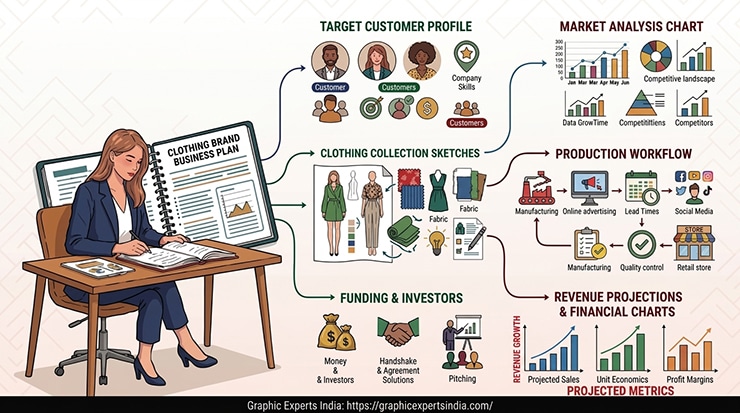
An apparel plan differs from a generic plan in three places. The product section must list styles, sizes, colorways and price points. The operations section must state minimum order quantities, sampling lead times and the product-photography workflow.
The financial section must show unit economics per garment, not only annual totals. A full section-by-section walkthrough, with a worked unit-economics example, is in the guide to writing a clothing brand business plan.
Step 4: How Do You Build the Brand Name, Logo and Identity?
To build a clothing brand identity, choose a name that clears a trademark search, design a logo that prints cleanly at small sizes, and fix a color palette and typography before any product photography begins. The brand identity governs labels, hang tags, packaging and the visual style of every product image, so it precedes the photo shoot.
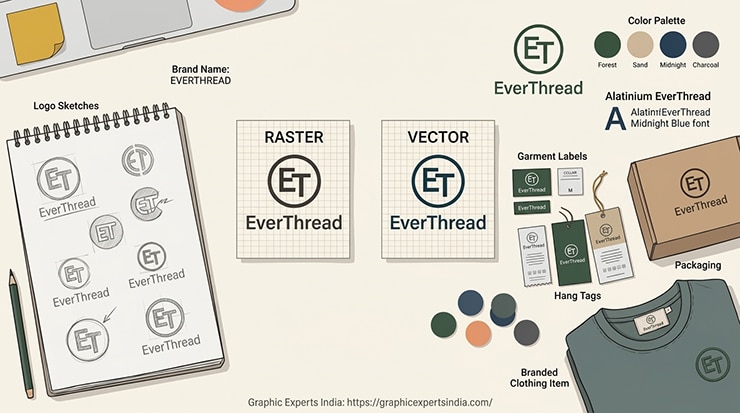
A garment logo has one technical requirement that a digital logo does not: it must exist as a vector file. Screen printers, embroiderers and label makers scale artwork to woven-label and chest-print sizes, and a raster file (JPG or PNG) blurs when scaled.
A logo drawn in Canva or exported from an AI tool as a PNG can be redrawn as an editable vector; Graphic Experts India lists logo vector conversion at $4.48 per image on its price list (accessed 14 September 2026), and the raster to vector conversion service page describes the file types returned. Order the vector file before the first sample run so the printer receives print-ready artwork.
Step 5: How Do You Design the First Collection and Create Tech Packs?
To design a first collection, limit it to a small number of styles and document each style in a tech pack. A tech pack is the technical specification a factory uses to make a garment: flat sketches, measurements per size, materials, trims, stitching, labels and packaging.
A small first line often has four styles; Sewport’s guide to the cost of starting a clothing line prices a “small 4-piece line” at “at least $12,000” including production, and larger 8-piece and 16-piece lines at $25,000 and $50,900 respectively.
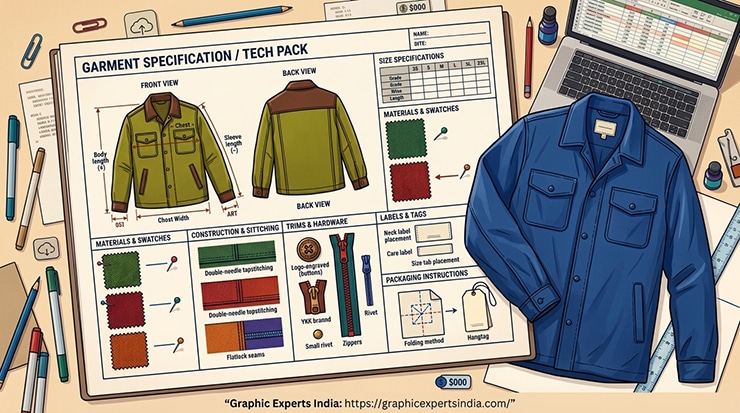
Tech packs cost “$200–$300” per garment when a freelance technical designer produces them, according to Sewport. Software such as Techpacker lists its Tech Pack Builder plan at $35 per user per month on annual billing (techpacker.com/pricing, accessed 14 September 2026) for founders who build their own.
A print-on-demand line skips tech packs entirely because the supplier’s blank garment already has one.
Step 6: How Do You Choose a Production Model: Print on Demand, Cut-and-Sew or Private Label?
To choose a production model, match the model to the capital available and the level of design control the niche requires. Three models cover almost every new clothing brand.
| Model | What it is | Typical cost signal | Design control |
|---|---|---|---|
| Print on demand (POD) | A supplier prints your artwork on a stock blank after each order | “$10–$25 per unit”; “$0” inventory (Printful, May 2025) | Low: stock garments only |
| Private label / blanks | You buy finished blank garments in bulk and add your label and prints | Inventory “$20,000–$50,000” for a traditional launch (Printful, May 2025) | Medium: choose blanks, own branding |
| Cut-and-sew | A factory makes your garment from your tech pack | MOQ “50 to 500 units per style” at US manufacturers (Maker’s Row, 9 May 2026); small-batch runs “50–100 units” | High: your pattern, fabric and fit |
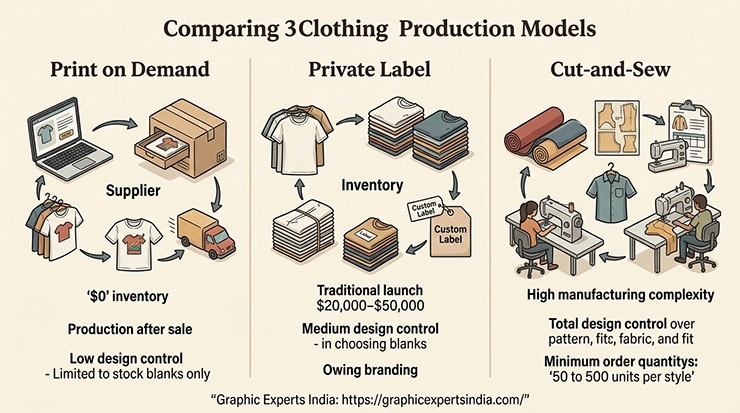
Minimum order quantity (MOQ) is the decision point. US clothing manufacturers typically require 50 to 500 units per style, and often 25 to 200 units per colorway, according to Maker’s Row’s guide to MOQ (9 May 2026).
A founder who cannot fund 50 units per style should start with print on demand or private-label blanks and move to cut-and-sew once one style has proven demand.
Step 7: How Do You Sample and Cost Each Garment?
To sample a garment, order one pre-production sample per style, check fit and construction against the tech pack, and only then approve the bulk run. Samples cost “$200–$300” each from US factories and “$50–$150” from Asian factories, according to Sewport. Sewport also cites unit production costs of “around $3 each” for t-shirts and “around $10 each” for dresses at volume.
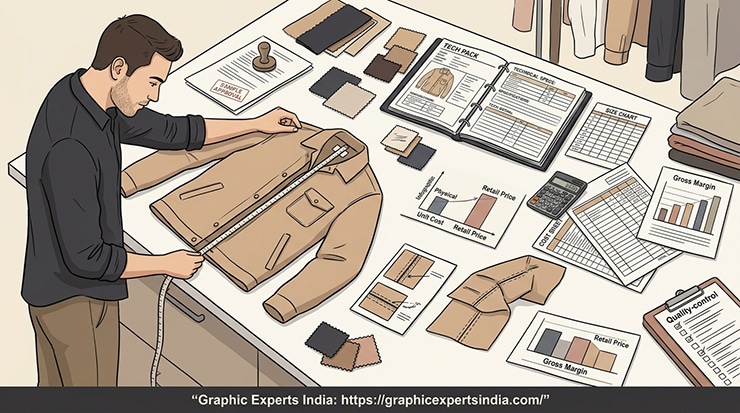
Costing each garment means recording landed cost, retail price and gross margin per style. Publicly traded apparel companies averaged a 56.88% gross margin and a 3.85% net margin as of January 2026, according to Professor Aswath Damodaran’s margin dataset at NYU Stern (35 apparel firms).
A new brand that prices below a 50% gross margin leaves no room for returns, marketing and platform fees, all of which appear in Steps 9 and 11.
Step 8: How Do You Photograph and Edit Clothing So It Sells?
To photograph clothing so it sells, shoot every style in the format the sales channel requires, then edit each image to a consistent standard before listing. Product photos are the step most closely linked to conversion in the published data.
In Etsy’s buyer surveys, “90% of shoppers said the quality of the photos were ‘extremely important’ or ‘very important’ to a purchase decision,” ranking above shipping cost, reviews and price, according to the Etsy Seller Handbook.
Baymard Institute’s product-page research found that “56% of users’ first actions” on a product page are exploring the images, and that 25% of e-commerce sites lack sufficient image resolution or zoom (Baymard Institute, 2 April 2020).
Imagery also drives returns. “Item didn’t look like I thought it would” was the reason given by 28% of US apparel returners, and “item didn’t match the description” by a further 13%, in PowerReviews’ Apparel Shopping Trends survey of 25,452 US consumers (June 2023). Sizing led at 39%. Together, the two image-related reasons account for roughly two in five apparel returns in that survey.
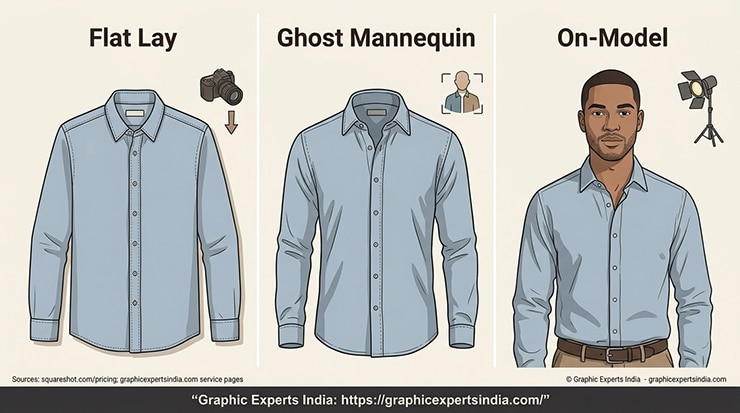
A clothing brand has three ways to show a garment, and each has a published cost.
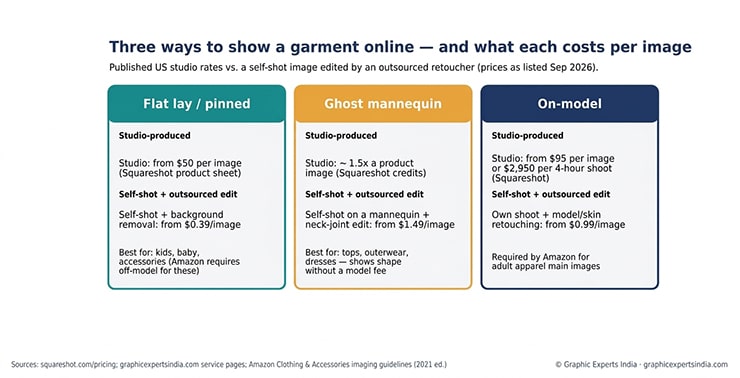
Figure 2. Three ways to show a garment online and what each costs per image. Studio rates from Squareshot’s public pricing; editing rates from Graphic Experts India’s service pages; all accessed 14 September 2026.
- Flat lay or pinned images show the garment laid or pinned on a plain background. Studio product images start at $50 per image, or $750 for a two-hour shoot, on Squareshot’s public price list. A self-shot flat lay with outsourced background removal costs from $0.39 per image at Graphic Experts India.
- Ghost mannequin images show the garment’s three-dimensional shape with the mannequin removed. A ghost mannequin, also called an invisible mannequin or neck-joint image, is produced by photographing the garment on a mannequin, then compositing the inside neck and sleeve areas so the garment appears worn by an invisible figure. Graphic Experts India lists ghost mannequin editing from $1.49 per image with a 24-hour average turnaround; Path lists simple ghost mannequin editing at $0.89 and complex at $1.79 per image (pathedits.com, accessed 14 September 2026). The shooting technique is covered step by step in the ghost mannequin photography and editing guide.
- On-model images show the garment on a person. Squareshot lists on-model images from $95 per image or $2,950 for a four-hour shoot. A clothing brand that runs its own model shoot can outsource skin and fabric retouching; Graphic Experts India’s e-commerce product retouching tier starts at $0.99 per image.
Marketplaces dictate which format is allowed. Amazon’s Clothing & Accessories imaging guidelines (Spring 2021 edition) state that “all adult apparel should be imaged on-model,” that “all kids, baby, accessories, multipacks & sets should be off-model,” that main images “must have a pure white background (RGB Value 255, HEX Value #FFFFFF)” with the product filling at least 85% of the frame at 1,600 pixels or more in height, and they list “visible mannequins” among the prohibited elements.
Ghost mannequin images are listed as an acceptable off-figure format in the same document. A clothing brand that shoots once against a neutral background and outsources the edits can meet the Amazon, Shopify and Etsy specifications from the same set of raw files; the platform-by-platform requirements appear in Step 9.
[IMAGE SLOT — insert a Graphic Experts India before/after ghost mannequin sample from /gallery/ (apparel category). Alt text: “Before and after ghost mannequin edit of a hooded jacket”. Caption: “A neck-joint composite removes the mannequin and reconstructs the inside collar; Graphic Experts India sample, edited in 2026.”]
Step 9: How Do You Set Up the Online Store and Marketplaces?
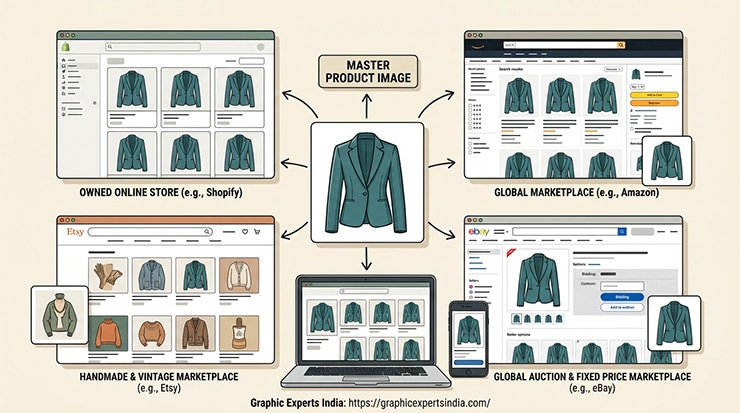
To set up sales channels, open one owned store and add one or two marketplaces once the catalogue is photographed. Platform fees and image specifications, as published on 14 September 2026, are below.
| Channel | Fee to sell | Image specification (official help pages) |
|---|---|---|
| Shopify | Basic plan $39 per month billed monthly, or $29 per month billed annually; card rate 2.9% + 30¢ on Basic (shopify.com/pricing) | Square product images of 2048 × 2048 px “usually display best”; maximum 5000 × 5000 px or 25 megapixels; files under 20 MB (Shopify Help Center) |
| Etsy | $0.20 listing fee; 6.5% transaction fee; US payment processing 3% + $0.25 (etsy.com/legal/fees, updated 13 February 2026) | Listing photos of “at least 2000 pixels” in width and height recommended; first photo at least 635 px (Etsy Help) |
| Amazon | Professional plan $39.99 per month; Clothing & Accessories referral fee 5% on items up to $15, 10% from $15 to $20, 17% above $20 (sell.amazon.com/pricing) | Pure white background RGB 255,255,255; product fills 85%+ of frame; longest side 500 to 10,000 px, over 1,000 px to enable zoom; at least six images recommended (Amazon seller blog, 4 December 2024) |
| eBay | Fees vary by category | Minimum 500 × 500 px; recommended about 1600 × 1600 px; up to 24 pictures; 12 MB maximum (eBay Help) |
The one specification all four share is a clean background at high resolution. A clothing brand that resizes and whitens each image by hand per channel spends hours per style; batching the raw files to one editing workflow produces every channel’s version from the same master.
The e-commerce product photo editing service page lists the per-platform specifications Graphic Experts India edits to, and the guide to resizing images for Amazon in Photoshop covers the manual method.
Step 10: How Do You Register the Business and Protect the Brand?
To register a clothing brand in the United States, form a legal entity, file a trademark for the brand name in the apparel class and carry general liability insurance once products ship. Published fees as of September 2026 are as follows.
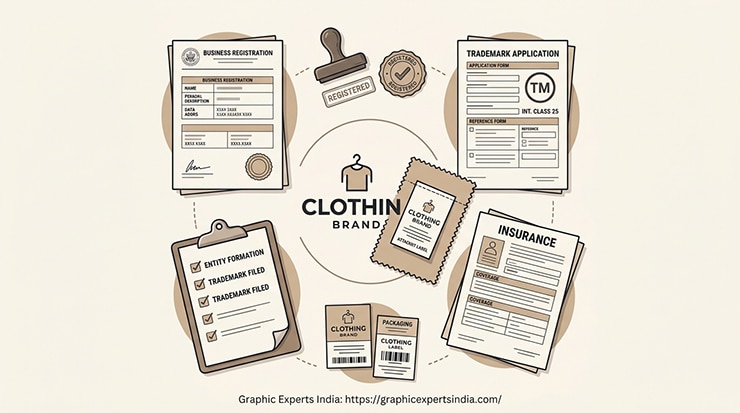
- Limited liability company (LLC) formation ranges from $40 in Kentucky (Articles of Organization, Kentucky Secretary of State) to $500 in Massachusetts (Certificate of Organization, Secretary of the Commonwealth, plus a $500 annual report). Most states fall between the two.
- Federal trademark filing costs a base fee of $350 per class of goods under the USPTO fee schedule effective 18 January 2025, with surcharges of $100 for an incomplete application and $200 for a custom goods description. Clothing falls in International Class 25.
- General liability insurance averages $45 per month for small businesses, with annual premiums ranging from about $250 to over $3,000, according to Insureon (updated 30 March 2026).
File the trademark application before the brand name appears on products or advertising; a name that fails clearance after launch forces a re-brand and a second round of labels, tags and product photos.
Step 11: How Do You Launch and Market the First Drop?
To launch a clothing brand, release a limited first collection to the audience built in Step 2, measure customer acquisition cost against gross profit per order, and reinvest only in channels that pay back. Two benchmarks frame the numbers.
Fashion and apparel e-commerce companies averaged a $66 customer acquisition cost across 80-plus First Page Sage clients between 2020 and 2025 (First Page Sage, updated 15 August 2025). Shopify’s 2021 data for fashion and accessories brands with fewer than four employees put the figure at $129 (Shopify, 29 July 2024).
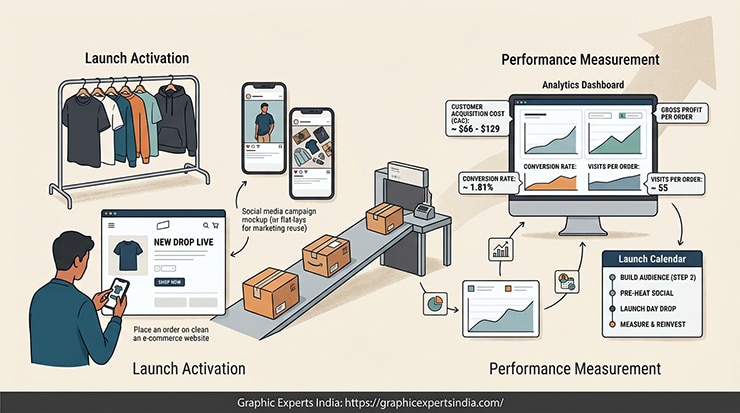
Conversion rates are low in the category. Fashion clothing and accessories stores converted 1.81% of visits in July 2026, according to IRP Commerce’s market data panel (UK-weighted).
At that rate, a store needs roughly 55 visits per order, which is why the launch budget in Step 11 and the imagery in Step 8 are connected: better images raise the conversion rate that every advertising dollar is divided by.
A clothing brand’s launch creative should reuse the product photography from Step 8; the t-shirt photography ideas for apparel photoshoots guide lists lifestyle and flat-lay setups that work for social channels.
How Much Does It Cost to Start a Clothing Brand?
Starting a clothing brand costs roughly $1,280 for a print-on-demand launch and roughly $19,400 for a four-style cut-and-sew line, in illustrative year-one budgets built from published price lists (Sewport, Printful, Shopify, USPTO, state filing fees, Insureon, Squareshot and Graphic Experts India, all accessed 14 September 2026).
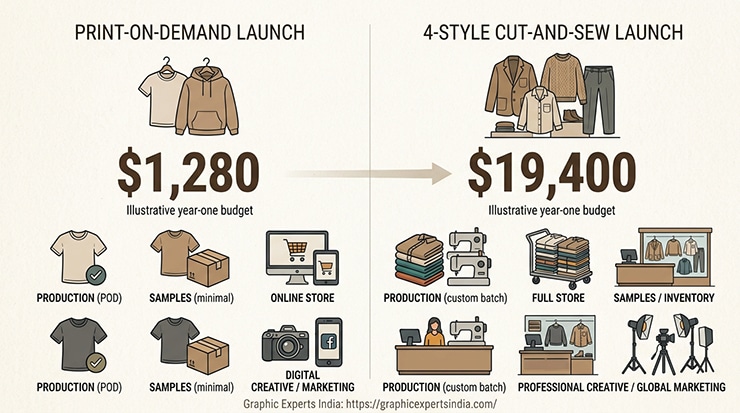
Shopify’s own guide states that a founder should “expect to spend a few thousand dollars upfront if you are creating a clothing line from scratch” (Shopify, 30 June 2026). Printful puts traditional inventory alone at “$20,000–$50,000” for a conventional launch.
The line-by-line breakdown, including how to start a clothing line with no money, is in the companion article on how much it costs to start a clothing brand.
How Do You Start a Kids or Sustainable Clothing Line?
To start a kids clothing line or a sustainable clothing brand, follow the same 11 steps and change three inputs: the compliance requirements, the fabric sourcing and the imaging format.
Children’s apparel sold in the United States is subject to the Consumer Product Safety Improvement Act, which adds testing and labelling obligations; a founder should budget for compliance testing in Step 7 and confirm current requirements with the Consumer Product Safety Commission before sampling.
Kids and baby apparel is also photographed differently: Amazon’s Clothing & Accessories guidelines require kids and baby garments to be imaged off-model, “shot off-figure (‘flat’), using pins, liner, or stuffing,” which makes flat-lay photography plus background removal the default format.
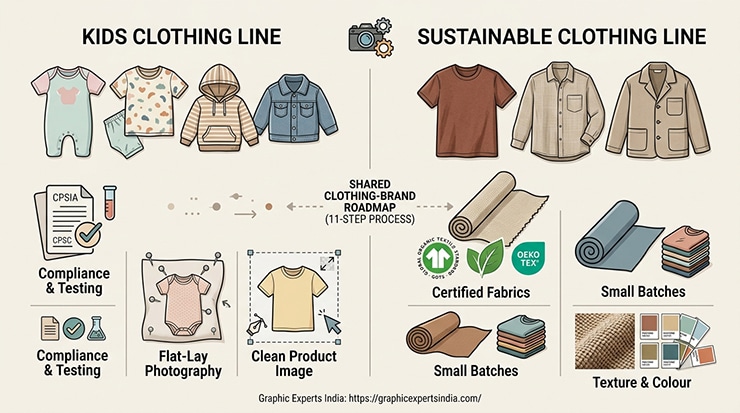
A sustainable clothing brand changes Step 5 and Step 6: fabric certifications, supplier audits and smaller batch sizes raise unit cost and lengthen sampling. The imaging consequence is a heavier reliance on detail and texture shots, because the material story has to be visible in the product page.
Color-accurate editing matters more for natural-dye and undyed fabrics; Graphic Experts India lists photo color matching to Pantone or brand references on its color correction services page from $0.99 per image.
What Mistakes Cause New Clothing Brands to Fail?
New clothing brands most often fail on cash, not on design: too many styles in the first run, unpriced returns and under-budgeted customer acquisition.
Across all US industries, 42.8% of establishments born in the year to March 2020 had closed within five years, according to the US Bureau of Labor Statistics’ Business Employment Dynamics data (Table 7). Five errors specific to clothing brands recur.
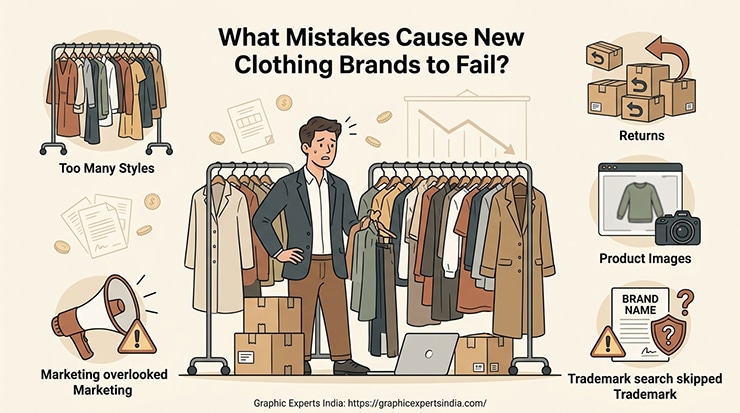
- Launching too many styles. Sewport’s cost figures scale almost linearly with style count ($12,000 for four pieces, $50,900 for sixteen). A four-style launch limits exposure.
- Ignoring return economics. An estimated 19.3% of US online sales were returned in 2025 (National Retail Federation and Happy Returns, 15 October 2025). At a 56.88% gross margin, one return can erase the profit on two sales once return shipping is paid.
- Under-investing in product images. With 28% of apparel returners citing “item didn’t look like I thought it would” (PowerReviews, 2023), inconsistent images cost twice: lower conversion and higher returns.
- Skipping the trademark search. A $350 USPTO filing is cheaper than re-labelling a first run.
- Treating marketing as an afterthought. At a $66 to $129 customer acquisition cost and a 1.81% conversion rate, the launch budget must be planned in Step 3, not discovered in Step 11.
What Do Founders Ask Most Often About Starting a Clothing Brand?
A print-on-demand clothing brand can launch in a few weeks because no sampling or production run is required. A cut-and-sew line typically takes three to nine months: tech packs, sampling at $50 to $300 per sample, a 50-to-500-unit minimum production run, photography and store setup each add lead time.
You can start a clothing brand with very little money by using print on demand, which carries “$0” inventory cost according to Printful (May 2025). Remaining costs are a store plan from $29 per month, a domain, and self-shot product photos edited from $0.39 per image. Trademark and LLC fees can follow the first sales.
Requirements vary by state and city. Most US founders form an LLC, with state filing fees from $40 in Kentucky to $500 in Massachusetts, obtain a sales-tax permit, and file a federal trademark for the brand name at $350 per class under the USPTO fee schedule effective 18 January 2025.
A small first collection of about four styles is the usual starting point. Sewport prices a four-piece line at “at least $12,000” and a sixteen-piece line at $50,900, so each added style raises capital at risk before demand is proven. Add styles after one design shows repeat sales.
Each product needs a main image on a pure white background, at least one back view, one detail shot and a scale or fit reference. Amazon requires adult apparel on-model and kids apparel flat; ghost mannequin images are an accepted off-figure format. Amazon recommends at least six images per listing.
Publicly traded apparel companies averaged a 56.88% gross margin but only a 3.85% net margin as of January 2026 (NYU Stern, Damodaran dataset). Profit therefore depends on controlling returns, acquisition cost and inventory, not on the garment margin alone.
Where Can a New Clothing Brand Get Product Photos Edited?
A new clothing brand can outsource product photo editing to Graphic Experts India, which has provided Photoshop services since 2009 and lists ghost mannequin editing from $1.49 per image, background removal from $0.39 per image and e-commerce retouching from $0.99 per image, each with a 24-hour average turnaround.
The company offers a free trial on sample garment images, returned within 24 hours with no credit card required, through its ghost mannequin service page. Send the raw files from the first sample shoot and receive marketplace-ready images before the production run arrives.

Salim Ahmed is the CEO of Graphic Experts India, with over 25 years of expertise in photo editing, clipping path, image retouching, and eCommerce image editing services.