

A clothing advertisement is a paid photo or video message that presents a garment to people who have not asked to see it, from a 4:5 Instagram feed image to a 30-second clothing commercial on TikTok.
To make a clothing advertisement, a brand moves through seven stages: a campaign idea, a brief and shot list, casting with releases and disclosures, the shoot, post-production, export to each placement’s specification, and a cost and time plan.
This guide walks through each stage for still and video creative, using eight dated campaign examples as idea templates, the US endorsement and model-consent rules that bind casting, and the five post-production tasks that turn a raw frame into a finished clothing brand commercial.
Two tables are original to this guide: a stage-by-stage record of who does what and which file leaves each stage, and an export matrix for eight placements. All sources were read on 14 October 2026. The guide is the production chapter of the Clothing Brand Marketing Strategy plan.
What Does Making a Clothing Advertisement Involve at a Glance?
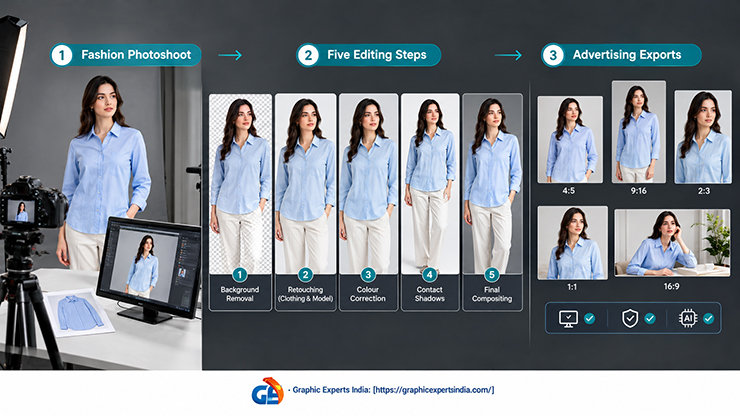
Making a clothing advertisement at a glance involves one shoot, five edits and eight export shapes, governed by three rule sets that decide whether the ad may run.
| Question | Short answer | Source |
|---|---|---|
| What counts as an endorsement in a clothing ad? | Under US rules, “any advertising, marketing, or promotional message for a product that consumers are likely to believe” reflects a person other than the sponsor | 16 CFR §255.0(b), effective 26 July 2023 |
| When must a creator or model disclose a payment or gift? | When the connection “might materially affect the weight or credibility of the endorsement”; the disclosure must be “difficult to miss” | 16 CFR §255.5 and §255.0(f) |
| What consent does a digital replica of a model need in New York? | The client’s “clear and conspicuous prior written consent” under the Fashion Workers Act, effective 19 June 2025 | Morgan Lewis, 8 January 2025 |
| What must an AI-generated ad image carry on Google? | Metadata “indicating that the image was AI-generated”; the IPTC DigitalSourceType tag must not be removed | Google Merchant Center Help |
| Which shape does each placement need? | Instagram feed 4:5 at 1080 × 1350; Reels and TikTok 9:16; Pinterest 2:3 at 1000 × 1500; Performance Max 1200 × 628, 1200 × 1200, 960 × 1200 | Meta, TikTok, Pinterest and Google help pages |
| What does the editing cost per image? | Background removal from $0.39, retouching from $0.99, color correction from $0.99, shadow from $0.40, compositing from $1.00; studio shots $50 to $95 per image elsewhere | Graphic Experts India; Squareshot |
What Is a Clothing Advertisement, and How Do Clothing Commercials Differ from Still Ads?
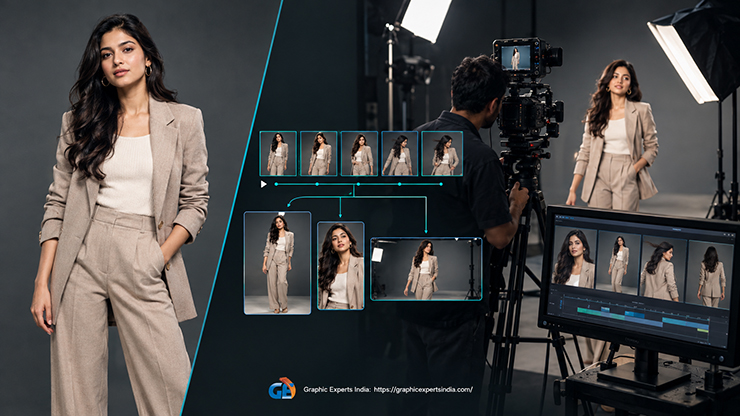
A clothing advertisement is a paid presentation of a garment in a space the brand does not own, built from a photograph or a video of that garment.
Clothing commercials are the video form: a clothes advertisement video that runs in a social feed, before a YouTube video or on television. Still ads and clothing commercials share the same raw material, a garment on a person or a form under controlled light, and the same disclosure and image-policy rules.
They differ in three production facts. A commercial needs movement, sound and a cut, so the shot list adds clips to frames. A commercial is reviewed as a file with duration, bitrate and a safe zone. And a fashion commercial is cut from one master into several lengths, while a still is cropped.
Budgets follow the video form. US digital video advertising revenue, “including CTV, social video, online video, and short-form video”, reached $78 billion in 2025, up 25.4%, and social advertising reached $117.7 billion, up 32.6% (IAB/PwC, 16 April 2026).
For a clothing brand, fashion advertising video and the 4:5 still now come out of the same shoot day. The product-page side of the same images is examined in the guide to how top fashion brands sell online.
How Do You Find a Campaign Idea for a Clothing Brand?
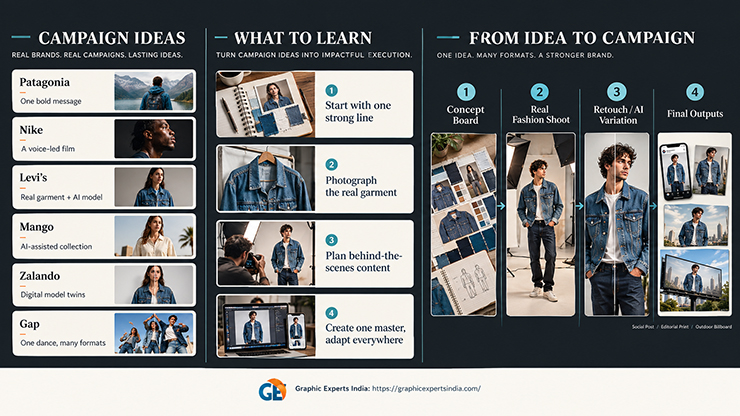
To find a campaign idea for a clothing brand, start from a campaign documented in a brand’s own newsroom and reduce it to the production decision behind it.
The eight examples below were verified from brand newsrooms or a named, dated outlet; no result figure is included unless the brand published it. Each row names the production method the idea implies, which is the part a small brand can copy.
| Brand and year | Campaign idea | Production method it implies | Source and date |
|---|---|---|---|
| Patagonia, 2011 | A New York Times newspaper ad headed “Don’t Buy This Jacket”, stating “Everything we make takes something from the planet we can’t give back.” | One product photograph, one headline, one body copy block | patagonia.com, 25 November 2011 |
| Nike, 2018 | “Dream Crazy”, a two-minute film narrated by Colin Kaepernick with the line “Believe in something, even if it means sacrificing everything” | A voice-over script written before the edit; archive and new footage cut to it | The Drum, 5 September 2018 |
| Levi’s, 2023 | A test of AI-generated models “to supplement human models”, with a later note that the company was “not scaling back our plans for live photo shoots” | Real garments photographed, then AI variation of the model, not of the garment | levistrauss.com, 22 March 2023; note 28 March 2023 |
| Mango, 2024 | The first AI-generated campaign for the Mango Teen “Sunset Dream” collection in 95 markets | “The creation process began with shooting with real photos of each garment in the collection”; afterwards “the art team selected, retouched, edited and mastered the images in the photography studio” | Mango pressroom, 10 July 2024 |
| Nike, 2024 | “Winning Isn’t for Everyone”, narrated by Willem Dafoe with 18 athletes, extended to social and out-of-home worldwide | One anthem film, athlete extension films, and one still described by Nike as an iconic image | about.nike.com, 19 July 2024 |
| Zalando, 2024–2025 | Digital twins of real models, “with approximately 70% of editorial campaign assets being AI-generated in Q4 2024” | A photographed twin re-used per trend; Matthias Haase, VP Content Solutions, cited going “from spotting a trend to producing tailored content in under 24 hours” | corporate.zalando.com, 7 May 2025 |
| H&M, 2025 | Digital twins of models in fashion-capital backdrops “showcasing seasonal yet timeless denim”, with a behind-the-scenes film | Model consent and twin creation as a pre-production step; the making-of as a second asset | hmgroup.com, 2 July 2025 |
| Gap, 2025 | “Better in Denim”, with the group KATSEYE dancing to “Milkshake”, directed by Bethany Vargas, run across digital, social, email, in-store and a Times Square billboard | One choreographed vertical video, cut into feed, Stories and billboard formats | gapinc.com, 19 August 2025 |
Four campaign ideas for a clothing brand come out of the table. First, write the sentence before the shoot: Patagonia and Nike each built the ad around one line.
Second, shoot the garment for real even when the person will be generated: Levi’s, Mango and Zalando all started from photographs of the physical product.
Third, plan the making-of as a second ad, as H&M did with its behind-the-scenes film. Fourth, shoot one vertical master and derive the rest, as Gap’s dance video ran on a billboard and in a feed.
Mark Breitbard, President and CEO of the Gap brand, called the KATSEYE partnership “a natural fit, we share a bold, expressive and inclusive point of view” (gapinc.com, 19 August 2025).
More campaigns, including the out-of-home and print cases, are catalogued in the guide to fashion advertising examples.
How Do You Write the Brief and Shot List for a Clothing Advertisement?
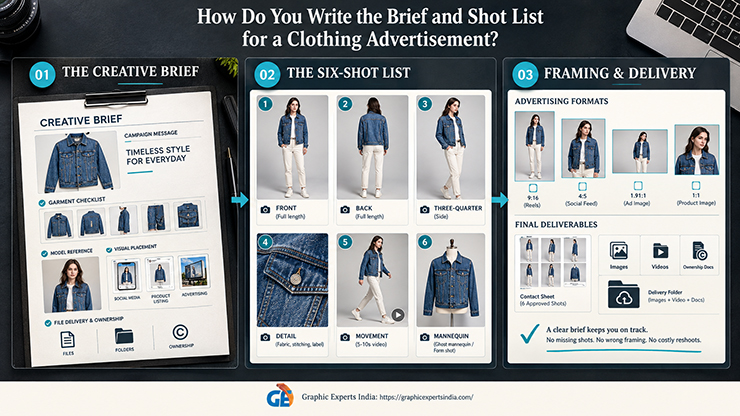
To write the brief for a clothing advertisement, record the one sentence the ad will say, the garment list, the person or form each garment will be shown on, the placements the ad will run in, and who will own the files.
The shot list then converts the brief into frames and clips per garment. Naming the placements first saves a re-shoot, because a 9:16 Reel and a 1.91:1 Performance Max image cannot both be cut from a tight 4:5 frame.
A working shot list for one garment on one model has six items.
- Front, full length, head and feet in frame, for the 4:5 feed and the Merchant Center main image.
- Back, full length, same framing.
- Three-quarter or side, for the lifestyle composite.
- Detail: fabric, stitching, label or print.
- Movement clip: a walk, turn or sit of 5 to 10 seconds in 9:16, which supplies the clothing advertisement video.
- Form shot on a mannequin for cut-out and ghost mannequin use; the camera positions are in the ghost mannequin photography guide.
The ownership line in the brief is a copyright fact. The US Copyright Office states that protection exists “as soon as an author fixes the work in a tangible form of expression”, that photographs are protected works, and that “works created by an employee within the scope of employment are owned by the employer” (copyright.gov, What Is Copyright?).
Consequently, a freelance photographer’s frames belong to the photographer unless the contract transfers or licenses them. Rules differ by country.
Who Can Appear in a Clothing Commercial, and What Must Be Disclosed?
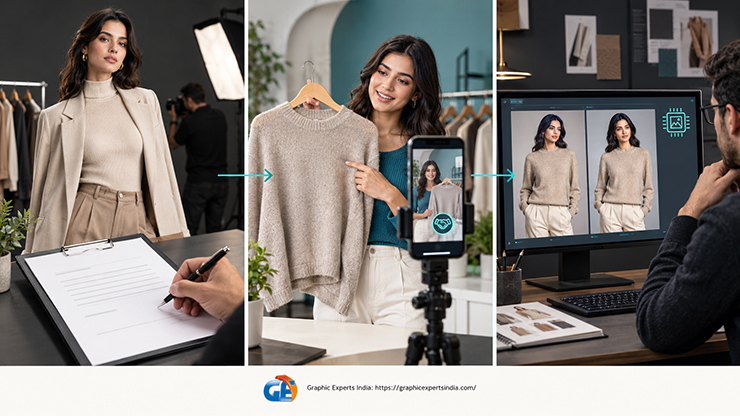
A recognisable person can appear in a clothing commercial once the brand holds a signed model release, and anyone who endorses the garment must disclose a paid or gifted connection to the brand. Three documents govern this stage in the United States; rules differ by country.
The model release. A model release is the written permission of a recognisable person to use their likeness in commercial content.
Stock agencies publish the strictest common standard: Shutterstock’s contributor rules state that “A separate model release is required for each recognizable person”, that an adult release carries the model’s name, address or email, date of birth, signature and signature date, and that a minor’s release needs the “Signature of the parent or guardian” (Shutterstock, Content Publishing Standards).
The same page notes that “Model releases are not required for recognizable people depicted in editorial content”, which is why a press photograph cannot be re-used as an ad. Garments on a form or a ghost mannequin edit need no release; the trade-offs between AI models, ghost mannequin and real models are a separate topic.
The FTC Endorsement Guides. The US Federal Trade Commission’s Guides at 16 CFR Part 255, effective 26 July 2023, define an endorsement as “any advertising, marketing, or promotional message for a product that consumers are likely to believe” reflects the views of a party other than the sponsor (§255.0(b)). §255.1(a) states: “Endorsements must reflect the honest opinions, findings, beliefs, or experience of the endorser.” §255.2(c) applies to a clothing commercial that casts people as customers: “Advertisements presenting endorsements by what are represented, expressly or by implication, to be ‘actual consumers’ should utilize actual consumers in both the audio and video, or clearly and conspicuously disclose that the persons in such advertisements are not actual consumers of the advertised product.” §255.5 requires disclosure where a connection between endorser and seller “might materially affect the weight or credibility of the endorsement”, and §255.0(f) defines the standard: “For purposes of this part, ‘clear and conspicuous’ means that a disclosure is difficult to miss (i.e., easily noticeable) and easily understandable by ordinary consumers.”
For a video, the FTC’s Disclosures 101 adds that “the disclosure should be in the video and not just in the description uploaded with the video” (FTC, November 2019, updated 3 December 2024). How to seed garments to creators under these rules is covered in the guide to social media promotion for clothing brands.
Digital replicas and AI disclosure. New York’s Fashion Workers Act, effective 19 June 2025, requires a client to “obtain clear and conspicuous prior written consent for any creation or use of a model’s digital replica”, detailing scope, purpose, rate of pay and duration; model management companies must likewise obtain replica consent “obtained separately” from the representation agreement; a client includes “a retail store, a manufacturer, a clothing designer, an advertising agency, a photographer, a publishing company” (Morgan Lewis, 8 January 2025). Google Merchant Center requires that “All images created using generative AI must contain meta data indicating that the image was AI-generated” and instructs: “Don’t remove embedded metadata tags such as the IPTC DigitalSourceType property” (Merchant Center Help, image_link). An AI-generated or composited ad image therefore leaves post-production with its metadata intact.
How Do You Shoot a Clothing Advertisement?
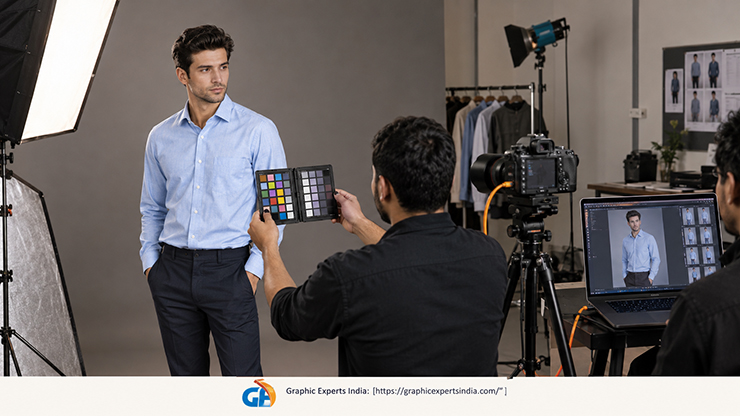
To shoot a clothing advertisement, light the garment so that fabric color and texture read accurately, photograph a color reference under that light, and capture to a computer so frames can be checked against the shot list before the model changes. Each habit removes a post-production problem.
Lighting for color. Fabric color is the attribute a buyer compares against the parcel, so the shoot lights for color fidelity before mood.
One large soft source, a reflector on the shadow side and a plain background give the retoucher an even exposure. Mixed light sources of different color temperatures produce a cast that color correction later has to neutralise per frame.
The color reference frame. A color checker is a card of printed patches with known values.
Calibrite’s ColorChecker Passport Photo 2 carries a white balance target and the 24-patch Classic target; the manufacturer’s page describes the white balance target as a way to “Create custom in-camera white balance for a consistent white point across a set of images” and the profiling workflow as a way to “Create custom camera profiles based on your individual camera/lens/lighting combinations for both DNG and ICC workflows” (calibrite.com, read 14 October 2026).
The usage rule is simple: “JPEG shooters should make it their first shot”, while “Raw shooters can capture this target anytime during the session.” One frame of the card per lighting setup is the reference the color-correction stage matches every garment to.
Tethered capture. Tethering connects the camera to a computer so each frame lands in the editing catalogue as it is taken.
Adobe’s Lightroom Classic documentation describes a session started from the Tethered Capture menu with a session name and destination folder, for Canon, Fujifilm, Nikon and Sony cameras (helpx.adobe.com, read 14 October 2026).
On a clothing shoot the tethered screen is where the art director ticks off the six shot-list items per garment and catches a crease or a cropped foot before the garment goes back on the rail. Posing and camera settings are covered in the guide to fashion photography tips.
How Do You Edit a Clothing Advertisement in Post-Production?
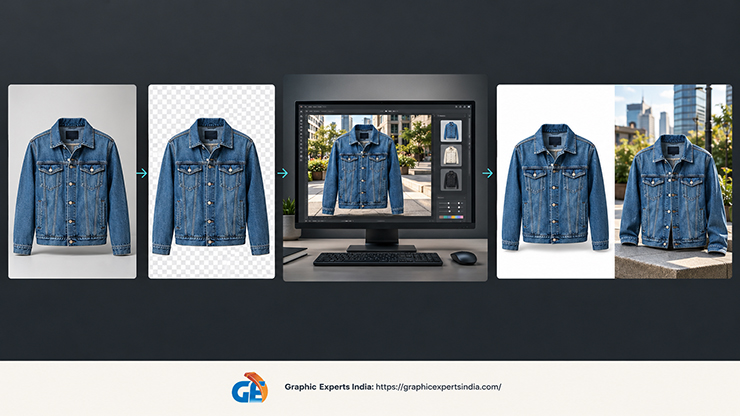
To edit a clothing advertisement in post-production, pass the selected RAW frames through five tasks in a fixed order: retouching, color correction and matching, background removal, compositing, and shadow creation, then export.
The order matters because a shadow built before the background is final has to be rebuilt, and color matched before retouching drifts when a crease is removed.
The table below names who does each stage and the file that leaves it, so a founder can hand any stage to a studio, a freelancer or an editing service without losing the chain.
| Stage | Who does it | What comes in | What leaves the stage | Cost reference |
|---|---|---|---|---|
| 1. Idea and brief | Founder or marketing lead | Campaign examples, garment list, placements | One-page brief with the ad’s sentence and the placement list | Internal time |
| 2. Shot list | Art director or photographer | Brief | Per-garment list: 5 frames + 1 movement clip | Internal time |
| 3. Casting and paperwork | Founder; agency if used | Model or creator; FTC and state rules | Signed model release per person; digital-replica consent if a twin is made; disclosure wording for creators | Model fee; release at no cost |
| 4. Shoot | Photographer, stylist, model | Lit set, color checker, tethered camera | RAW files per garment; one color-checker frame per lighting setup; 9:16 clips | Squareshot studio shoot $750 for 2 hours; model shoot $2,950 for 4 hours |
| 5. Selects | Art director | Tethered catalogue | Rated master per shot-list item, exported as 16-bit TIFF or full-size JPEG | Internal time |
| 6. Retouching | Retoucher or editing service | Master | Clean master: creases, lint, dust, skin blemishes removed; texture kept | Graphic Experts India from $0.99 per image |
| 7. Color correction and matching | Retoucher or editing service | Clean master + color-checker frame | Color-true master, matched across all frames of the garment and to the physical sample | From $0.99 per image |
| 8. Background removal | Editing service | Color-true master | Cut-out on pure white or transparent PNG; clipping path saved | From $0.39 per image |
| 9. Compositing | Editing service | Cut-out + background plate | Lifestyle composite; colorway variants; AI or composite metadata retained | From $1.00 per image |
| 10. Shadow creation | Editing service | Cut-out or composite | Drop, natural, reflection or cast shadow matched to the light direction | From $0.40 per image |
| 11. Export and QC | Editor | Finished master | Per-placement files from the export matrix; three-step quality check; metadata check | Included |
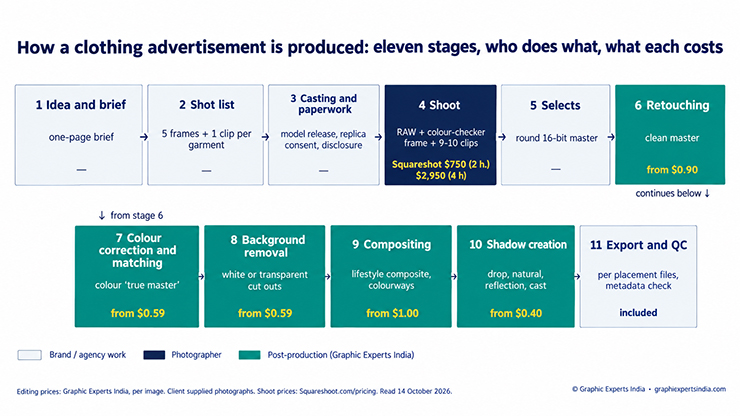
Figure 1. The eleven stages of clothing advertisement production, with the file that leaves each stage and the editing price per image where one applies. Prices read 14 October 2026 from graphicexpertsindia.com and squareshot.com/pricing.
How Do You Retouch a Clothing Advertisement Image?
To retouch a clothing advertisement image, remove what the garment will not have when it arrives, and keep what it will. Creases from the rail, lint, dust spots, stray threads and a loose tag go; the weave, the print edge and the drape stay. On a model, skin is evened without removing texture.
The output is the clean master that every later task is built on. Graphic Experts India prices e-commerce photo retouching from $0.99 per image, with a 24-hour average turnaround and a three-step quality check.
How Do You Color-Correct and Match the Garment?
To color-correct and match the garment, neutralise the white balance from the color-checker frame, apply the same correction to every frame shot under that light, then adjust the garment against its physical sample so that every angle, composite and colorway shows the same color.
Color matching prevents the return caused by a navy that photographed as black. It is also where second and third colorways are produced from one master by recoloring the garment with the texture intact.
Graphic Experts India prices color correction from $0.99 per image; the service page names photo color matching, color change and replacement, and exposure correction as the tasks included.
How Do You Remove the Background and Composite the Scene?
To remove the background, cut the garment or the model from the frame along a hand-drawn clipping path and place it on pure white or a transparent layer; to composite, place that cut-out into a photographed or generated background plate, match perspective and light, and add the colorway variants.
The white cut-out is the Merchant Center and Performance Max asset; the composite is the lifestyle asset for the feed and Pinterest. Replacing the garment itself in an existing photograph is a separate editing task with its own guide on how to change clothes in a photo.
Graphic Experts India prices background removal from $0.39 per image and image manipulation, which covers background change, image merging, perspective adjustment, object removal and photo compositing, from $1.00 per image. Where a generated element enters the composite, the file keeps its IPTC DigitalSourceType tag through this stage.
How Do You Add a Shadow to a Cut-Out Garment?
To add a shadow to a cut-out garment, build a shadow layer that matches the direction and softness of the light in the original frame, so the garment sits on the white or composite ground instead of floating above it.
Graphic Experts India’s service page lists four types: “Drop shadow, natural shadow, reflection shadow, cast shadow.”
A natural shadow re-creates the one the shoot lighting produced; a drop shadow is a soft offset used for flat-lay cut-outs; a reflection suits footwear and accessories on a glossy ground.
The shadow is the last pixel edit before export, because it depends on the final background. Graphic Experts India prices shadow making from $0.40 per image.
Which Export Spec Does Each Placement Need?
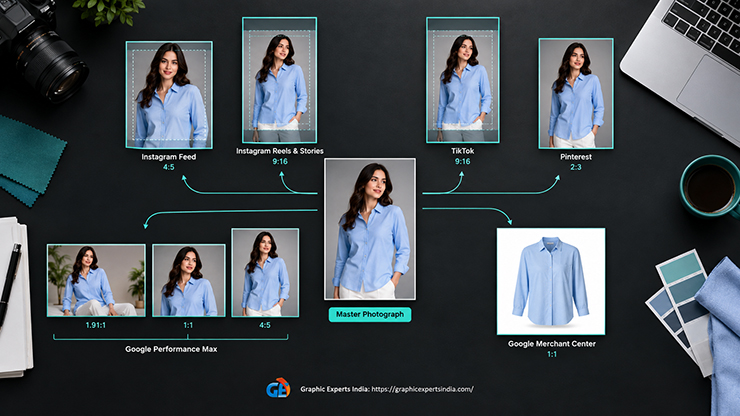
Each placement needs its own aspect ratio, pixel size, file cap and overlay rule, and the finished master should be exported to each one rather than uploaded once and cropped by the platform.
The matrix below is synthesised from Meta for Developers, TikTok Ads Manager Help, Pinterest Business Help, Google Ads Help and Google Merchant Center Help, all read on 14 October 2026, and adds the column a production team needs: which master each export is cut from.
| Placement | Shape and size | Format and caps | Text, overlay and safe-zone rule | Export from |
|---|---|---|---|---|
| Instagram feed image | 4:5 (range 4:5 to 1.91:1); 1080 × 1350 at 4:5; width 320 min, 1440 max | JPEG; 8 MB; sRGB | Platform caption carries the text | Retouched still master |
| Instagram Reels | 9:16 recommended “to avoid cropping or blank space”; up to 1920 px wide | MOV or MP4; H.264 or HEVC; 23–60 fps; 3 s to 15 min; 300 MB | Keep titles clear of the caption and UI area | 9:16 movement clip |
| Instagram Stories | 9:16 recommended; up to 1920 px wide | Video 3 s to 60 s, 100 MB; image JPEG 8 MB | As Reels | 9:16 clip or still |
| TikTok in-feed video | 9:16 at 540 × 960 px or larger (16:9 ≥ 960 × 540; 1:1 ≥ 640 × 640) | .mp4, .mov, .mpeg, .3gp, .avi; up to 10 min; 500 MB; ≥ 516 kbps | Use TikTok’s published safe-zone file for the region | 9:16 movement clip |
| Pinterest standard image ad | 2:3, 1000 × 1500 px | .PNG or .JPEG; 20 MB desktop, 32 MB in-app | Title up to 100 characters | Lifestyle composite |
| Pinterest standard video ad | Square or vertical; “(1:1) or vertical (2:3, 4:5, or 9:16)” | .MP4, .MOV or .M4V; H.264 or H.265; “Minimum 4 seconds, maximum 15 minutes”; 2 GB | 6 to 15 seconds recommended | 9:16 or 1:1 clip |
| Google Performance Max images | 1.91:1 1200 × 628 (min 600 × 314); 1:1 1200 × 1200 (min 300 × 300); 4:5 960 × 1200 (min 480 × 600) | JPG or PNG; 5120 KB; 4+ horizontal, 4+ square, 2+ vertical, up to 20 each | “Content needs to be in the center 80% of the image”; “at least one image without overlays for each aspect ratio” | White cut-out and composite |
| Google Merchant Center main image | ~1500 × 1500 recommended; 500 × 500 minimum for all products “beginning January 31, 2027” | JPEG or WebP recommended; 16 MB; 64 megapixels | “Don’t use an image that contains promotional elements or overlays”; AI images carry metadata | White cut-out with shadow |
Three production rules follow from the matrix. Shoot the still master with room on all four sides, because the 1.91:1 Performance Max crop and the 2:3 Pin cannot come from a tight 4:5 frame.
Shoot the movement clip in 9:16 with the garment inside the central area, because TikTok, Reels and Stories each reserve edges for captions.
Export text-free versions of every file, because Performance Max wants one overlay-free image per ratio and Merchant Center accepts none; Google adds that “Images go through quality and policy checks before being eligible to serve” (Google Ads Help).
The marketplace listing rules beside these ad specifications are compared in the guide to fashion eCommerce platforms and their image requirements.
How Much Does a Clothing Advertisement Cost to Produce?
A clothing advertisement costs between a few dollars of editing on a phone shoot and several thousand dollars for a studio day, and the ladder below separates the two parts of that range: capture and post-production. All prices were read on 14 October 2026.
| Rung | Item | Price | Source |
|---|---|---|---|
| 1 | Background removal, per image | from $0.39 | Graphic Experts India |
| 2 | Shadow creation, per image | from $0.40 | Graphic Experts India |
| 3 | E-commerce retouching, per image | from $0.99 | Graphic Experts India |
| 4 | Color correction and matching, per image | from $0.99 | Graphic Experts India |
| 5 | Image manipulation and compositing, per image | from $1.00 | Graphic Experts India |
| 6 | Ghost mannequin editing, per image | from $1.49 | Graphic Experts India |
| 7 | Studio product image, per image | “From $50 per image, or $750 for a 2-hour shoot” | Squareshot |
| 8 | On-model image, per image | “From $95 per image, or $2,950 for a 4-hour shoot” | Squareshot |
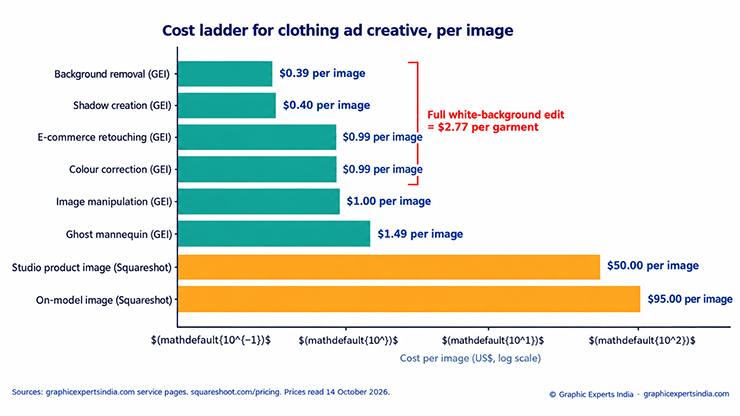
Figure 2. Cost per image for clothing advertisement creative, from outsourced editing of a client-supplied photograph to a studio on-model shot. Prices read 14 October 2026 from graphicexpertsindia.com and squareshot.com/pricing.
A worked example shows how the rungs combine. A ten-garment campaign that shoots one hero frame per garment and sends it through the full edit, retouching at $0.99, color correction at $0.99, background removal at $0.39 and a shadow at $0.40, pays $2.77 per garment, or $27.70 for ten finished white-background masters.
One lifestyle composite per garment at $1.00 brings the post-production total to $37.70 for 20 ad-ready masters, before the free export step to the eight placements above.
The same ten garments shot as on-model studio images at Squareshot’s listed rate cost $950 at $95 per image, or $2,950 for the four-hour shoot.
The two routes are the floor and the ceiling of the same ladder, and a new label can start at the floor with a phone, daylight and a color checker card. Each service page, such as the photo retouching service page, lists its own per-image rate.
How Long Does It Take to Make a Clothing Advertisement?
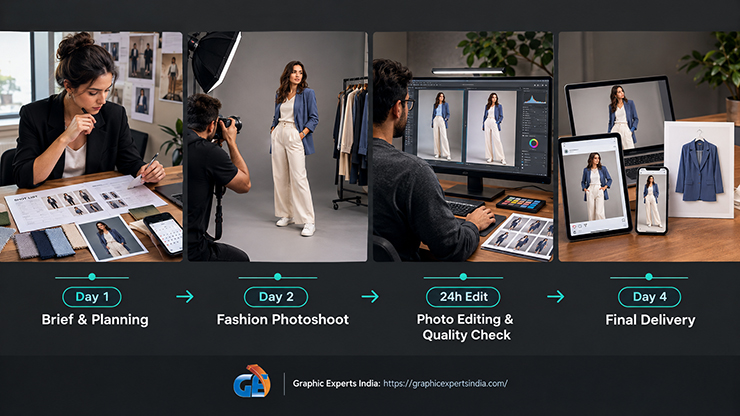
A clothing advertisement takes from about four days to about two weeks from brief to live file, depending on whether the brand shoots in-house and outsources the edit or books a studio.
Published turnaround figures are few, so the schedule below marks everything else as a planning allowance.
| Step | Time | Basis |
|---|---|---|
| Brief and shot list | Allow 1 to 2 days | Planning allowance |
| Casting, releases and consents | Allow 2 to 5 days, longer if an agency negotiates a digital-replica consent | Planning allowance; NY Fashion Workers Act consent is a separate written document (Morgan Lewis, 8 January 2025) |
| Shoot | Half a day to a full day | Squareshot sells 2-hour product and 4-hour model shoots |
| Studio route, shoot to final shots | “8 DAYS from payment to final shots” | Squareshot pricing page, read 14 October 2026 |
| Outsourced edit of client-supplied frames | 24-hour average turnaround | Graphic Experts India |
| AI-assisted content from a photographed twin | “from spotting a trend to producing tailored content in under 24 hours” | Zalando, 7 May 2025 |
| Export, QC and upload | Allow 1 day | Planning allowance |
The shortest path for a new label is therefore: brief on day one, phone shoot with a color checker on day two, files to an editing service that evening, finished masters back within 24 hours, exports and uploads on day four.
A brand with a weekly drop can hold that cycle by sending each week’s frames to the same editor, the model described in the guide to outsourcing Photoshop editing.
What Do Clothing Brands Ask Most Often About Making Clothing Advertisements?
Shoot in 9:16 at the phone’s highest resolution in steady daylight, film a 5-to-10-second walk or turn per garment, and include one frame of a color checker card. Cut the clip to under 15 seconds, keep the garment inside the centre of the frame, export MP4 at 1080 × 1920 and upload separately to Reels, TikTok and Stories using each platform’s own file.
Yes, in commercial use, for every recognisable person. Stock-agency standards state that “A separate model release is required for each recognizable person”, signed and dated, with a parent or guardian signing for a minor. Editorial photographs do not carry releases and cannot be re-used as ads. Garments on a form or ghost mannequin need no release. Rules differ by country.
Yes, within three constraints. Google Merchant Center requires AI-generated images to carry metadata “indicating that the image was AI-generated”, with the IPTC DigitalSourceType tag intact. New York’s Fashion Workers Act requires “clear and conspicuous prior written consent” for a model’s digital replica. The FTC’s disclosure standard, “difficult to miss”, applies to any endorsement in the ad. Levi’s, Mango, Zalando and H&M have each published their own use.
Export 9:16 for Instagram Reels, Stories and TikTok. Meta recommends 9:16 at up to 1920 pixels wide, 3 seconds to 15 minutes and 300 MB for Reels. TikTok’s in-feed specification is 9:16 at 540 × 960 pixels or larger, up to 500 MB and at least 516 kbps. Pinterest accepts 1:1, 2:3, 4:5 or 9:16 video from 4 seconds, with 6 to 15 seconds recommended.
Post-production for one finished white-background master costs $2.77 at Graphic Experts India’s listed rates: retouching $0.99, color correction $0.99, background removal $0.39 and a shadow $0.40. A lifestyle composite adds $1.00. A studio on-model image costs from $95 at Squareshot, or $2,950 for a four-hour shoot. Ten garments therefore run from $37.70 in editing to $950 in studio images.
Where Can a Clothing Brand Get Its Ad Creative Edited Overnight?
A clothing brand can send its RAW or phone-shot frames to Graphic Experts India and receive retouched, color-matched, cut-out, composited and shadowed masters ready for the export matrix in this guide.
Graphic Experts India lists e-commerce retouching from $0.99 per image, color correction from $0.99, background removal from $0.39, shadow creation from $0.40, image manipulation from $1.00 and ghost mannequin editing from $1.49, each with a 24-hour average turnaround and a three-step quality check, and has served apparel brands since 2009.
A free trial on sample images is available through the image manipulation service page, returned within 24 hours with no credit card required.

Salim Ahmed is the CEO of Graphic Experts India, with over 25 years of expertise in photo editing, clipping path, image retouching, and eCommerce image editing services.