

A logo for a clothing brand is the mark that identifies the brand on a label, a left chest, a hangtag and a product page, and clothing brand logo design is the process of choosing that mark’s type, style, color and file format so it prints on fabric as well as it renders on a screen.
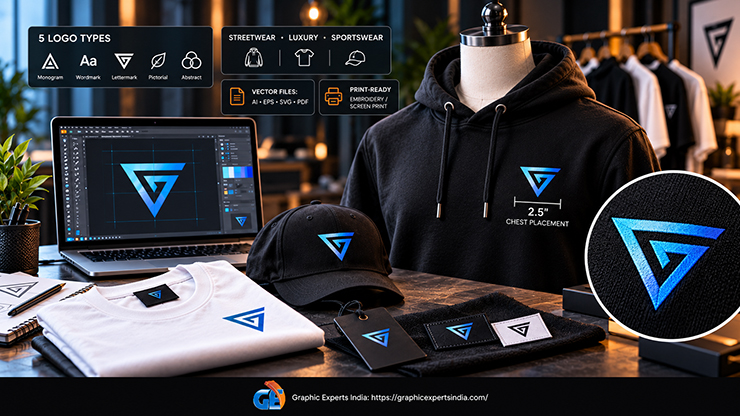
A clothing logo differs from a software or restaurant logo in one way: it must survive embroidery thread, screen-print ink and a 2.5-inch chest placement, so the file format is part of the design.
This guide defines the five logo types with verified examples, compares logo styles across streetwear, luxury, sportswear, minimalist direct-to-consumer and heritage brands, describes ten well-known clothes logos and brands from the brands’ own records, and sets out a seven-step process for designing a clothing brand logo.
It then prices DIY logo makers against designers, explains the vector file requirement for printing, shows how a raster logo is converted, and covers trademark basics from the United States Patent and Trademark Office. All sources were read on 14 October 2026.
The logo is step four of the wider guide on How to Start a Clothing Brand in 2026.
What Is Clothing Brand Logo Design at a Glance?
Clothing brand logo design at a glance is a choice of one of five mark types, one segment style, and one vector master file, made before the first garment is printed.
| Question | Short answer | Source |
|---|---|---|
| Which logo types exist? | Five: wordmark, lettermark or monogram, symbol, combination mark and emblem | Consensus classification; examples verified below |
| Which brand put the first visible logo on clothing? | Lacoste; its crocodile “takes shape in 1927 under the pen of designer Robert George” | global.lacoste.com, read 14 October 2026 |
| What does a DIY logo cost? | Canva from US$0; Looka $20 (PNG only) or $65 (with EPS, SVG, PDF); 99designs contests from US$249 | Canva, Looka, 99designs pricing pages, read 14 October 2026 |
| What does a designer cost? | Upwork lists logo designers at $15–$30 per hour, median $25; Fiverr gigs “From $5” to “From $65” | upwork.com; fiverr.com, read 14 October 2026 |
| What file does a printer need? | DTG: PNG at 150 DPI or more in sRGB; embroidery and screen printing: a vector file (AI, EPS, PDF or SVG) | Printful; Printify; RushOrderTees |
| How is a raster logo made print-ready? | Vector conversion at $4.48 per image with a 24-hour average turnaround | Graphic Experts India |
| What does a US trademark cost? | $350 per class, base electronic fee, effective 18 January 2025; clothing is Class 25 | USPTO fee page |
What Is a Clothing Brand Logo and Which Types Exist?
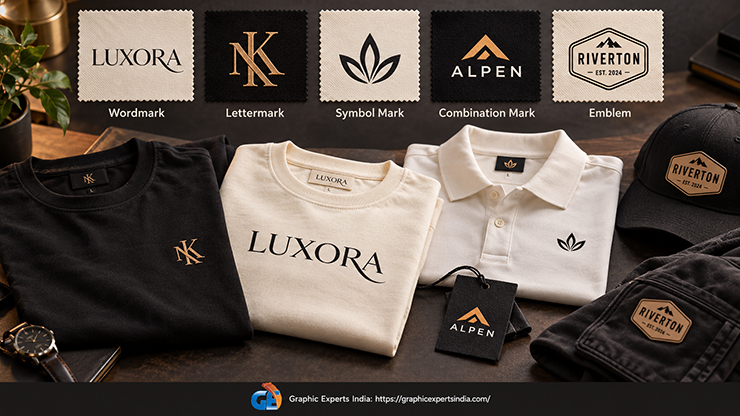
A clothing brand logo is a graphic mark, a styled name, or both, that a clothing company places on its garments and communications so a buyer can attribute the product to one source.
The USPTO’s definition of the legal object behind a logo is broad: “A trademark can be any word, phrase, symbol, design, or a combination of these things” (uspto.gov, “What is a trademark?”, read 14 October 2026). Logo design practice sorts those combinations into five types, and every brand logo for clothes in the examples below fits one of them.
| Logo type | Definition | Verified clothing example | Where it works on a garment |
|---|---|---|---|
| Wordmark | The full brand name set in a distinctive typeface, with no separate symbol | Stüssy, whose founder “scrawled his signature on the finished boards which soon became his trademark and logo” (Stab, 14 June 2016) | Full-front prints, hem labels, back necks |
| Lettermark or monogram | One or more initials used as the mark | Champion, whose “familiar”C” appeared for the first time on a Notre Dame basketball uniform” in 1978 (champion.com) | Left chest, sleeve, cap front |
| Symbol or pictorial mark | A picture or abstract shape that stands alone without text | Nike’s Swoosh, invoiced by student Carolyn Davidson for $35 in 1971 (about.nike.com, 2 October 2025); Lacoste’s crocodile | Embroidered chest, woven label, hardware |
| Combination mark | A symbol and a wordmark that can be used together or apart | adidas, which pairs the Three Stripes, the Trefoil or the Badge of Sport with the lowercase name (adidas.com blog, September 2022) | Hangtags, website, full-front prints |
| Emblem | Text locked inside a shape or badge, used as one unit | Supreme’s “distinctive red box logo with”Supreme” in white Futura Heavy Oblique” (V&A collection record, 2017 object); Levi’s Two Horse patch | Woven patches, box-logo prints, leather patches |
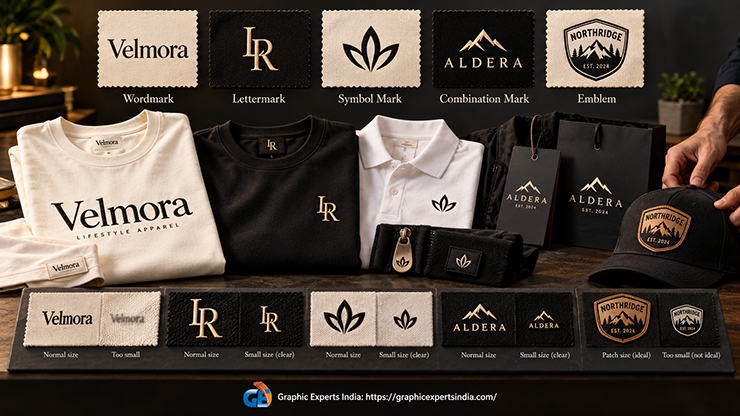
The five types trade off differently on fabric. A wordmark depends on typeface and loses legibility fastest as it shrinks. A monogram or symbol holds up at embroidery sizes because it has fewer strokes. A combination mark gives the brand two assets, which is why most new clothing brands commission one.
An emblem prints well as a patch but fails as a small embroidered chest mark because its interior text drops below the minimum stitch size described in the file-format section below.
Which Logo Styles Suit Each Clothing Segment?
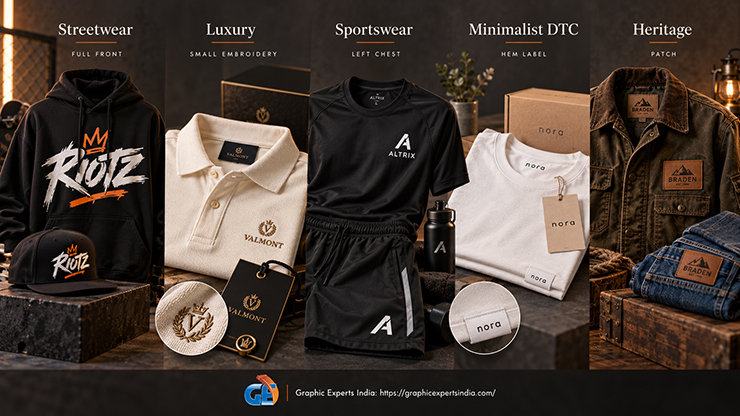
Five segment styles cover most clothes logos and brands: streetwear, luxury and high-end, sportswear and athleisure, minimalist direct-to-consumer, and heritage or workwear. Each segment favours a logo type because of how its garments are decorated and sold.
Streetwear sells the logo itself as the print, luxury sells restraint plus one recognisable device, sportswear needs a mark that reads at speed and on television, direct-to-consumer brands design first for a phone screen, and heritage brands keep a device that predates the brand’s current owners.
The logo is one part of the wider identity system covered in the guide to Branding a Clothing Company, which treats voice, color, labels and packaging together.
| Segment | Dominant logo type | Verified examples | Typical garment placement | Design constraint |
|---|---|---|---|---|
| Streetwear and street style clothing brand logos | Wordmark or emblem printed large | Stüssy signature (wordmark); Supreme box logo (emblem) | Full front, back, cap | Must work as the print itself; screen printing needs a vector file |
| Luxury and high end clothing brand logos | Wordmark plus a heraldic or equestrian device | Burberry Equestrian Knight Design, “the winning entry of a public competition to design a new logo, circa 1901” (burberryplc.com, 6 February 2023); Ralph Lauren Polo Pony | Woven label, small embroidery, hardware | Fine detail must survive embroidery minimums |
| Sportswear and sports clothing brand logos | Symbol or lettermark, no text needed | Nike Swoosh; adidas Three Stripes and Trefoil; Champion “C” | Left chest, sleeve, hip of shorts | Single color, readable at distance and in motion |
| Minimalist direct-to-consumer | Lowercase or geometric wordmark | No brand verified from a primary source for this guide | Back neck print, hem label, packaging | Designed on screen first; must still convert to thread |
| Heritage and workwear | Emblem or symbol with a dated origin | Levi’s Two Horse (1886); Lacoste crocodile (1927); Fred Perry Laurel Wreath | Leather or woven patch, left chest | Device is kept consistent across decades |
Womens clothing brand logos and fashion designer logo design follow the same segment logic rather than a separate style; a dress designing studio that sells through boutiques usually sits in the luxury column with a wordmark and a small device, while one that sells on Instagram sits in the direct-to-consumer column.
What Do Well-Known Clothes Logos and Brands Look Like and Where Did They Come From?
Ten popular clothing brands logos are described below from the brands’ own sites or a named, dated source, with the logo type and the brand’s stated origin. No logo is reproduced here, and no history is included beyond what the source states.
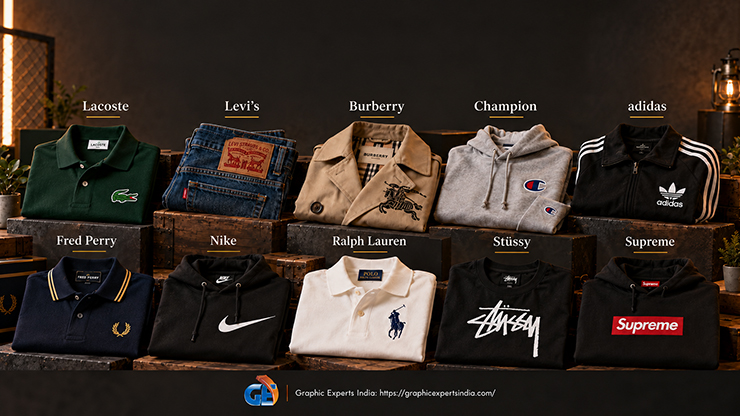
| Brand | Logo type | What the mark shows | Brand’s own stated origin | Source and date |
|---|---|---|---|---|
| Lacoste | Symbol | A crocodile, worn “over the heart” | “The crocodile takes shape in 1927 under the pen of designer Robert George”; the name came because “an American journalist gave him this nickname”; the brand says the crocodile “makes Lacoste the first brand to display a visible logo on an article of clothing”; company founded in 1933 with André Gillier | global.lacoste.com; corporate.lacoste.com, read 14 October 2026 |
| Levi’s | Emblem (patch) | A pair of overalls “attached to two horses attempting to pull them apart” | “The solution came in 1886.” The design answered the question “what possible symbol would customers, even those who couldn’t read, recognize?” | levistrauss.com, 7 April 2016 |
| Burberry | Symbol (Equestrian Knight Design) with wordmark | A mounted knight carrying a banner that “features the Latin word ‘Prorsum’ meaning ‘Forwards’” | “the winning entry of a public competition to design a new logo, circa 1901”; “The new Burberry logo is archive inspired” | burberryplc.com, 6 February 2023 |
| Champion | Lettermark | A single “C” | “Champion’s familiar”C” appeared for the first time on a Notre Dame basketball uniform” (1978); “The company was started May 6, 1919 as Knickerbocker Knitting Mills.” | champion.com, read 14 October 2026 |
| adidas | Combination (Three Stripes, Trefoil, Badge of Sport) | Three parallel stripes; a three-leaf trefoil; a three-bar mountain shape | Founded “by Adolf Dassler in 1949”; the Trefoil “was added in 1972, when adidas branched out from solely selling shoes”, “Inspired by florals”; “Those telltale stripes, by the way, don’t hold numerological meaning.” | adidas.com blog, September 2022 |
| Fred Perry | Symbol (Laurel Wreath) | A laurel wreath placed “just above the heart of the player” | The brand calls it “a signature of both individuality and of belonging, from elite sportsmen to fringe subcultures”; the original one-color shirt dates from 1952 | fredperry.com brandbook, read 14 October 2026 |
| Nike | Symbol (Swoosh) | A “checkmark-shaped stripe” | Designed in 1971 by Portland State student Carolyn Davidson, who “sent Knight an invoice for $35”; “She thought it suggested motion.”; Phil Knight: “What we wanted it to stand for was speed, which it did and still does.” | about.nike.com, 2 October 2025 |
| Ralph Lauren | Symbol (Polo Pony) | An embroidered polo player on horseback | “The iconic Polo Pony debuts on the cuff of a new line of women’s shirts” (1971); Ralph Lauren: “On one level, there’s an aspirational quality to having a polo player on it” | ralphlauren.ca 50th-anniversary timeline, read 14 October 2026 |
| Stüssy | Wordmark (signature) | Shawn Stussy’s handwritten signature | He “scrawled his signature on the finished boards which soon became his trademark and logo”; “I had the logo screen-printed on T-shirts and sweatshirts, but it had nothing to do with producing clothes.”; Stussy Inc. established 1984 | Stab, 14 June 2016 |
| Supreme | Emblem (box logo) | “The distinctive red box logo with”Supreme” in white Futura Heavy Oblique” | The V&A record says the logo “is argued to be largely based on artist Barbara Kruger’s slogan-led collage work”; the shop “opened its doors on Lafayette Street on April 21, 1994” | V&A collection record CD.41-2018; The Fashion Law, 22 February 2018 |
Three facts from the table matter for a new brand. Seven of the ten marks are symbols or emblems that work without any text, which is why they survive on a 2.5-inch chest. Four of the ten have a documented origin older than 1950, and the brands still use them, so the logo decision is a long one.
And the two streetwear marks began as something other than a clothing logo, a surfboard signature and a shop sign, which shows that a wordmark can carry a brand when the typeface is distinctive enough. The way these brands present the logo on product pages and lookbooks is covered in the guide to how top fashion brands sell online.
How Do You Create a Clothing Brand Logo Step by Step?
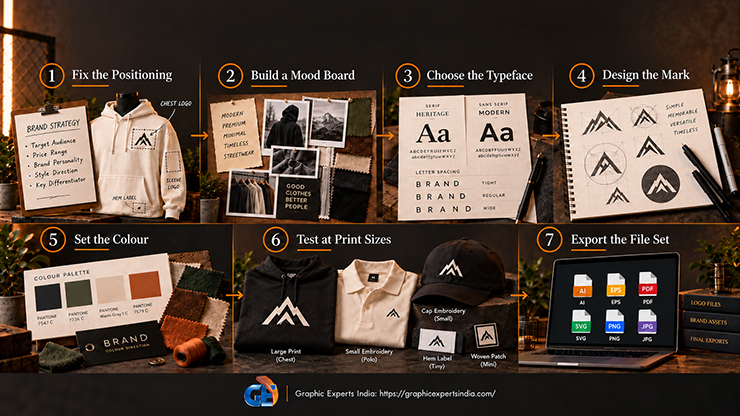
To create a clothing brand logo, fix the positioning, build a mood board, choose the typeface, design the mark, set the color, test the result at print sizes, and export the file set, in that order. The sequence puts the decisions that cannot be undone, positioning and typeface, before the ones that can.
Step 1: How Do You Set the Positioning Before Designing a Clothing Brand Logo?
To set the positioning, write one sentence that names the segment, the customer and the price point, because the segment table above decides the logo type before any sketching starts.
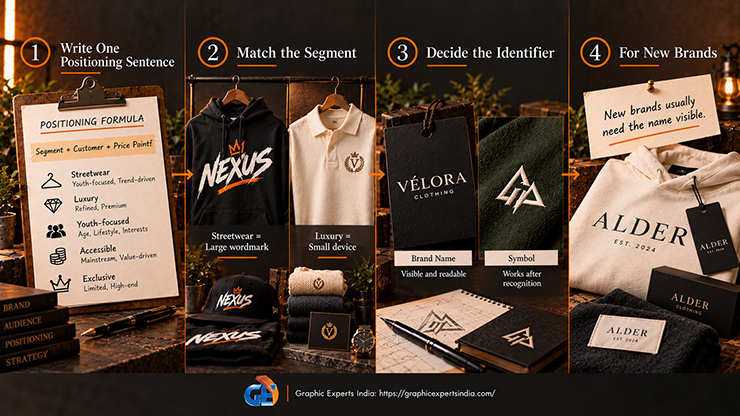
A streetwear label needs a wordmark that prints large; a luxury label needs a device that embroiders small. Decide also whether the brand name or a symbol will do the identifying work, since a new brand with no recognition usually needs the name visible.
Step 2: How Do You Build a Mood Board for a Fashion Brand Logo?
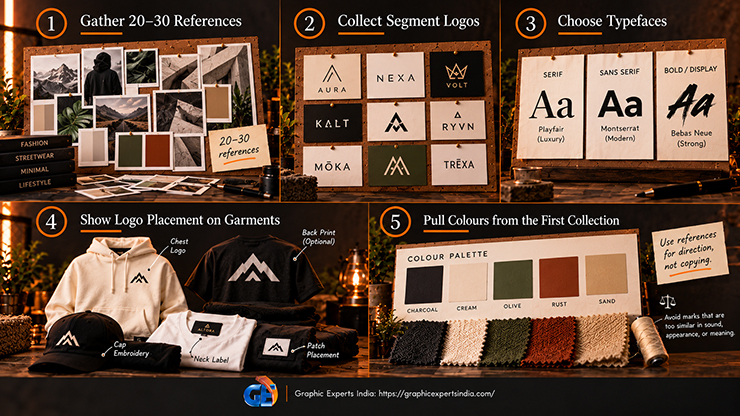
To build a mood board, collect 20 to 30 references in four groups: logos from the chosen segment, typefaces, garments showing where the logo will sit, and colors taken from the first collection. The references are for direction, not copying; the USPTO’s confusion standard in the trademark section applies to marks that are “similar in sound, appearance, or meaning”, not only identical ones.
Step 3: How Do You Choose a Typeface for a Clothing Logo?
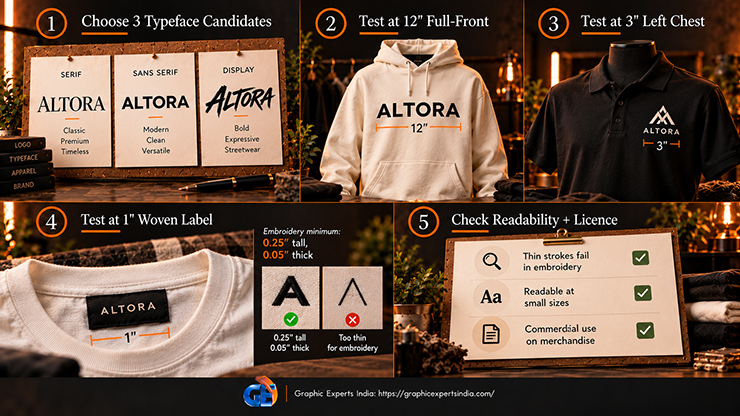
To choose a typeface, test the brand name in three candidates at three sizes: 12 inches wide for a full-front print, 3 inches for a left chest, and 1 inch for a woven label. Printful’s embroidery guidance sets the floor: “Keep lettering at least 0.25″ tall and 0.05″ thick” (printful.com blog, 1 September 2026).
A typeface whose thin strokes fall under 0.05 inch at left-chest size will not embroider, whatever it looks like on screen. Check the typeface licence covers commercial use on merchandise before buying.
Step 4: How Do You Design the Mark Itself?
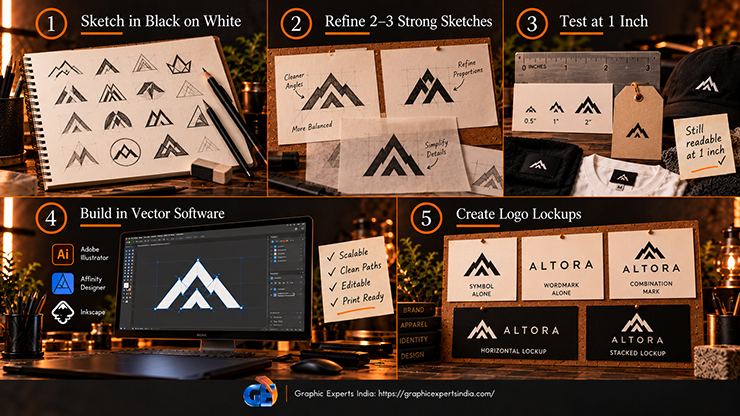
To design the mark, sketch in black on white at thumbnail size first, then refine the two or three sketches that still read at 1 inch.
Build the final artwork in a vector program such as Adobe Illustrator, Affinity Designer or Inkscape, not in a photo editor, so that the master file is scalable from the start. Produce the mark in three lockups: symbol alone, wordmark alone, and the combination, each in horizontal and stacked versions where the shape allows.
Step 5: How Do You Choose Colors for a Clothing Brand Logo?
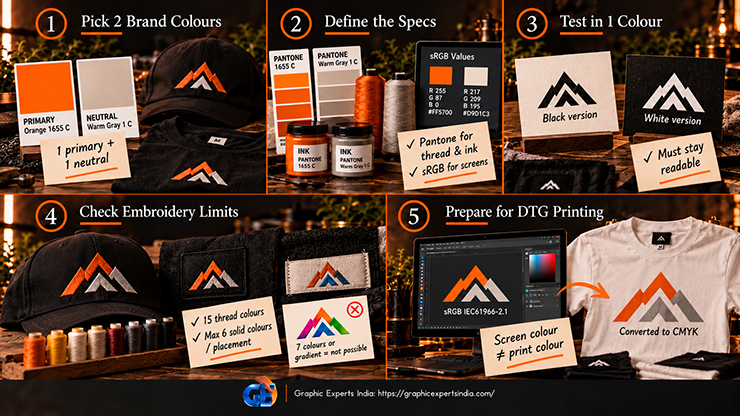
To choose colors, pick one primary color and one neutral, specify each as a Pantone reference for thread and ink and as sRGB values for screens, and confirm the mark works in single-color black and single-color white. Printful states that it provides “a curated selection of 15 thread colors, with up to six solid colors available per placement” (printful.com blog, 1 September 2026), so a logo with seven colors or a gradient cannot be embroidered as designed.
For direct-to-garment printing, Printful’s file page says to use “the sRGB color profile, specifically sRGB IEC61966-2.1” and notes that “Our printers then convert your submitted file into CMYK format”, which means the printed color will differ from the screen color.
Step 6: How Do You Test a Logo at Print Sizes?
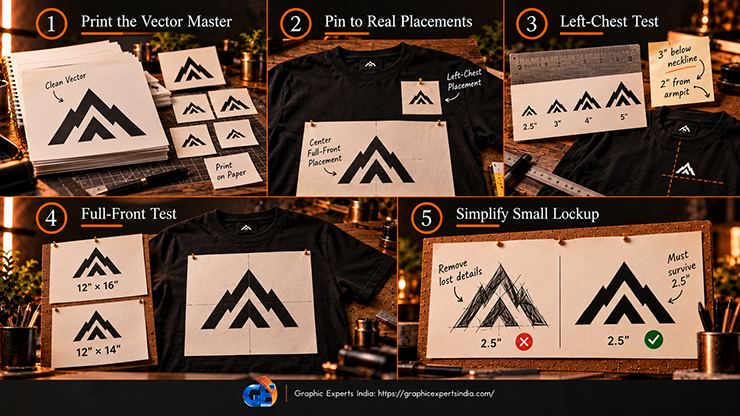
To test a logo at print sizes, print the vector master on paper at the three real placements and pin each to a garment.
Printful’s placement guide puts a left-chest design at “between 2.5″ × 2.5″ and 5″ × 5″”, positioned “about 3 inches below the neckline and 2 inches from the armpit”, and a full-front print area at “12″ × 16″ for most Printful t-shirts” (printful.com blog, 14 May 2026).
RushOrderTees gives the screen-print standard as a 3- to 4-inch left chest and a 12 × 14-inch full front (rushordertees.com, 14 November 2022).
A complete placement-by-placement size chart for t-shirt logo placement belongs in a separate guide; the test here is only whether the mark survives the smallest placement. Consequently, any element that disappears at 2.5 inches is removed from the small lockup rather than kept.
Step 7: Which Files Should the Final Logo Package Contain?
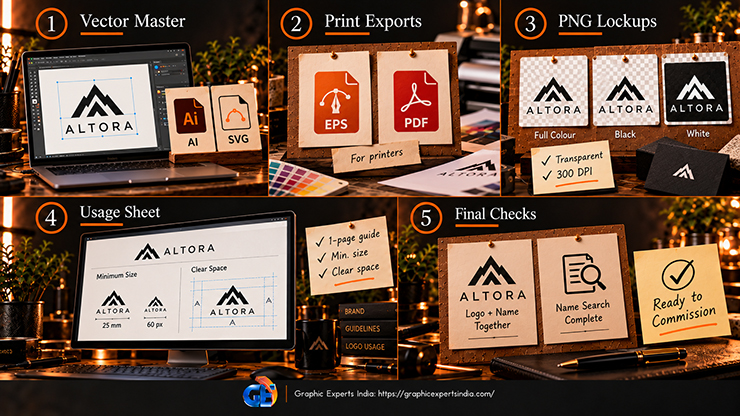
To export the final package, save the vector master as AI or SVG, then export EPS and PDF for printers, and PNG files with transparent backgrounds at 300 DPI for each lockup in full color, black and white. Add a one-page usage sheet stating minimum sizes and clear space.
The logo and name should be filed together, and the name search described in the trademark section should be complete before the final files are commissioned.
Should You Use a DIY Logo Maker or Hire a Designer for a Clothing Brand Logo?
A DIY logo maker suits a clothing brand that needs a wordmark quickly and will print by direct-to-garment, while a designer suits a brand that needs an ownable symbol or will embroider and screen print. The decision turns on two facts: whether the output is a vector file, and whether the mark is exclusive.
The prices below were read on each company’s own site on 14 October 2026 (Looka’s from its help center, dated 24 September 2021, because its pricing page does not print prices) and are listed from lowest to highest.
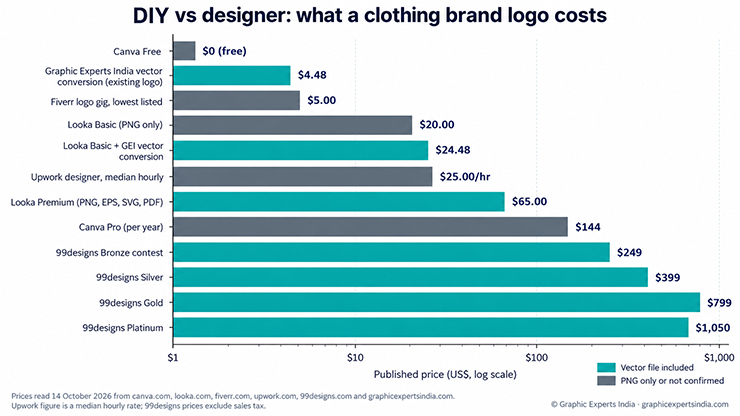
Figure 1. Cost of a clothing brand logo by route, from free logo design tools to a design contest. Prices read 14 October 2026 from canva.com, looka.com, fiverr.com, upwork.com, 99designs.com and graphicexpertsindia.com.
| Route | Published price | What the price includes | Vector file included? | Exclusivity |
|---|---|---|---|---|
| Canva Free | “US$0” per year for one person | Template-based editor | Not stated on the pricing page for the free plan | Templates are shared with every user |
| Fiverr logo gig | Gigs listed “From $5”, “From $10”, “From $25”, “From $35”, “From $65” | Varies by seller | Varies by seller; Fiverr lists separate “SVG Logo design” and “PNG Logo design” categories | Set by the seller’s licence terms |
| Looka Basic Logo Package | “$20 USD”, one-time | “One PNG logo file.” | No | AI-generated; purchase transfers the copyright per Looka |
| Looka Premium Logo Package | “$65 USD”, one-time | “Multiple high-res file types (PNG, EPS, SVG, PDF).” | Yes | As above |
| Canva Pro | “US$144” per year for one person | Full editor, brand kit features | Not confirmed from the pricing page | Templates remain shared |
| Upwork freelance designer | “$15–$30/hr”, median “$25” | Custom design, hours agreed per project | Agreed in the contract | Agreed in the contract |
| 99designs Bronze contest | “US$249” | About 30 design concepts from multiple designers | Final files supplied by the winning designer | Winner’s files transferred to the client |
| 99designs Silver, Gold, Platinum | “US$399”, “US$799”, “US$1,050” | About 60, 90 and 60 concepts; higher tiers restrict to “Mid & Top Level designers only” or “Top Level designers only” | As above | As above |
Two calculations follow from the table. A Looka Basic logo at $20 plus a Graphic Experts India vector conversion at $4.48 costs $24.48 and yields a vector file, against $65 for the Looka Premium package, so the cheapest route to a print-ready file is not the obvious one.
An Upwork designer at the $25 median rate reaches the 99designs Bronze price of $249 at about ten hours, which is the point at which a custom brief and revisions become cheaper per concept than a contest.
Free clothing logo design is available from Canva and from Looka’s editor, which states that “You can use Looka to design, edit, preview, and save as many logos as you want for free” (help.looka.com, 24 September 2021), but the download and the copyright are the paid part.
Upwork notes that its figures represent “typical hourly rate ranges of certain historical contracts worldwide”. Where the logo sits in the full launch budget, alongside samples, store fees and photography, is set out in the guide to how much it costs to start a clothing brand.
Which File Formats Does a Clothing Brand Logo Need for Printing?
A clothing brand logo needs one vector master file plus raster exports, because the three main garment decoration methods read files differently. Vector files (AI, EPS, PDF and SVG) store the logo as mathematical paths and scale without quality loss. Raster files (PNG and JPG) store pixels and blur when enlarged.
RushOrderTees states that “Vector file types include AI, EPS, and PDF” and that “The key feature of vector files, which makes them so valuable for printing, is that they are infinitely scalable” (rushordertees.com, 14 November 2022). The same article asks that raster files “be at least 200 dpi at full size”.
The three decoration methods set three different floors.
- Direct-to-garment (DTG). Printful states: “For most Printful products, your print file has to be at least 150 DPI to ensure optimal print quality.” The file should be a PNG with a transparent background in “the sRGB color profile, specifically sRGB IEC61966-2.1” (printful.com, creating a DTG file, read 14 October 2026). Printify accepts “JPEG, PNG, and SVG”, recommends 300 DPI for JPEG and PNG, and caps SVG files at 20 MB (help.printify.com, read 14 October 2026).
- Embroidery. The logo is digitised into stitch paths, which requires clean vector boundaries. Printify’s embroidery guidance states that “Raw JPGs fall short for machine plotting because they lack the mathematical precision needed for clean stitch lines” and describes SVG as “non-negotiable” for its automated digitisation (printify.com knowledge hub, 28 May 2026). Printful’s embroidery design guide allows “up to six solid colors available per placement” and advises keeping lettering “at least 0.25″ tall and 0.05″ thick” (Printful blog, 1 September 2026). Printful’s embroidery guidelines page adds that “Each embroidery type requires a separate digitized file” and that it will “digitize all your files for free” on orders of 25 or more embroidery products (read 14 October 2026).
- Screen printing. Each color is separated onto its own screen, so the printer needs editable paths and spot colors, which is the vector format described by RushOrderTees above.
The pixel arithmetic shows why a web logo fails on fabric. At Printful’s 150 DPI minimum, a 2.5-inch left chest needs a file at least 375 pixels wide, a 5-inch chest needs 750 pixels, and a 12 × 16-inch full front needs 1,800 × 2,400 pixels.
A 1,000-pixel logo downloaded from a website prints cleanly at a maximum of 6.67 inches wide by DTG and cannot be used at all for embroidery or screen printing without redrawing. The matrix below combines the five logo types, the five segments and the three decoration methods into one suitability check.
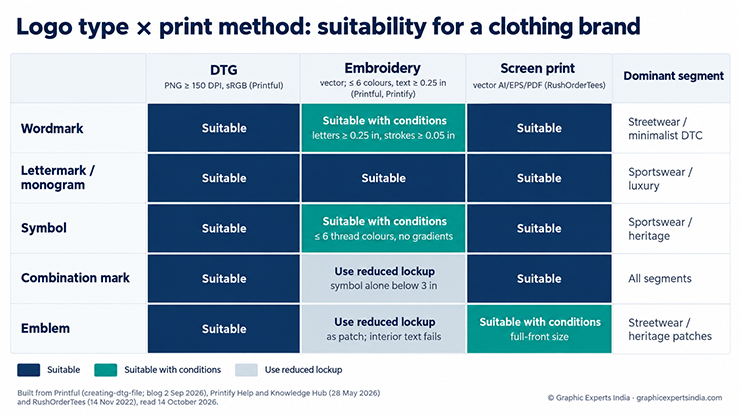
Figure 2. Suitability of each clothing logo type for DTG, embroidery and screen printing, with the segment that most often uses it. Built from Printful, Printify and RushOrderTees file rules read 14 October 2026.
| Logo type | Segment where it dominates | DTG (PNG ≥ 150 DPI, sRGB) | Embroidery (vector; ≤ 6 colors; text ≥ 0.25 in) | Screen print (vector, spot colors) |
|---|---|---|---|---|
| Wordmark | Streetwear; minimalist DTC | Suitable at full-front size | Suitable only if letter height ≥ 0.25 in and stroke ≥ 0.05 in at the placement size | Suitable; one screen per color |
| Lettermark or monogram | Sportswear; luxury | Suitable | Most suitable: few strokes, large letterforms | Suitable |
| Symbol | Sportswear; heritage | Suitable | Suitable in one or two thread colors; gradients removed | Suitable |
| Combination mark | All segments | Suitable; test the wordmark half at small size | Use the symbol half alone below 3 in | Suitable; count colors across both halves |
| Emblem | Streetwear; heritage patches | Suitable at full-front size | Suitable as a woven or printed patch; interior text fails below 0.25 in as direct embroidery | Suitable at full-front size; small badge prints lose interior detail |
The practical rule from the matrix is that every clothing brand needs a reduced lockup, usually the symbol or monogram alone, approved for placements under 3 inches, and that the lockup must exist as a vector before the first embroidery order.
The t-shirt-specific version of these rules, including how a logo behaves on dark garments and on a print-on-demand mockup, is the subject of a separate guide on t-shirt logo design. The fulfilment side, including Printful’s and Printify’s base prices and turnaround times, is covered in the guide to what print on demand is.
How Do You Convert a Raster Logo to a Vector File?
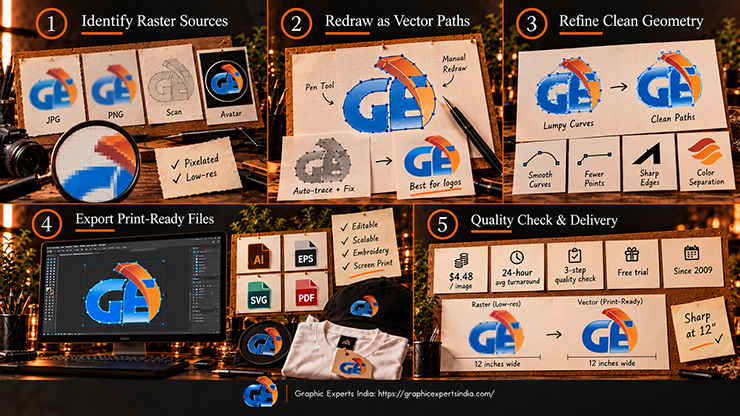
To convert a raster logo to a vector file, the logo is redrawn as paths in a vector program, either manually with the pen tool or by auto-tracing followed by manual correction, and then saved as AI, EPS, SVG or PDF.
Auto-tracing alone produces lumpy curves and extra anchor points on anything except simple geometric shapes; RushOrderTees’ answer to whether there is an easy conversion is “Not really”, with the warning that free online vectorisers give results that “may vary” (rushordertees.com, 14 November 2022). Manual redrawing is therefore the standard for a logo that will be embroidered or screen printed.
Graphic Experts India performs this redraw as its raster to vector conversion service at $4.48 per image, with a 24-hour average turnaround and a three-step quality check.
The service page describes the task directly: “Logo vector conversion transforms a blurry or low-quality raster logo into a clean, sharp vector file.” The input can be a JPG from an old website, a scan of a sketch or a PNG from a logo maker, and the output is an editable vector file with the colors separated so a printer can assign thread or ink.
A brand that bought a $20 PNG-only logo, inherited a logo from a previous owner, or has only the social-media avatar of its mark uses this route rather than commissioning a new logo.
The typical before-and-after is a pixelated 500-pixel PNG with soft edges and a halo around the letters, and after conversion a clean path file that prints at 12 inches wide with sharp edges.
Graphic Experts India has handled clothing and merchandise files for apparel brands since 2009, and offers a free trial on sample images with no credit card required.
How Do You Protect a Clothing Brand Logo with a Trademark?
A clothing brand logo is protected in the United States by registering it as a trademark with the USPTO, which treats a logo as a design mark under the same definition as a name: “A trademark can be any word, phrase, symbol, design, or a combination of these things” (uspto.gov).
Registration is optional. The USPTO states, “You’re not required to register your trademark”, but federal registration creates nationwide rights that an unregistered mark does not have. The facts below are US federal rules; rules differ by country, and this section is not legal advice.
- Cost. The USPTO’s base application filing fee is $350 per class of goods under the fee rule effective 18 January 2025, with a $100 per-class surcharge for insufficient information and a $200 per-class surcharge for using the free-form text box instead of the Trademark ID Manual (uspto.gov fee page). Clothing is International Class 25, so a logo filed for apparel alone costs $350; filing the name and the logo as separate marks doubles the fee.
- Search before filing. The USPTO retired the Trademark Electronic Search System (TESS) on 30 November 2023 and replaced it with “our new trademark search system” (uspto.gov, 18 October 2023), which searches both word marks and design marks. The clothing name itself, and the same search for word marks, is covered in the guide to Clothing & T-Shirt Brand Name Ideas, which also walks through the name registration.
- The refusal standard. The USPTO states: “This is known as a likelihood of confusion, and it’s the most common reason for refusing registration.” It adds that “Trademarks don’t have to be identical to be confusingly similar” and that marks “could just be similar in sound, appearance, or meaning, or could create a similar commercial impression” (uspto.gov, likelihood of confusion, updated 30 November 2023). The test also weighs whether the goods are related, which means a logo resembling another Class 25 mark is at higher risk than one resembling a mark in an unrelated class.
In practice, a new clothing brand searches the design mark before the final files are commissioned, files the word mark first if the budget allows only one class fee, and files the logo once the mark has been used in commerce on labels and hangtags.
What Do Founders Ask Most Often About Clothing Brand Logo Design?
To make a clothing brand logo, set the positioning, build a mood board, choose a typeface that embroiders at 0.25-inch letter height, design the mark in a vector program, choose a color set of six or fewer thread colors, test it at 2.5-inch, 3-inch and 12-inch placements, and export AI or SVG, EPS, PDF and transparent PNG files.
Good clothes brand logo ideas start from the segment: a signature or bold wordmark for streetwear, a monogram or small device for luxury, a single-color symbol for sportswear, and a lowercase wordmark for a direct-to-consumer label. The verified examples in this guide, from the Lacoste crocodile of 1927 to the Supreme box logo of 1994, each belong to one of these four patterns.
Yes, within limits. Canva’s free plan is listed at US$0 per year, and Looka states that users can “design, edit, preview, and save as many logos as you want for free”, with the download and the copyright transfer as the paid step at $20 or $65. Free templates are shared with other users, so a free logo can rarely be registered as an exclusive design mark.
A clothing logo should exist as a vector master in AI or SVG, with EPS and PDF exports for printers and transparent PNG exports for direct-to-garment and web use. Printful requires DTG files at 150 DPI or more in the sRGB IEC61966-2.1 profile, and embroidery digitisation needs the vector paths, which is why a PNG-only logo must be converted before an embroidery order.
A clothing brand logo costs from $0 on a free template to US$1,050 for a 99designs Platinum contest, as read on 14 October 2026. The mid-points are Looka at $20 or $65, Fiverr gigs from $5 to $65, Upwork designers at a $25 median hourly rate, and 99designs Bronze at US$249. Converting an existing raster logo to a vector costs $4.48 at Graphic Experts India.
Where Can a Clothing Brand Get Its Logo Converted to a Print-Ready Vector File?
A clothing brand can send a JPG, PNG or scanned logo to Graphic Experts India and receive an editable vector file suitable for embroidery digitisation, screen-print separation and large-format printing.
Graphic Experts India lists logo vector conversion at $4.48 per image, background removal from $0.39 per image, e-commerce retouching from $0.99 per image, color correction from $0.99 per image and ghost mannequin editing from $1.49 per image, each with a 24-hour average turnaround and a three-step quality check.
The company has served e-commerce retailers, photographers and apparel brands since 2009. A free trial on sample files, with no credit card required, is available through the vector conversion services page.

Salim Ahmed is the CEO of Graphic Experts India, with over 25 years of expertise in photo editing, clipping path, image retouching, and eCommerce image editing services.