

A clothing brand can show a garment in three ways: on a real model, on a ghost mannequin, or on an AI model for clothes generated or composited by software. A real model is a photographed person. A ghost mannequin image is a garment photographed on a form, with the form removed in editing so the garment holds its shape.
An AI model is a rendered or generated person onto which a photographed garment is placed. The three methods differ in cost per SKU, production time, platform compliance, return-rate evidence and disclosure obligations, and this guide compares them on each.
It defines the three methods, sets them side by side in one table, and examines each in depth with dated sources. It then prices a 50-SKU and a 500-SKU catalogue under every route, including the free AI model for clothing brand tiers that vendors publish, and maps the image rules of Amazon, Google, Walmart, Etsy, Shopify and TikTok Shop.
All sources were read on 21 October 2026. Product imagery is step five of the parent guide on How to Start an Online Clothing Store, and this article is the detailed comparison that step points to.
What Does the AI Model vs Ghost Mannequin vs Real Model Comparison Show at a Glance?
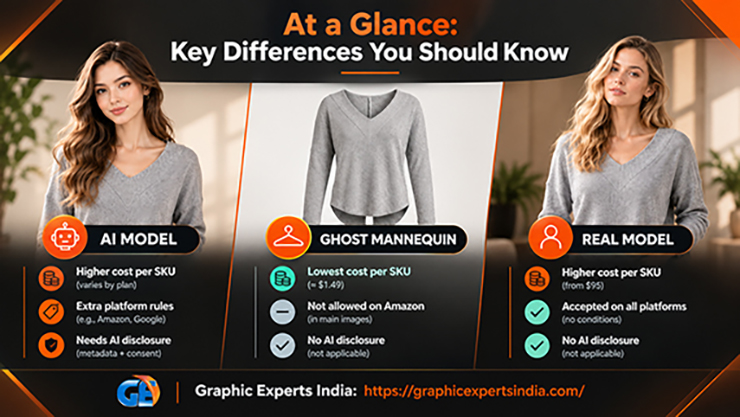
At a glance, the comparison shows that ghost mannequin editing is the lowest cost per SKU, real models are the only method every platform accepts without conditions, and AI models carry metadata and consent obligations that the other two methods do not.
| Question | Short answer | Source |
|---|---|---|
| Which method costs least per image? | Ghost mannequin editing of a self-shot photo at $1.49 per image; an on-model studio image costs from $95 | Graphic Experts India; Squareshot pricing, read 21 October 2026 |
| Which platform requires a real person in the main image? | Amazon: “All adult apparel should be imaged on-model.” Google advises it; Walmart, Etsy and Shopify publish no rule on it | Amazon Clothing & Accessories imaging guidelines, Spring 2021; Google Merchant Center Help |
| Does Amazon allow ghost mannequins? | No in MAIN images: “Visible mannequins” and “Ghost mannequins” are listed under the MAIN image DON’Ts | Amazon imaging guidelines, Spring 2021 |
| What evidence links imagery to returns? | 28% of apparel returners said the item “didn’t look the way they thought it would”; 39% returned for fit | PowerReviews, survey of 25,452 US consumers, June 2023 |
| What must an AI-generated product image carry? | Metadata “indicating that the image was AI-generated”; the IPTC DigitalSourceType tag must stay | Google Merchant Center Help, image_link |
| Does an AI twin of a real model need consent? | In New York, yes: “clear and conspicuous prior written consent” under the Fashion Workers Act, effective 19 June 2025 | Morgan Lewis, 8 January 2025 |
| Is there a free AI model for a clothing brand? | ZMO.ai lists a $0 plan with “10 Credits To Start” and “No credit card required”; Lalaland.ai lists “3 trial renders”; Photoroom offers a free trial on its Pro and Max plans | Vendor pricing pages, read 21 October 2026 |
What Are the Three Ways to Show Clothing and How Is Each Produced?
The three ways to show clothing are on-model photography, ghost mannequin photography and AI model generation, and each is produced by a different combination of a shoot and an edit.
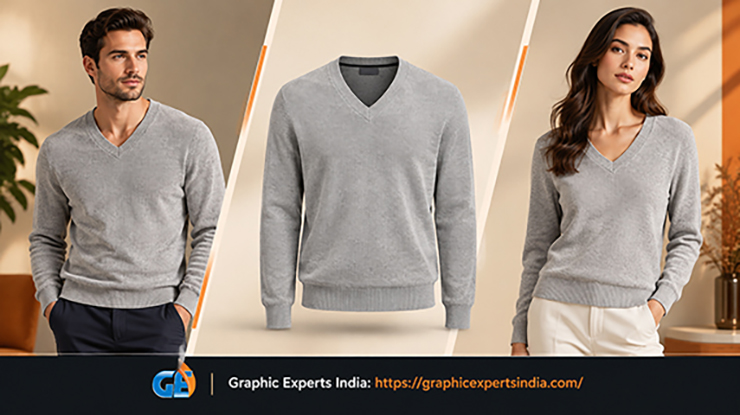
A real model image is a photograph of a person wearing the garment, produced in a studio or on location by a photographer, a stylist and the model, then retouched. Google’s apparel best-practice page describes the result it wants: “Show clothing on models. Show how your product looks on a real person” (Google Merchant Center Help, answer 7348545).
The shoot is the cost centre; Squareshot’s published studio price for model photography is “From $95 per image, or $2,950 for a 4‑hour shoot” with “8 DAYS from payment to final shots” (squareshot.com/pricing, read 21 October 2026).
A ghost mannequin image is a garment photographed on a mannequin and then edited so the mannequin disappears while the garment keeps a three-dimensional shape. The method is also called invisible mannequin, hollow man or neck joint photography.
Graphic Experts India’s guide describes the principle: “clothing is shot on a mannequin, and the mannequin is later removed in post-processing” (Ghost Mannequin Photography & Editing Guide, last updated 10 April 2026).
The editor needs two frames per garment, an outer view on the mannequin and an inner view of the neck or hem, and joins them in Photoshop so the inside of the collar is visible where the mannequin’s neck was. The full shooting setup is in the ghost mannequin photography guide.
An AI model image is a rendered or generated person wearing a garment, produced by software from either a flat or on-form photograph of the real garment or from a brand’s own digital twin of a real model.
Mango’s published process for its 2024 campaign shows the sequence most vendors follow: “The creation process began with shooting with real photos of each garment in the collection”, after which “the art team selected, retouched, edited and mastered the images in the photography studio” (Mango Fashion Group pressroom, 10 July 2024).
Zalando’s version uses “high-fidelity 3D replicas of real models” built with a studio partner (corporate.zalando.com, 7 May 2025). In every published case the garment is photographed first; the AI replaces the model, not the product shot.
How Do AI Models, Ghost Mannequins and Real Models Compare Side by Side?
Side by side, the three methods separate on six attributes, and the table below is built only from published prices, platform pages and surveys read on 21 October 2026.
| Attribute | Real model | Ghost mannequin | AI model |
|---|---|---|---|
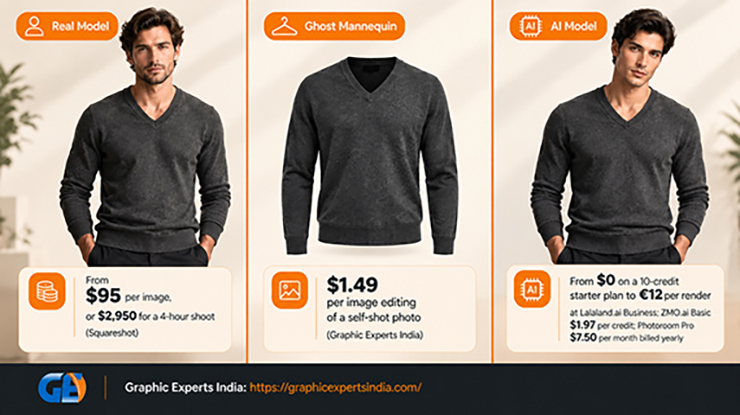
| Cost per SKU (one image) | From $95 per image, or $2,950 for a 4-hour shoot (Squareshot) | $1.49 per image editing of a self-shot photo (Graphic Experts India) | From $0 on a 10-credit starter plan to €12 per render at Lalaland.ai Business; ZMO.ai Basic $1.97 per credit; Photoroom Pro $7.50 per month billed yearly |
| Production time | “8 DAYS from payment to final shots” (Squareshot) | 24-hour average editing turnaround after a self-run shoot (Graphic Experts India) | Minutes per render after the garment shoot; Zalando cites “in under 24 hours” from trend to tailored content |
| Platform compliance | Required for Amazon adult apparel main images; advised by Google; accepted everywhere | Prohibited in Amazon MAIN images; no rule at Walmart, Etsy or Shopify | No platform prohibits it; Google requires AI metadata; Amazon’s on-model rule names no exception for generated people |
| Return-rate evidence | 23% of benchmarked sites omit a human-model image (Baymard, 2026); 28% of returns are “didn’t look the way they thought it would” (PowerReviews, 2023) | Shows shape and interior; no survey isolates its return effect | No published return-rate study; Levi’s said AI “will likely never fully replace human models for us” (2023) |
| Disclosure and consent | Model release per recognisable person; FTC rules if presented as consumers | None: no person is shown | IPTC DigitalSourceType metadata (Google); written consent for a digital replica of a real model (New York, from 19 June 2025) |
| Best use | Main images on Amazon; fit and scale communication | Catalogue depth: every colorway, back and detail view at low cost | Variations of an existing on-model shot; lifestyle context without a second shoot |
The rest of this guide expands each column with its sources, then turns the table into a cost ladder and a platform matrix.
When Should a Clothing Brand Use Real Models?
A clothing brand should use real models when it sells adult apparel on Amazon, when it advertises through Google Shopping, and when fit and scale are the main return risks, because those are the three cases with published evidence or rules behind them.
The platform rules. Amazon’s Clothing & Accessories imaging guidelines (Spring 2021 edition) state: “All adult apparel should be imaged on-model.” The same guide states: “All kids, baby, accessories, multipacks & sets should be off-model.”
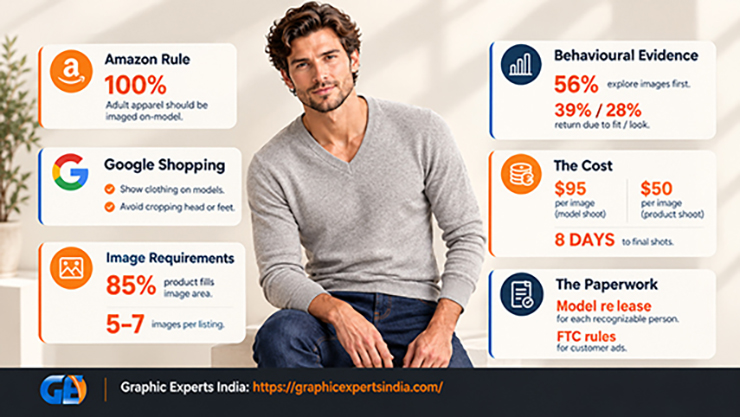
MAIN images must also sit on “a pure white background (RGB Value 255, HEX Value #FFFFFF)”, the product “must fill at least 85% of the image area”, and “each product listing should have a minimum of 5 and maximum 7 images to enable an informed purchasing decision.”
Google Merchant Center’s apparel page adds two instructions: “Show clothing on models. Show how your product looks on a real person”, and “If you’re using a full-body image, avoid cropping the model’s head or feet” (Google Merchant Center Help, answer 7348545). Google’s sentence is best-practice guidance, not a disapproval rule; Amazon’s is a listing requirement.
The behavioural evidence. Baymard Institute’s product-page benchmark reports that 23% of the 155+ benchmarked sites do not provide a human-model image for wearable products and that 37% lack an in-scale image (Baymard, updated 18 March 2026).
Baymard’s usability testing found that 56% of users’ first action on a product page was to explore the images, and that 25% of sites provided insufficient resolution or zoom (Baymard, 2 April 2020). PowerReviews’ survey of 25,452 US consumers states:
“Nearly four in 10 (39%) consumers return apparel because they don’t like the way it fits” and “28% do so because the item didn’t look the way they thought it would” (PowerReviews, June 2023). A real-model image answers the second reason directly and, with the model’s size and height stated, part of the first.
The cost. Squareshot lists model photography at “From $95 per image, or $2,950 for a 4‑hour shoot” and product photography at “From $50 per image, or $750 for a 2‑hour shoot”, with “8 DAYS from payment to final shots” (squareshot.com/pricing, read 21 October 2026).
A brand that runs its own model shoot pays the model, the photographer and the location instead, and then pays for post-production. Graphic Experts India retouches on-model frames at $0.99 per image through its photo retouching service, with color correction at $0.99 and background removal at $0.39 where the main image must be pure white.
The paperwork. Every recognisable person in commercial imagery needs a signed model release; the stock-industry standard reads “A separate model release is required for each recognizable person” (Shutterstock, Content Publishing Standards).
Where an advertisement presents people as customers, the FTC’s Endorsement Guides apply: such advertisements “should utilize actual consumers in both the audio and video, or clearly and conspicuously disclose that the persons in such advertisements are not actual consumers of the advertised product” (16 CFR §255.2(c), effective 26 July 2023). Rules differ by country.
When Should a Clothing Brand Use Ghost Mannequin Photography?
A clothing brand should use ghost mannequin photography when it needs every colorway, back view and detail image of a large catalogue at a cost below $2 per image, and when the channel does not require a person in the frame.
What the edit does. Graphic Experts India’s service page defines it: “Ghost mannequin editing is a post-processing technique applied to RMG product photographs.” The neck-joint step is the part a flat-lay cannot reproduce: the inner-view frame shows the inside of the back collar, and “GEI combines the front and inner-view photographs to fill this area”, so the garment appears hollow and worn rather than flat.
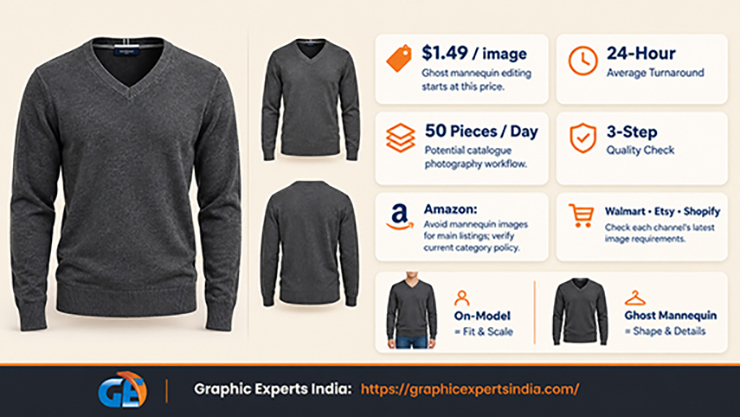
The service covers “Neck joint, invisible mannequin, and 3D ghost mannequin” edits “starting at $1.49 per image”, with a 24-hour average turnaround and a three-step quality check. The shoot itself needs one mannequin, two lights, a tripod and a camera or phone locked in position between the outer and inner frames. A brand can photograph a 50-piece collection in a day and send the frames for editing the same evening through the ghost mannequin neck joint service.
Where it is allowed. Amazon is the one platform in this guide that restricts it. Its imaging guide lists “Visible mannequins” and “Ghost mannequins” among the MAIN image DON’Ts. The same guide defines off-figure images as “flat or laydown, on a ghost mannequin, or on a traditional visible mannequin”, and adds: “Note: mannequins are not allowed in product images.”
The guide states no exception for additional images. An Amazon apparel seller therefore plans on-model main images and treats mannequin frames as internal masters until Seller Central confirms current policy for the category. Walmart’s image guideline requires that “Main images should feature items on a seamless white background” at 2200 × 2200 pixels and does not mention models or mannequins (Walmart Marketplace Learn, 12 May 2026).
Etsy recommends photos of “at least 2000 pixels or more” and sets no rule on how a garment is worn (Etsy Help). Shopify’s guidance is that “a size of 2048 x 2048 px usually displays best” and says nothing about models (Shopify Help Center). On those three channels, and on a brand’s own store, a ghost mannequin image is compliant as a main image.
What it cannot show. A ghost mannequin image shows shape, drape and interior construction, but it cannot show scale against a body or how the fabric moves, which are the two gaps Baymard’s 37% in-scale and 23% human-model figures describe. The standard pairing is therefore one on-model image per style for fit and scale, with ghost mannequin images for the remaining views and colorways.
When Should a Clothing Brand Use AI Models for Clothes?
A clothing brand should use an AI model for clothes when it already holds a photographed garment and needs more variations, backgrounds or body types than a second shoot would justify, and when it can meet the metadata, consent and disclosure obligations that attach to generated people.
What Have Large Brands Published About AI Models?
Four large brands have published their own use of AI models, each with a date. Levi Strauss & Co. announced on 22 March 2023 that it was planning tests of “AI-generated models to supplement human models”, stated in the same release that “AI will likely never fully replace human models for us”, and added an editor’s note on 28 March 2023 that “human models and collaborators are core to that experience” and that the company was “not scaling back our plans for live photo shoots” (levistrauss.com).
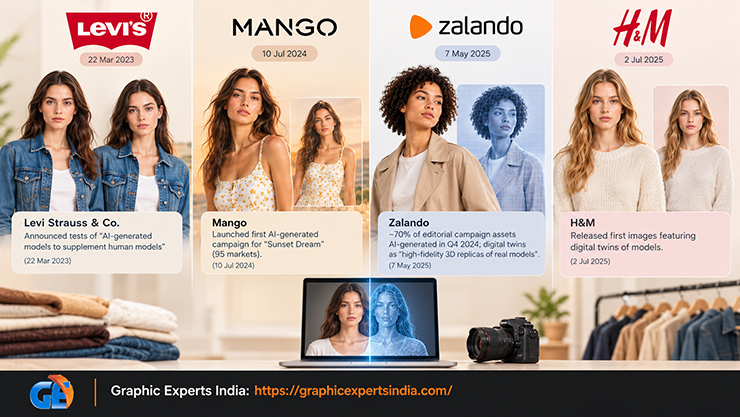
Mango produced its first AI-generated campaign for the Mango Teen “Sunset Dream” collection in 95 markets, starting from “real photos of each garment in the collection” (Mango pressroom, 10 July 2024). Zalando reported “approximately 70% of editorial campaign assets being AI-generated in Q4 2024” and described its digital twins as “high-fidelity 3D replicas of real models” (corporate.zalando.com, 7 May 2025).
Matthias Haase, VP Content Solutions at Zalando, cited going “from spotting a trend to producing tailored content in under 24 hours”. The same page explains the twin’s role across channels: “A real model might appear in an inspirational campaign” while “the same recognizable presence can continue on detailed product pages”.
H&M released its first images featuring digital twins of models on 2 July 2025, and Jörgen Andersson, Chief Creative Officer of H&M, stated: “We’re exploring emerging technologies like generative AI to amplify creativity and reimagine how we showcase fashion” (hmgroup.com).
In all four cases the AI model sits alongside, not instead of, photographed models, and the product-page lessons from these and other retailers are collected in the guide to how top fashion brands sell online.
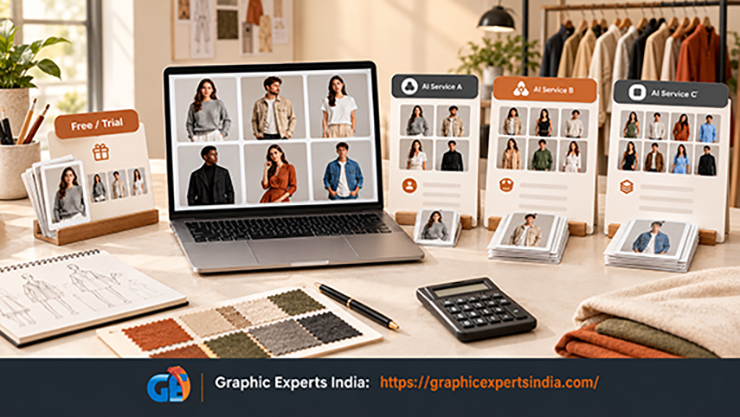
What Do AI Model Generators Cost and Is There a Free AI Model for a Clothing Brand?
Three vendors publish prices on their own pages, read on 21 October 2026, and each offers a free entry point with a different definition of “free”.
| Vendor and plan | Published price | What it includes | Free tier wording |
|---|---|---|---|
| ZMO.ai Free | “$0 / month” | “10 Credits To Start”, 3 models in the library; “Each credit can generate one standard definition image.” | “Experience ZMO.AI Risk-Free”; “No credit card required” |
| ZMO.ai Basic | “$59 / month” (a second price set shows $49, unlabelled; the toggle offers Monthly and Annual) | “30 Credits Every Month”, 10 models, model customisation, unused credits roll over | — |
| ZMO.ai PRO / ENTERPRISE | $199 / $799 per month (second set $149 / $599) | 100 / 400 credits per month, 30 / 80 models | — |
| Lalaland.ai Trial | “FREE” | One Lalaland model per size (S/M/L/XL), 5 poses per size, “3 trial renders” | Trial renders only |
| Lalaland.ai Business | “€600/month” plus “€300 per additional user/month” | Unlimited Lalaland models, 3 complexions, up to 50 renders per month | — |
| Lalaland.ai Enterprise | “€900/month” plus “€450 per additional user/month” | Unlimited renders per month, subject to a fair use policy | — |
| Photoroom Pro | “$7.50” “Per month, billed yearly” | “8,000 AI credits • 1,000 exports” per month; AI Fashion Models “Up to 1,600 generations” at 1K resolution | “Start free trial” (no free plan listed) |
| Photoroom Max / Ultra | “$20.99” / “$82.50” per month, billed yearly | 25,000 / 75,000 AI credits; AI Fashion Models “Up to 5,000” / “Up to 15,000” generations at 1K | “Start free trial” on Max |
Three calculations follow. ZMO.ai’s Basic plan works out at $1.97 per standard-definition image ($59 ÷ 30 credits), which is above Graphic Experts India’s $1.49 ghost mannequin edit and far below Squareshot’s $95 on-model image.
Lalaland. Ai’s Business plan works out at €12 per render at its 50-render ceiling (€600 ÷ 50). Photoroom’s Pro plan allows 1,600 AI Fashion Model generations at 1K resolution inside its 8,000 monthly credits, which implies 5 credits per generation and a marginal cost under one cent per image once the $7.50 monthly fee, billed yearly, is paid.
The free routes are a 10-image trial at ZMO.ai with no card, three renders at Lalaland.ai, and a time-limited trial at Photoroom; none of the three publishes a permanent free plan with commercial-volume output. Botika’s pricing page was also read but its displayed plan prices were internally inconsistent on the day, so it is not listed.
What Obligations Attach to an AI Model Image?
Three obligations attach to an AI model image, and they come from a platform, a state law and a federal regulator rather than from the vendors.
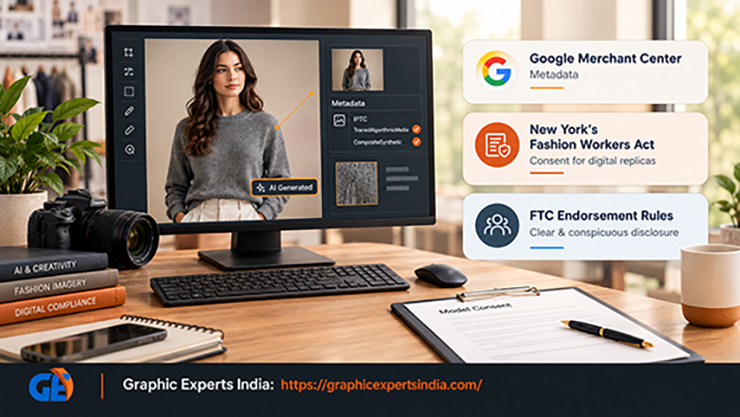
- Google Merchant Center metadata. The image_link specification states: “All images created using generative AI must contain meta data indicating that the image was AI-generated” and instructs: “Don’t remove embedded metadata tags such as the IPTC DigitalSourceType property.” The page lists the IPTC values to preserve, including TrainedAlgorithmicMedia, “The image was created using a model derived from sampled content”, and CompositeSynthetic, “The image is a composite that includes synthetic elements” (Google Merchant Center Help, answer 6324350). A photographed garment placed on a generated model is a composite with synthetic elements, so the tag survives every export.
- New York’s Fashion Workers Act. From 19 June 2025, a client in New York must “obtain clear and conspicuous prior written consent for any creation or use of a model’s digital replica”, where a digital replica is “a significant, computer-generated or artificial intelligence-enhanced representation of a model’s likeness”; a client includes “a retail store, a manufacturer, a clothing designer, an advertising agency, a photographer, a publishing company” (Morgan Lewis, 8 January 2025). A wholly synthetic model with no real-person basis is outside that definition; a twin of a real model is inside it.
- FTC endorsement rules. If generated people are presented as customers, 16 CFR §255.2(c) applies as it does to actors, and the disclosure standard is that it “is difficult to miss (i.e., easily noticeable) and easily understandable by ordinary consumers” (§255.0(f)). A plain product image of a generated model wearing a garment is not an endorsement; a generated “customer” review image is.
The evidence base for AI models on conversion and returns is thin. No retailer in the published cases above has released a return-rate or conversion comparison. Levi’s statement that AI “will likely never fully replace human models for us” is the only published position on the ceiling of the method. Rules differ by country, and this section is not legal advice.
How Should a Clothing Brand Choose by Catalogue Size, Platform and Budget?
A clothing brand should choose by three inputs in order: the platform’s main-image rule, the number of SKUs multiplied by views, and the budget per image, because the first removes options, the second sets the volume and the third decides between the options that remain.
The cost ladder below prices one main image per SKU at 50 and 500 SKUs under each route, using the published rates above. Real catalogues need five to seven images per SKU, so a brand multiplies the ghost mannequin and AI rows by its view count while the on-model row usually covers one or two views per style.
Figure 1. Cost of one image per SKU for 50 and 500 SKUs by method. Prices read 21 October 2026 from graphicexpertsindia.com, zmo.ai, lalaland.ai, photoroom.com and squareshot.com.
| Route | Published rate | 50 SKUs | 500 SKUs | Note |
|---|---|---|---|---|
| Self-shot flat lay + background removal (Graphic Experts India) | $0.39 per image | $19.50 | $195 | White background only; no shape |
| Self-shot on mannequin + ghost mannequin edit (Graphic Experts India) | $1.49 per image | $74.50 | $745 | Not for Amazon MAIN images |
| AI model, Photoroom Pro | $7.50 per month, billed yearly | $90 (one year, 1,600 generations per month cap) | $90 | Garment photo still required; metadata obligation |
| AI model, ZMO.ai Basic rate | $1.97 per credit ($59 ÷ 30) | $98.33 at the credit rate; two monthly plans ($118) to reach 50 credits | $983.33 at the credit rate; ENTERPRISE $799 covers 400 credits per month | Standard-definition output |
| AI model, Lalaland.ai | €12 per render (Business, 50 per month); Enterprise €900 unlimited | €600 (one Business month; page shows monthly and annual billing without labelling which the figure reflects) | €900 (one Enterprise month, fair use) | Enterprise tier priced per user |
| Studio on-model (Squareshot) | $95 per image | $4,750 | $47,500 | Required for Amazon adult apparel main images |
| Studio 4-hour model shoot (Squareshot) | $2,950 per shoot | $2,950 if 50 looks fit a shoot (images per shoot not published) | Several shoots | 8 days to final shots |
Three decision rules fall out of the table.
- Amazon adult apparel. The main image must be on-model, so the budget line is the on-model shoot; ghost mannequin and AI images are candidates only for the brand’s own store and other channels. A 50-SKU seller pays $4,750 per image set at Squareshot’s per-image rate, or runs one 4-hour shoot for $2,950 and sends the files for $0.99 retouching and $0.39 background removal per image, $69 for 50 images.
- Own store, Etsy, Walmart or Shopify, under 100 SKUs. Ghost mannequin editing at $1.49 covers five views of 50 SKUs, 250 images, for $372.50, within the 24-hour turnaround; one on-model image per style, 50 images, adds $4,750 at studio rates or one $2,950 shoot.
- Five hundred SKUs or more. Per-image AI subscriptions become cheaper than ghost mannequin editing only at Photoroom’s flat $90 per year, and only for a brand that already holds the garment photograph each generation starts from. Every published AI case begins with a real garment shot, so the ghost mannequin or flat-lay cost is a prerequisite, not an alternative: 500 ghost mannequin masters at $745 plus a $90 AI subscription is $835, against $47,500 for 500 studio on-model images.
Graphic Experts India edits all three inputs to the platform specifications through its ecommerce image editing service, from $0.39 per image for background removal to $1.49 for ghost mannequin, each with the 24-hour average turnaround.
Which Platforms Allow AI Models, Ghost Mannequins and Real Models?
Every platform in this guide allows real-model images, one prohibits mannequins in main images, and one requires metadata on AI images; the matrix below carries only rules read from each platform’s own page.
Figure 2. Main-image rules by platform and method, from Amazon, Google, Walmart, Etsy, Shopify and TikTok Shop pages read 21 October 2026.
| Platform | Real model | Ghost mannequin | AI model | Source and date |
|---|---|---|---|---|
| Amazon (Clothing & Accessories) | Required for adult apparel main images: “All adult apparel should be imaged on-model.” Kids, baby and accessories off-model | Prohibited in MAIN images (“Ghost mannequins” in the DON’Ts); “mannequins are not allowed in product images” | No specific rule; the on-model requirement names no exception for generated people | Amazon imaging guidelines PDF, Spring 2021 |
| Google Merchant Center | Advised: “Show clothing on models. Show how your product looks on a real person.” | Allowed; “Use a solid white or transparent background.” | Allowed with metadata: “All images created using generative AI must contain meta data indicating that the image was AI-generated.” | Google Merchant Center Help, answers 7348545 and 6324350 |
| Walmart Marketplace | Allowed | Allowed; “Main images should feature items on a seamless white background.” 2200 × 2200 px | Allowed with a truthfulness rule: “Images generated by artificial intelligence must be truthful, accurate and not misleading.” | Walmart Marketplace Learn, 12 May 2026 |
| Etsy | Allowed | Allowed; “at least 2000 pixels or more” recommended | No rule published on the photo-requirements page | Etsy Help |
| Shopify (own store) | Allowed | Allowed; “2048 x 2048 px usually displays best” | No rule | Shopify Help Center |
| TikTok Shop | Fee verified at 6% for menswear and womenswear (schedule effective 31 October 2024); image-method rules not read for this guide | As left | As left | TikTok Shop Seller University (fee page only) |
Two caveats apply. Platform help pages change, and the Amazon guide is dated Spring 2021, so a seller checks the current Seller Central version before a bulk upload. And the matrix covers main-image rules only; dimension, file-size and background requirements for each platform are set out in the guide to platform image requirements.
The disclosure and consent obligations across the three methods reduce to one table.
| Obligation | Real model | Ghost mannequin | AI model | Source |
|---|---|---|---|---|
| Model release per recognisable person | Yes | No person shown | Yes for the source model when a real person’s likeness is used | Shutterstock Content Publishing Standards |
| Written consent for a digital replica (New York) | Not applicable unless a replica is made | Not applicable | Yes, where a real model’s likeness is replicated; effective 19 June 2025 | Morgan Lewis, 8 January 2025 |
| IPTC DigitalSourceType metadata (Google) | Not required | Not required (an edited photograph is not generative AI output) | Required and must not be removed | Google Merchant Center Help |
| FTC disclosure when people are shown as consumers | Yes, unless actual consumers | Not applicable | Yes | 16 CFR §255.2(c), 26 July 2023 |
How Do You Change Clothes in a Photo Without a New Shoot?
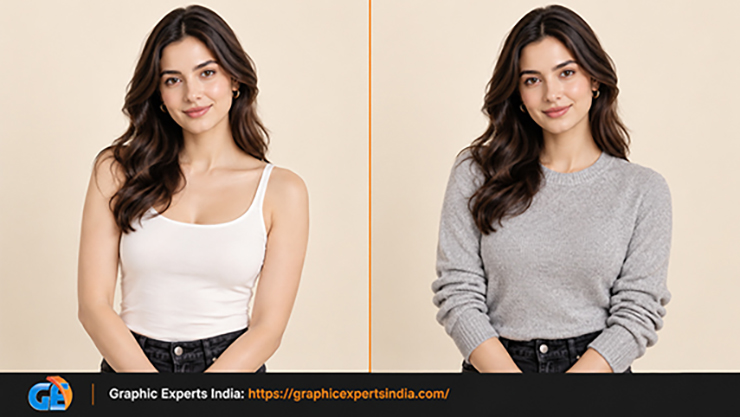
To change clothes in a photo without a new shoot, a brand either runs an AI clothes-changer tool that re-dresses a photographed person, or commissions a manual composite. In the manual route an editor places a photographed garment onto an existing model frame and rebuilds the shadows and folds.
The first route is the consumer end of the AI model market described above and carries the same metadata obligation; the second is image manipulation, which Graphic Experts India lists from $1.00 per image. The two routes, their quality limits on patterned fabric and sleeves, and the cases where each is the right tool are compared in the guide to How to Change Clothes in a Photo.
What Do Clothing Brands Ask Most Often About AI Models, Ghost Mannequins and Real Models?
Yes, within limits. ZMO.ai lists a $0 plan with “10 Credits To Start” and “No credit card required”, where “Each credit can generate one standard definition image.” Lalaland.ai’s Trial is “FREE” with “3 trial renders”. Photoroom offers “Start free trial” on its Pro and Max plans but lists no free plan. All three were read on 21 October 2026, and none publishes a permanent free plan with commercial-volume output.
Not in main images. Amazon’s Clothing & Accessories imaging guidelines (Spring 2021) list “Visible mannequins” and “Ghost mannequins” under the MAIN image DON’Ts and state that “All adult apparel should be imaged on-model.” The same guide notes that “mannequins are not allowed in product images” and states no exception for additional images. Sellers confirm current category policy in Seller Central before upload.
On Google, yes. Merchant Center requires that “All images created using generative AI must contain meta data indicating that the image was AI-generated” and that the IPTC DigitalSourceType tag is not removed. In New York, a digital replica of a real model also needs the model’s “clear and conspicuous prior written consent” under the Fashion Workers Act, effective 19 June 2025. Rules differ by country.
Ghost mannequin editing at $1.49 per image is cheaper than ZMO.ai’s Basic rate of $1.97 per credit and Lalaland.ai’s €12 per render, and more expensive per image than Photoroom’s Pro plan at $7.50 per month billed yearly once volume exceeds about five images. Every AI route still needs a photographed garment, so the AI cost is added to a shoot or edit cost rather than replacing it.
The published evidence is indirect. PowerReviews found that 28% of apparel returners said the item “didn’t look the way they thought it would” and 39% returned for fit (June 2023 survey of 25,452 US consumers), and Baymard found 23% of benchmarked sites omit a human-model image (updated 18 March 2026). No study in this guide measures the return-rate change from adding on-model images.
Where Can a Clothing Brand Get Ghost Mannequin and Product Images Edited?
A clothing brand can send its mannequin, flat-lay or on-model frames to Graphic Experts India and receive platform-ready images with a 24-hour average turnaround.
Graphic Experts India lists ghost mannequin and neck joint editing from $1.49 per image, background removal from $0.39, e-commerce retouching from $0.99, color correction from $0.99, image manipulation from $1.00 and shadow creation from $0.40, each checked through a three-step quality process.
The company has served e-commerce retailers, photographers and apparel brands since 2009. A free trial on sample images, with no credit card required, is available through the ghost mannequin service page.

Salim Ahmed is the CEO of Graphic Experts India, with over 25 years of expertise in photo editing, clipping path, image retouching, and eCommerce image editing services.