

Fashion industry trends in 2026 are a slow-growth market, a rising online share of clothing sales, value-seeking shoppers who return one online order in five, and a visual-commerce layer in which AI-generated models and virtual try-on set new image requirements.
This roundup records the fashion industry trends of 2025 and 2024 as the dated baseline and compares them with 2026 on the same metrics. It sizes the market, tracks the retail and channel shifts, documents consumer behavior, lists the visual-commerce trends with the image asset each one requires, notes one EU regulation, and ends with the actions a small clothing brand can take.
Every figure carries its source and date, and all sources were read on 14 October 2026. The page is refreshed each year and is the trends chapter of the Clothing Brand Marketing Strategy guide.
What Are the Fashion Industry Trends in 2026 at a Glance?
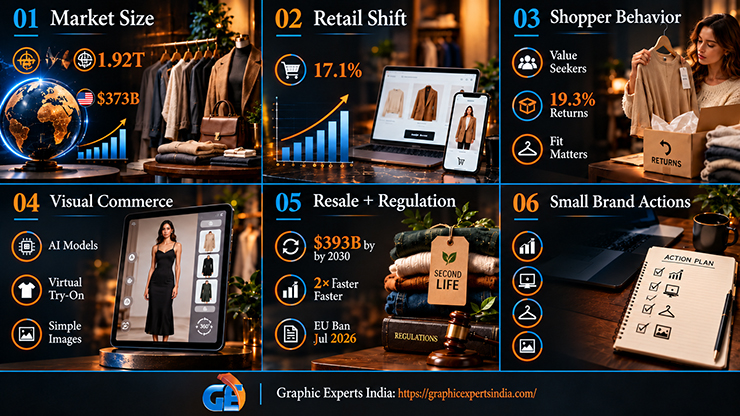
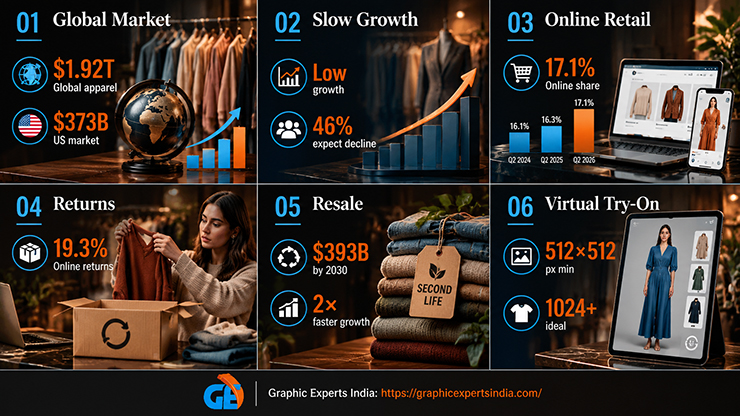
Fashion industry trends in 2026 at a glance are seven dated numbers that describe the market a clothing brand sells into this year.
| Question | Short answer | Source |
|---|---|---|
| How much is the fashion industry worth? | Global apparel revenue is estimated at US$1.92 trillion in 2026; the United States is the largest market at US$373 billion | Statista Market Insights, Apparel Worldwide, read 14 October 2026 |
| How fast is it growing? | “low single-digit growth in 2026”; 46% of executives expect conditions to worsen, up from 39% | McKinsey & Company and The Business of Fashion, 17 November 2025 |
| How much shopping is online? | US e-commerce was 17.1% of retail sales in Q2 2026, up from 16.3% in Q2 2025 and 16.1% in Q2 2024 | US Census Bureau, 18 August 2026 |
| Are clothing stores growing? | US clothing and clothing accessories store sales were $28.35 billion in August 2026, up 4.3% year on year; nonstore retailers grew 9.9% | US Census Bureau, 16 September 2026 |
| How many online orders come back? | An estimated 19.3% of online sales were returned in 2025 | NRF and Happy Returns, 15 October 2025 |
| How fast is resale growing? | Secondhand apparel is projected to reach $393 billion by 2030, growing “2X faster than the overall apparel market” | ThredUp Resale Report, 2 April 2026 |
| What image does the newest channel need? | Virtual try-on wants “one garment on one front-facing model or mannequin in a simple pose, or laying flat on a surface”, at least 512 × 512 pixels | Google Merchant Center Help, read 14 October 2026 |
How Much Is the Fashion Industry Worth in 2026?
The fashion industry is worth an estimated US$1.92 trillion in global apparel revenue in 2026, according to Statista Market Insights’ Apparel Worldwide outlook (read 14 October 2026). The same outlook puts women’s apparel at US$1.00 trillion, the largest segment, the United States at US$373 billion, the largest country market, and revenue per person worldwide at US$243.15.
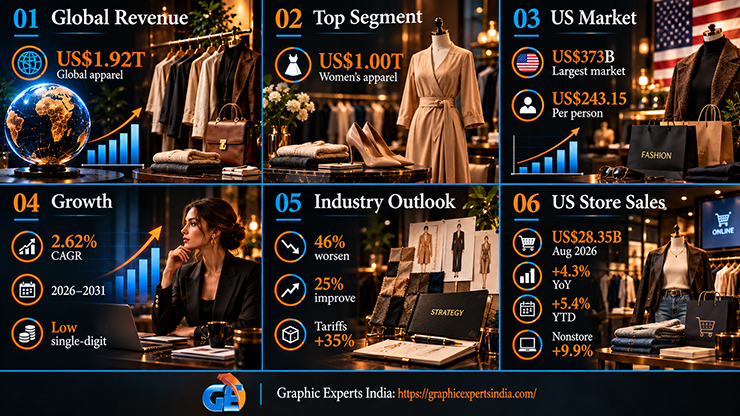
Statista projects a compound annual growth rate of 2.62% from 2026 to 2031. The figures are market-model estimates from a free outlook page and carry the read date rather than a publication date.
The industry’s own leaders expect the same slow pace. “A McKinsey analysis projects that the global fashion industry will once again post low single-digit growth in 2026,” McKinsey & Company and The Business of Fashion wrote in The State of Fashion 2026 (17 November 2025).
In the report’s executive survey, “46 percent said they expect conditions to worsen in 2026, compared with 39 percent in last year’s survey,” while “25 percent believe industry conditions will improve, up from 20 percent in 2025.” The report names tariffs as the top hurdle: “US tariffs have redrawn trade maps and forced brands and their suppliers to rapidly adjust.”
McKinsey’s follow-up article of 11 February 2026 quantifies the effect: “tariffs have increased prices for apparel and leather goods by roughly 35 percent from a first-cost perspective.”
The US store channel is growing faster than the global forecast. US clothing and clothing accessories stores sold $28.35 billion in August 2026, up 4.3% from August 2025 (US Census Bureau, Advance Monthly Retail Trade Report, 16 September 2026).
The same release puts year-to-date 2026 clothing and clothing accessories store sales 5.4% above the first eight months of 2025 (US Census Bureau, 16 September 2026). Those are sales through physical clothing stores only; online apparel sales sit mostly in the nonstore category, which grew 9.9% in the same month.
How Did Fashion Industry Trends Change from 2024 to 2025 to 2026?
Fashion industry trends changed from 2024 to 2026 in direction more than in size: growth forecasts stayed in the low single digits, executive pessimism rose, the online share of US retail rose each year, and the returns rate stayed near one in six overall and one in five online.
The table tracks the same metric across three annual editions of each source, so a reader searching for fashion industry trends 2025 or fashion industry trends 2024 can see what has moved.
| Metric | 2024 | 2025 | 2026 | Source and dates |
|---|---|---|---|---|
| McKinsey/BoF growth forecast for the year | “top-line growth of 2 to 4 percent in 2024” | “revenue growth is expected to stabilize in the low single digits” | “low single-digit growth in 2026” | The State of Fashion 2024 (29 Nov 2023), 2025 (11 Nov 2024), 2026 (17 Nov 2025) |
| Executives expecting conditions to worsen | 38% | 39% | 46% | Same three reports |
| Executives expecting conditions to improve | 26% | 20% | 25% | Same three reports |
| US e-commerce share of retail sales, Q2 | 16.1% | 16.3% | 17.1% | US Census Bureau quarterly series, updated 18 Aug 2026 |
| US e-commerce share of retail sales, Q4 | 16.2% | 16.7% | not yet published | US Census Bureau quarterly series |
| US clothing-store sales, January to August | $188.8bn | $197.4bn | $208.2bn | US Census Bureau monthly series, read 14 Oct 2026 |
| US retail returns rate, all channels | 16.9% ($890bn) | 15.8% ($849.9bn) | due in the 2026 report | NRF and Happy Returns, 15 Oct 2025 |
| Online returns rate | not stated in the fetched release | 19.3% | due in the 2026 report | NRF and Happy Returns, 15 Oct 2025 |
| Fashion e-commerce conversion rate, August | not published | 1.66% | 1.86% | IRP Commerce, Fashion Clothing and Accessories, Aug 2026 |
| Share of editorial campaign assets AI-generated at Zalando | ~70% in Q4 2024 | digital twins of real models in use | no new figure published | Zalando, 7 May 2025 |
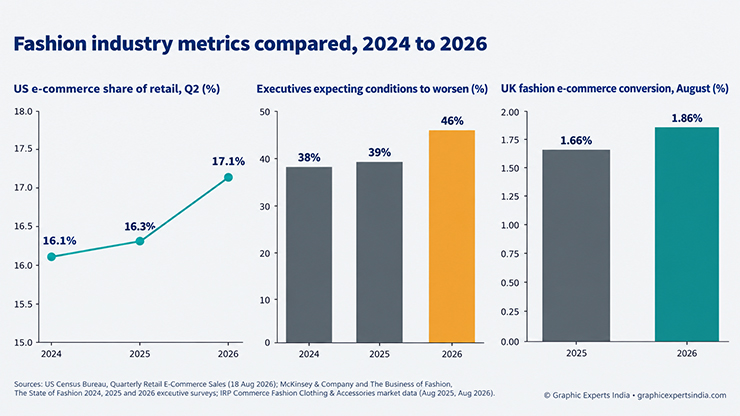
Figure 1. Three fashion industry metrics tracked across recent years: US e-commerce share of retail sales (Q2 2024–2026), executives expecting conditions to worsen (State of Fashion 2024–2026) and UK fashion e-commerce conversion (August 2025 and 2026). Sources: US Census Bureau (18 August 2026); McKinsey & Company and The Business of Fashion; IRP Commerce.
Two readings follow from the table. First, the online share of retail rose by one full percentage point between Q2 2024 and Q2 2026, from 16.1% to 17.1%, while clothing-store sales also grew, so online growth is additional rather than a transfer from stores.
Second, executive sentiment worsened faster than the numbers did: the share expecting worse conditions rose eight points in two years while the growth forecast barely changed.
Which Fashion Retail Industry Trends Are Changing Where Clothes Are Sold?
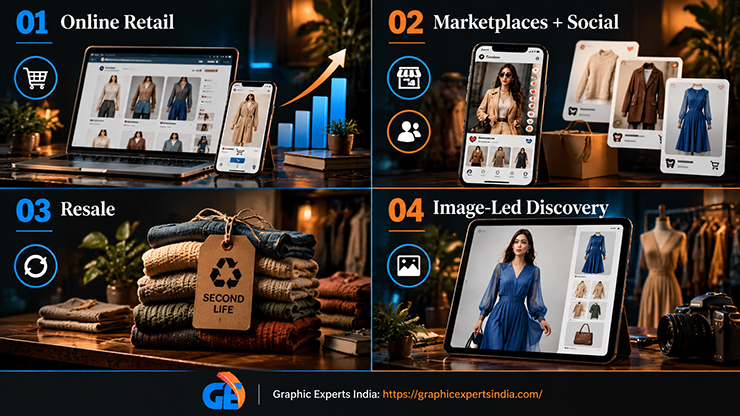
Four fashion retail industry trends are changing where clothes are sold in 2026: the online share keeps rising, marketplaces and social commerce take a growing part of that online share, resale grows faster than firsthand retail, and the fastest-growing channels all discover products through images rather than search.
How Much of Clothing Retail Is Online?
US e-commerce reached $340.2 billion in the second quarter of 2026, 17.1% of total retail sales and 12.2% above the second quarter of 2025 (US Census Bureau, 18 August 2026).
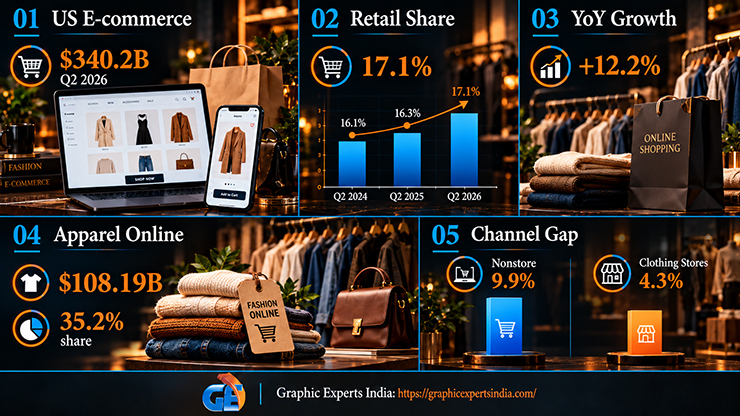
Apparel is more online than retail as a whole. “Online sales among the Top 1000 Apparel & Accessories merchants increased to $108.19 billion in 2023,” and “those sales comprised 35.2% of the total combined in-store and online sales in the category” (Digital Commerce 360, updated 17 September 2024).
The Census Bureau’s August 2026 report shows the gap between channels in one month: nonstore retailers grew 9.9% year on year against 4.3% for clothing stores (16 September 2026).
Which Marketplaces and Social Channels Are Growing?
Marketplaces and social commerce are growing on the strength of discovery. TikTok reported that “83% of all shoppers say they have discovered a new product on TikTok Shop, and 70% have discovered a new brand,” and that “over a third of all TikTok Shop US purchases each month in 2024 went to small businesses” (TikTok Newsroom, citing a GlobalData study, 13 June 2025).
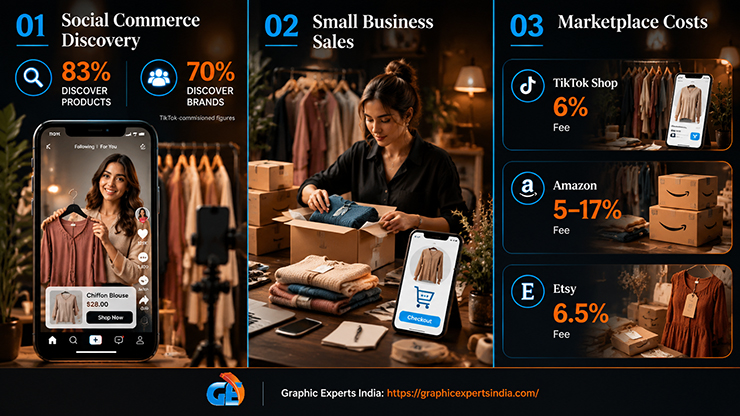
The figures are TikTok-commissioned. TikTok Shop charges a 6% referral fee on menswear and womenswear under its October 2024 schedule; Amazon charges $39.99 a month plus a 5%, 10% or 17% referral fee on apparel; Etsy charges a $0.20 listing fee plus 6.5% transaction and 3% plus $0.25 payment processing (platform fee pages, read 7 October 2026).
The image rules of each marketplace, which decide whether a listing is accepted, are compared in the guide to fashion eCommerce platforms and their image requirements.
How Fast Is Resale Growing?
Resale is growing about twice as fast as firsthand apparel. ThredUp’s 14th annual Resale Report describes the global secondhand apparel market as “Projected to Reach $393 Billion by 2030, Growing 2X Faster Than Overall Apparel Retail” (2 April 2026).
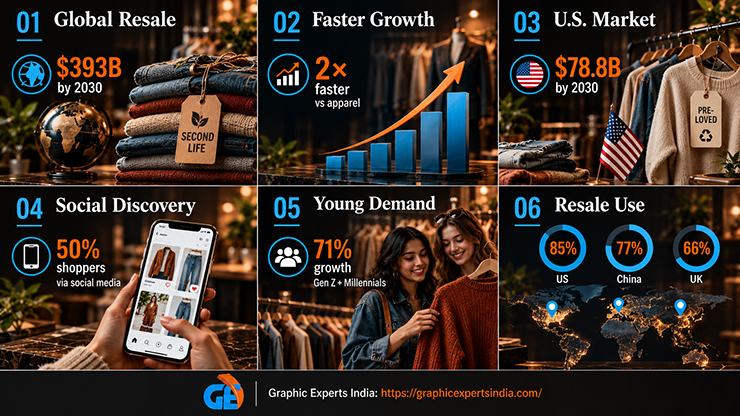
James Reinhart, ThredUp cofounder and CEO, said: “In 2025, the U.S. secondhand market grew nearly 4X faster than the broader retail clothing market.” Neil Saunders, managing director and retail analyst at GlobalData, which prepared the market sizing, said: “We expect the U.S. market alone to reach $78.8 billion by 2030.”
The same release reports that “nearly 50% of shoppers now discover their next secondhand find through social media” and that Gen Z and Millennials will account for “71% of all market growth” to 2030.
McKinsey’s State of Fashion 2026 gives a compatible range: resale is “forecast to grow two to three times faster than the firsthand market through 2027” (17 November 2025), and its February 2026 article reports that 85% of surveyed US consumers and 77% in China say they use resale, against 66% in the United Kingdom (11 February 2026).
How Is Consumer Behaviour Shaping Global Clothing Market Trends?
Consumer behaviour is shaping global clothing market trends through three measurable habits: spending less and seeking value, returning a fifth of online orders, and abandoning or returning purchases when the listing misdescribes the product.
Value-seeking. McKinsey’s 2026 consumer research found “70 percent telling us that they plan to spend less and 80 percent indicating value-seeking behavior,” described as “waiting for sales or perhaps shopping around at different retailers for an item that they want” (11 February 2026).
The same article reports that “nine in ten consumers cite being part of a like-minded community as a top driver of brand connection.” The State of Fashion 2025 had already recorded that “it is nonluxury that will drive the entirety of the increase in economic profit for the first time since 2010” (11 November 2024), so the value shift predates the 2025 tariff round.
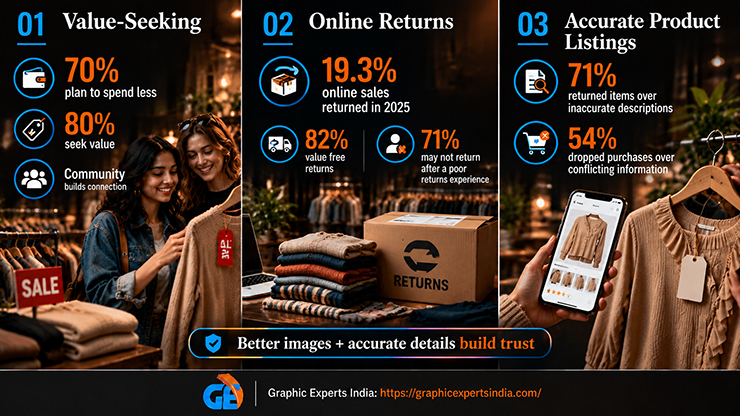
Returns. The National Retail Federation and Happy Returns estimated that “an estimated 19.3% of online sales will be returned in 2025,” against 15.8% of all retail sales, or $849.9 billion, which the release describes as “in line with 16.9% last year, when returns totaled $890 billion” (15 October 2025).
Free returns as a major purchase consideration rose to 82% from 76% the year before, and 71% of consumers said a poor returns experience makes them less likely to shop with the retailer again, up from 67%. Katherine Cullen, NRF vice president of industry and consumer insights, said: “Returns are no longer the end point of a transaction.”
For apparel, PowerReviews’ survey of 25,452 US consumers fielded in June 2023 found that “nearly four in 10 (39%) consumers return apparel because they don’t like the way it fits” and “28% do so because the item didn’t look the way they thought it would.”
Listing accuracy. Salsify’s survey of 1,910 online shoppers in the United States and United Kingdom in October 2024 found that “71% returned items over inaccurate descriptions” and “54% dropped purchases due to conflicting information” (23 January 2025).
Conversion remains low in absolute terms: the fashion clothing and accessories market conversion rate was 1.86% in August 2026, up from 1.66% in August 2025, with an average order value of £78.24 (IRP Commerce, read 14 October 2026).
A brand that raises conversion from 1.66% to 1.86% sells 12% more from the same traffic, which is the arithmetic behind the image and listing investments in the next section. How the largest retailers answer fit and returns on the product page is documented in the guide to how top fashion brands sell online.
What Are the Visual-Commerce Trends in Fashion for 2026?
The visual-commerce trends in fashion for 2026 are AI-generated models and digital twins, virtual try-on, 360-degree and video product views, and stricter platform image standards, and each one carries a specific image-asset requirement.
AI-generated models and digital twins. Zalando reported that “approximately 70% of editorial campaign assets” were AI-generated in Q4 2024, using digital twins of real models, and Matthias Haase, VP Content Solutions at Zalando, described moving “from spotting a trend to producing tailored content in under 24 hours” (corporate.zalando.com, 7 May 2025).
H&M released its first digital-twin images on 2 July 2025; Jörgen Andersson, Chief Creative Officer of H&M, said: “We’re exploring emerging technologies like generative AI to amplify creativity and reimagine how we showcase fashion.”
Levi Strauss & Co. framed the limit in 2023: the company planned tests “using AI-generated models to supplement human models,” with Dr. Amy Gershkoff Bolles stating “While AI will likely never fully replace human models for us,” and an editor’s note of 28 March 2023 adding that “human models and collaborators are core to that experience.”
McKinsey’s 2026 report states that “AI is shifting from a competitive edge to a business necessity” (17 November 2025), while its February 2026 article reports that “about 90 percent of projects have stalled at the pilot phase.” A forthcoming guide on AI models vs ghost mannequin vs real models compares the three ways of showing a garment on a product page.
Virtual try-on. Google announced on 20 May 2025: “Now you can virtually try billions of apparel listings on yourself, just by uploading a photo,” covering shirts, pants, skirts and dresses in Search Labs in the United States.
The feature draws on merchants’ existing images, and Google’s Merchant Center page on apparel virtual try-on sets the requirement: “The image should feature one garment on one front-facing model or mannequin in a simple pose, or laying flat on a surface.”
Images should be at least 512 × 512 pixels and ideally 1024 pixels or higher, the whole garment must be visible and uncovered by hands, bags or accessories, and for tops the sleeves should be rolled down, hoods down, zippers closed and the top untucked (Google Merchant Center Help, read 14 October 2026). Brands with a Shopping feed and qualifying imagery are opted in automatically.
Product-page image depth. Baymard Institute’s product-page benchmark, built from “30,000+ manually rated performance scores” across “155+ benchmarked sites”, states: “Up to 62% of leading ecommerce sites have “mediocre” or worse Product Page UX.” (updated 18 March 2026).
In the same benchmark, 37% of sites do not provide in-scale images and 23% do not provide a human-model image. Those two gaps map directly onto the two largest apparel return reasons, fit and appearance.
Image standards. Google Merchant Center announced “new image size requirements of at least 500 x 500 pixels for all products beginning January 31, 2027,” recommends “images around 1500×1500 pixels or above”, and requires that “all images created using generative AI must contain meta data indicating that the image was AI-generated” (Merchant Center Help, image_link page, read 14 October 2026).
The table maps each trend to the asset a brand must hold before it can take part, with the editing step Graphic Experts India prices for that asset through its ecommerce image editing service.
| Visual-commerce trend | Required image asset | Specification from the source | Editing step and register price |
|---|---|---|---|
| Google virtual try-on | One garment on one front-facing model or mannequin, or flat lay | ≥ 512 × 512 px, ideally ≥ 1024 px; whole garment visible; tops untucked, zips closed (Google Merchant Center Help) | Ghost mannequin from $1.49; background removal from $0.39 |
| Google Shopping and Performance Max feeds | Clean main image, no overlays | ≥ 500 × 500 px from 31 Jan 2027; ~1500 × 1500 recommended; AI images carry metadata (Merchant Center Help) | Background removal from $0.39; color correction from $0.99 |
| AI-generated models and digital twins | A clean garment master on a model or form that the generation step dresses | Zalando: digital twins of real models; Levi’s: AI “to supplement human models” | E-commerce retouching from $0.99; image manipulation from $1.00 |
| Marketplace and social discovery (TikTok Shop, Etsy, Amazon) | On-model image plus in-scale detail images | Baymard: 37% of sites lack in-scale images, 23% lack a human-model image | E-commerce retouching from $0.99; shadow from $0.40 |
| Resale listings | Front, back, label and flaw close-ups of a worn garment | ThredUp: nearly 50% discover secondhand items through social media | Background removal from $0.39; color correction from $0.99 |
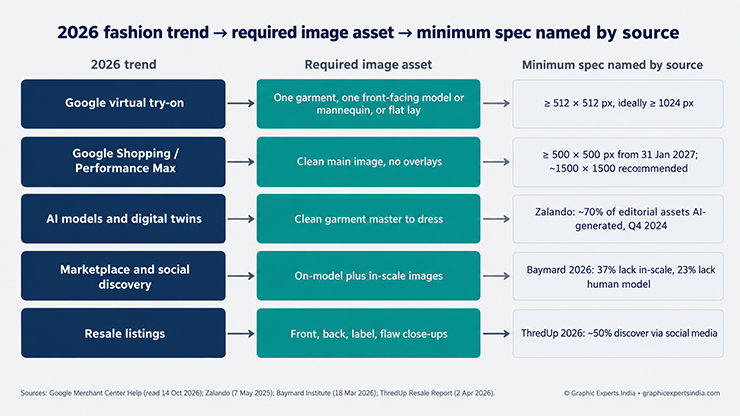
Figure 2. Five 2026 visual-commerce trends mapped to the image asset each requires and the minimum specification named by the source. Sources: Google Merchant Center Help (read 14 October 2026); Zalando (7 May 2025); Baymard Institute (18 March 2026); ThredUp (2 April 2026).
Which Regulations Will Affect Fashion Brands in 2026?
One European regulation with a 2026 date affects fashion brands directly: the Ecodesign for Sustainable Products Regulation, which prohibits the destruction of unsold clothing and footwear.
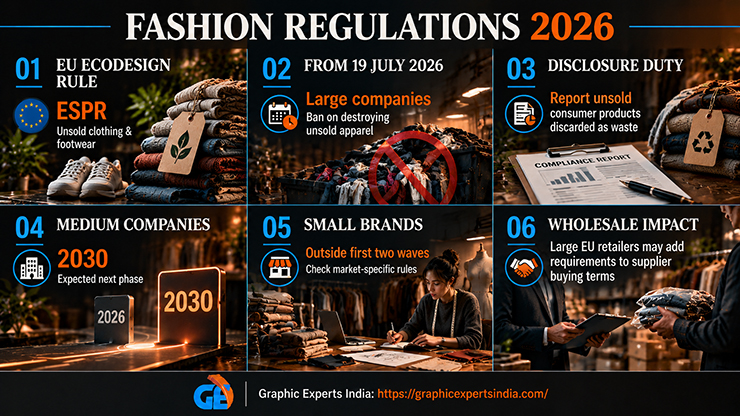
The prohibition “will apply to large companies from 19 July 2026,” and “medium-sized companies are expected to follow in 2030” (European Circular Economy Stakeholder Platform, 11 February 2026). The European Commission’s textiles transition pathway page confirms the rules entered application on 19 July 2026 and notes a disclosure duty covering “the unsold consumer products they discard as waste” (28 July 2026).
A small brand selling into the EU is outside the first two waves, but a brand that wholesales to a large EU retailer will meet the rule in that retailer’s buying terms. Rules differ by country, and this section states dates only.
What Do These Fashion Industry Trends Mean for a Small Clothing Brand?
These fashion industry trends mean that a small clothing brand in 2026 should plan for flat demand, win on the product page rather than on advertising reach, and produce one set of images that serves every channel in this guide. Six actions follow from the evidence.
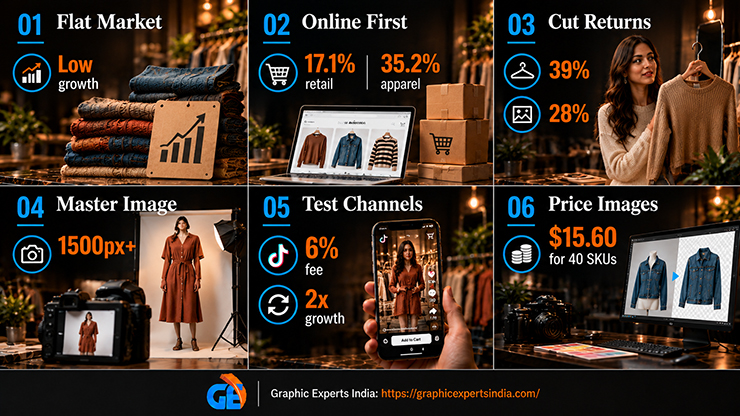
- Budget for low single-digit market growth. McKinsey’s forecast has read “low single-digit” for two consecutive years, so a brand’s growth plan must come from share, not market lift.
- Move stock planning to the online share. With US e-commerce at 17.1% of retail and apparel at 35.2% of the top 1,000 retailers’ sales, hold inventory where the online listing, not the shop window, sells it.
- Attack the two return reasons. Fit (39%) and appearance (28%) are addressed with an on-model image, an in-scale image and a written fit note, which Baymard’s 2026 benchmark shows 37% and 23% of sites still lack.
- Shoot one master image that qualifies for every channel. A front-facing on-model or mannequin shot at 1500 pixels or wider on a plain background meets the virtual try-on requirement, the 2027 Merchant Center minimum and the marketplace main-image rules at once.
- List on a discovery channel. TikTok Shop’s 6% referral fee and its reported discovery figures make it the lowest-cost test of social commerce; the resale market’s 2X growth makes a brand’s own resale or trade-in listing a second test.
- Price the images, not the studio. Graphic Experts India prices background removal from $0.39 per image, e-commerce retouching from $0.99, color correction from $0.99 and ghost mannequin editing from $1.49, with a 24-hour average turnaround. A 40-SKU range with one master image per SKU costs $15.60 at the background-removal rate.
What Do Clothing Brands Ask Most Often About Fashion Industry Trends?
The fashion industry is worth an estimated US$1.92 trillion in global apparel revenue in 2026, according to Statista Market Insights (read 14 October 2026). The United States is the largest single market at US$373 billion, and women’s apparel is the largest segment at US$1.00 trillion. Statista projects 2.62% compound annual growth from 2026 to 2031, consistent with McKinsey’s “low single-digit growth” forecast.
The fashion industry trends of 2025 were slower growth expectations and a stronger value shift than 2024. McKinsey’s forecast moved from “top-line growth of 2 to 4 percent in 2024” to “low single digits” for 2025, the share of executives expecting worse conditions rose from 38% to 39%, and the US e-commerce share of retail rose from 16.1% to 16.3% in the second quarter.
The market trends in fashion retail in 2026 are a rising online share, 17.1% of US retail in Q2 2026, nonstore retail growing 9.9% against 4.3% for clothing stores in August 2026, resale growing twice as fast as firsthand apparel, and social commerce where 83% of TikTok Shop shoppers report discovering a new product. All four reward a brand whose product images qualify for every channel.
Streetwear and sportswear remain a growth segment, but the published evidence points to challenger brands rather than the category leaders.
McKinsey and the WFSGI’s Sporting Goods 2025 report estimates sportswear growth at “about 6 percent a year” from 2024 to 2029 and records that “the two large incumbents ceded three percentage points of market share to challenger brands.” No primary source read for this guide publishes a streetwear-specific market size, so none is quoted.
The fashion advertising trends for 2026 are AI-generated campaign imagery with disclosure rules attached, short vertical video, creator advertising and retail media, each documented with dated evidence in the guide to fashion advertising. The link to this page is the image rule: Google Shopping ads and virtual try-on both start from the same clean, on-model product photograph.
Where Can a Clothing Brand Get Trend-Ready Product Images?
A clothing brand can send phone-shot or studio garment photographs to Graphic Experts India and receive files that meet the virtual try-on, Google Merchant Center and marketplace specifications in this guide.
Graphic Experts India lists e-commerce product photo editing from $0.39 per image, background removal from $0.39, e-commerce retouching from $0.99, color correction from $0.99, ghost mannequin editing from $1.49, image manipulation from $1.00 and shadow creation from $0.40.
Each order carries a 24-hour average turnaround and a three-step quality check, and the company has served e-commerce retailers, photographers and apparel brands since 2009. A free trial on sample images is available through the ecommerce image editing page, with no credit card required.

Salim Ahmed is the CEO of Graphic Experts India, with over 25 years of expertise in photo editing, clipping path, image retouching, and eCommerce image editing services.